


Many Arab states were created as artificial political constructs, incorporating rival ethnic and religious communities without forging a shared national identity or an agreed framework of power. Authoritarian regimes managed these internal cleavages through repression, attempting to impose a top-down nationalism rather than resolve underlying divisions. Iraq, Libya, Yemen, Syria, Sudan, and Somalia illustrate this dynamic. When acute internal crises struck, central authority in several of these states collapsed or eroded sharply, allowing suppressed intrastate conflicts to reemerge—sometimes to the point of outright state disintegration. In each case, these dynamics produced failing states, with internal crises accelerating the process of state failure.
In a limited number of cases, formal separation into distinct political entities resulted. Only two such cases—Sudan and Somalia—can be regarded as relatively successful. The agreed separation between Sudan and South Sudan brought a prolonged and violent conflict to an end. In Somalia, the process of disintegration and fragmentation enabled Somaliland to break away from the parent state and establish a stable, functioning political entity, although it has failed to secure international recognition—apart from Israeli recognition in late 2025. By contrast, in other Arab states that have effectively disintegrated, no consensual framework for separation has emerged. Instead, violent conflicts persist, and the trajectory of state failure continues to deepen.
Across the Arab world, states have largely rejected the notion of separation or fragmentation along ethnic or religious lines, adhering instead to the principle of territorial integrity of the nation state. This position reflects deep concern over a potential domino effect that could undermine domestic stability and amplify regional volatility. The stance of Arab states is typically reinforced by the international community, even as many failing states remain trapped in chronic instability. These states are marked by persistent intrastate conflicts among distinct and hostile ethnic and religious groups that are neither willing nor able to coexist under a single sovereign authority or within a national framework that they do not regard as representative.
A persistent gap between political borders and collective identity has accelerated state failure in a number of cases. South Yemen, South Sudan, and Somaliland show that when separation is conducted in an orderly manner and aligns territory and borders with ethnic and religious identity, it can generate broad domestic legitimacy that in turn, supports stability, security, and effective territorial control. In certain contexts, the lesson is that separation, federalization, or the recognition of autonomies—applied according to the specific characteristics of each state—may be a prerequisite for long-term stability and, at times, preferable to strict adherence to the principle of territorial integrity.
Introduction
In early 2026, intrastate conflicts are expanding and spreading across Arab countries in the region, in turn accelerating and deepening processes of state failure in those countries. State failure does not remain confined within national borders. It is exported across the region and beyond through refugee flows, criminal activity, and, most notably, by drawing in external actors whose interests are affected by the chronic instability of failing states. Foreign involvement, whether through support for one domestic actor or through direct military action against another, has led to confrontations among the intervening states themselves. Prominent and particularly destabilizing examples include the clash between Saudi Arabia and the United Arab Emirates in Yemen, and the confrontation involving Egypt and Saudi Arabia on one side and the United Arab Emirates on the other in the case of Sudan.
State failure in the Arab world is becoming more entrenched as an inherent and structural condition. It is rooted, among other factors, in ethnic-sectarian and religious identities, social structures, and political culture, all of which drive acute intrastate struggles over power, manifested in intractable and protracted conflict. The persistent mismatch between ethnic-sectarian—and at times national—identity and territory or borders (state to nation balance) continues to shape regional dynamics. With the exception of the Arab Gulf states, most Arab countries are experiencing prolonged state failure, manifested in ongoing intrastate conflict. These conflicts produce a fragile and deeply fractured social fabric divided along ethnic and religious lines, alongside the absence of a monopoly over the use of force. The result is a lack of effective territorial control, the collapse of civilian governing institutions, chronic economic crisis, erosion of public legitimacy, and the replacement of the state by networks of sectarian, religious, and tribal militias and external actors.
Despite the structural difficulty inherent in mitigating identity-based conflicts rooted in deep historical tensions among ethnic, religious, and at times national groups—including cases of invented or imposed nationalism, such as the Babylonian identity that Saddam Hussein sought to graft onto an imposed Iraqi national identity—Arab states continue to adhere, with the backing of international institutions, to the principle of territorial integrity. They strongly oppose solutions based on partition, loose federal arrangements, or substantive autonomy. The source of this opposition lies in the dominant ethnic group’s fear of losing assets and resources, erosion of the state’s regional and international standing, and above all concern over an uncontrolled domino effect that could lead additional groups to demand separation from the parent state, culminating in complete disintegration.
Insistence on preserving the artificial territorial integrity of states that are, in essence, failing states in several cases perpetuates, and even intensifies, state failure. This dynamic leads to increased violence, anarchy, and external dependence. These conditions, in turn, encourage intervention by external actors and, in some cases, transform such states into arenas of confrontation among those actors, who operate according to their own interests, which do not necessarily align with the vital interests of the failing state in which they have intervened. The result is a vicious cycle that deepens intrastate conflict and state failure. Libya, Yemen, and Sudan are prominent examples.
The central argument of this article is that state failure in most non-monarchical regimes in the Arab world, unlike the far more stable monarchical systems, is structural and deep-rooted and, in most cases, not amenable to remedy due to profound ethnic-sectarian and national cleavages (for further discussion of state failure in the Arab world, see Michaeli and Guzansky, 2016). Despite the possibility of ameliorating conditions through alternatives such as separation, federalization, or the recognition of autonomies—even where such arrangements exist in practice and contribute to better alignment between identity and territory—Arab leaderships, with international backing, continue to adhere to the principle of territorial integrity. This persistent adherence perpetuates the problem and intensifies it. Violent intrastate conflicts are exacerbated, state failure deepens, and the resulting effects are “exported” across the region and beyond in the form of terrorism, religious radicalization, and migration. The outcome is damage to regional and global security stability.
This article briefly presents the theoretical foundations of the phenomenon of state failure, examines its salient characteristics through a series of key case studies. It rev. iews and analyzes the implications and consequences of state failure for the affected states as well as for the near and wider regional environments, and concludes with a set of possible recommendations for improving the situation.

State Failure as an Explanation for the Expansion of Ethnic and Religious Conflicts—and for the Way These Conflicts Reinforce State Failure
State failure describes a condition in which the state and its institutions are unable to provide citizens with the required level of personal security. Personal security, in the broad sense defined by the United Nations, encompasses physical security in the sense of freedom from threat or risk—as well as human dignity, employment, housing, education, health care, welfare, and civil rights. State failure exists along a spectrum of severity. The commonly used benchmark for assessing its level is the Fragile States Index, which is based on twelve distinct and measurable criteria. The most fragile states in the Arab world rank high on the scale of failing states; for example, Somalia, Yemen, Syria, and Libya. These countries have persistently placed high on the index, indicating a chronic reality whose prospects for repair or meaningful improvement are doubtful, particularly under conditions that have worsened since the Arab upheaval.
The Middle East has never been a region characterized by stability. Interstate wars and intrastate conflicts have been a persistent feature since the region was shaped into a system of territorial nation-states—a process that began with the 1916 agreement between Britain and France to divide spheres of influence, known as the Sykes–Picot Agreement. Instability has intensified further since the “Arab Spring” erupted in late 2010 and spread across the Arab world. Current instability is rooted in struggles for power and influence among states, expressed primarily through a form of cold war, though violent frictions also erupt from time to time. The arena of confrontation and competition among Arab and non-Arab states in the region—including Turkey, Iran, and Israel—has largely converged on failing and unstable states such as Sudan, Libya, Yemen, Syria, and Somalia (for further discussion, see Hussein Aboubakr Mansour, The Logic and Structure of the New Middle Eastern Cold War).
While the Arab monarchies—particularly the Gulf states—successfully contained limited civil unrest within their countries, the Arab republics, in the vast majority of cases, failed. As Guzansky argues, it is not the monarchical nature of these regimes that accounts for their relative stability, but rather the practices they have adopted—chief among them the effective use of oil revenues, efficient suppression of protests that did impact the Gulf, co-optation through the integration of protest leaders into the establishment, and reliance on external assistance, primarily from Western states.
In Egypt, for example, state failure reached dangerous levels following the removal of President Hosni Mubarak, before a measure of stablization emerged after the ouster of President Mohamed Morsi and President al-Sisi’s takeover of power with the backing of the Egyptian military and the outlawing of the Muslim Brotherhood. (For further discussion of Egypt’s fragile security reality following the “Arab Spring” and the rise and subsequent removal of the Muslim Brotherhood, see Khader Sawaed, Egypt’s Statehood Challenge after the Arab Spring). Other countries—Libya, Yemen, and Syria— simply collapsed. Somalia, where state failure had been acute and severe even prior to the Arab upheaval, remained mired in failure.
Other Arab states experienced different manifestations of failure. For example, Tunisia, which was briefly regarded as the great hope of the Arab world—an almost-democracy—retreated, following a deterioration in the security situation amid growing tensions with the Muslim Brotherhood, into an authoritarian system with repressive one-man rule of its president, who was democratically elected and effectively dismantled democracy. Another example is Algeria, where the gap between the Kabyle minority and the regime widened significantly, culminating in a declaration of independence by the Kabyle people in Paris in December 2025 and a demand to secede from Algeria and establish an independent state..
The situation in Lebanon deteriorated as Hezbollah strengthened its position and took control of the political arena under the protection of its military power. Although Hezbollah was severely weakened by Israeli strikes after it launced strikes against Israel following the Hamas assault of October 7, 2023, and despite the election of a new president and the formation of a new government, the president and his government have thus far failed to disarm Hezbollah. Lebanon’s reality therefore continues to reflect a high level of state failure.
Iraq remains deeply fragmented along sectarian and ethnic lines, divided between the Shiite majority, Sunnis, and Kurds, with a low level of state functionality and subject to overt Iranian intervention, including through the operation of Iraqi Shiite militias. The very existence and activity of these militias undermine the central government’s ability to maintain a monopoly over the use of organized violence and endangers Iraq’s security through their declared readiness to act against Israel and the United States on Iran’s behalf and at its direction.
Jordan faces a complex demographic reality marked by a Palestinian majority and the presence of approximately 1.5 million Syrian and Iraqi refugees. It is also exposed to the influence of the Muslim Brotherhood—most of whose members are Palestinians identified with Hamas—who have since been outlawed in the kingdom due to the severe security risk they pose. Within this demographic context, changes have also emerged among the Bedouin population, which for many years constituted the principal pillar of support for the Hashemite monarchy. Economic hardship, water and energy shortages, and the weakening of the monarchy create favorable conditions for sustained Iranian efforts to undermine the kingdom’s stability and to prepare the ground for its activation as an additional front against Israel.
The disintegration of Arab states and the expansion of state failure following the Arab Spring —marked primarily by the loss of the monopoly over the use of force (for a discussion of the importance of this monopoly and its absence as a driver of state failure, see Khader Sawaed, Egypt’s Statehood Challenge, pp. 45–47)—enabled non-state actors, some of them terrorist organizations, to become influential and significant players. Some of these actors were, by nature, terrorist organizations. A prominent example is ISIS, which in 2014 succeeded in establishing a state-like entity on territory in Iraq and Syria. Although the Islamic State survived in this form for only three years, the organization continues to operate in the Middle East and beyond, particularly in Europe. A comparable development occurred with Hay’at Tahrir al-Sham, which took control of the Idlib region in northern Syria and later overthrew the Syrian regime, stepping into its place. Alongside these cases, ethnic groups—for example the Kurds in Syria—have also exploited the process of state disintegration to seize territory and resources and establish an autonomous region.
The disintegration of Syria accelerated Kurdish separatist momentum and led to the consolidation of autonomous arrangements that eroded Syrian sovereignty and were perceived by Turkey as a direct threat. This perception, in turn, drove Turkish intervention on Syrian sovereign territory, including the seizure of geographic areas in the north of the country along the Turkish border. Ethnic and sectarian rifts in Syria have deepened further since the collapse of the Assad regime and the takeover of the country by Mohammad al-Julani (Ahmad al-Sharaa) and his jihadist organization. Massacres of Druze and Alawites—and, in January 2026, of Kurds—have reinforced a sense of existential threat, despair, and separatism among all three minorities, each seeking autonomy and protection from the regime’s muderous violence. Minority leaders have also sought channels to Israel in the hope of securing protection and assistance. Particularly notable in this context is the Druze effort, led by community leader Hikmat al-Hajri, who has recently spoken in favor of establishing an independent Druze entity under Israeli auspices or affiliated with Israel.
The Palestinian Authority, which is not a state despite having declared itself one and being recognized as such by most countries, slid into a condition of prolonged state failure. This, in turn, facilitated the significant strengthening of its historical rival, Hamas, which succeeded in ousting the Authority from power in the Gaza Strip through a military coup in June 2007. The consequences of Hamas’s rise and its institutionalization as a semi-state actor exercising de facto sovereignty in Gaza were manifested in the murderous attack of October 7, 2023, which in turn led to a regional war with repercussions for the international arena. Israel’s response to the October 7 attack, after finding itself engaged in a broad regional war, produced a fundamental shift in the regional architecture: severe damage to Hamas and the destruction of the Gaza Strip; a crippling blow to Hezbollah, which in turn contributed to the collapse of the Assad regime in Syria; and a severe and humiliating blow to Iran. The latter led to Iran’s weakening and the downgrading of its status as a regional power, as well as a marked weakening of the regime—developments that may have contributed, alongside other factors, to the outbreak of widespread popular protests in Iran that threaten the regime’s survival.
Three failed states— Libya, Syria, and Afghanistan—(a Muslim state that is neither Arab nor part of the Middle East) have emerged as major “exporters” of refugees to the Western world, particularly Europe. These flows have strained the foundations of European nation-states and undermined social cohesion, while also fueling radicalization processes that threaten social, political, economic, and undermine both national stability that of the European Union.
In Syria, state failure facilitated the expansion of the captagon drug economy and distribution of the drug throughout the Middle East and Europe, turning narcotics production into a key economic pillar for both the Syrian regime and Hezbollah. In Libya, state failure resulted in the emergence of two rival political entities backed by competing regional and extra-regional actors. External military support for these rival centers has generated political and military tensions among the intervening states themselves, further destabilizing the broader region. Similar dynamics are evident in Yemen, where Saudi Arabia and the United Arab Emirates support rival factions while competing for regional influence; in Sudan, where the UAE, Saudi Arabia, and Egypt are involved, and more recently in Somalia, where rising tensions—amounting in some cases to direct confrontation—involve the UAE, Saudi Arabia, Egypt, Turkey, Qatar, and, to a limited extent, Israel following its recognition of Somaliland.
Efforts to redraw the borders of failing and fragmented nation-states along ethnic-sectarian, religious, or national lines have largely failed. A primary obstacle has been the firm opposition of Arab states, reinforced by the international community, to any form of territorial reconfiguration and their continued adherence to the principle of territorial integrity. This resistance is driven mainly by fears that partition or the transformation of unitary states into weakened federations—designed to accommodate demands for independence by ethnic or religious groups—could trigger an uncontrolled domino effect. Such a process is seen as risking either the complete disintegration of the state or its significant weakening through the loss of resources and prestige. International opposition reflects related concerns that newly created entities might themselves become failing states due to limited resources and insufficient governing capacity, or—perhaps primarily—that redrawing borders would shift conflicts from the intrastate to the interstate level.
This persistent resistance to separation, or to replacing existing state models with loose federal arrangements that could accommodate identity-based aspirations, has left countries such as Syria (for further discussion of these implications in Syria, see Frzand Sherko, in an article published by the Washington Institute on January 25, 2026), Iraq, Yemen, Libya, Algeria, and even Lebanon trapped in irretractable bloody intrastate conflicts. Any effort to promote or support models of separation is perceived as an infringement on state sovereignty and an attempt to undermine it. Israel’s recognition of Somaliland, for example, is viewed as a subversive move aimed at destabilizing the Arab world and as an attempt to align with ethnic and religious minorities—such as the Druze and Kurds in Syria, the Kurds in Iraq, Christians in Lebanon, and others—in order to establish regional hegemony and weaken Arab regimes.
The next section examines three case studies: South Yemen, Somaliland, and South Sudan. In our assessment these countries represent relatively successful models, in practice or in potential, of separation in the Arab space, whether consensual or non-consensual. Concentrating on these cases does not narrow the broader discussion of separation in environments marked by intrastate conflicts driven by identity and contests over power. The courses of action adopted—or that could be adopted—in these cases should be understood as options within a wider spectrum of possible approaches. The clear preference is for voluntary and consensual separation, implemented through a model tailored to each state and its specific characteristics, as in the case of Sudan and South Sudan. Accordingly, different forms of loose federal arrangements, as well as varying models of territorial division or fragmentation and of relations between the resulting entities, may emerge.
The organizing logic underlying our approach and central argument is the possibility of bringing conflicts that cannot be resolved and that perpetuate bloodshed and state failure (protracted and intractable intrastate conflicts) to an end in order to ensure the security of diverse ethnic and religious groups in fractured and failed states. The core assumption is that the right to life and physical security supersedes all other rights. Realizing this right can create a greater and more meaningful opportunity for state development, help break the cycle of state failure, and, in turn, contribute to stabilizing regional security.
At the same time, this underlying logic cannot be applied without regard to the distinct historical, socio-political, and other characteristics of each state. For this reason, we emphasize a necessary complementary principle: tailoring the operational model or process to the specific circumstances of each case. Syria should not be treated in the same way as Yemen, Libya, or Sudan. Yet, what all these cases have in common is the imperative to end bloody and destabilizing civil wars. Where it proves impossible to construct agreements among rival groups, it is necessary, at a minimum, to consider, among other options, models of separation.
Case Studies
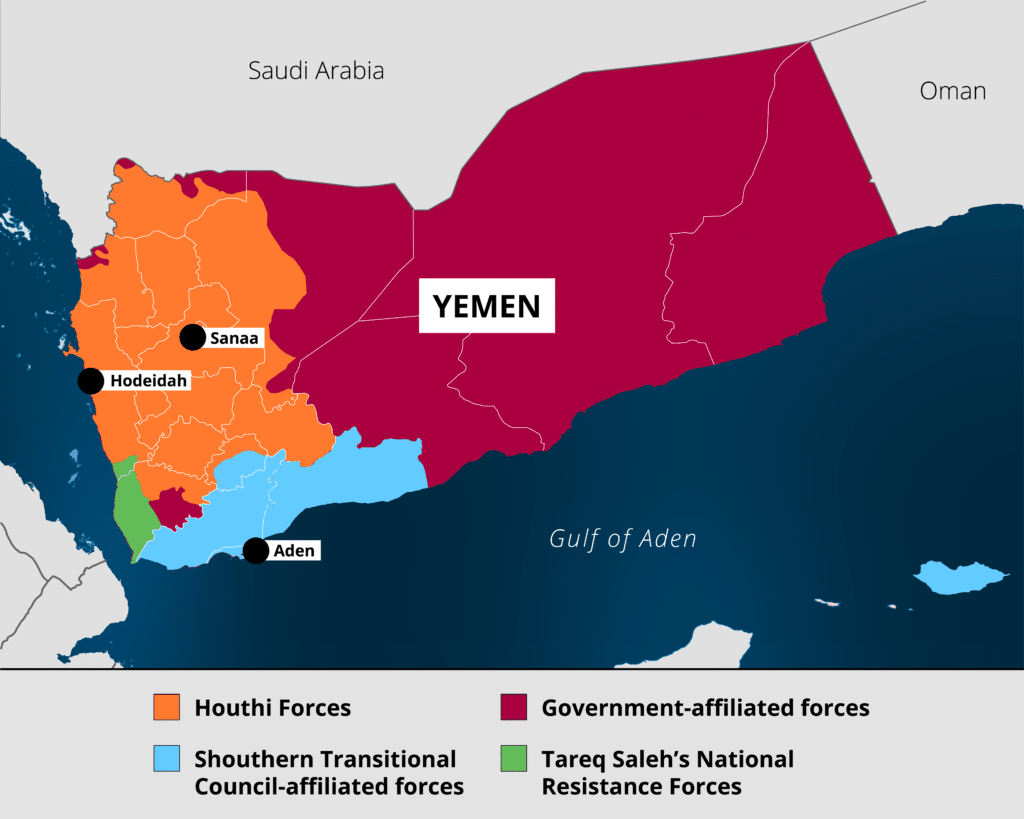
South Yemen: Yemen offers a particularly clear illustration of the failure of state unification in the Arab world. The 1990 merger of North and South Yemen was not the result of social or political integration but a hurried political bargain resting on a temporary balance among competing elites. The south, which had its own state tradition and a distinct social structure, was subordinated to Sanaa without a fair distribution of power or resources. When the Yemeni state collapsed after 2015, this arrangement unraveled, revealing a reality of de facto separation. In the south, an autonomous political and security entity took shape, exercising territorial control, operating governing institutions, and enjoying public legitimacy with support from the United Arab Emirates. The north, meanwhile, came largely under Houthi control, sustained by long-standing Iranian backing. Despite this reality, the international community and most Arab states, led by Saudi Arabia, continue to insist on the framework of a “unified Yemen,” even though it no longer exists in practice. Refusal to consider an orderly separation or a genuinely equitable confederal arrangement does not preserve unity; it entrenches war, humanitarian collapse, and the proliferation of armed actors.
In December 2025, southern Yemeni separatists supported by the United Arab Emirates seized districts in eastern Yemen and drove the pro-Saudi government out of Aden, openly declaring their intention to reestablish the state of South Yemen. Saudi Arabia, which views southern independence as a direct threat to its national security, intervened to assert control over the south and effectively blocked the creation of autonomy there. The United Arab Emirates, having reached the limits of its leverage, subsequently announced an end to its military involvement in Yemen.
The logic behind reconstituting a South Yemeni state is nonetheless compelling. The Southern Transitional Council represents a civilian-oriented actor that is opposed to both the Muslim Brotherhood and the Houthis, possesses financial backing and demonstrated military capacity, and is capable of exercising sovereignty and effective governance that could make the country a model. Over ttime, it could potentially join regional normalization frameworks involving Israel, namely the Abraham Accords. Such a development would strengthen efforts against the Houthis by narrowing their land and maritime smuggling routes and enabling economic recovery in the south.
South Sudan: Sudan long represented a classic case of prolonged state failure, marked by the central government’s inability to control peripheral regions or meet basic civilian needs. For decades, the country was consumed by armed conflict between the north and the south, as well as in Darfur and the Blue Nile region, driven by ethnic, economic, and political tensions. Repeated efforts to prevent fragmentation through strict adherence to territorial integrity—including through military force and highly centralized political structures—consistently failed.
In 2011, international recognition of South Sudan’s independence—achieved through a negotiated separation that included the division of oil revenues—provided a formal and structured resolution to a long-running conflict and underscored the potential advantages of agreed and organized separation. Sudan itself, however, remained burdened by severe internal challenges and has since descended into a prolonged civil war that constitutes one of the world’s gravest humanitarian disasters, with approximately 150,000 fatalities. Even so, the separation demonstrated that a regulated breakup can reduce violence and create a more stable space for the parties involved.
Somaliland: Somaliland constitutes an exceptional case in the Arab–African space in which separation or non-consensual state disintegration has produced stable state functioning despite the absence of formal international recognition. Israel remains the only state to recognize Somaliland’s independence, although several countries, most notably the United Arab Emirates, maintain de facto recognition and security and economic ties.
Since the collapse of Somalia in 1991, Somaliland has built its own governing institutions, effective security forces, a judicial system, and electoral mechanisms. It has managed to preserve relative public order and establish a foundation for internal legitimacy. The Somaliland case demonstrates that stable governance does not depend solely on international recognition, but rather on the ability to exercise territorial control, build public institutions, and consolidate a shared national identity. It also highlights the possibility that the structured disintegration of a failing state can generate stability, effective governance, and legitimacy, while laying the foundations for economic recovery, security, and administration—even in a complex and unstable regional environment.
The Modern Arab State: Artificial Borders and Fragile Identities
Despite widespread skepticism toward separation as a solution to intrastate conflict, several cases in the Arab world suggest that state fragmentation can, under certain conditions, improve stability, governance, and security. South Sudan, despite its serious internal failures, represents a success in one central respect: it brought an end to a prolonged civil war rooted in the imposition of a single state framework on populations with conflicting identities, interests, and conceptions of sovereignty (with a predominantly Christian or animist population in the south and a majority Muslim population in the north). Separation itself created a clear political boundary, reduced the intensity of inter-identity conflict with the north, and allowed each side to focus on internal challenges rather than an ongoing existential struggle.
Somaliland presents an even clearer case of functional success. Since 1991, it has operated as a de facto state, with governing institutions, security forces, electoral mechanisms, and a level of public order that is relatively stable compared to its surroundings. Despite the absence of international recognition, Somaliland has succeeded in establishing internal legitimacy, a monopoly over the use of force, and a meaningful degree of governance—achievements that many internationally recognized states in the region have failed to attain. Its success reinforces the argument that effective state functioning is more critical than formal recognition in the initial stage.
In the Yemeni context, separation between the north and the south could constitute another case of aligning the state framework with underlying social, political, and religious realities (with a predominantly Zaydi Shiite population in the north and a largely Sunni population in the south). South Yemen possesses, at least in principle, most of the conditions necessary for a viable state: a clear geographic boundary, a distinct political identity, a consolidated local leadership, relative control over ports and maritime trade routes, an organized military force, natural resources, and regional backing that could support the development of security and governance institutions. A functioning South Yemeni state could narrow the Houthis’ room for maneuver not solely through military defeat, but by undermining their legitimacy, stabilizing the southern arena, and offering a competing state model based on order, economic activity, and civilian services.
These cases suggest that separation is not necessarily a sign of state failure; in some contexts, it represents a corrective to a deeper historical flaw. Where a single state framework proves incapable of accommodating divergent identities and interests, an orderly breakup can reduce violence, strengthen governance, and lay the groundwork for long-term stability—even at the cost of abandoning the myth of territorial unity. Most Arab states emerged from externally imposed geopolitical arrangements rather than from an organic process of nation-building. Borders drawn in the early twentieth century bound together ethnic, sectarian, and tribal groups, often in mutual hostility,without creating civic mechanisms capable of mediating among them. The state was thus experienced not as a social contract but as a governing shell sustained by coercion, patrimonial resource distribution, or an empty national ideology devoid of civic substance.
State sovereignty therefore depended—by Francis Fukuyama’s account as well—on the centeral authority’s ability to maintain a monopoly over the use of force. When that mechanism collapsed—because of war, external intervention, an internal crisis driven by a struggle over the structure of power, or an economic crisis—the state’s fragility was exposed, and sub-state identities reasserted themselves as the basis of political legitimacy. Yugoslavia is a particularly prominent example of this phenomenon. Yet despite the collapse of the model, a regional and international assumption persisted that territorial integrity is a foundational principle that must be upheld and enforced. In too many cases, adherence to this principle comes at the price of the collapse of the state structure itself. Arab opposition to separation may reflect more than fears of a domino effect in which additional ethnic groups and minorities demand independence and the familiar state order dissolves into chaos and chronic instability, and more than concerns about the loss of resources, power, and prestige. It may also reflect fear that successful, stable, and perhaps even democratic entities could emerge, challenging authoritarian and repressive regimes in the Arab world. To preserve the status quo, Arab states have shown a willingness to resort to military confrontation even with other Arab states, as in the Saudi attack on Emirati forces in Yemen and, according to reports, an Egyptian strike (January 2026) on forces loyal to the United Arab Emirates in Sudan.
This article proposes a critical reexamination of the tension between the weight traditionally assigned to the principle of territorial integrity and the risks associated with secession or separation from the territorial nation-state, and the potential opportunity inherent in territorial partition or loose federal arrangements in cases of protracted, intractable, and violent intrastate conflicts. Such conflicts deepen state failure, undermine regional security through the export of refugee flows, crime, and violence, and turn failing states into arenas of confrontation among external powers intervening to safeguard their vital interests.
The idea of separation or state fragmentation is not a panacea, nor does it inherently guarantee the emergence of prosperous new state entities. Rather, it should be understood as a legitimate political instrument for aligning the state framework with social realities, based on the necessary correspondence—under extreme conditions—between identity and territory, between nation, religion, or ethnic affiliation and the state. The primary objective is to halt bloodshed and secure physical safety and the right to life. Choosing separation or a loose federal system may offer a more viable reality than the one currently prevailing in fractured and failed states, enabling extraction from the vicious cycle in which deep ethnic and religious rifts fuel and accelerate state failure, which in turn further intensifies those very conflicts.
Accordingly, we argue for expanding the boundaries of the prevailing and conservative discourse that clings to the principle of territorial integrity of the nation-state—even where that national framework is artificial and invented, fragile, or viewed as illegitimate by significant segments of the population. This requires a more open examination of separation across a range of possible models, tailored to the specific characteristics of each state. The region’s violent historical experience makes clear that countries such as Yemen, Sudan, Libya, and Syria warrant renewed consideration of these questions. The experiences of South Sudan and Somaliland demonstrate that separation is not only possible but can also be the right choice, and, successful, even if only to a limited extent. There is little dispute that the current realities in Somaliland and South Sudan are safer, more stable, and preferable to the conditions prevailing today in countries such as Sudan, Yemen, Libya, and, most starkly, Syria since the fall of the Assad regime.
JISS Policy Papers are published through the generosity of the Greg Rosshandler Family.