


Introduction
This paper analyzes the wave of protests that swept in Iran in late December 2025 and early January 2026, examining how the principal actors—the regime, the opposition in exile, led by Reza Pahlavi, the reformist camp, and the United States and other Western governments—have assessed the events, drawn lessons, and prepared for the next stage. The paper goes beyond a chronological account of developments to assess emerging strategic dynamics: how violent repression, expanding protest activity, and international pressure are reshaping the internal and external balance of power surrounding the Islamic Republic.
The regime succeeded in containing the protests in the short term through a combination of large-scale repression, control of the digital space, and narrative framing that distinguished between “legitimate protest” and “rioting.” This, however, is no more than a tactical achievement that does not resolve the underlying economic and political crisis and further deepens the alienation between the state and broad segments of the public. At the same time, the reformist camp has weakened as an intermediary within the system, while Pahlavi’s international profile has strengthened—without evidence that symbolic support can be translated into an effective domestic leadership structure.
The international context—particularly U.S. and European pressure—affects the internal arena but does not, at this stage, create conditions for immediate regime change. The current wave of protests is therefore not a decisive turning point but another phase in an ongoing confrontation, in which each actor seeks to convert the lessons of recent events into strategic advantage in the next round. *
The Trajectory of Escalation
An analysis of the January 2026 events in Iran points to three principal phases in the development of the protests:
Phase One – Localized Economic Protest (December 28–29, 2025)
There appears to be broad agreement among opposition actors and regime officials that the January 2026 events began with an economic protest in Tehran’s Grand Bazaar on December 28, 2025, before spreading nationwide. In its initial stage, the protest focused on economic grievances and was triggered by the sharp depreciation of the rial during that period. On the first day, demonstrations were led primarily by merchants and labor organizations calling for a strike.
Phase Two – Politicization of the Protests (December 29, 2025–January 6, 2026)
By the second day, numerous online videos circulated calling for the overthrow of the regime, including slogans such as “Death to Khamenei” and “Death to the dictator.” This marked the beginning of an accelerated process of politicization of the protests, shifting the focus from the rising cost of living to a broader challenge to the legitimacy of the Islamic Republic’s governing system.
According to internal reporting in Iran, the level of violence at this stage remained relatively limited, though clashes between protesters and security forces were reported. In several instances, security forces temporarily withdrew from certain localities, including the city of Abdanan in Ilam Province in southwestern Iran[1]—incidents that underscore the scale of the challenge the protestors posed to local security forces.
Alongside the initial escalation, several senior regime officials adopted relatively restrained rhetoric. On January 7, President Pezeshkian stated that “identifying and addressing deficiencies and the potential social consequences [in government subsidy policies] are necessary to solve the problems of the people’s livelihood.”[2] On January 2, Interior Security Forces Commander Ahmad-Reza Radan declared that Iran’s police were thwarting scenarios of chaos and disintegration orchestrated by the enemy through dignity, fairness, and operational integrity. He expressed pride in the resilience of the internal security forces—described as the first line of defense in safeguarding order at the borders and in the cities—and in their patience and responsible management of the situation on the ground despite economic hardship.[3] Radan’s remarks reflect alertness and an effort to frame the events as contained, while also signaling empathy for the economic difficulties felt by the Iranian people. At this stage, he had not characterized the unrest as a broad political crisis.
Phase Three – Escalation and Violent Repression – January 6–10, 2026
During this phase, the protests continued to expand both geographically and in intensity. The demonstrations received clear support from opposition figures outside Iran, most prominently Reza Pahlavi, son of the shah deposed in the 1979 revolution. During this period, Pahlavi encouraged Iranians to take to the streets and press for regime change. This followed earlier stages of the protests in which he had called on various sectors within Iran to strike and had encouraged the Iranian diaspora to support the demonstrations.[4] His first explicit public call directed at Iranians inside the country was issued on January 6, urging protests on January 8 and 9.[5] Subsequently, he also presented a proposed framework for regime change — a step intended to position his role as part of an organized political process rather than a spontaneous development.
The protests reached a peak around January 8–10. It is difficult to establish the precise course of events, since on January 8, hours before protestors took to the streets, Iranian authorities almost completely cut internet access.[6] Despite this limitation, there appears to be broad agreement — both among opposition sources and in regime reporting — that the largest protests took place in that time with the most intense violence between protesters and security forces. Numerous testimonies indicate that unusually severe force was employed, including the use of live fire and, at times, indiscriminate shooting of protesters.
There are substantial gaps between official estimates and figures reported by opposition groups and human rights organizations outside Iran regarding the scale of casualties. The regime claims 3,117 people were killed, including both protesters and members of the security forces.[7] By contrast, sources outside Iran present far higher estimates, suggesting tens of thousands killed, hundreds of thousands wounded, and large numbers detained.
Amnesty International reported on January 26 that approximately 20,000 people were killed and tens of thousands detained.[8] The organization Iran Human Rights issued a higher estimate on January 22, stating that 25,000 people were killed and claiming verified information on at least 3,428 fatalities — a figure exceeding the regime’s official estimate.[9] According to this organization, roughly 330,000 people were injured during the protests, including around 8,000 who sustained eye injuries.[10] In addition, the Abdorrahman Boroumand Center, which monitors executions in Iran, reported that 316 executions were carried out in January–February alone.[11] This figure may indicate an especially high level of tension between the public and the regime and suggests the use of executions as a tool of deterrence and pressure.
Phase Four – Continued Repression, and Consolidation of Legitimacy – January 10, 2026, onward
After January 10, the protests gradually subsided. Security forces nevertheless maintained an elevated presence in major cities, effectively creating conditions resembling unofficial martial law.[12] Internet access remained disrupted for an extended period and was only gradually restored under restrictions.[13] Regime officials publicly acknowledged that the shutdown caused substantial economic damage, estimated at tens of millions of dollars per day.[14]
On January 12, the authorities organized a large pro–regime rally in Tehran. From the regime’s perspective, this event was intended to reinforce public legitimacy in the face of the protests.[15] Referring to the rally, Ayatollah Ali Khamenei stated that “the Iranian nation proved its resolve and identity before its enemies, and this served as a warning to American politicians to stop misleading public opinion and not rely on treacherous mercenaries.”[16] Within this narrative framework, the authorities drew a distinction between what they portrayed as largely legitimate economic grievances and what they characterized as illegitimate unrest attributed to external actors.
Since January 12, and at least up to the time of writing, the regime has continued an intensive arrest campaign while seeking to tighten its political control and redefine the boundaries of acceptable political discourse. At the same time, as internet access has gradually resumed, additional information — particularly from hospital reporting — has begun to surface regarding the scale of casualties. These reports point to unusually harsh repression and a high level of state violence even after the protests were put down.
1. The Iranian Authorities – Engagement with “Protesters” alongside Aggressive Repression of “Rioters”
The Iranian authorities’ primary strategy in responding to the current protest wave has centered on drawing a sharp distinction between “legitimate” protest and “illegitimate unrest” — typically framed as rioting. This distinction serves a dual purpose: on the one hand, it delineates a purportedly democratic space in which limited criticism can be expressed; on the other, it provides moral and legal justification for forceful repression of activity deemed to exceed those boundaries. In this framing, repression is presented not as the silencing of dissent but as the defense of public order and national security.
Defining the Boundaries of Legitimate Discourse:
The regime has sought to clarify the acceptable limits of protest and establish explicit red lines. Supreme Leader Ali Khamenei addressed this early in the unrest, stating in a public speech that “we speak with protesters, but there is no point in speaking with rioters; rioters must be dealt with firmly.”[17] In the same address, he acknowledged certain economic grievances, noting that bazaar merchants were justified in their concerns over currency instability and declining purchasing power, adding that President Masoud Pezeshkian and senior officials were “working to solve the problem.”[18] This framing established a distinction between economic protest viewed as legitimate and actions portrayed as a threat to public order.
Alongside Khamenei, President Masoud Pezeshkian emerged early in the protests as a central figure in efforts to maintain dialogue with segments of the public.[19] Even during the escalation phase, he appealed for engagement while reinforcing the distinction between “protesters” and “rioters.” He urged families not to allow their sons to join what he described as “bands of terrorist or rioters,” who he accused of having been trained for such activities. Grievances should be voiced openly and peacefully, Pezeshkian said, warning that nighttime violence, arson, and attacks on infrastructure would only deepen public hostility rather than advance legitimate demands. “Coming at night, setting fires, burning banks, fire trucks, or public transportation — what kind of protest is that? What message does it send? It only creates hatred among the public.”[20]
At the same time, Pezeshkian met with representatives of the merchant class during the early days of the protests in an effort to address their demands. Agreements reportedly included establishing a mechanism to monitor traders’ grievances and allowing their representatives to raise issues directly in government forums.[21] These steps illustrate the regime’s effort to maintain channels of engagement with constituencies it perceives as legitimate protesters.
Even at the height of the violence, regime officials continued to address the protesters’ economic demands. On January 8, on the eve of the largest protests, Pezeshkian stressed the need to prevent delays in port shipments, improve interagency coordination, monitor supply chains and pricing, and ensure uninterrupted energy provision to industries producing essential goods.[22] These remarks were made against the backdrop of sanctions pressure, inflation, and energy and water shortages that have compounded Iran’s economic strain.
Following the suppression of the protests in early January, there were signs of an effort to formalize protest activity within an official legal framework. Iran’s Majlis passed elements of legislation regulating demonstrations, defining lawful protest as the expression of views or demands across economic, social, cultural, and political domains.[23]
Later, the Fars News Agency, affiliated with the Islamic Revolutionary Guard Corps, launched a dedicated “protest desk” intended, according to its announcement, to strengthen engagement with the public and reflect societal concerns. Citizens were invited to submit complaints and criticisms on various issues, including politics and the economy. An announcement launching the initiative emphasized the need “to adhere to the law, national security and vital interests,” and to avoid spreading false information.[24] Both the legislative move and the Fars initiative appear designed to display openness to criticism, while in practice preserving the authorities’ ability to suppress such criticism.
Following the violent suppression of the protests, the leadership continued to combine expressions of concern and empathy over economic hardship with condemnation of the protests and accusations of foreign instigation. On January 17, Khamenei called on the government to intensify efforts to ensure the supply of basic goods[25] while asserting that the recent unrest had been incited by the United States, whose objective, he claimed, was to “swallow up” Iran.[26]
The Iranian authorities believe they have won the current round, yet the structural and economic grievances underlying the unrest remain largely unresolved. As a result, suppression may have bought the regime time, but it does not constitute a durable long-term resolution of the underlying crisis.
Delegitimizing “Illegitimate” Protests:
Alongside expressions of empathy, regime representatives made clear that they would act firmly against those they labeled “rioters.” Interior Security Forces Commander Ahmad-Reza Radan stated that rioting is not legitimate protest and that every rioter would be dealt with down to the very last one, including those who publish online what he described as plans by foreign intelligence services to incite unrest.[27]
The regime has consistently reinforced the claim that the “riots” were organized by foreign actors. The Ministry of Intelligence and the Islamic Revolutionary Guard Corps Intelligence Organization released “testimonies,” “confessions,” and assertions that the rioters were acting on behalf of foreign intelligence services,[28] primarily those of the United States and Israel. Ali Larijani, secretary of the Supreme National Security Council, likewise stated that, according to information held by the authorities, those who destroyed buildings and institutions during the protests had been directed by Israel.[29] The regime portrayed the unrest as an organized campaign directed by agents operating on behalf of Israel and the United States, who, it claimed, had deliberately incited segments of the public to confront security forces.
Supreme Leader Ali Khamenei also addressed the matter on January 9, as the protests peaked. “Last night, in Tehran and elsewhere,” he said,” “a group of rioters came and destroyed buildings belonging to their own country in order to please the President of the United States, because he made a baseless statement that ‘if the Iranian government does this, I will come and support your side’ — the side of the rioters and those who harm the country.” Khamenei emphasized that “everyone should know that the Islamic Republic, which rose to power through the blood of several hundred thousand people, will not retreat in the face of the rioters. It does not tolerate foreign mercenaries.”[30]
The regime has indeed followed up on its threats. Daily reports describe mass arrests across Iran, and intelligence bodies release to the media “confessions” by alleged rioters describing violent acts they claim to have carried out and asserting that they received payment and direction from abroad. According to some accounts, these confessions may well have been obtained under torture.[31]
The head of Iran’s judiciary Gholamhossein Mohseni Ejei noted the criminal and security dimensions of the events, stating that organized offenders had taken to the streets and caused extensive damage and that the unrest constituted “an attack on state security.”[32] He further pledged that the judiciary would take “effective and deterrent” measures against the rioters with the greatest possible speed.[33]
These measures are intended, primarily, to deter the public from participating in future protests and, second, to reinforce the legitimacy of the methods of repression, which many—both inside and outside Iran—regard as illegitimate.
Hospitals as an Arena of Repression
The dynamics of repression and efforts to conceal it have created an additional and significant arena: hospitals. These facilities have become both a source of information on the scale of casualties and a space in which repression has continued.
Following the aggressive dispersal of the protests, many of the injured required urgent medical care. However, reports indicated that many were afraid to seek treatment at hospitals. By mid-January, reports increased of patients being arrested in hospitals without receiving adequate treatment,[34] as well as of pressure exerted by security forces on medical staff not to share information with external actors about events inside the facilities.[35] The presence of security forces in hospitals was described as visible and pervasive.
Hospitals have also served as a primary source of reporting on the number of those killed and injured during the protests. Testimonies from physicians, morgue workers, and cemetery employees formed a substantial part of the reporting on which external assessments were based.[36] Some physicians went further and provided clandestine medical treatment to protesters.[37] Subsequent reports indicated that doctors and medical personnel who treated protesters and/or refused to share information with security forces were arrested.[38]
Hospitals have therefore become both arenas of activity and a source of information. As incidents of information leakage and unauthorized treatment of protesters expand, security forces are likely to tighten their grip on these facilities and increase pressure on medical staff.
2. The Role of the Opposition
Reza Pahlavi – The Lead Iranian Opposition Figure in Exile
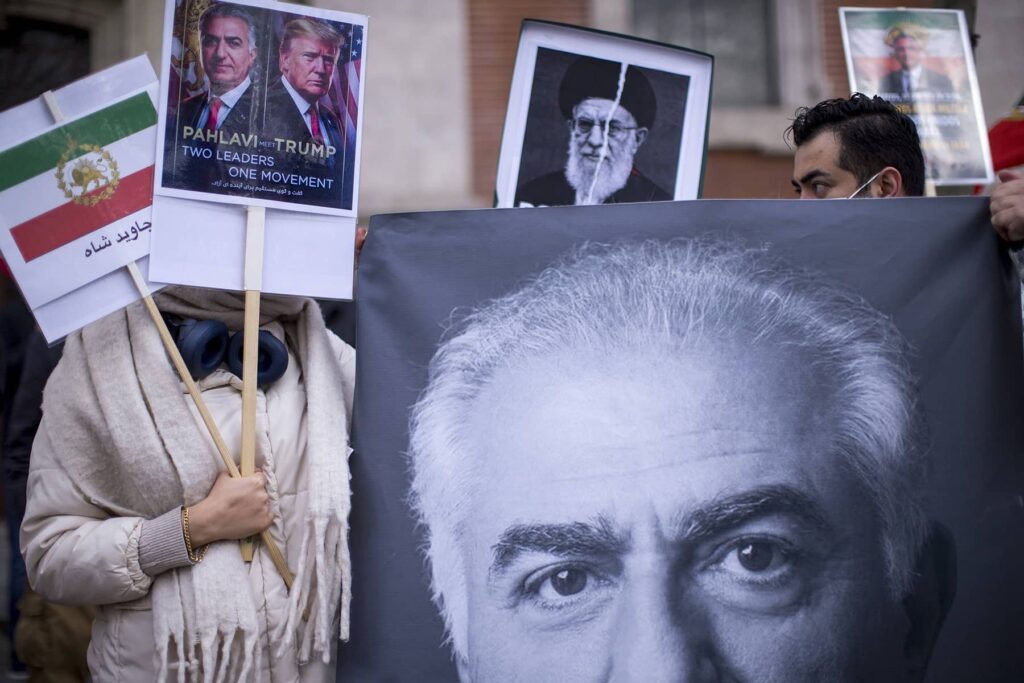
Reza Pahlavi, the son of the deposed Shah, was highly active during the protests in an effort to establish himself as the lead figure of the opposition to the regime. He issued guidance and messages directed at protesters inside Iran, engaged in dialogue with foreign leaders, and explicitly called for international intervention in developments on the ground.
A key moment in his campaign was his call for nationwide demonstrations on January 8 and 9[39]—dates that became the most volatile of the recent protests. The authorities appear to have treated the call as a tangible threat, given its wide circulation. On January 8,[40] several hours before the demonstrations he had called for, they imposed a broad internet shutdown.
Pahlavi subsequently released additional videos and statements. He called on members of the security forces to lay down their arms and register on a platform he established to coordinate with him. He also warned that “those who oppress the nation and those who open fire against the Iranian people can be certain they will be identified and punished,” while promising that “those who stand with the Iranian nation will receive the nation’s honor and praise.”[41] Through these statements, he sought to project authority ahead of any prospective “day after.”
Pahlavi went beyond rhetorical positioning and presented a concrete framework for a transitional government from the current regime to a secular democratic system. The proposal outlines a 180-day emergency phase to stabilize the country and maintain basic services, followed by a stage of institutional reconstruction.[42] In doing so, he aimed to demonstrate that he offers an operational plan rather than a purely declarative vision, and that he would be able to lead Iran through a complex transitional period. This approach is intended to reduce public concern about anarchy in the event of the collapse of the regime.
He stated that he seeks to lead Iran during a transitional period but not beyond in order to stabilize the situation, preserve the bureaucratic apparatus, encourage defections from the security forces, and prepare the ground for a new constitution to be approved by referendum.[43] He identified four foundational principles for Iran under his leadership: territorial integrity; individual liberty and equality before the law; a secular democracy based on separation of religion and state; and the public’s right to determine the form of government.[44]
At the same time, Pahlavi sought meetings with foreign leaders to present himself as a legitimate alternative to the regime. He met privately with Trump’s envoy, Steve Witkoff, to discuss developments in Iran[45] and held discussions with global political figures. A statement by Trump several days after the meeting suggested limited U.S. confidence in Pahlavi: “I don’t know whether or not his country would accept his leadership, and certainly if they would, that would be fine with me.”[46] Despite Trump’s reservations, Pahlavi achieved a symbolic gain when he was invited to speak at the Munich Security Conference,[47] while the invitation extended to representatives of the Iranian regime was withdrawn following the violent suppression of the protests.[48]
The Reformist Movement
The reformist movement in Iran has traditionally advocated gradual change, particularly in the economic and political spheres and in foreign policy, while preserving the existing regime framework. It enjoys formal legitimacy, but its relationship with the conservative institutions that control the principal centers of power has long been complex. One of the most significant confrontations between the camps occurred during the 2009 “Green Movement” protests, following which two prominent leaders—Mir Hossein Mousavi and Mehdi Karroubi—were placed under house arrest.
Since the Green Movement protests, the reformist camp appears to have maintained a cautious working relationship with the authorities. Although its activists continue to face institutional repression and political restrictions, two presidents identified with its values—Hassan Rouhani and Masoud Pezeshkian—have been elected in recent years. Moreover, in the period following the 2022–2023 “Woman, Life, Freedom” protests, and particularly after Pezeshkian’s election in August 2024, the movement appeared to regain momentum and demonstrate an ability to advance elements of its agenda.[49]
In the most recent protests, however, a shift in the movement’s approach toward the ruling conservative establishment became evident. Following the violent events during the latest unrest, many senior reformist figures voiced unprecedented criticism of the repression and, in some cases, of the governing structure and Khamenei himself.
Mousavi, who remains under house arrest, criticized the violent suppression of the January 8–9 protests and described it as “a great crime against the nation.” He also called on the security forces to lay down their arms, urged the regime to step aside, and called for a constitutional referendum.[50] Karroubi stated that “the dire situation in Iran is the result of Khamenei’s intervention and destructive policies in both the domestic and international arenas,” and likewise called on the regime to disarm and withdraw from leading the country.[51]
Azar Mansouri, head of the Reform Front, also urged the regime to avoid war amid tensions with the United States.[52] The organization she leads called for lifting internet restrictions and establishing an independent commission of inquiry into the protest events.[53] It is noteworthy that the Reform Front is an active political movement, and that these calls did not come solely from imprisoned figures or activists marginalized from the public sphere.
A further statement was issued by the imprisoned reformist activist Mostafa Tajzadeh, who described the suppression of the protests as “unprecedented” and called for the establishment of a national independent commission of inquiry to clarify the scope of the events. In his statement, Tajzadeh attributed responsibility for the situation to the clerical establishment and the regime.[54]
Gholamhossein Karbaschi, a journalist identified with the reformist camp and a former mayor of Tehran, described the situation as the most severe he has witnessed in politics, culture, governance, and the economy since entering public life. Karbaschi questioned the government’s narrative of organized incitement behind the protests and argued that the security bodies had failed in their responsibility to prevent the violence. He also called on the authorities to substantiate these claims in the presence of objective international observers.[55]
These examples represent a broader pattern of statements by prominent reformist figures reflecting unusually sharp criticism of the regime’s conduct in suppressing the recent unrest. In response, the authorities arrested a number of senior figures in the movement, including Azar Mansouri, Ebrahim Asgharzadeh, Mohsen Aminzadeh, Javad Emam, Hossein Karroubi (the son of Mehdi Karroubi), and Ali Shakouri.[56]
At this stage, it is too early to assess the long-term implications for the reformist movement following this direct confrontation with the conservative establishment. However, the delicate equilibrium that had characterized their relationship in recent years has clearly been disrupted, and the space within which the movement operates inside the system appears to be narrowing.
3. International Pressure
Reports of the repression in Iran resonated both among the Iranian diaspora and with Western leaders, particularly in the United States. Several Western governments took steps to penalize Tehran for its harsh crackdown on its citizens. At the same time, the United States sought to leverage the situation in pursuit of its broader strategic interests vis-à-vis Iran.
European leaders moved beyond statements of condemnation. European Union foreign ministers voted in favor of designating the Islamic Revolutionary Guard Corps as a terrorist organization,[57] and the EU announced new sanctions against Iran.[58] The United Kingdom imposed sanctions on a number of government and security officials involved in suppressing the protests,[59] and Australia likewise announced sanctions against individuals linked to the IRGC.[60]
An emergency session of the UN Human Rights Council was convened, resulting in a resolution condemning human rights violations and mandating an investigation into the suppression of the protests.[61] In addition, invitations extended to representatives of the Iranian regime to attend the World Economic Forum in Davos[62] and the Munich Security Conference[63] were rescinded in light of the violent crackdown.
In parallel, the United States imposed new sanctions on entities associated with Iran’s “shadow fleet”[64] and threatened to raise tariffs on countries engaged in trade with Iran.[65] Beyond economic measures, President Trump issued repeated public statements following the suppression of the unrest. He accused Khamenei of mismanaging Iran and stated that “the leadership should focus on running his country properly, like I do with the United States, and not killing people by the thousands in order to keep control.”[66]
Trump also expressed support for the protesters. On January 13, he called on the Iranian public to continue protesting and to take control of state institutions, concluding his remarks by saying “Help is on its way,”[67] a comment that prompted significant debate in Iran and abroad regarding his intentions. He further warned the regime against executing protesters and later stated that he had succeeded in preventing the execution of 837 demonstrators,[68] a claim that Iranian media denied.[69]
At the same time, the United States exerted significant pressure on Iran to resume negotiations. Contrary to previous rounds, which focused primarily on the nuclear program, Washington has sought to broaden the agenda of the talks to include Iran’s ballistic missile program, its financing of armed groups in the Middle East, and its treatment of its citizens.[70] As of this writing, Tehran has indicated willingness to discuss only the nuclear issue. Senior regime officials have explicitly stated that they will not agree to halt enrichment.
As of this writing, talks between Iran and the United States are ongoing. Concurrently, the United States has deployed additional weapons systems and military forces to the Middle East to increase pressure on Tehran to reach an understanding. President Trump has described the situation as “fluid.”
For the time being, countries aligned with Iran—primarily Russia and China—have largely backed Tehran at the declaratory level. However, social media reports of airlifts from these countries have raised questions about whether they are also providing Iran with military assistance.
Interim Assessment of Events
The recent protest wave in Iran once again underscored the depth of the rift between the regime and broad segments of the public. Violent repression, mass arrests, and tight control over the information space have enabled the authorities, for the time being, to contain the spread of unrest, but not to address its underlying causes. It remains too early to assess the long-term consequences. Even so, three central trends are already discernible.
First, there is no clear formula to ensure that U.S. military action would trigger a shock wave culminating in the fall of the clerical regime. This remains the case despite the broad public support for the protests and the courage displayed by those who participated. Among other factors, this reflects the lack of cohesion among opponents of the regime.
At the same time, Reza Pahlavi has strengthened his standing as the principal symbol of the opposition in the international arena and as a unifying figure for segments of the Iranian public. His ability to generate public resonance and mobilize support outside Iran has given him visibility and stature that were not previously assured. Nonetheless, the depth of his domestic support and his ability to translate symbolic standing into effective organizational leadership remain open questions.
Second, the violent suppression of the protests has deepened the divide between the regime and wide sectors of society, including groups that previously did not adopt a clear anti-regime position. Particularly notable is the weakening of the reformist camp as a legitimate mediator between state and society, a development that could push parts of it to adopt a more critical stance toward the regime and its structure.
Third, the international context continues to shape the domestic arena. Ongoing tensions with the United States, sustained economic pressure, and uncertainty surrounding diplomatic contacts create a strategic environment that constrains the regime’s room for maneuver and exacerbates the economic crisis, which in turn fuels internal unrest.
These developments do not mark an endpoint but rather another phase in a continuing confrontation. What follows is an analytical examination of how each of the principal actors is internalizing events and preparing for what lies ahead.
Lessons Drawn by the Principal Actors and Their Preparations for the Next Phase
The Regime
The key conclusion from the regime’s perspective is confirmation of the effectiveness of rapid, decisive, and large-scale repression. The leadership is likely to conclude that a combination of tight security control, digital restrictions, and centralized narrative management can still prevent the consolidation of a sustained nationwide movement. Nevertheless, beneath the appearance of control lies an understanding that public alienation is deepening and that traditional mediating channels—most notably the reformist camp—are eroding.
Accordingly, the regime is likely to pursue two parallel tracks: further tightening of oversight and control mechanisms on the one hand, and a limited effort to stabilize the economic arena and ease social pressures on the other, to the extent that international conditions and negotiations with the United States allow. General uncertainty—particularly regarding the possibility of U.S. military action—and the regime’s limited capacity to address public grievances will likely compel it to seek to avert such action through a combination of nominal readiness for negotiations, accompanied by very limited flexibility, in order to buy time, while continuing to warn of the regional and U.S.-related consequences of any attack.
Civil Society and the Protest Movement
Among protest activists and elements of civil society, an opposite lesson may be taking shape: early exposure of visible organizing centers should be avoided in favor of decentralized, spontaneous, or socio-economic forms of protest that make it more difficult for the regime to suppress mobilization at its outset. There may also be a shift from large, concentrated events toward sustained forms of attrition—strikes, civil boycotts, or ongoing symbolic protest.
The recent events have reinforced the understanding that without clear leadership or effective coordination, it is difficult to translate public anger into a cumulative political process. The question of leadership therefore remains a central axis for the future of the protest movement.
Reza Pahlavi
For Reza Pahlavi, the events demonstrated his capacity to generate resonance among the Iranian public and position himself as a clear political address outside Iran. At the same time, they underscored the limits of leading from afar. A possible lesson for him is the need to move from rhetoric and calls to action toward institutional groundwork: broadening opposition coalitions, articulating a more detailed and concrete transitional platform, and establishing discreet coordination mechanisms within Iran.
He may also seek to deepen his international legitimacy through systematic dialogue with Western governments and policy actors, with the aim of positioning himself not only as a protest symbol but as a potential governing alternative. In this context, the extent of trust he succeeds in building—both among the Iranian public and among international actors—will be decisive for his future standing.
The Reformist Camp
The reformist camp faces a major dilemma: continued identification with the system may further erode public trust, while distancing itself risks its remaining institutional footholds. The recent events may accelerate an internal reassessment and lead parts of the camp to adopt more fundamental criticism of the regime’s structure, not merely its policies. If this trend intensifies, it could alter the intra-elite balance of power over the medium term.
The United States and the West
For the United States and the West, the recent protests serve as a reminder of both the regime’s internal vulnerability and the resilience of its coercive apparatus. A possible lesson is that economic pressure alone does not necessarily produce immediate political change but may deepen structural conditions that fuel instability. Accordingly, Western policy may continue to combine economic pressure, principled support for human rights, and avoidance of an explicit commitment to regime change—so long as there is no clear and viable.
Looking Ahead
At this stage, none of the actors appears to view the events as a definitive end to the confrontation. The regime seeks to reinforce internal deterrence; the protest movement is attempting to learn how to organize more resiliently; Reza Pahlavi is working to consolidate his standing as an alternative to the regime; and Western governments are weighing the balance between pressure and regional stability.
Taken together, these dynamics suggest a high likelihood of renewed protest cycles, even if they differ in timing and form to the recent protests. The central question, therefore, is not whether another outbreak will occur, but which actor will succeed in converting the lessons of the current round into strategic advantage in the next.
* The information on which this paper is based is current as of February 12, 2026. The author extends sincere thanks to Daniel Hirschfeld for his extensive research assistance in the preparation of this paper.
[1] “Abdanan Under the Control of Protesters” (original in Persian – آبدانان در تسخیر شهروندان معترض), Iran International, January 6, 2026, https://www.iranintl.com/video/ott_f98c28b81e9e4387959bfcf36250123d
[2] “Pezeshkian Emphasizes Addressing Potential Shortcomings in the Government’s Welfare Policies” (original in Persian – تاکید پزشکیان بر رفع کاستیهای احتمالی سیاستهای حمایتی دولت), Tasnim News Agency, January 7, 2026, https://t.me/Tasnimnews/382546
[3] “Commander Radan: We Will Thwart Scenarios of Chaos and Disintegration” (original in Persian – سردار رادان: سناریوهای آشوب و تجزیه را نقش برآب میکنیم), Fars News Agency, January 2, 2026, https://farsnews.ir/Ansari/1767342415911029095
[4] “My courageous compatriots, Your presence in the streets across Iran has kindled the flame” (Post on the X account of Reza Pahlavi), X, December 30, 2025. https://x.com/PahlaviReza/status/2006080530207445388
[5] “Today I Share with You My First Call, Urging You to Take to the Streets and Chant Slogans…” (X account of Reza Pahlavi; original in Persian – من اولین فراخوان خود را امروز با شما در میان میگذارم و از شما دعوت میکنم…), X, January 6, 2026,
https://x.com/PahlaviReza/status/2008609747931721831
[6] ” Confirmed: Live metrics show #Iran is now in the midst of a nationwide internet blackout…” (Post on the X account of Netblocks), X, January 8, 2026. https://x.com/netblocks/status/2009313506726957230
[7] “Director of the Forensic Medicine Organization Institution Confirms 3,117 Deaths in the Recent Events” (original in Persian – پزشکی قانونی آمار ۳۱۱۷ جانباخته در حوادث اخیر را تأیید کرد), Tasnim News Agency, January 21, 2026, https://t.me/Tasnimnews/384388
[8] ” What happened at the protests in Iran?”, Amnesty, January 26, 2026. https://www.amnesty.org/en/latest/campaigns/2026/01/what-happened-at-the-protests-in-iran/
[9] ” Iran Protests Death Toll: Official Figures Lack Credibility; UN Fact-Finding Investigation Essential”, Iran Human Rights, January 22, 2026. https://iranhr.net/en/articles/8546/
[10] ” Iran’s Protest Massacre – Daily Update | January 18–20, 2026″, Iran Human Rights, January 20, 2026. https://iranhrdc.org/irans-protest-massacre-daily-update-january-18-20-2026/
[11] “The Abdorrahman Boroumand Center has documented 316 executions” (Post on the X account of the Abdorrahman Boroumand Center), X, February 3, 2026. https://x.com/IranRights_org/status/2018749743183147503
[12] “According to Reports We Are Receiving from Citizens…” (post on the X account of Tavaana; original in Persian – در گزارشهایی که از شهروندان دریافت میکنیم…), X, January 19, 2026, https://x.com/Tavaana/status/2013070199549833507
[13] “It’s Friday Evening in #Iran Where Internet Remains…” (post on NetBlocks’ X account), X, January 30, 2026, https://x.com/netblocks/status/2017276633699230086
[14] “Internet Shutdown Causes Daily Damage of 5 Trillion Tomans to the Country” (original in Persian – قطع اینترنت روزانه ۵ همت به کشور ضرر میزند), January 28, 2026, https://t.me/Tasnimnews/385370
[15] “Aerial Images of Millions in Tehran Attending a Rally Against the Riots” (original in Persian – تصاویر هوایی از حضور میلیونی مردم تهران در اجتماع ضد اغتشاشات), Tasnim News Agency, January 12, 2026, https://www.tasnimnews.ir/fa/news/1404/10/22/3493095
[16] “Message of Praise from the Leader of the Islamic Revolution to the Great Nation of Iran Following Today’s Large Gatherings, 22 Dey” (original in Persian – پیام تجلیل رهبر انقلاب اسلامی از ملت عظیمالشان ایران در پی اجتماعات گسترده امروز ۲۲ دیماه), Tasnim News Agency, January 12, 2026, https://t.me/Tasnimnews/383215
[17] “Supreme Leader: We Speak with Protesters, but There Is No Point in Speaking with Rioters; Rioters Must Be Put in Their Place” (original in Persian – رهبر انقلاب: ما با معترض حرف میزنیم اما با اغتشاشگر حرفزدن فایده ندارد؛ اغتشاشگر را باید سرجایش نشاند), Fars News Agency, January 3, 2026, https://t.me/farsna/406737
[18] “Supreme Leader: The Bazaar Class Is Among the Most Loyal in the Country to the Islamic Revolution; One Cannot Confront the Islamic System in the Name of the Bazaar and Its Merchants” (original in Persian – رهبر انقلاب: قشر بازاری جزو وفادارترین قشرهای کشور به انقلاب اسلامی است؛ به اسم بازار و بازاری نمیتوان با نظام اسلامی مقابله کرد), Fars News Agency, January 3, 2026, https://t.me/farsna/406736
[19]“Pezeshkian: Where in the World Are People Beheaded in the Name of Protest?” (original in Persian – پزشکیان: کجای دنیا به اسم اعتراض سر مردم را میبرند؟), Tasnim News Agency Telegram Channel, January 11, 2026, https://t.me/Tasnimnews/383011
[20] “Pezeshkian Meets with Bazaar Merchants: We Are Working to Address the Concerns of the Guilds” (original in Persian – پزشکیان در دیدار با بازاریان: برای حل دغدغههای اصناف تلاش میکنیم), Fars News Agency, December 30, 2025, https://farsnews.ir/Mohammadhosseini/1767102799971601706
[21] “Pezeshkian: Hoarding and Price Gouging Will Be Addressed Decisively” (original in Persian – پزشکیان: با هرگونه احتکار و گرانفروشی برخورد قاطع خواهد شد), Tasnim News Agency Telegram Channel, January 8, 2026, https://t.me/Tasnimnews/382676
[22] “Members of Parliament Defined ‘Assembly,’ ‘Gathering,’ ‘March,’ ‘Organizer,’ and ‘Public Place’ / Approval of Terminology in the Majlis” (original in Persian – نمایندگان اجتماع، تجمع، راهپیمایی، برگزارکننده و مکان عمومی را تعریف کردند/ تصویب تعاریف واژگان در صحن مجلس), Khabar Online, January 19, 2026, https://www.khabaronline.ir/news/2170616
[23] “Fars News Agency to Launch Protest Column” (original in Persian – ستون اعتراض در خبرگزاری فارس فعال میشود), Fars News Agency, January 18, 2026, https://t.me/farsna/408296
[24] “Supreme Leader: The Public’s Livelihood Is Truly in Difficulty” (original in Persian – رهبر انقلاب: معیشت مردم واقعاً مشکل دارد), Tasnim News Agency, January 17, 2026, https://t.me/Tasnimnews/383778
[25] “Supreme Leader This Morning, in a Meeting with Thousands from Various Segments of Society: ‘The Recent Sedition Was an American Plot, and America’s Goal Is to Devour Iran’” (original in Persian – رهبر انقلاب صبح امروز در دیدار هزاران نفر از قشرهای مختلف مردم: فتنه اخیر یک فتنه آمریکایی بود و هدف آمریکا، بلعیدن ایران است), Tasnim News Agency, January 17, 2026, https://t.me/Tasnimnews/383772
[26] “Radan: Protest Are Different from Riots” (original in Persian – رادان: اعتراض متفاوت از اغتشاش است), Tasnim News Agency Telegram Channel, January 7, 2026, https://t.me/Tasnimnews/382494
[27] “Arrest of Three Rioters Linked to the ‘Zionist’ Iran International Channel” (original in Persian – بازداشت ۳ آشوبگر مرتبط با شبکه صهیونی اینترنشنال), Tasnim News Agency, January 3, 2026, https://t.me/Tasnimnews/381859
[28] “Larijani: The Zionist Regime Contacted Thugs to Conduct Armed Urban Warfare in Iran” (original in Persian – لاریجانی: رژیم صهیونی برای جنگ شهری مسلحانه در ایران با اوباش ارتباط گرفته بود), Tasnim News Agency, January 26, 2026, https://t.me/Tasnimnews/385135
[29] “Supreme Leader: Last Night in Tehran, a Group of Vandals Destroyed Buildings Belonging to Their Own Country to Please the U.S. President” (original in Persian – رهبرانقلاب: دیشب در تهران یک مشت تخریبگر آمدند ساختمان متعلق به خودشان را خراب کردند برای اینکه دل رئیسجمهور آمریکا خوش بیاید), Tasnim News Agency, January 9, 2026, https://t.me/Tasnimnews/382795
[30] “Citizen from Hamadan Reports Forced Confessions under Torture in IRGC Detention Centers” (original in Persian – گزارش یک شهروند از همدان درباره اعترافگیری اجباری با شکنجه در بازداشتگاههای سپاه), Iran International, February 5, 2026, https://www.iranintl.com/fa/202602050963
[31] “Ejei’s Strong Criticism of the Charges Filed Against a Rioter” (original in Persian – انتقاد جدی اژهای از اتهام تفهیم شده به یک اغتشاشگر), Tasnim News Agency, January 21, 2026, www.tasnimnews.ir
[32] “Ejei Threatened Detained Protesters with ‘Swift and Deterrent Punishment’” (original in Persian – محسنی اژهای، معترضان بازداشتی را به «مجازات سریع و بازدارنده» تهدید کرد), Iran International, January 19, 2026, https://www.iranintl.com/202601196122
[33] “Report: Police Forcing Hospitals to Provide Lists of Injured Protesters” (original in Persian – پیام مخاطب: ماموران، بیمارستانها را مجبور میکنند فهرست معترضان مجروح را بدهند), Iran International, January 29, 2026, https://www.iranintl.com/fa/202601295546
[34] “At Least 10 Doctors in Tehran Received Threats from Security and Intelligence Agencies” (original in Persian – دستکم ۱۰ پزشک در تهران از نهادهای امنیتی و اطلاعاتی تماسهای تهدیدآمیز دریافت کردهاند), Iran International, January 28, 2026, https://www.iranintl.com/fa/202601273154
[35] “Disappeared Bodies, Mass Burials and ‘30,000 Dead’: What Is the Truth of Iran’s Death Toll?” The Guardian, January 27, 2026, https://www.theguardian.com/global-development/2026/jan/27/iran-protests-death-toll-disappeared-bodies-mass-burials-30000-dead
[36] “Report from Isfahan: Medical Staff Secretly Treated the Injured in the Hospital Courtyard” (original in Persian – پیام مخاطب از اصفهان: کادر درمان مجروحان را پنهانی در حیاط بیمارستان مداوا میکردند), Iran International, January 28, 2026, https://www.iranintl.com/fa/202601282811
[37] “Medical Organization Confirms the Arrest of Several Doctors During the Nationwide Uprising” (original in Persian – سازمان نظام پزشکی بازداشت شماری از پزشکان را در جریان خیزش سراسری تأیید کرد), VOA, January 31, 2026, https://ir.voanews.com/a/8108499.html
[38] “Today I Share with You My First Call and Invite You…” (post on the X account of Reza Pahlavi; original in Persian – من اولین فراخوان خود را امروز با شما در میان میگذارم و از شما دعوت), X, January 6, 2026, https://x.com/PahlaviReza/status/2008609747931721831
[39] “Confirmed: Live metrics show #Iran is now in the midst of a nationwide internet blackout…” (Post on the X account of NetBlocks), X, January 8, 2026. https://x.com/netblocks/status/2009313506726957230
[40] “This Is a Direct Message to the Armed Forces and Security Forces of Iran…” (post on the X account of Reza Pahlavi; original in Persian – این پیامی مستقیم خطاب به نیروهای مسلح و امنیتی ایران), January 7, 2026, https://x.com/PahlaviReza/status/2008914759203065942
[41] “With Prince Reza Pahlavi, the path to victory over the Islamic Republic is defined…” (Post on the X account of Reza Pahlavi), X, January 7, 2026. https://x.com/PahlaviComms/status/2008958324260184354
[42] “Exiled Iranian Shah’s Son Reza Pahlavi Asked: ‘Are You Confident That This Uprising Will Work?'” (Interview on Forbs’ YouTube channel), YouTube, January 24, 2026. https://www.youtube.com/watch?app=desktop&v=9jzDU5ZD8Rs
[43] “To my brave compatriots in Iran, Our magnificent national revolution, the Lion and Sun Revolution…” (Post on the X account of Reza Pahlavi), X, February 4, 2026. https://x.com/pahlavireza/status/2019152513472057752?s=48
[44] “Scoop: Trump’s envoy secretly met Iran’s exiled crown prince”, Axios, January 12, 2026. https://www.axios.com/2026/01/13/pahlavi-witkoff-iran-protest-meeting-trump
[45] “Exclusive: Trump questions support for son of Iran’s last Shah inside country”, Reuters, January 15, 2026. https://www.reuters.com/world/americas/trump-questions-reza-pahlavis-ability-garner-support-iran-2026-01-15/
[46] “Iranian exiled prince invited to Munich Security Conference – Bild”, Iran International, February 4, 2026. https://www.iranintl.com/en/202602046827
[47] “Munich Security Conference withdraws Iran’s invitations”, DW, January 16, 2026. https://www.dw.com/en/munich-security-conference-withdraws-irans-invitations/a-75540795
[48] “Are Iran’s Moderates on the Up After the War with Israel,” Jerusalem Institute for Strategy and Security, August 12, 2025, https://jiss.org.il/en/davidi-are-irans-moderates-on-the-up-after-the-war-with-israel/
[49] “Mir-Hossein Mousavi from House Arrest: The Game Is Over; Lay Down Your Guns and Relinquish the Centers of Power” (original in Persian – میرحسین موسوی از حصر: بازی به پایان رسیده؛ تفنگها را زمین بگذارید و از قدرت کناره بگیرید), January 29, 2026, https://www.iranintl.com/202601294919
[50] “Karroubi: The Grave Situation in Iran Today Is the Result of Khamenei’s Destructive Policies” (original in Persian – کروبی: وضعیت اسفبار امروز ایران نتیجه سیاستهای ویرانگر خامنهای است), BBC, January 30, 2026, https://bbc.in/45ZLr7F
[51] “Leader of the Reform Front: The Minimum We Demand of the Government Is to Prevent War” (Original in Persian – رئیس جبهه اصلاحات: حداقل خواسته ما از حاکمیت، جلوگیری از در جنگ است), Asr Iran News Website, February 2, 2026, https://www.asriran.com/fa/news/1137668
[52] “The Reform Front’s Proposals Under the Current Conditions in the Country” (original in Persian – پیشنهادهای جبهه اصلاحات ایران در شرایط فعلی کشور), Fararu News Agency, February 1, 2026, https://fararu.com/fa/news/945759
[53] “Tajzadeh: The Supreme Leadership and the Failed Clerical Regime Have Imposed the Current Situation on the Iranian Nation” (Original in Persian – تاجزاده: ولایت فقها و حکومت شکست خورده روحانیت این اوضاع را بر ملت ایران تحمیل کرده است), Iran International, January 29, 2026, https://www.iranintl.com/202601295216
[54] “Gholamhossein Karbaschi: Today’s Generation Neither Knows Us Nor Accepts Us” (original in Persian – )غلامحسین کرباسچی: نسل امروز نه ما را میشناسد و نه قبول دارد, Gooya News, February 2, 2026, https://news.gooya.com/2026/02/post-106140.php
[55] “Arrest of Several Political Figures on Charges of Collaboration with the United States and the Zionist Regime” (original in Persian – بازداشت تعدادی از عناصر سیاسی با اتهام فعالیت به نفع آمریکا و رژیم صهیونیستی), Kayhan, February 10, 2026, https://kayhan.ir/fa/news/327556
[56] “Iran’s security forces are responsible for mass killings.” (Post on the X account of Kaja Kallas), X, January 29, 2026. https://x.com/kajakallas/status/2016797144808563186
[57] “Repression cannot go unanswered.” (Post on the X account of Kaja Kallas), X, January 29, 2026. https://x.com/kajakallas/status/2016887341567103257
[58] “UK announces sanctions against perpetrators of human rights violations in Iran”, gov.uk, February 2, 2026. https://www.gov.uk/government/news/uk-announces-sanctions-against-perpetrators-of-human-rights-violations-in-iran
[59] “Targeted sanctions in response to brutal repression of protests in Iran”, Minister of Foreign Affairs, February 3, 2026. https://www.foreignminister.gov.au/minister/penny-wong/media-release/targeted-sanctions-response-brutal-repression-protests-iran
[60] “UN rights body condemns Iran’s ‘brutal repression’ of protests, mandates probe”, The Times of Israel, 23 January 2026. https://www.timesofisrael.com/un-rights-body-condemns-irans-brutal-repression-of-protests-mandates-probe/
[61] “The Iranian Foreign Minister will not be attending Davos…” (Post on the X account of the World Economic Forum), 19 January, 2026. https://x.com/wef/status/2013163543642673254
[62] “German Pressure to Revoke Araghchi’s Invitation” (original in Persian – فشار آلمان برای لغو دعوت عراقچی), Tasnim News Agency, January 18, 2026, https://t.me/Tasnimnews/383899
[63] “Sanctions to Counter Illicit Traders of Iranian Oil and the Shadow Fleet” (original in Persian – تحریمها برای مقابله با فعالان تجاری غیرقانونی نفت ایران و ناوگان سایهای), U.S. Department of State Persian Website, February 7, 2026, https://ir.usembassy.gov/fa/sanctions-to-combat-illicit-traders-of-iranian-oil-and-the-shadow-fleet/?fbclid=IwY2xjawP4IQhleHRuA2FlbQIxMABicmlkETF4SG5mRFhrRTk4NjYyTjFJc3J0YwZhcHBfaWQQMjIyMDM5MTc4ODIwMDg5MgABHhRMhDr2EggwtpyBKpUniM4xE3OJkIsWQd8ZY-svdnLlhEIv7EzidNkA_JZ8_aem__Dzlfz25p6hycHvGw_YJ3g
[64] “Trump threatens tariffs for countries trading with Iran”, BBC, February 7, 2026. https://www.bbc.com/news/articles/c4glgz2l83vo
[65] “Donald Trump, President of the United States, Said Regarding Khamenei…” (post on the U.S. State Department X account in Persian – دونالد ترامپ، رئیسجمهور آمریکا، درباره خامنهای گفت…), X, January 18, 2026, https://x.com/USABehFarsi/status/2012717883520901463
[66] “Trump tells Iranian protesters ‘Help is on its way’ as 2,500 killed”, The Telegraph, January 13, 2026. https://www.telegraph.co.uk/world-news/2026/01/13/trump-tells-iranian-protesters-help-is-on-way/
[67] “Trump: Iran canceled 837 hangings after we warned it would be ‘very bad day for them’”, The Times of Israel, January 20, 2026. Trump: Iran canceled 837 hangings after we warned it would be ‘very bad day for them’
[68] “The Attorney General: Trump’s Claim That Iran Decided to Execute 800 People Is False” (original in Persian – دادستان کل کشور: ادعای ترامپ دربارۀ تصمیم ایران برای اعدام ۸۰۰ نفر کذب است), Fars News Agency, January 23, 2026, https://t.me/farsna/408926
[69] ” PART 2 @SecRubio on meaningful talks with Iran…” (Post on Department of State’s X account), X, February 4, 2026. https://x.com/StateDept/status/2019097277739188589
[70] “Scoop: President Trump told me in an interview on Monday” (Post on Barak Ravid’s X account), January 26, 2026. https://x.com/BarakRavid/status/2015888130935599577