


Introduction: The Internal Arena as a Decisive Variable in Decision-Making
Iran is approaching a critical decision point in the war with the United States and Israel. The regime must decide whether to continue the war to strengthen its negotiating position by applying pressure on the flow of goods through key maritime routes that carry a substantial share of global trade and energy or to accommodate the American position, at the risk of intensifying internal strain, and at the cost of relinquishing core elements of its security doctrine.
One of the most significant variables shaping Iran’s decision is the internal situation—above all, the regime’s ability to maintain effective control over the domestic arena. It is no coincidence that regime leaders and regime-affiliated commentators have stressed the importance of national unity during wartime—a concept that, in practice, reflects regime cohesion and the integrity of its governing mechanisms. As long as the threat of a ground invasion remains limited, the primary risk to regime stability lies in internal revolt or fragmentation within the leadership, as demonstrated by the protests at the beginning of 2026 and those of recent years, which were perceived as a substantive threat to the regime.
This paper focuses on the components of Iran’s internal arena in order to assess their stability and the regime’s capacity to manage them, without suggesting that these factors alone determine its decisions. It concludes by evaluating the extent and nature of their influence on the regime’s decision-making at the current strategic juncture.
The bottom line is that the regime does not currently face an immediate threat to its survival; however as the protests three months ago in which thousands were killed show, the potential for uprising and change exists. The blows to the leadership have strengthened the conservative camp, which is acting with resolve; the cohesion of the security apparatus remains intact; there are no signs of shortages, and daily life continues largely as normal. In the contest for symbolic control of the streets, the regime faces little meaningful challenge from opposition forces, whether inside or outside Iran, while its coercive machinery continues to function effectively, including through the restriction of internet access and communications.
At the same time, the regime still faces risks emanating from the internal friction between hardliners and more pragmatic elements within the leadership; the possibility of renewed popular unrest, potentially backed by the United States and Israel; the U.S. threat to strike energy infrastructure; and the cumulative cost of a prolonged war and sustained sanctions. To manage these risks, the regime leverages its capacity to disrupt global energy markets and threatens its Gulf neighbors.
Assassinations of Iranian leaders and the erosion of balancing mechanisms
One of the most consequential actions taken against the Iranian regime during the current war has been the targeting of its leadership. The significance lies not only in the scale of the eliminations of senior figures, but also in the stature of those removed and in the cumulative damage to command continuity, decision-making capacity, and coordination mechanisms between the political and security echelons. In the opening blow of Operation Roaring Lion, Israel eliminated Supreme Leader Ali Khamenei along with a number of other senior and influential figures within the Iranian leadership.[1]
Beyond the near-total elimination of the military leadership, Israel also removed several highly significant key figures—foremost among them Khamenei and, alongside him, Secretary of the Supreme National Security Council Ali Larijani and Secretary of the Defense Council and Senior Political Advisor Ali Shamkhani. The loss is not merely of personnel but a systemic blow as the assassinations undermine established centers of authority and mediation mechanisms between competing power centers.
The three central figures, notable for their ability to preserve a balance within the governing system between the conservative camp—including the security establishment, which advocates hardline positions—and the more pragmatic camp, which is willing to engage in dialogue and, at times, to compromise. This balance, anchored in the authority of the Supreme Leader, was a defining feature of Iranian policymaking throughout Khamenei’s tenure.
This balance enabled Tehran, among other things, to adapt its policy to changing circumstances and to conduct negotiations, and even reach agreements with the United States, including during periods of tension, while managing internal frictions without allowing them to escalate into systemic paralysis.[2]
With Khamenei gone and no supreme authority left to arbitrate disputes, friction between rival camps is all but inevitable. A notable example was President Masoud Pezeshkian’s apology to regional states for Iran’s attacks against them. A March 7, 2026 Reuters report indicated that the statement drew sharp criticism from conservative factions, including the IRGC, exposing growing tensions between the president and hardline elements.[3]
Another indication emerged in reports of a dispute between Pezeshkian and IRGC commander Ahmad Vahidi roughly a month into the war, centered on its conduct and mounting economic costs. According to the report, amid Pezeshkian’s push to reclaim certain authorities for the government, Vahidi rejected calls to halt the war and instead blamed the presidency for the deteriorating economic situation.[4]
Shamkhani and Ali Larijani brought extensive governing experience and the personal authority needed to mediate between competing power centers. Both held senior roles in both the defense establishment and the civil sector —including as secretary of the Supreme National Security Council, a pivotal position in shaping Iran’s strategic decision-making—and maintained close ties to Khamenei.
The removal of these three figures points to a potential structural shift in the Iranian system—both in the internal balance of power and in decision-making patterns. As long as the conservative camp remains cohesive, anchored in the power of the IRGC and the armed forces, it is likely to consolidate its dominance over decision-making at the expense of the more pragmatic camp. That dominance will likely translate into more confrontational positions, both externally and domestically, alongside restricted room for diplomatic maneuver.
At the same time, Iran’s security establishment has also been dealt severe blows during the war, including the elimination of the chief of staff, the IRGC commander, the Basij commander, the navy commander, the head of intelligence, and other senior officials. The result is mounting strain on mid- and senior-level ranks, with likely knock-on effects for control and oversight. If this trend continues, succession struggles and internal power contests could emerge—though there are no clear signs of that at this stage.
The battle for the streets: control of the public sphere and legitimacy
One of the central fronts in Iran’s internal arena during the war with Israel and the United States is the struggle over control of the streets. On one side stands the regime; on the other, the opposition in exile led by Crown Prince Reza Pahlavi and aligned with Israel and the United States. The core question is not territorial control, but political legitimacy: whether the street remains a domain the regime commands or becomes a space through which it is challenged.
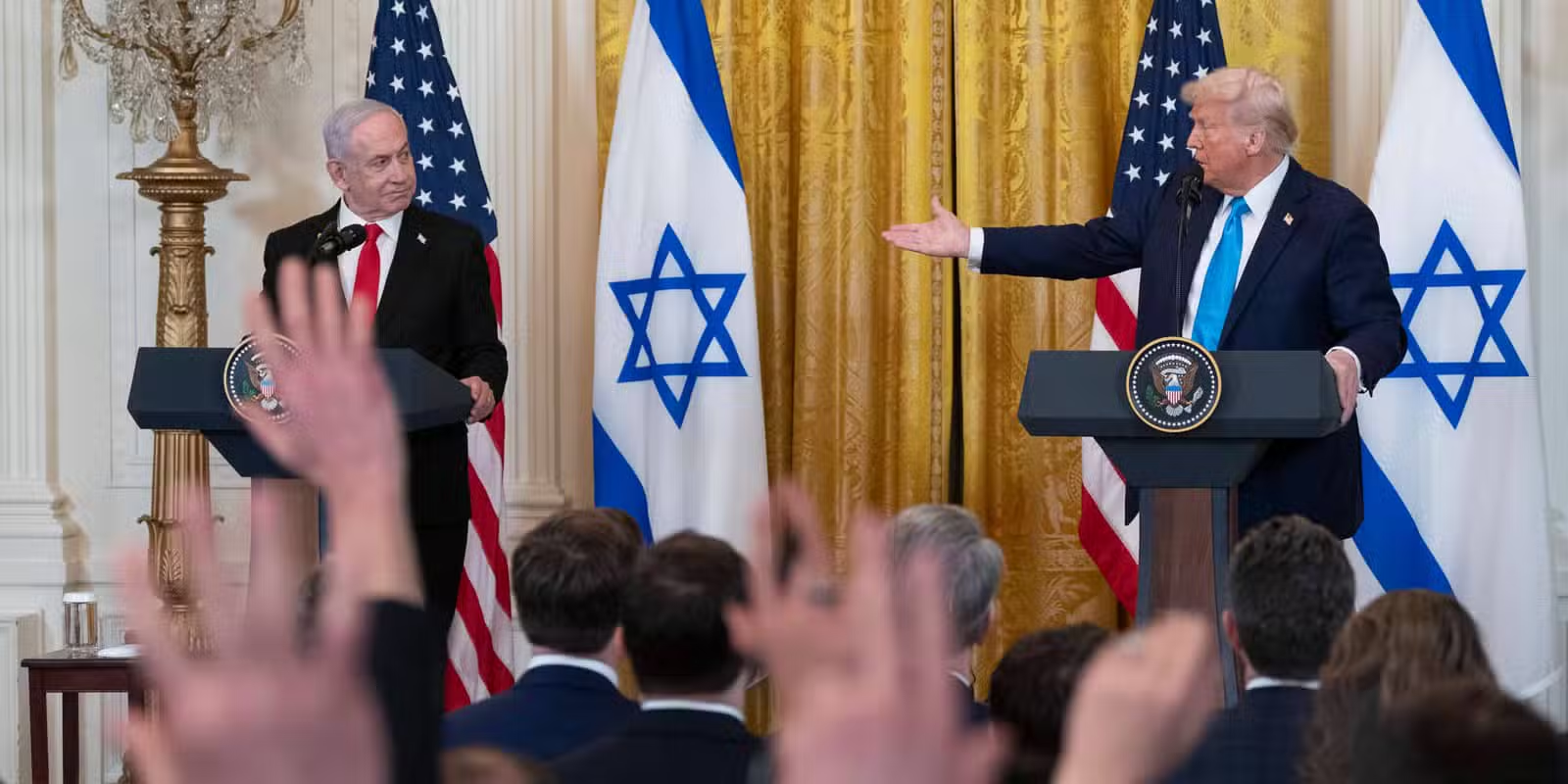
From the outset of the war, messaging from Pahlavi, U.S. President Donald Trump, and Israeli Prime Minister Benjamin Netanyahu was broadly aligned:
• On the first day of the operation, the exiled crown prince Pahlavi urged restraint: “I ask you, for now, to remain in your homes and remain calm and safe. Stay alert and ready to return to the streets for the final action at the appropriate time, which I will communicate to you.”[5]
• President Trump, in his initial statement on the attack, addressed the Iranian public directly: “The hour of your freedom is at hand. Stay sheltered. Don’t leave your home. It’s very dangerous outside. Bombs will be dropping everywhere. When we are finished, take over your government. It will be yours to take.”[6]
• Netanyahu delivered a similar message: “We will create the conditions for the brave Iranian people to free themselves from tyranny. Do not miss this opportunity. Your moment is approaching—the moment when you will be called to take to the streets in large numbers and bring down the regime that has made your lives unbearable. Your suffering and sacrifice have not been in vain. The help you have been waiting for has arrived.”[7]
There is no evidence of formal coordination between Israel and the United States and Pahlavi, and at times various statements in both countries have appeared to distance them from his leadership. Yet in practice, the messaging and actions on the ground of the three parties appear to be aligned — or at the very least not to contradict each other. This apparent convergence helps create a sense (real or not) among the Iranian public that a “window of opportunity” may be opening. At the same time, it raises the personal risk for anyone attempting to challenge the regime, given the uncertainty over whether external backing would actually materialize.
The regime meanwhile has moved quickly to reinforce its presence using occasions such as Quds Day and the days following Khamenei’s assassination to encourage its supporters to go out on to the streets. Senior officials, including Iran’s new leader Mojtaba Khamenei,[8] the son of the assassinated Supreme Leader (or at least statements attributed to him) have emphasized the importance of regime supporters showing a visible presence. For the regime, this is not only a sign of support; it is a tool of deterrence, a display of control, and a way to project an image of normalcy.
One of the key flashpoints in this struggle for the streets came on March 17, the eve of Charshanbeh Suri (the “Festival of Fire”). Reza Pahlavi called on Iranians to go out onto the streets and take part in the celebrations: “This year we will mark Charshanbeh Suri with national fervor, in memory of those who gave their lives so that Iran and our national identity can be reclaimed.”[9] He did not explicitly call for protests or for the overthrow of the regime, but he urged security forces to avoid clashes with celebrants from 18:00 onward. In effect, he sought to carve out a public space that was not fully controlled by the regime.
The regime viewed the holiday as a potential trigger for instability. Police Chief Ahmad-Reza Radan warned on March 16 that it would be “decisive” and called on regime supporters to “fill the streets and the squares.” The Ministry of Intelligence issued a warning that hostile actors might exploit the celebrations to create chaos, underscoring the regime’s view of the holiday as a potential vulnerability.[10] [11]
In the days leading up to the holiday, reports surfaced of targeted attacks against Basij personnel on city streets, and of growing fear among security forces that they would come under attack. According to these reports, the attacks involved explosive drones and small arms—tactics that suggest an effort to raise the cost of enforcement for the regime and erode the confidence of forces on the ground. The pattern of attacks could be read as preparation for a broader call to take to the streets, combined with targeted pressure on security forces. In the event, however, the holiday passed relatively quietly: no significant clashes were reported, and there were no meaningful expressions of protest beyond a handful of isolated incidents. This points to a clear gap between the potential for escalation and its actual realization.[12]
It is too early to determine whether the Charshanbeh Suri events amounted to a failed attempt at incitement or uprising. What is clear is that the tension surrounding them was palpable, in particular on the part of the regime, which appeared to be preparing for potential violence in view of the events of December 2025-January 2026 and allocated resources accordingly.
It is noteworthy in this context that from the first day of the war the regime effectively shut down open internet access across Iran,[13] a familiar move in times of crisis, seen previously during the January 2026 protests and Operation Rising Lion in June 2025. Shutting down the internet is a central tool used to choke off the flow of unfiltered information. The blackout makes it far harder to document repression, organize or coordinate protest activity, and circulate opposition messaging. It also obscures the situation on the ground, limiting the ability, both inside and outside of Iran, to form a reliable picture of events. At the same time, it blunts the reach of opposition figures such as Reza Pahlavi, constraining their ability to mobilize quickly.
So far, the regime still appears able to maintain effective control over the public sphere, although it is under mounting pressure.
The internal threat: separatism, collaborators, and coercive mechanisms
A key indicator of the regime’s sense of control lies in the conduct of the judiciary and internal security forces—particularly their use of executions, arrests of suspected collaborators, and handling of internal threats. These measures serve not only as instruments of enforcement but also as tools of public deterrence. Throughout the war, there have been widespread reports of arrests of collaborators across Iran, alongside operations targeting separatist elements, especially in minority regions such as Urmia,[14] Ilam and Kermanshah[15] in the west, as well as Sistan and Baluchestan in the east[16]—areas marked by heightened security sensitivity and a long history of tension with the central government.
There have been numerous reports during the course of the war of a potential incursion by Kurdish forces from the Iraqi border. While no such incursion appears to have materialized, both official statements and reported military activity suggest that Iranian decision-makers treat this as a credible scenario that informs operational planning. Every few days, the armed forces issue statements about strikes on positions and headquarters in Iraqi Kurdistan, which they claim belong to Kurdish separatist groups and/or Western elements. These actions are intended to signal deterrence and to push the perceived threat away from Iran’s borders.[17]
Regime-media periodically report on the situation along the borders, typically emphasizing that security forces are deployed and ready for all contingencies.While they do not hide the threat of a potential incursion, they consistently highlight that they are on top of the situation and ready for any eventuality, thus reinforcing a public narrative of stability and control.[18]
In addition to separatist threats, the regime finds itself under pressure at home, where it employs the judiciary as a deterrent force. In the opening days of the war, Judiciary Chief Gholam-Hossein Mohseni-Ejei warned that “those acting in line with the enemy’s will will be dealt with decisively,”[19] and announced that the assets of convicted collaborators would be seized.[20] At the same time, the regime has resumed executions, including of detainees from recent protests.[21] This signals a willingness to absorb international criticism in order to reassert control. Executions had previously been treated as a red line by Trump, and for a while the regime refrained from crossing that line.
The regime clearly recognizes the risks posed by separatist activity and Iranian citizens collaborating with Israel, particularly if these dynamics converge with broader public unrest. Nevertheless, it has not progressed beyond familiar patterns of repression. That restraint suggests a working assumption among decision-makers that the threat remains manageable, or can be contained and isolated. This confidence is reinforced by the situation in the streets: many participants in recent unrest have been accused of links to Israel, blurring the line between internal dissent and external threat.
The economy, infrastructure, and regime resilience
As of this writing, Iran’s economic and infrastructure conditions have not shifted dramatically since the outbreak of the war, and the regime continues to successfully sustain basic civilian economic activity. That said, several structural vulnerabilities—above all its dependence on energy infrastructure, imported goods, and distribution systems—could become critical fault lines if disruptions persist or intensify.
Basic goods: Iranian authorities have consistently emphasized that prices remain stable and supply continues uninterrupted, inter alia as part of an effort to project resilience and “business as usual” and to prevent panic. While there are no confirmed reports of shortages, the issue likely weighs on decision-makers. A report by the ILNA news agency on the establishment of a corridor for importing goods from the United Arab Emirates via a third country[22] suggests an effort to create alternatives to disrupted trade routes—and points to the regime’s sensitivity to logistical disruptions.
Electricity: Trump’s threat to strike Iran’s electricity infrastructure has been deferred to April 6, but the regime is well aware of its potentially destructive economic and social impact. Before he was assassinated, Ali Larijani warned that “if the United States attacks our electricity infrastructure, the entire region will be left without power.”[23] Although parts of the grid have been hit,[24] there are no reports so far of widespread or sustained electricity shortages—suggesting either a degree of systemic resilience or effective short-term crisis management.
Steel: On March 27, Israel carried out an unusual strike targeting two major steel plants in Iran.[25] The steel sector is a key pillar of Iran’s exports and a significant source of hard-currency revenue, particularly given constraints on oil exports. Iranian security officials responded with threats of retaliation against Israeli industrial targets, framing the strike as a “change in the rules of the game.” The attack is viewed not merely as a blow to Iran’s military-industrial base, but as a direct hit on the core of Iranian industry.[26]
Kharg Island and energy infrastructure: Iran’s energy infrastructure has not yet sustained major damage, aside from Israeli strikes on fuel storage facilities[27] and installations in the South Pars gas field,[28] which appear to have caused limited damage. However, the United States retains a significant latent threat against this sector. President Trump has explicitly warned of strikes on Iran’s energy and electricity infrastructure,[29] including oil export facilities on Kharg Island, with talk of possible seizure of these assets. Given that a substantial share of Iran’s oil exports passes through Kharg Island,[30] any disruption there would directly hit state revenues and constrain the regime’s ability to fund both civilian and military activity.
A breakdown in any one of these areas could deal a significant blow to the economy and to regime revenues over time, generating cumulative public pressure. The most consequential impact would likely come from sustained damage to energy infrastructure and disruptions to the supply of basic goods, both of which are essential to social stability and to the regime’s ability to maintain legitimacy and function.
The impact of external factors on the internal equation
Beyond the internal dynamics examined in this paper, the regime’s decision-making environment is also shaped by external factors, primarily through their indirect impact on domestic stability. Chief among them is the regional arena and Iran’s use of proxy forces, particularly Hezbollah and the Houthis. These actors allow Tehran to apply pressure on Israel, the United States, and the broader international system while shifting part of the confrontation beyond its own borders. In the near term, this reduces direct pressure on the domestic front and reinforces the regime’s confidence in sustaining an assertive strategy.
At the same time, the positions of major powers—above all Russia and key European states—as well as the international sanctions regime, shape the scale of economic and political pressure on Iran. Russian support, or even restraint, combined with European fears of broader escalation, can provide the regime with a measure of strategic breathing space. Conversely, tighter sanctions or a disruption to Iran’s energy exports would deepen economic strain and translate directly into internal pressure.
These external pressures do not operate in a vacuum; their impact is filtered through Iran’s internal situation. In practice, the regime’s ability to leverage gains abroad or to absorb international pressure depends first and foremost on the level of domestic stability and its capacity to maintain effective control at home.
Conclusion: between relative stability and the risk of fracture
Across most indicators, Iran’s internal arena remains stable. The regime has preserved cohesion within its security apparatus and continues to exercise effective control over key centers of power—security, economic, and informational. This stability allows it to sustain an assertive posture toward Israel, the United States, and regional actors, while taking a harder line, backed by external leverage, in any negotiations over ending the war. Tehran’s primary lever remains its ability to disrupt critical maritime chokepoints—above all the Strait of Hormuz, and potentially Bab al-Mandab via the Houthis—thereby exerting pressure on the global economy and strengthening its bargaining position. The elimination of Khamenei, uncertainty over succession, and the growing dominance of the conservative camp all serve, at this stage, to narrow diplomatic flexibility and point toward a more hardline Iranian posture.
At the same time, the regime faces a number of risks that could alter the situatio and force a shift in its position:
- Fragmentation within the conservative camp due to continued targeting of its leadership: If Israel continues to eliminate senior IRGC commanders, potentially including figures such as Majlis Speaker Mohammad Bagher Ghalibaf, rival factions within the conservative camp could turn on one another, eroding internal cohesion. Such fragmentation would likely impair decision-making, slow response times, and trigger internal power struggles. It is not yet possible to identify the actors who might emerge in such a contest, but the continued removal of senior figures without agreed successors would increase the likelihood that latent divisions surface.
- Strikes on energy infrastructure in Iran and the seizure or destruction of Kharg Island facilities: If Iran’s energy infrastructure is destroyed, its security forces would be able to function only for a limited period, while at the same time broad shortages would set in rapidly, affecting the entire country’s civilian and military systems and potentially marking the onset of an attrition process. If Kharg Island were seized and U.S. forces were able to maintain effective control over its oil facilities over time, Washington would hold a significant strategic lever, directly undermining regime revenues and its ability to finance its activities. This could compel meaningful concessions, including from a conservative-led leadership. The threat alone may be sufficient to push the current Iranian leadership toward compromise.
- The outbreak of mass unrest, encouraged by Pahlavi and coordinated with Israel and the United States, alongside a Kurdish incursion from Iraq: This is the most dangerous scenario from Tehran’s perspective, as it combines an internal threat with an external one. Under such conditions, the leadership would be forced to redirect significant attention and resources to the domestic arena, at the expense of its ability to sustain the external campaign. This scenario could also intersect with Israeli and U.S. strike plans, likely reserved for moments of internal destabilization. If Tehran assesses that this threat is becoming real and poses a tangible risk to regime survival, it would likely move quickly toward compromise with the United States.
It is difficult to predict how Iran’s decision-makers will act. Their choices depend on multiple variables, shifting internal power balances, and leaders weighing several available courses of action. Moreover, a moderate deterioration in the stability of any of the factors outlined above could push the regime toward compromise. A more severe disruption, however, could trigger a chain of chaotic developments, including partial loss of control, whose course and consequences cannot be anticipated in advance.
* The information on which this paper is based is current as of March 29, 2026. The author thanks Daniel Hirshfeld for his assistance with the research for this paper.
[1] “The major eliminations in Operation Roaring Lion,” IDF website, accessed March 28, 2026.
https://www.idf.il/אתרי-יחידות/יומן-המלחמה/כל-הכתבות/הפצות/רשימת-החיסולים-המתעדכנת-במבצע-שאגת-הארי
[2] “Cracks emerge in Iran’s leadership as it reels under bombardment,” Reuters, March 7, 2026.
https://www.reuters.com/world/middle-east/cracks-emerge-irans-leadership-it-reels-under-bombardment-2026-03-07
[3] The rift between Pezeshkian and Vahidi over the conduct of the war and its economic consequences has deepened” (Persian: شکاف میان پزشکیان و وحیدی درباره مدیریت جنگ و پیامدهای اقتصادی آن شدت گرفته است), Iran International, March 28, 2026, https://www.iranintl.com/202603286562
[4] Note: Ahmad Vahidi previously served as interior minister under President Raisi and played a central role in shaping the environment with which the Pezeshkian government is now contending, including the suppression of unrest following the death of Mahsa Amini.
[5] “My dear compatriots, decisive moments lie before us.” (Post on Reza Pahlavi’s X account), X, February 28, 2026. https://x.com/PahlaviReza
[6] “President Donald J. Trump on the United States Military Major Combat Operations in Iran,” The White House, February 28, 2026. https://www.whitehouse.gov/videos/president-donald-j-trump-on-the-united-states-military-major-combat-operations-in-iran
[7] “Brothers and sisters, citizens of Israel…” (Post on Benjamin Netanyahu’s X account, Hebrew), X, February 28, 2026,https://x.com/netanyahu.
[8] “Given this, participation in Quds Day (Jerusalem) ceremonies is of importance” (Persian: از این رو اهمیت حضور در مراسم روز قدس), Mehr News Agency Telegram channel, March 12, 2026, https://t.me/mehrnews/359554.
[9] “My compatriots, on the eve of Charshanbeh Suri…” (Post on Reza Pahlavi’s X account), X, March 15, 2026, https://x.com/PahlaviReza/status/2033267478827012279.
[10] “Radan’s red lines for Charshanbeh Suri” (Persian: خط و نشان رادان برای چهارشنبه سوری), Gooya News, March 17, 2026, https://news.gooya.com/2026/03/post-107591.php.
[11] “The Ministry of Intelligence warns of exploitation of Charshanbeh Suri by Israeli elements” (Persian: هشدار واجا درباره سوءاستفاده معدود سربازان اسرائیل از چهارشنبه سوری), Tasnim News Agency, March 17, 2026, https://www.tasnimnews.ir/fa/news/1404/12/26/3542559.
[12] “Last night, all checkpoints under the bridges were attacked…” (Persian: دیشب هر چی ایست بازرسی زیر پل زده بودن رو زدن زیر پل آزادگان و زیر پل آزادی), post by Omid Dana (Telegram), March 16, 2026, https://t.me/rodast_omiddana/67174.
[13] “Update: Iran’s internet blackout has now entered day 30…” (Post on NetBlocks X account), X, March 29, 2026. https://x.com/netblocks/status/2038156319744508160
[14] “Twenty individuals linked to the Zionist regime arrested in Urmia” (Persian: دستگیری ۲۰ نفر از عوامل مرتبط با رژیم صهیونیستی در ارومیه), ISNA Telegram channel, March 15, 2026, 2026, https://t.me/isna94/372165.
[15] “They sought to incite unrest in cities via anti-revolutionary influence from the Kermanshah–Ilam border…” (Persian: میخواستند از مرزهای کرمانشاه-ایلام با نفوذ ضدانقلاب شهرها را به آشوب بکشند…), ILNA News Agency, March 20, 2026. https://www.ilna.ir/بخش-سیاسی-3/1758304-می-خواستند-از-مرزهای-کرمانشاه-ایلام-با-نفوذ-ضدانقلاب-شهرها-را-به-آشوب-بکشند-دشمن-هوس-ورود-زمینی-به-کشور-را-کند-با-مقابله-جانانه-مواجه-خواهد-شد
[16] “Police: we will eliminate aggressive terrorist groups” (Persian: فراجا: نسل گروههای تروریستی متجاوز را ریشهکن میکنیم), Tasnim Telegram channel, March 5, 2026, https://t.me/Tasnimnews/392918.
[17] “IRGC: positions of separatist groups targeted” (Persian: سپاه: مواضع گروههای تجزیهطلب هدفگیری شد), Tabnak, March 7, 2026, https://www.tabnak.ir/fa/news/1361598.
[18] “The borders of Ilam province are fully secure at this time” (Persian: مرزهای استان ایلام تا این لحظه در امنیت کامل قرار دارند), Tasnim News Agency, March 5, 2026, https://www.tasnimnews.ir/fa/news/1404/12/14/3531746.
[19] “Judiciary chief: those acting in line with the enemy will be dealt with decisively” (Persian: رئیس قوۀ قضائیه: با افرادی که به هر نحوی در راستای خواست دشمن عمل کنند، برخورد قاطع خواهد شد), Fars News Telegram channel, March 4, 2026, https://t.me/farsna/415081.
[20] “Confiscation of assets of Iranians cooperating with the enemy inside and outside the country” (Persian: مصادره اموال ایرانیان همکار با دشمن در داخل و خارج کشور), Tasnim News Agency, March 16, 2026, https://www.tasnimnews.ir/fa/news/1404/12/25/3541790.
[21] “Individuals acting in favor of Israel and the United States were executed this morning…” (Persian: عملیاتی به نفع اسرائیل و آمریکا صبح امروز به دار مجازات آویخته شدند), ISNA X account, March 19, 2026, https://x.com/isna_farsi/status/2034491179182477456.
[22] “Launch of a ‘green corridor’ to accelerate imports from the United Arab Emirates” (Persian: راه اندازی کریدور سبز برای تسریع در واردات کالا از امارات), ILNA News Agency, March 24, 2026, https://www.ilna.ir/بخش-اقتصادی-4/1765036-راه-اندازی-کریدور-سبز-برای-تسریع-در-واردات-کالا-از-امارات.
[23] “Larijani responds to Trump’s threats to target Iran’s electricity infrastructure” (Persian: واکنش لاریجانی به تهدیدات ترامپ برای هدف قرار دادن برق ایران), Nour News, March 12, 2026, https://nournews.ir/fa/news/301003.
[24] “Identification of impact points in the electricity transmission network during the Ramadan war” (Persian: شناسایی نقطه اصابت به شبکه انتقال فوق توزیع برق در جنگ رمضان), ILNA News Agency, March 21, 2026, https://www.ilna.ir/بخش-اقتصادی-4/1764139-شناسایی-نقطه-اصابت-به-شبکه-انتقال-فوق-توزیع-برق-در-جنگ-رمضان.
[25] “Iran’s steel industry targeted—Tehran threatens retaliation,” Ynet, March 27, 2026, https://www.ynet.co.il/news/article/rjavcgesbg.[26] “Zionist AI data centers: response to the attack on Iran’s steel industry” (Persian: دیتا سنترهای AI صهیونی؛ پاسخ تعرض به صنعت فولاد ایران), Fars News Agency, March 27, 2026, https://farsnews.ir/N_bourbouri/1774630534550071370.
[27] “Response to attacks on Iran’s fuel facilities will be forceful and regrettable (for the attackers)” (Persian: پاسخ به تجاوز به تأسیسات سوخت ایران، مقتدرانه و پشیمانکننده است), Tasnim News Agency, March 18, 2026, https://www.tasnimnews.ir/fa/news/1404/12/27/3543952.
[28] Several facilities in the South Pars energy zone were damaged” (Persian: تعدادی از تأسیسات منطقه ویژه انرژی پارس دچار آسیب شد), Tasnim News Agency, March 18, 2026, https://www.tasnimnews.ir/fa/news/1404/12/27/3543934.
[29] “AM PLEASED TO REPORT THAT THE UNITED STATES OF AMERICA…” (Post on Donald J. Trump’s TRUTH account), TRUTH, March 23, 2026. https://truthsocial.com/@realDonaldTrump/posts/116278232362967212?email=467cb6399cb7df64551775e431052b43a775c749&emaila=12a6d4d069cd56cfddaa391c24eb7042&emailb=054528e7403871c79f668e49dd3c44b1ec00c7f611bf9388f76bb2324d6ca5f3&utm_source=Sailthru&utm_medium=email&utm_campaign=3.23.36%20%E2%80%94%20Energy%20%26%20Environment%20–%20RF
[30] “Why does the US have Iran’s Kharg Island in its sights?”, BBC, March 26, 2026. https://www.bbc.com/news/articles/c8jxzlwvd8ro
JISS Policy Papers are published through the generosity of the Greg Rosshandler Family.