

Wars have never been confined to the front lines. Military success has always depended on the industrial and technological infrastructure that enables armies to fight. During World War II, both Germany and the Allies sought to cripple each other’s war-making capacity through sustained attacks on factories, transportation networks, oil facilities, and power stations. The same pattern has recurred since then and is clearly visible in the ongoing war in Ukraine. Russia has repeatedly attacked Ukraine’s power grid, defense industries, and logistics infrastructure, while Ukraine has increasingly targeted Russian oil refineries, ammunition depots, and defense-industrial facilities.
Military revolutions do not eliminate strategic infrastructure—they redefine which infrastructure matters most. As AI and autonomous systems become central to modern warfare, the industrial, technological, and digital ecosystems that develop, power, maintain, and continuously improve them will take on equal strategic importance.
The future of warfare will therefore depend not only on the autonomous systems deployed on the battlefield but also by each nation’s ability to protect, expand, and sustain the infrastructure on which those systems depend.
The race to acquire military AI capabilities is already underway. China has made little secret of its ambition to become a global leader in military AI, autonomous systems, and humanoid robotics. Although the full extent of Beijing’s military objectives remains unclear, available evidence points to sustained investment in intelligent unmanned systems across every operational domain.
Washington has likewise accelerated investment in autonomous military capabilities. America’s allies are pursuing similar initiatives, while Russia and other major military powers are expanding their own programs. The result is an emerging global arms race centered less on nuclear arsenals or hypersonic missiles than on AI, autonomous systems, and the industrial ecosystem needed to sustain them.
Several factors may slow this transition. AI software remains vulnerable to cyberattacks, electronic warfare, deception, and the unpredictable conditions of real battlefields. Governments also remain reluctant to entrust lethal decisions entirely to algorithms, while international law has yet to establish broadly accepted rules governing fully autonomous weapons.
These constraints are real. But history suggests they are more likely to affect the pace of adoption than to block it altogether.
Assuming this trend continues, the central strategic question is no longer whether autonomous military systems will proliferate, but where nations will seek decisive advantage once they become widespread.
The answer lies increasingly beyond the battlefield itself.
Throughout the twentieth century, military planners measured national power largely by the number of soldiers a country could mobilize and by the industrial capacity available to replace combat losses. Factories producing tanks, aircraft, ships, ammunition, and missiles formed the backbone of military endurance.
The war in Ukraine offers an early glimpse of how this logic is evolving. During the first year of the conflict, Russia discovered that its traditional advantages in tanks, artillery, and combat aircraft were insufficient to secure a decisive breakthrough. Moscow responded by acquiring large numbers of Shahed-136 loitering munitions from Iran, along with the technology and production know-how needed to establish domestic manufacturing facilities capable of producing them at scale. Ukraine, which initially possessed only limited capabilities in this area, adapted with remarkable speed. By rapidly expanding its own drone industry through government support, private innovation, and decentralized production, Kyiv now claims the capacity to manufacture millions of drones annually.
The lesson extends far beyond drones. Modern military advantage increasingly depends not merely on possessing advanced autonomous systems, but on sustaining an industrial ecosystem capable of continuously producing, upgrading, and replacing these systems under wartime conditions.
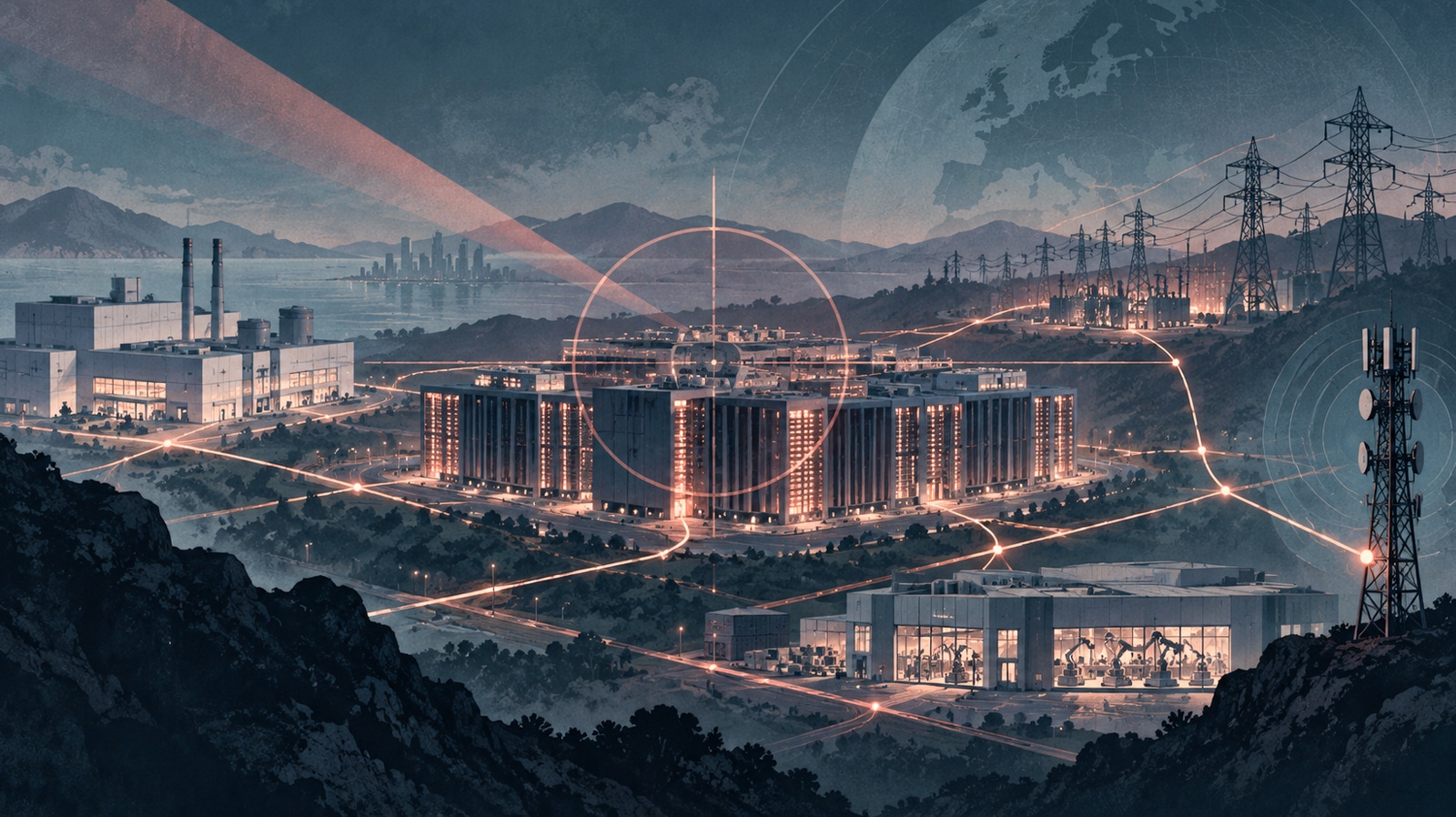
In the age of autonomous warfare, the definition of strategic infrastructure expands dramatically. Tomorrow’s decisive assets will include hyperscale data centers, advanced semiconductor fabrication plants, high-performance computing facilities, critical communications nodes, specialized manufacturing capabilities, cloud infrastructure, and the complex supply chains that connect them. Nations that can not only design autonomous systems but also produce, update, repair, and replace them at scale will enjoy enduring military advantages.
Military planners will therefore have to rethink deterrence and resilience. Just as modern armed forces disperse air bases and maintain redundant command-and-control networks, future defense planning will increasingly require resilient AI infrastructure, secure energy supplies, distributed manufacturing capacity, communications networks, and computing resources. Critical facilities cannot remain concentrated in a handful of locations vulnerable to missile strikes, cyberattacks, or sabotage. Geographic dispersion, redundancy, and rapid recovery may become as strategically important as production capacity itself.
The vulnerability of such infrastructure is no longer theoretical. In a recent example from the Middle East, an Iranian strike on an Amazon-operated data center in the United Arab Emirates highlighted the growing strategic importance—and vulnerability—of commercial cloud infrastructure. Data centers that once appeared primarily as economic assets may increasingly be viewed as legitimate military targets because they host computing resources, communications capabilities, and digital services on which governments and defense organizations depend.
Offensive planning will likewise evolve. Intelligence agencies will devote increasing effort to identifying critical vulnerabilities within an adversary’s AI ecosystem—from semiconductor production and data centers to communications networks and software development hubs. Disrupting these components could severely degrade the enemy’s ability to generate, sustain, and improve autonomous military capabilities. The ability both to strike these targets and to defend one’s own AI assets may become a defining characteristic of twenty-first-century warfare.
The decisive contests of future wars may therefore occur not only between opposing armies but also between competing defense-industrial AI ecosystems. Victory will belong not simply to the nation that fields the most sophisticated autonomous weapons, but to the one capable of continuously generating technological advantage—innovating faster, manufacturing at scale, rapidly incorporating battlefield lessons into software and hardware, protecting its critical infrastructure, and replacing losses more quickly than its adversaries.
In the age of military AI, the true center of gravity may no longer lie on the battlefield alone. It may be the industrial and digital ecosystem that keeps autonomous warfare alive.
JISS Policy Papers are published through the generosity of the Greg Rosshandler Family.