
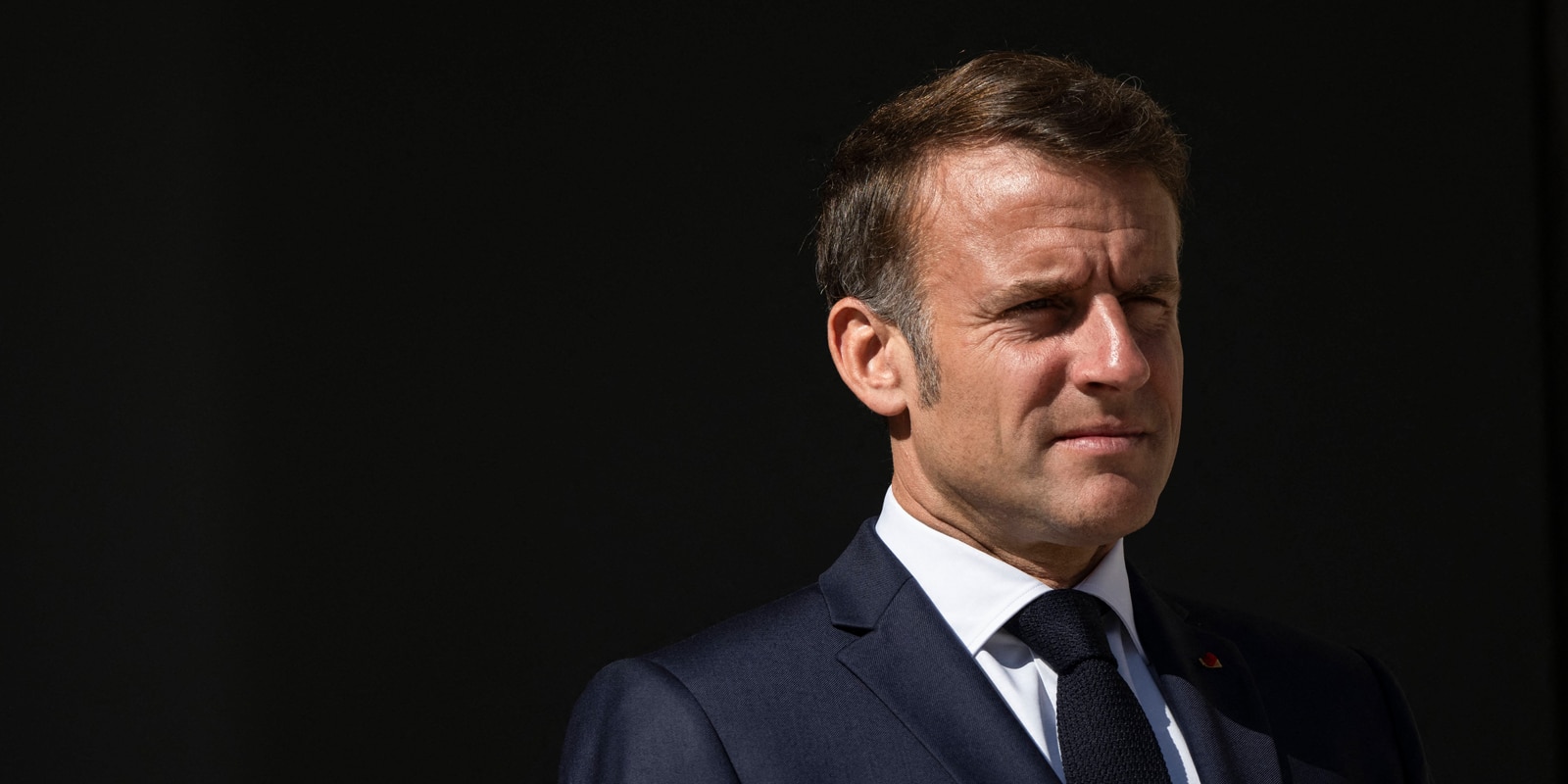
The UN conference for a ‘Peaceful Settlement of the Question of Palestine,’ to be held in New York between June 17th and 20th under the joint chairmanship of France and of Saudi Arabia, falls on a date that will not go unnoticed by French President Emmanuel Macron. On June 18, 1940, Charles de Gaulle delivered a defiant speech on the BBC calling upon the French to reject the armistice with Germany, and to continue the war together with Britain. “This war shall not be settled by the Battle of France,” he said. “This war is a world war.” To this day, the French commemorate June 18th as the day when their honor was saved. This year’s commemoration, however, will be marked by a French attempt to impose an armistice on a fellow democracy in partnership with an Islamic theocracy.
The war being fought by Israel belongs to a wider conflict. Iran’s web of proxies, its arsenal of missiles, and its nuclear program, are directed both at Israel and at the entire West. The Mullahs’ declared aim of eradicating Israel has suffered a serious blow thanks to Israel’s achievements against Iran’s proxies in Gaza, Lebanon, Syria, and Yemen. Yet the war will not be won until Iran’s nuclear program is incapacitated and until the Palestinians’ dream of replacing Israel “from the River to the Sea” is shattered. The two are related.
Since its creation in 1964 (three years before Israel took control of the West Bank and the Gaza Strip in the Six Day War), the Palestine Liberation Organization (PLO) relied on outside support such as the Soviet Union and the Islamic Republic of Iran. Facing obliteration and bankruptcy due to his support for Saddam Hussein during the Gulf War, PLO chairman Yasser Arafat signed the Oslo agreements in 1993 for the sake of political survival. By his own account, however, Arafat signed an agreement with Israel as a temporary ploy and in accordance with the PLO’s 1974 “phased plan” (i.e., to establish a PLO foothold in the West Bank and Gaza as a phase for the ‘liberation of Palestine.’) Once his bluff was called during the Camp David summit in July 2000, Arafat reverted to war, sending suicide bombers to target Israelis and buying weapons from Iran via the Karine A ship, a scheme exposed by Israel in January 2002.
Arafat’s second Intifada was eventually defeated by Israel, but Iran kept sending money and weapons to Hamas after it took over the Gaza Strip in 2007. Iran’s nuclear program gave hope, and continues to give hope, to the ‘Palestinian cause.’ Meanwhile, the Abraham Accords in 2020, and the prospects of normalization between Israel and Saudi Arabia in 2023, threatened to undermine Iran’s strategy and Hamas’s aim. Hence the war launched on October 7.
While Israel has mostly gained the upper hand in this war, it has not yet achieved victory. Such victory is prerequisite to a political modus vivendi between Israel and the Palestinians. By pushing for Palestinian statehood before Israel’s victory, Macron is providing a tactical gain to the Iranian axis before its defeat.
Macron is also the PLO’s dupe, because the absence of a Palestinian state never was the root cause of the conflict, and therefore establishing such a state (in addition to the existing 21 Arab states) will not solve it. The conflict did not start when Israel took control, in a war of self-defense, of the West Bank and of the Gaza Strip in 1967. And it did not end when Israel accepted the establishment of a Palestinian state in those territories in 2000 and in 2008. How can Macron be so wrong? There are two possible explanations.
One is Macron’s eagerness to appease France’s Muslim public opinion. Le Figaro recently leaked a 73-page report on the Muslim Brotherhood in France, which was submitted to French Interior Minister Bruno Retailleau. The report shows how the Muslim Brotherhood has penetrated French society and public discourse. The report claims that French Muslims are attracted to the Muslim brotherhood because of “frustrations” toward the French government, and that those frustrations may be assuaged by France’s recognition of a Palestinian state.
Another explanation for Macron’s policy is that he is taking a page out of the Gaullist book. De Gaulle resented “les Anglo-Saxons” for ignoring France. Hence his confrontational policy. He vetoed Britain’s membership in the European market, pulled France out of NATO’s central command, and fiercely criticized the U.S. over the Vietnam war. Today, Macron is challenging America over President Trump’s plans for Gaza, and he is trying to woo the “Global South.” Except that Macron is no de Gaulle. Far from saving France’s honor on June 18, he will discredit French diplomacy, alienate Israel, and create a wedge with the United States.
This article originally appeared on the European Conservative.
JISS Policy Papers are published through the generosity of the Greg Rosshandler Family.
Source: https://jiss.org.il/en/navon-macrons-middle-east-faux-pas/