
Introduction
Global trade depends on a fragile network of shipping lanes, ports, canals, and straits that is often taken for granted despite its considerable vulnerability. A sustained threat to just one narrow sea passage can disrupt commercial voyages and drive up insurance costs. It can also lengthen supply chains, affect energy and food prices, and even put economic pressure on countries not directly involved in the conflict. Disruptions to freedom of navigation in the Strait of Hormuz and Bab el-Mandeb have demonstrated these effects clearly.[1] During the War of Redemption, Houthi attacks launched from Yemen against vessels linked to Israel turned freedom of navigation from a legal and economic concern into a major security issue for Israel.[2]
Bab el-Mandeb is the southern gateway to the Red Sea and the Suez Canal. Its importance lies not only in the volume of trade passing through it but also in the absence of a short, inexpensive alternative between Asia and Europe. Rerouting ships around the Cape of Good Hope lengthens voyages and increases operating costs. It also makes the global
merchant fleet less efficient and forces many ports to adjust to new patterns of cargo traffic. The consequences for Israel go beyond economic losses. They directly affect the Port of Eilat and Israel’s southern gateway to the Indian Ocean, as well as its position along regional trade routes and its ability to maintain economic continuity during wartime.
One of the main lessons from the crisis is that securing maritime trade routes is more than a technical matter: it is essential to a functioning economy. Modern supply chains keep inventories low, rely on accurate demand forecasts, and plan around predictable arrival times. When voyages on a major route take two weeks longer, and sometimes more, the damage extends beyond freight costs. Manufacturers must increase inventories, retailers struggle to plan sales, ports must adapt to changes, and factories may have to halt production lines for lack of an essential component. A local threat thus becomes a global problem. The expansion of international trade, roughly 80 percent of which moves by sea, is turning the world into a “global village” and making it increasingly dependent on open, secure trade routes.[3]
This article examines how the blockage of critical straits exposes the vulnerability of global maritime trade. It begins with the role of shipping routes, ports, and canals in the global economy, then examines straits as weak points in globalization. It then turns to the Red Sea crisis and the Houthi threat to Bab el-Mandeb, tracing the effects on global trade, energy markets, marine insurance, and the environment. Finally, it considers the Israeli dimension through the damage caused to the Port of Eilat and the broader regional implications. The article aims to show how a seemingly limited maritime threat becomes an international challenge and to propose modes of action combining security, diplomacy, economics, and infrastructure.
Straits as Weak Points in Global Trade
World trade and economic globalization grew on the assumption that ships could sail the seas freely. Manufacturers and the energy, food, and technology industries were built through the international distribution of labor and the movement of large quantities of cargo at relatively low cost. Yet this efficiency depends on just a few indispensable passages. The straits of Hormuz, Bab el-Mandeb, Malacca, and Gibraltar, together with the Suez and Panama canals, confer extraordinary power on anyone who can disrupt them: the power to influence prices, the availability of goods, and the continuity of supply chains.
A critical strait has an economic impact out of all proportion to its physical width. Bab el-Mandeb is a clear example: only about 29 kilometers wide at its narrowest point, it links the Indian Ocean, Gulf of Aden, Red Sea, Suez Canal, and Mediterranean. A threat to this passage therefore threatens the operation of the entire Asia–Europe route.
Concentration in the shipping industry compounds this vulnerability. A small number of companies handle a substantial share of the world’s container and oil-tanker traffic. If just one reroutes ships around Africa, capacity, rates, and vessel availability change even on routes that do not pass through the Red Sea. Ports experience a parallel chain reaction: ships arrive off schedule, empty containers are not where they are needed, and crews and tugboats face fluctuating workloads. Blocking any one of the critical straits listed above therefore disrupts global trade, not just the route through a particular passage.
Blocking a strait also exposes the gap between efficiency and resilience. For decades, companies cut transport costs by reducing inventories, consolidating suppliers, and choosing the cheapest route. Successive crises—the COVID-19 pandemic, the Ever Given’s blockage of the Suez Canal, and Houthi attacks—have shown that maximizing efficiency in normal times can leave businesses fragile in an emergency. Resilience requires a level of redundancy, alternative suppliers and ports, larger inventory reserves, flexible shipping contracts, and up-to-date information on risks.
Charging for passage through a natural strait creates another problem. Iran’s demand at the Strait of Hormuz is one example; such charges can take the form of a “service fee” or a direct tax. Free passage through natural straits helps drive the global economy. Demands for payment violate the principles of international law, including the right of free passage under the UN Convention on the Law of the Sea. They could also set a dangerous precedent, encouraging other countries to levy similar charges at other critical straits and turning free trade routes into tools of economic and political extortion. The map below shows the straits and canals critical to global maritime trade, along with the main route between Asia and Europe. It also shows the alternative around the Cape of Good Hope, which adds about 6,500 kilometers to the voyage.[4]

The Houthi Threat and the Port of Eilat
Beginning in November 2023, the Houthis turned the Red Sea into a combat zone. They portrayed their actions as solidarity with Gaza’s population and a means of pressuring Israel, but in practice created a broader threat to international trade. Vessels suspected of links to Israel, the United States, Britain, and other countries were attacked with drones, anti-ship missiles, boats packed with explosives and faced attempted seizures. Even when a particular ship was not hit, the risk alone prompted shipping companies, insurers, and cargo owners to reassess the economic feasibility of passage through the region.[5]
The crisis has shown that a strait need not be physically closed to become commercially unviable. By posing a credible threat, the Houthis were able to raise risk premiums and create economic uncertainty. Insurance considerations, legal liabilities, fuel costs, and difficulties in meeting timetables leave risk managers preferring to stay away.
The Houthis are well placed geographically to deny access. Their control of large parts of western Yemen and areas near the Red Sea coast allows them to combine sensors, commercial intelligence, civilian identification systems, and relatively inexpensive weapons. A single missile or drone does not have to sink a ship to have an effect. Limited damage, the release of attack footage, and even just a missile or drone entering an area can be enough to raise perceived risk. The effects can be far-reaching.
By May 2024, the International Maritime Organization had recorded dozens of incidents, including crew deaths, the sinking of the Rubymar, and strikes on vessels far from the straits. The expanding range of attacks showed that the threat was not confined to a single passage. The danger stretched from the Gulf of Aden to the northern Red Sea, and at times into the Indian Ocean. Shipping companies have struggled to establish a safe corridor across this area and must assess the risk for each voyage. UN Security Council Resolution 2722 condemned Houthi attacks and emphasized navigation rights and the duty to protect commercial vessels. Recognizing the right to defend ships, however, does not necessarily make that defense effective. Naval forces can intercept an immediate threat but will struggle to protect thousands of kilometers of sea at all times.
Figures from international organizations show extensive disruption to traffic through the Suez Canal and Bab el-Mandeb. According to the UN Conference on Trade and Development (UNCTAD), Suez Canal transits fell by double-digit percentages in early 2024, with a substantial decline in container traffic. The World Bank estimated that traffic volume through Suez and Bab el-Mandeb had halved by March 2024, while traffic around the Cape of Good Hope rose sharply.[6] Higher freight costs are only part of the economic damage. Deliveries take longer, moving the same volume of cargo requires more ships, emissions rise, inventories come under pressure, and industrial supply chains become less reliable.
UNCTAD figures show the scale of the crisis: in 2023, about 22 percent of global seaborne container trade passed through the Suez Canal, but data shows that traffic through the canal has been dealt a severe blow. In the first half of 2025, cargo volume and tonnage passing through it were still about 70 percent below their 2023 levels. That is a substantial decline. Containers carry machinery, electronic components, pharmaceuticals, textiles, and automotive parts, so the disruption also hurts industries not usually associated with maritime security.
Rerouting around the Cape of Good Hope increases sailing distances by double-digit percentages, depending on the route and cargo. The World Bank estimates increases of up to 53 percent for cargo and tanker voyages. The result is that ships consume more fuel, suffer more wear, require larger stocks of spare parts, and availability is impaired. Longer round trips reduce effective global capacity even if the number of vessels remains unchanged. The damage is uneven. Large shipping companies can reroute vessels, pass some costs on to customers, and sometimes even benefit from higher freight rates. Small exporters and importers in developing countries struggle to absorb the costs. Egypt loses Suez Canal revenue, Red Sea ports lose business, and countries such as Djibouti, Saudi Arabia, and Israel are forced to reassess their access to the Red Sea.
Marine insurance also puts a price on the threat. Shipowners pay additional premiums when an area is designated a war zone and seek guarantees from charterers and cargo owners. These costs quickly feed into freight rates. In some cases, uncertainty about a ship’s links to Israel or a Western country itself raises the risk, as the Houthis have broadened and changed their definition of targets over time. The crisis has also harmed the environment as ships sailing around Africa burn more fuel and emit more greenhouse gases. Attacks on tankers and cargo ships risk spilling oil, fuel, and fertilizer into the Red Sea ecosystem. The sinking of the Rubymar and the fire aboard the tanker Sounion showed how a security incident can become an environmental disaster affecting fishing, tourism, desalination plants, and the coasts of many countries.
Energy markets face similar consequences. The U.S. Energy Information Administration reported that oil and petroleum-product flows through Bab el-Mandeb fell from 8.7 million barrels a day in 2023 to about 4 million a day in the first eight months of 2024. Flows around the Cape of Good Hope rose over the same period. Even without a physical global oil shortage, a longer route raises transport costs, requires more tankers, and distances supplies farther from their destination markets.
Disruption to Red Sea routes has left the Port of Eilat in a prolonged economic and operational crisis. For years, it handled little traffic compared with Israel’s Mediterranean ports, but its national importance exceeded its commercial weight. It provided a southern gateway for imports from the Far East, an entry point for vehicles and industrial goods, and a source of employment and economic stability for the town of Eilat.
Vehicle traffic, which accounts for most of the port’s business, fell sharply in 2024–2025, with no cars arriving during some periods. A partial recovery in 2026 brought thousands of cars in certain months, but activity remains very low sometimes only one ship a month. The port is unprofitable and handles a much smaller share of vehicle imports than before the crisis: about 15 percent today compared to 44 percent previously. Most vehicle imports from the East have shifted to Haifa and Ashdod, adding to congestion and lengthening unloading times. Asia supplies about 33 percent of Israel’s goods imports, excluding diamonds, and the natural route runs through Bab el-Mandeb. The detour lengthens voyages and raises costs. Estimates pointed to a three- to fourfold increase in container shipping prices from China, delays of two to three weeks, and higher inventory costs.
The effective closure of the port is a major cognitive achievement for the Houthis. By disrupting an Israeli port, a nonstate organization has blurred the lines between military conflict, economic conflict, and the battle for public opinion. The damage to the Eilat port also limits Israel’s ability to diversify the origin ports of its maritime trade. Most of that trade passes through the Mediterranean ports of Haifa and Ashdod. This concentration is economically efficient in peacetime but leaves the country dependent on a single area in times of war. Eilat provided independent access to Asia and the Indian Ocean without passing through the Suez Canal. The loss of business there leaves Israel less room to maneuver precisely when its Mediterranean ports could face threats from the northern theater.
The decision goes beyond whether to subsidize a temporary loss. Israel must decide what role the Port of Eilat should play in its national security doctrine. Should Eilat compete with Israel’s Mediterranean ports under all conditions, or serve simply to diversify supply routes, support the city, and provide infrastructure for future connections to overland and regional corridors? In our view, Eilat is critical to Israel’s security. Its effective closure is therefore unacceptable, and the government must provide financial support in addition to taking the necessary diplomatic and military measures to ensure the port’s continued operations.
The Battle Over Shipping Routes
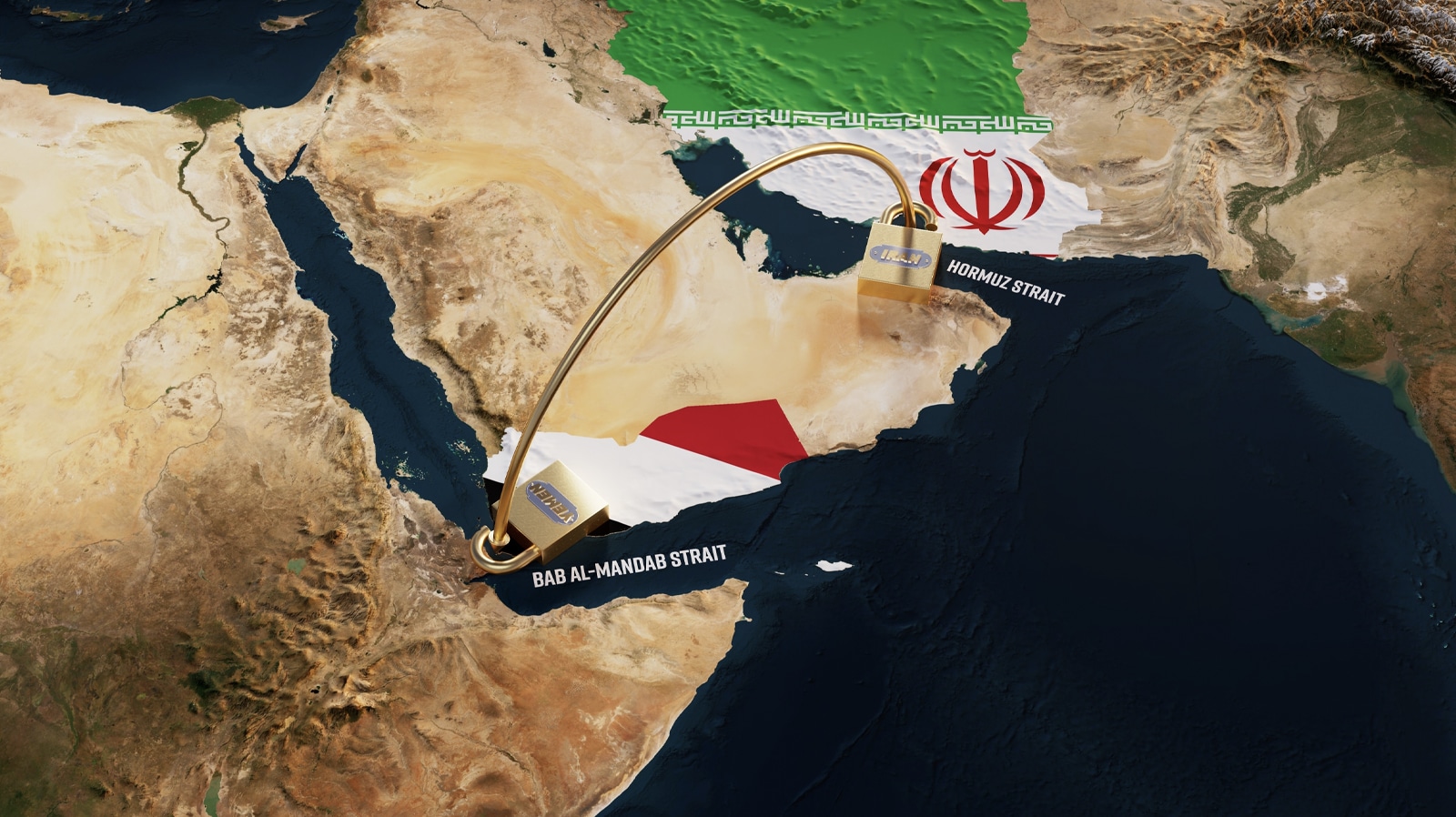
In the Middle East, straits are instruments of regional competition, not just trade routes. Iran and its partners regard threats to sea routes as one way to offset their relative weakness against American and Israeli power. As part of a broader network of proxies, the Houthis can pressure Israel, Saudi Arabia, Egypt, Europe, and the United States simultaneously. Their use of Bab el-Mandeb complements Iran’s threat to the Strait of Hormuz, allowing pressure on the flow of energy and goods from two directions.
The crisis also brings together the interests of countries that are not political partners. Egypt wants normal shipping traffic restored through the Suez Canal; Saudi Arabia wants to protect its energy exports and Red Sea ports. The United Arab Emirates, Qatar, Oman, Iraq, and Kuwait want stable trade routes. Europe depends on a short route to Asia, while Israel needs to address the security and economic threats to its south. Although sometimes presented as an Israeli–Houthi or Saudi–Houthi conflict, this is in fact a struggle over the regional and global maritime order.
Egypt stands out among the countries harmed by the crisis. The Suez Canal is a major source of foreign currency for Cairo; reports in 2024 estimated that it had seen a decline of more than 60 percent $7 billion in revenues. For Egypt, the Houthi threat is not a remote problem, it is a direct blow to macroeconomic stability. Even so, Cairo is cautious about openly joining the fighting. It wants to protect the canal without being seen to be fighting alongside Israel or Saudi Arabia in a sensitive regional war. Egyptians still vividly remember their country’s role alongside Saudi Arabia in the war against the Houthis in Yemen, and that memory serves to discourage a return to war.
Saudi Arabia also faces a dilemma. It has a long Red Sea coastline, important ports, and ambitious development plans. Although it wants to reduce the direct threat to its territory, it is in direct confrontation with the Houthis. In the wake of the disruptions in the Strait of Hormuz, the kingdom relied on its East–West Pipeline and Red Sea ports as an alternative route for oil exports. That dependence, however, has become a weakness. The Iranian-backed Houthis have seized critical stretches of coast and ports on the Red Sea, declared a naval blockade of Saudi shipping, and stepped up attacks on tankers, energy facilities, and ports around the Bab el-Mandeb. A military response could draw the kingdom back into the costly, full-scale war in Yemen it had tried to escape. Holding back, however, allows the Houthis to consolidate their control and further disrupt Saudi oil exports, which have already fallen dramatically. The conflict has led to an increase in insurance and energy prices, hitting the Saudi economy and global markets. Riyadh finds itself between the hammer and the anvil with substantial risks whatever course it chooses. The damage also weakens Crown Prince Mohammed bin Salman, the kingdom’s de facto ruler, whose domestic standing declines as Saudi interests suffer and the country’s military weakness becomes more apparent.
Proposed Courses of Action
A broad, lasting naval coalition is needed; temporary operations are not sufficient. The U.S.-led Operation Prosperity Guardian and the EU’s Operation Aspides demonstrated an international willingness to defend freedom of navigation in the Red Sea. Their effectiveness against the Houthis, however, remained limited.[7] The coalition must move beyond a reactive presence. It should secure routes, provide intelligence support, share warnings, actively defend against drones and missiles, and keep naval forces, shipping companies, and insurers in continuous contact.[8]
The naval coalition should adopt a layered defense. At long range, it should detect preparations for launches and build the necessary intelligence picture. At intermediate range, aircraft, ships, and detection systems should work together to defend areas under threat. At close range, it should protect them threatened vessels and improve their ability to evade attacks and respond. Europe’s Operation Aspides offers a defensive model based on escort of shipping, situational awareness, and protection against threats across multiple domains. The operation enjoyed broad legitimacy, but the forces deployed were limited relative to the vast area involved. Moreover, a fundamentally defensive approach will always leave ships passing through the strait exposed to some attacks and damage. Taking the offensive, as Israel has done against the Houthis, can inflict lasting damage that stops the threat, even if only temporarily.
Action must target the entire Houthi chain of capabilities, not only the immediate threat. Targets must therefore include intelligence infrastructure, weapons stores, command and control systems, local manufacturing and assembly facilities, explosive boats, and coastal radar stations. Strikes must comply with international law and take collateral damage into account. This will require accurate intelligence and operational continuity, as well as a clear distinction between protecting freedom of navigation and being drawn into a land war of attrition in Yemen.
Attacks must be intercepted, and the means of launching them denied. Relying on interception alone means accepting an unfavorable cost ratio and merely postponing the next attack. Yet deep strikes without supporting intelligence and a political objective can deteriorate into a cycle of retaliation that has no clear purpose. Targets should therefore be chosen based on their direct contribution to the enemy’s ability to launch maritime attacks. These include radars, storage facilities, communications systems, launch sites, unmanned vessels, and infrastructure used to transfer components. Success should be measured by the return of shipping, rather than the number of targets struck.
Regional and diplomatic pressure is also required. Egypt, Saudi Arabia, the United Arab Emirates, Jordan, and Israel share a practical interest in restoring security to the Red Sea. The parties should construct a mechanism for maritime intelligence sharing, dialogue with countries in the Horn of Africa, and support for Yemen’s legitimate government and local opponents of the Houthis along the Red Sea coast. Israel’s developing relationship with Somaliland is especially important given its location and potential as a forward base for operations in the region. The prime minister’s meeting in Abu Dhabi on September 27, 2026, may have laid the groundwork.
Enforcement is also necessary to cut off the flow of components and money to the Houthis. Their capabilities depend on Iranian-made systems, dual-use components bought on the civilian market, engineering knowledge, and local assembly. Cargo inspections should be stepped up and shell companies monitored more closely. Targeted sanctions should be strengthened, and customs authorities and banks should share information. Although creating enforcement mechanisms takes longer than a military strike, they may slow the Houthis’ buildup over time and reduce their ability to restore their capabilities after attacks. The Houthis should also be blockaded, as the Americans have blockaded the Iranians in the Strait of Hormuz. A blockade, however, requires international cooperation, which does not appear realistic at present.
Saudi Arabia is current fighting alone—and rightly so. Rather than pursue membership in the Abraham Accords with Israel and participation in the India–Middle East–Europe Economic Corridor (IMEC), it pressed the United States to stop fighting Iran and formed an alliance with Turkey and Pakistan, the “Mecca Alliance.” The Saudi approach to Iran and the Mecca Alliance have both proved ineffective so far. Iran is inflicting serious harm on the Saudis through its Houthi proxies in Yemen and the Shiite militias in Iraq. Saudi Arabia’s push to dislodge the UAE from its foothold in Yemen, and support for local tribes that fought the Houthis, are now backfiring as well. The Houthis are advancing on the ground, seizing territory previously controlled by Saudi-backed tribes all the way to the shores of Bab el-Mandeb itself.
Israel, for its part, should develop its own strategy for maintaining trade flows. This includes developing alternative land and air routes and reaching agreements with regional ports. One example would be cooperation with Saudi Arabia to ship oil from Red Sea ports for onward transport through the Eilat–Ashkelon oil pipeline. The diagram below illustrates this route:

The India–Middle East–Europe Economic Corridor (IMEC) offers another alternative. The project aims to connect India, the Gulf states, and Europe through a multimodal transport network combining sea routes, railways, roads, and digital and energy infrastructure. The UAE would serve as the principal gateway to the Gulf, with the route then continuing overland through Saudi Arabia, Jordan, and Israel to the Port of Haifa, followed by a short sea crossing to European ports in Greece, Italy, or France.
The government must also make a clear decision about the Port of Eilat’s future. If it regards the port as an essential asset, short-term accounting alone should not govern its management. Compensation, infrastructure investment, inclusion in a national security plan, and preparations for the reopening of the southern route should all be considered. Trade is part and parcel of national security and requires a policy that reflects that. Policy should map dependence on straits, assess critical inventories, encourage supplier diversification, enable real-time monitoring of shipping risks, and maintain coordination among the ministries of Defense, Transport, and Economy, the Shipping and Ports’ Administration, insurers, and the business sector.
The government also needs to assist the private sector in dealing with maritime risks. It can provide warnings and intelligence, arrange emergency insurance, offer guarantees for essential voyages, and coordinate cargo priorities. This does not mean that the state should guarantee all commercial costs, it means preventing situations in which decisions made by individual companies can cause a systems failure at the national level. Keeping trade moving requires scenario planning, service targets, and clear measures of recovery time. Israel depends on maritime trade and therefore on having a national shipping company—ZIM. It must retain the ability to use that company for national needs and avoid selling it for short-term economic gain.
The Houthi threat also requires a cognitive response. The Houthis seek to portray every ship diversion and port shutdown as proof that they can impose a regional order serving their interests. An effective public response should emphasize that the attacks have failed to achieve their goals and expose the harm done to Arab countries and the Yemeni population. Israel should also do as much as it can to build the confidence of shipping companies and insurers confidence in the Port of Eilat and the ability to reach it.
Conclusion
The Bab el-Mandeb crisis shows that freedom of navigation is now contested. For years, the global economy took sea routes for granted, assuming they would be readily available and inexpensive. The crisis exposed that assumption as largely illusory. Those who can undermine the confidence of shipping companies and insurers need neither control of the seas nor even military victory. They need only create uncertainty and force the market to reassess risks to make routine commercial decisions matters of long-term consequence.
For Israel and other countries dependent on maritime trade, economic resilience requires more than additional ports, ships, or inventories. It also requires quick decisions amid sustained disruption. Reopening a blocked route is only part of the task. The important question is how to prevent an enemy, even a relatively weak enemy, from turning a partial blockage into lasting leverage. This requires a doctrine that integrates maritime defense, intelligence, insurance policy, regional diplomacy, infrastructure planning, and cognitive management. The Port of Eilat is more than a transport asset. It tests Israel’s ability to retain room to act when a route closes, a market is deterred, or an international coalition struggles to act effectively.
The struggle over critical straits thus extends beyond the passage of goods. It is also a struggle to sustain the confidence of companies, consumers, states, and investors that the seas will remain open during conflict. If that confidence erodes, economic costs arise even before physical damage occurs. Success must therefore be measured not only by attacks thwarted or ships returning to their routes, but also by the ability to convince market participants that the risk can be managed. Maritime security is thus inseparable from national security, foreign policy, and economic management in times of war.
[1] UNCTAD, Navigating Troubled Waters: Impact to Global Trade of Disruption of Shipping Routes in the Red Sea, Black Sea and Panama Canal, Rapid Assessment, February 2024.
[2] U.S. Energy Information Administration, “Fewer Tankers Transit the Red Sea in 2024”, October 11, 2024.
[3] Times of Israel, “Hurt by Houthi Blockade, Debt-Ridden Eilat Port Seeks Aid to Help It Stay Afloat”, July 17, 2025.
[4] The map was prepared by the authors.
[5] U.S. Department of Defense, “U.S., Partners Committed to Defensive Operations in Red Sea,” January 4, 2024.
[6] World Bank, The Deepening Red Sea Shipping Crisis: Impacts and Outlook, February 2025.
[7] European External Action Service, “EUNAVFOR Operation ASPIDES”, 14.9 2026.
[8] Lloyd J. Austin III, “Statement from Secretary of Defense Lloyd J. Austin III on Ensuring Freedom of Navigation in the Red Sea”, U.S. Department of Defense, 18.12 2023.
Source: https://jiss.org.il/en/siboni-winner-maritime-chokepoints-and-the-vulnerability-of-global-trade/