

In the digital battlegrounds of the Israel-Hamas conflict, a new form of warfare is emerging, where algorithms are the new siege engines and global public opinion is the territory to be conquered.
The architecture of modern conflict has undergone a fundamental transformation. The post-modern hybrid battlefield is no longer defined solely by trenches and airstrikes, but by a digital evolution from overt Information Warfare and Influence Operations (IWIO) to a more insidious and structural form of engagement: Algorithmic Siege Warfare. This new paradigm powerfully illustrates the conflict between the non-state actor Hamas and the state of Israel and represents a decisive shift in how geopolitical outcomes are shaped not by physical force alone, but by weaponizing the very infrastructure of the global digital public square.[1]
For decades, Information Warfare, the battle for the human mind, has been a tool in the arsenal of states and non-state actors alike. As scholars like Molander et al. noted, this form of warfare uses emotions and beliefs as weapons, achieving a far more influential status in 21st-century power games than traditional propaganda.[2] It operates on the principle of platformized statecraft, a process where digital infrastructures, contested by transnational networks, become the primary arena for geopolitical struggle. The core components are simple yet powerful: an Agent (the creator of dis/misinformation), a Target (the audience to be influenced), and a Platform (the digital space where the engagement occurs). In the case of Hamas versus Israel, the agents are both the non-state militant group and the state actor, and the target is the international community, whose perception is the ultimate prize.
However, the tactics have evolved beyond mere propaganda. The conflict has provided a stark case study in how non-state actors are refining IWIO into a form of algorithmic siege. Recognizing that social media platforms like X (formerly Twitter) operate on engagement-driven algorithms, Hamas’s cyber troops pioneered a simple yet devastatingly effective technique. Under the directive “let’s break the algorithm – reply with a dot,” they carried out information operations to artificially inflate engagement metrics on pro-Hamas content.
A single dot as a reply, while semantically empty, signals to the platform’s algorithm that the post is popular and relevant, thereby pushing it to a wider, unsuspecting international audience. This technique reflects what can be described as algorithmic siege warfare – a digital siege designed to isolate the target, in this case, Israel’s narrative, from the global information flow, while amplifying the besieging agent’s message to drown out all others.
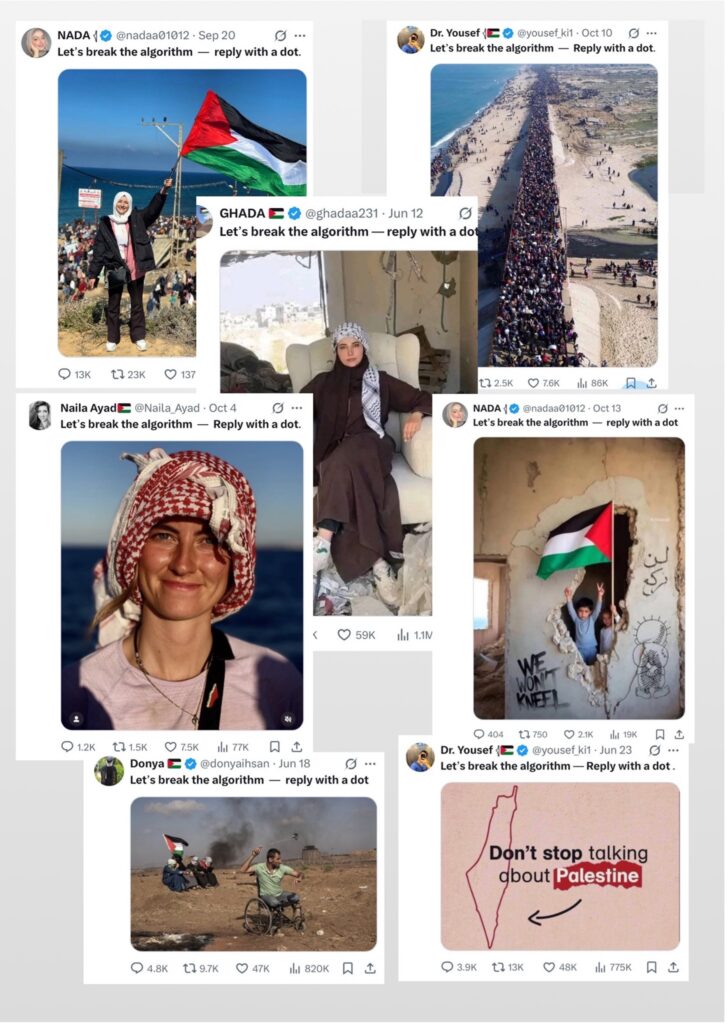
Figure 1 presents a composite of high-engagement posts circulating across the X platform in which Hamas-aligned cyber troop networks instruct users to ‘break the algorithm—reply with a dot.’ The figure models these influence operations by deconstructing how coordinated networks weaponize platform algorithms through ‘dot-reply’ campaigns, transforming information operations from persuasion to system manipulation. The analysis reveals a two-pronged attack on the platform’s information ecosystem: (1) Computational Manipulation through the systematic deployment of semantically null, low-effort, high-volume replies to exploit platform architecture and trigger algorithmic amplification loops—each dot-reply functioning as an algorithmic signal that forces preferential visibility of pathos-rich content; and (2) Affective Engineering through strategically paired imagery curated to depict civilian casualties, vulnerable populations, national symbols, and destroyed infrastructure. This visual content is engineered for high-arousal emotional stimuli that platform algorithms systematically privilege, aligning with the platform’s inherent bias toward content eliciting suffering, outrage, sympathy, defiance, and strong national identity. This synergy of computational manipulation and affective persuasion demonstrates a shift from traditional information warfare to platform-optimized narrative siege.
The geopolitical success of this algorithmic tactic, while difficult to attribute solely to this operation, is notable. It contributed to a media environment that culminated in a significant political outcome: the subsequent recognition of Palestinian statehood by several EU member states, as well as Canada, Australia and the United Kingdom. This demonstrates a direct line from a coordinated, platform-specific manipulation tactic to a tangible shift in international statecraft, proving that non-state actors can now project power and achieve strategic objectives without traditional diplomatic channels.
This new warfare aligns with predictions made by scholars like Mölder, who foresaw a future where wars would be fought as “wars of narratives,” supported by limited military operations to strengthen images of fear and hatred.[3] Hamas’s strategy exemplifies this, leveraging powerful emotions and portraying the conflict as an interstate struggle to galvanize global support. From a Hobbesian perspective,[4][5] they operate as an actor that does not recognize the right of its enemy to exist, and in the digital realm, they have found a means to force a form of surrender not on the physical battlefield, but in the court of world opinion. As Robert Kagan predicted in The Return of History and the End of Dreams, radical Islamist movements continue to present a potent challenge to the liberal international order,[6] and they are now doing so with digitally native tactics.
This phenomenon is not isolated. The double-edged sword of IWIO is equally potent for state actors. For instance, China actively employs IWIO and what analysts term “cognitive warfare” to weaken perceptions of adversaries, particularly targeting Taiwan by weaponizing cultural and identity politics.[7] Russia, viewing itself as a strategic disruptor,[8],has masterfully used troll farms and bots as part of a strategy of disruption and denial, as seen in its operations in Ukraine and the United States.[9],[10] While research has predominantly focused on these state-vs-state (S-v-S) conflicts, the activities of non-state actors like the Islamic State also provided an early blueprint for the weaponization of digital platforms.[11]
The rise of algorithmic siege warfare by non-state actors signals a new and more chaotic era of geopolitical conflict. When a non-state entity can orchestrate a global information campaign from a smartphone, the traditional monopoly of state power in international relations is profoundly challenged. The rules of this new game are being written in real-time, not in treaty halls, but in the code of social media platforms and the strategic playbooks of digital cyber troops. As the dust settles on future conflicts, the victors may not be those with the most powerful military, but those who most skilfully lay siege to the algorithms that shape our perception of reality.
The victims of this new reality, Israel foremost among them, must fully recognise this shift, study the methods of this mode of warfare and develop strategies to foil their enemy’s tactics. This necessitates a dual-axis response. First, they must achieve doctrinal and tactical mastery over this new warfare domain to develop effective counter-strategies. Second, this effort requires operational collaboration with global social media platforms, urging them to align their core algorithmic governance with security imperatives to mitigate systemic vulnerability to information manipulation.
References
Mölder, H., & Sazonov, V. (2018).
“Information Warfare as the Hobbesian Concept of Modern Times — The Principles, Techniques, and Tools of Russian Information Operations in the Donbass.” The Journal of Slavic Military Studies, 31(3), 308–328. https://doi.org/10.1080/13518046.2018.1487204
Molander, R.C., Riddile, A.S. and Wilson, P.A. (1996). Strategic Information Warfare: A New Face of War. Santa Monica, CA: RAND.
Mölder, H. (2016). “The War of Narratives — Putin’s Challenge to International Security Governance in Ukraine.” Estonian Journal of Military Studies, VI (2), pp. 101–106.
Hobbes, T. (1651/1839-45). The English Works of Thomas Hobbes of Malmesbury; Now First Collected and Edited by Sir William Molesworth, Bart, https://oll-resources.s3.us-east-2.amazonaws.com/oll3/store/titles/770/Hobbes_0051-06_EBk_v6.0.pdf (accessed September 2, 2017).
Wendt, A. (1999). Social Theory in International Politics, Cambridge: Cambridge University Press, p265
Kagan, R. (2008). The Return of History and the End of Dreams, Vintage Books, New York.
Huang, Joyce. “China Using ‘Cognitive Warfare’ Against Taiwan, Observers Say.”, VOA News, July 26, 2021. https://www.voanews.com/a/east-asia-pacific_china-using-cognitive-warfare-against-taiwan-observers-say/6200837.htmlLance Y. Hunter, Craig D. Albert, Josh Rutland, Kristen Topping & Christopher Hennigan “Artificial Intelligence and Information Warfare in Major Power States: How the US, China, and Russia Are Using Artificial Intelligence in Their Information Warfare and Influence Operations,” Defense & Security Analysis 40:2, 235-269, DOI: 10.1080/14751798.2024.2321736Marks, R.J., and Bendett, S. (2020). “Russia is Systematically Copying U.S. Military AI Robotics.” Mind Matters, October 19, 2020. https://mindmatters.ai/2020/10/russia-is-systematically-copying-u-s-military-ai-robotics/ Plazova, T., Kuz, O., Konnova, N., Korotkov, D., & Galushchenko, O. (2024). “Information Warfare as an Instrument of Geopolitical Influence on Ukraine: Main Aspects and the State’s Response.”. International Journal of Religion, 5(2), 121–130. https://doi.org/10.61707/0g2yt516
[1] Mölder, H., & Sazonov, V. (2018). “Information Warfare as the Hobbesian Concept of Modern Times — The Principles, Techniques, and Tools of Russian Information Operations in the Donbass.” The Journal of Slavic Military Studies, 31(3), 308–328.https://doi.org/10.1080/13518046.2018.1487204
[2] Molander, R.C., Riddile, A.S. and Wilson, P.A. (1996). Strategic Information Warfare: A New Face of War. Santa Monica, CA: RAND.
[3] Mölder, H. (2016). “The War of Narratives — Putin’s Challenge to International Security Governance in Ukraine.” Estonian Journal of Military Studies, VI (2), pp. 101–106.
[4] Hobbes, T. (1651/1839-45). The English Works of Thomas Hobbes of Malmesbury; Now First Collected and Edited by Sir William Molesworth, Bart, https://oll-resources.s3.us-east-2.amazonaws.com/oll3/store/titles/770/Hobbes_0051-06_EBk_v6.0.pdf (accessed 02 September 2017).
[5] Wendt, A. (1999). Social Theory in International Politics, Cambridge: Cambridge University Press, p265
[6] Kagan, R. (2008). The Return of History and the End of Dreams, Vintage Books, New York.
[7] Huang, Joyce. “China Using ‘Cognitive Warfare’ Against Taiwan, Observers Say.”, VOA News, July 26, 2021. https://www.voanews.com/a/east-asia-pacific_china-using-cognitive-warfare-against-taiwan-observers-say/6200837.html
[8] Lance Y. Hunter, Craig D. Albert, Josh Rutland, Kristen Topping & Christopher Hennigan “Artificial Intelligence and Information Warfare in Major Power States: How the US, China, and Russia Are Using Artificial Intelligence in Their Information Warfare and Influence Operations,” Defense & Security Analysis 40:2, 235-269, DOI: 10.1080/14751798.2024.2321736
[9] Marks, R.J., and Bendett, S. (2020). “Russia is Systematically Copying U.S. Military AI Robotics.” Mind Matters, October 19, 2020. https://mindmatters.ai/2020/10/russia-is-systematically-copying-u-s-military-ai-robotics/
[10] Plazova, T., Kuz, O., Konnova, N., Korotkov, D., & Galushchenko, O. (2024). “Information Warfare as an Instrument of Geopolitical Influence on Ukraine: Main Aspects and the State’s Response.” International Journal of Religion, 5(2), 121–130. https://doi.org/10.61707/0g2yt516
[11] Ingram, H.J. (2015). “The Strategic Logic of Islamic State Information Operations.” Australian Journal of International Affairs, 69(6), pp.729–752. doi: https://doi.org/10.1080/10357718.2015.1059799.
JISS Policy Papers are published through the generosity of the Greg Rosshandler Family.
Source: https://jiss.org.il/en/haile-from-information-warfare-to-algorithmic-siege/