

Four days into the joint operation launched by Israel and the United States against Iran, the two militaries have sharply degraded Iran’s senior leadership, its core power structures, and military capabilities. Nevertheless, the regime still retains control of the country and the ability to carry out attacks against Israel and regional states hosting U.S. forces, as it pledged before hostilities began. This raises several questions as to the path that led to the campaign, its timing, and its implications for Iran and the wider regional order.
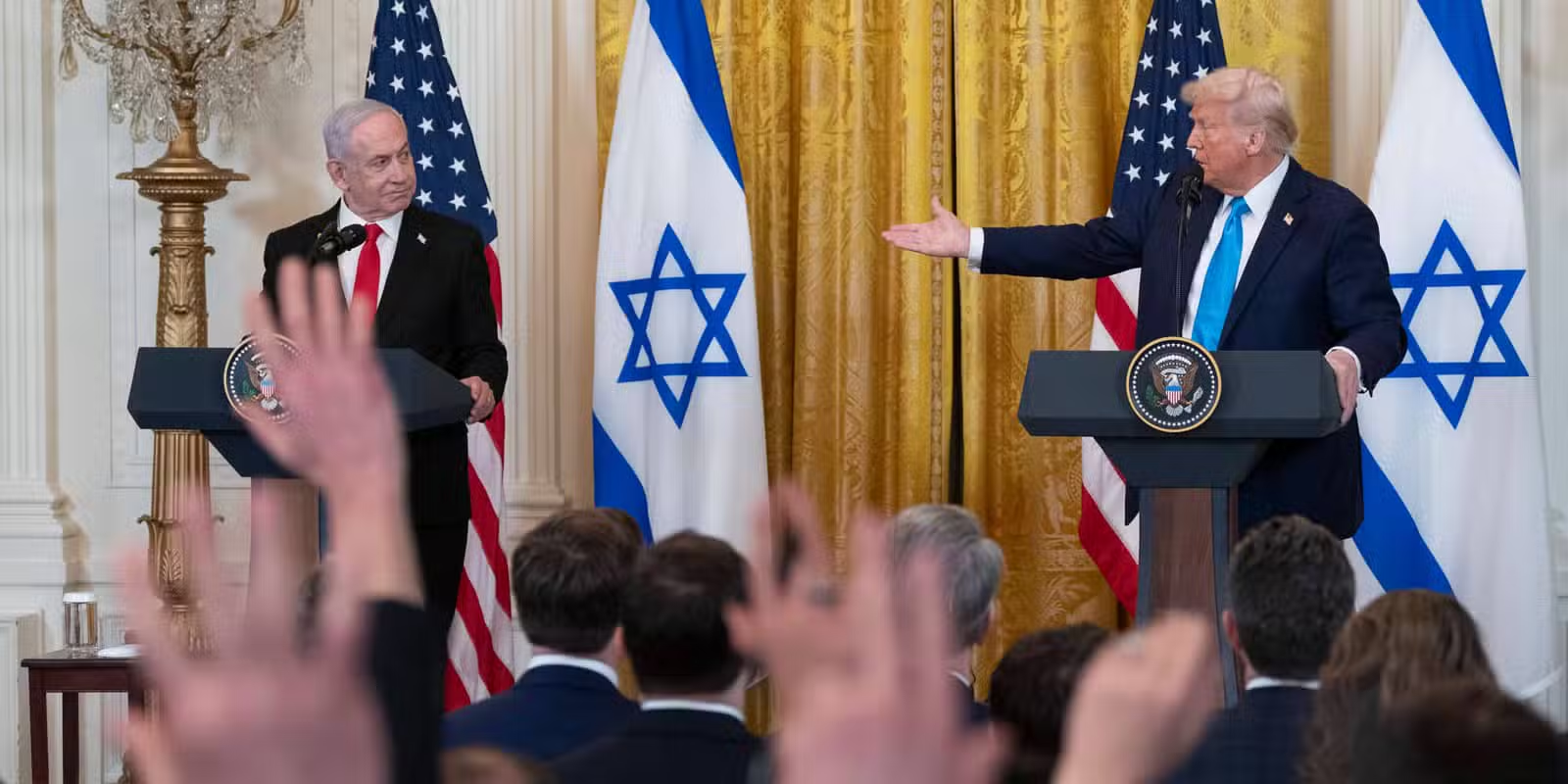
First, uncertainty persists regarding the campaign’s objectives. At the outset, U.S. President Donald Trump and Israeli Prime Minister Benjamin Netanyahu stated that the goal of the operations—respectively named “Epic Fury” and “Roaring Lion”—was to create conditions that would enable the Iranian people to take to the streets and topple the regime. Since then, however, amid domestic debate in the United States over the necessity of the operation, senior American officials have framed the campaign differently. They have emphasized the need to deny Iran key ballistic missile capabilities in order to prevent it from advancing a nuclear weapons program under a missile umbrella, and have argued that action was required at this stage because Israel was prepared to strike in any case, a move that could have prompted Iranian retaliation against U.S. forces.
Steve Witkoff, the U.S. envoy in the talks with Iran, described an Iranian negotiating position that refused to relinquish the nuclear program and even claimed the capacity to produce eleven nuclear bombs. Together with the regime’s killing of tens of thousands of Iranians, these factors were presented as evidence that military action against the Iranian regime had become unavoidable.
The specific timing reflected the collapse of the talks; President Trump’s need to fulfill his pledge that “help is on the way”; the prior concentration of substantial forces; assessments that the Iranian regime is weaker than at any point in recent years; recognition of Iran’s severe economic distress, which limits the regime’s ability to recover from its current vulnerability; Israeli pressure; the understanding that inaction and leaving the regime in place would carry heavy strategic and political costs for both Israel and the United States; and finally, an operational opportunity created by intelligence regarding a Saturday morning meeting chaired by Supreme Leader Ali Khamenei.
In practice, the objective was and is still to create conditions that would allow the Iranian people to bring down the regime, while avoiding, as far as possible, a “boots on the ground” deployment in order to prevent a slide into Iraq-style scenarios. At the same time, the United States and Israel have sought to preserve the option of a negotiated exit from the campaign, under which Iran would abandon its nuclear and ballistic missile programs, its support for proxy terrorist groups, and its threats against demonstrators—concessions that would, in practical terms, amount to capitulation.
How long will it take to achieve the objective? Operations Epic Fury and Roaring Lion, which have involved an extraordinary level of strategic, military, and intelligence coordination between Israel and the United States, constitute a far-reaching historic development. Their significance lies not only in the attempt to remove a regime without deploying ground forces, but also in their potential impact on the future of the Middle East, international terrorism, and the broader international system. For that reason, setting fixed timetables for achieving their objectives would be both counterproductive and unrealistic.
Having entered the campaign, Israel and the United States cannot halt it without attaining their objectives. For the Iranian regime and its supporters, this is an existential confrontation for which they have prepared for years, and they are therefore likely to fight for as long as they are able. Endurance on the part of Israel and the United States will accordingly be a critical factor in determining the outcome.
President Trump has estimated that the campaign could take approximately four to five weeks, while making clear that the United States will continue if additional time is required. At the same time, the faster the objectives can be achieved, the better. The intensive use of force by Israel and the United States against the regime, its security apparatus, and its ballistic capabilities is intended to shorten the campaign as much as possible. Both governments have acknowledged that the operation will entail casualties, and they regard them as justified in light of the objective of removing the Iranian terrorist regime and dismantling its capabilities.
So far, the operations appear to have been successful. Iran’s leadership has been badly hit and its operational capabilities have been substantially degraded. The spontaneous celebrations following the elimination of Khamenei suggest that a majority of the Iranian public supports the campaign, and that at least part of it may be prepared to act when called upon.
At the same time, uncertainty over Iran’s future on “the day after” casts a shadow over the entire effort. Domestic opposition forces cannot openly organize for fear of repression. The Iranian opposition in exile, while energized by what it views as the fulfillment of a long-held objective—an American-Israeli military move against the regime—remains fragmented. Limited attempts at coordination, including a meeting of five Kurdish factions in Erbil and a gathering of several opposition figures in London, have not resolved the internal divisions and tensions among its various components.
Reza Pahlavi, the son of the last Shah, remains the most prominent opposition figure, but he does not command universal support despite his effort to present himself as a bridge toward a democratic Iran. Fears of chaos, civil war, or alternatively the consolidation of power by the Revolutionary Guards weigh heavily on the Iranian public. Even so, many Iranians may ultimately judge the risks of uncertainty to be preferable to the continuation of the current regime.
It remains unclear whether the United States—and Israel—have a defined plan for the “day after,” although President Trump has stated on at least one occasion that he knows with whom he intends to work in a future Iran. He may be looking to elements within the regime’s reformist camp, following the Venezuelan precedent, or placing hope—likely without foundation—in the regular army turning its weapons on the regime. It is doubtful, however, that either option would command broad public legitimacy in Iran.
For now, decision-making in Tehran appears to rest with Khamenei’s surviving advisers and close associates, led by Ali Larijani, secretary of the Supreme National Security Council, who played a central role in shaping Iran’s response to the escalating U.S. pressure during the negotiations. At the same time, the regime has begun preparations to select a new Supreme Leader, preparations that may have been disrupted by the reported strike on a session of the Assembly of Experts.
Another question concerns Iranian strikes on Gulf states hosting U.S. forces, even though some of those states maintain relatively stable relations with Tehran. Several considerations likely drive this approach. First, Iranian officials warned before the war began that they would target such states to deter Washington, and they now seek to impose tangible costs on the United States and its hosts in order to preserve credibility. Second, resentment toward Gulf neighbors that permit U.S. military activity on their territory, regardless of whether that activity directly relates to the current campaign, drives Tehran’s calculations. Third, Iran hopes that because of their limited defensive capabilities, the Gulf states will pressure Washington to halt the offensive because of their inability to protect their territory effectively. It should also be noted that many of Iran’s missiles and drones have an effective operational range that does not reach beyond the Gulf states, making this a convenient theater for action.
It is unclear whether this strategy ultimately serves Iran’s interests. While it increases the incentive of the targeted states to seek an end to the war, it simultaneously underscores (especially for the United States and Europe) the extent of the Iranian threat and the importance of preventing Iran from acquiring weapons that endanger its neighbors. The United Kingdom, which has a presence in Cyprus, together with Greece and France have joined efforts to assist in defending friendly states.
Amid the broader regional turmoil, Turkey stands out for its opposition to the use of force against Iran. Ankara appears concerned that regime change in Tehran could weaken Turkey’s regional standing, embolden Kurdish separatist elements, and trigger a new wave of migration from Iran into its territory.
Another element of Iran’s strategy involves urging its affiliated organizations, foremost among them Hezbollah, to strike Israeli and American targets. While the Houthis appear to be weighing their options, Hezbollah, after remaining on the sidelines for two days, responded to Iranian appeals. In doing so, it exposed itself to the likelihood of a severe Israeli response and to criticism from the Lebanese government.
The selection of Naim Qassem as Hezbollah’s Secretary General after the assassination of Hassan Nasrallah in September 2024 underscored that the group’s Lebanese identity and its failed effort to present itself as Lebanon’s defender carry limited weight. Its primary identity remains that of a proxy organization serving its Iranian patron. The cost Hezbollah is now paying is substantial, but it is too early to determine whether the Lebanese government will move to disarm it as a result. A change of regime in Iran would increase the likelihood of such a development. In the meantime, Israel should seize the opportunity and, alongside its strikes in Iran, inflict significant damage on Hezbollah as well.
In conclusion, the operations in Iran have yielded significant achievements and inflicted heavy damage on Iran’s leadership and its strategic weapons systems. Nonetheless, attaining the far-reaching objectives set for this campaign, chief among them creating the conditions that would enable the Iranian people to remove the radical Islamist regime, will require sustained effort over time. Achieving that goal will depend on resilience and persistence both in Israel, where public support for the campaign remains strong, and in the United States, where there has been extensive criticism.
As Israel continues its military campaign, it must ensure that American support remains intact. That objective is likely attainable, as President Trump understands that failure to meet the stated goals would be seen as a setback for the United States and for him personally, and as a major strategic gain for the radical Iranian regime, with broad regional and international implications. At the same time, the question of the “day after” continues to hover over the entire operation. If, however, the campaign achieves its intended results, regime change in Iran could enable the construction of a new regional architecture centered on the expansion of the Abraham Accords and the formation of a bloc of pragmatic states that will promote stability and prosperity in the region and beyond.
JISS Policy Papers are published through the generosity of the Greg Rosshandler Family.
Source: https://jiss.org.il/en/kuperwasser-an-early-review-of-the-iran-war/