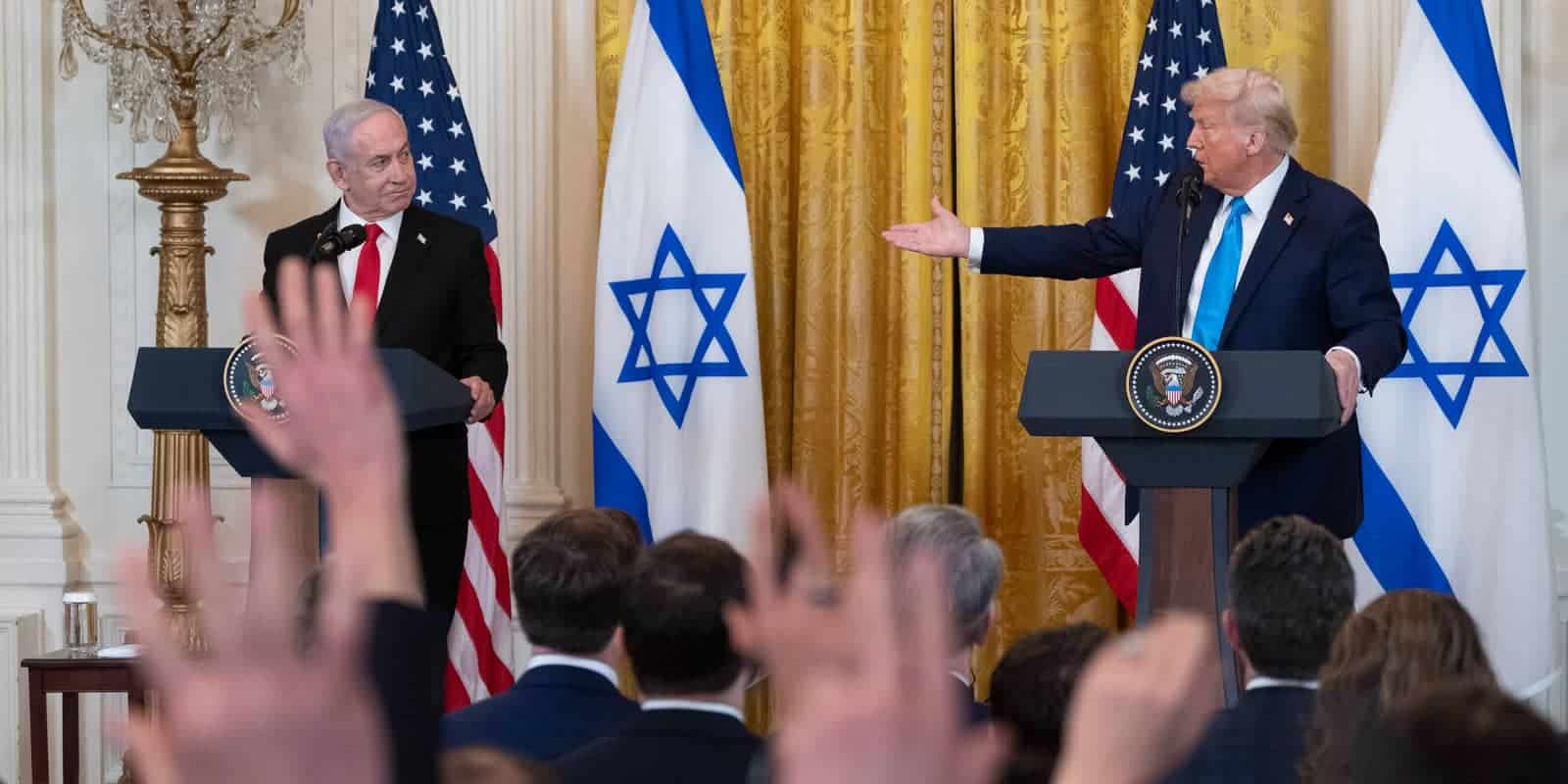



U.S. President Donald Trump weighed in on Israel’s political dysfunction Sunday, saying that an “all messed up” Jerusalem needs to “get [its] act together” following the inability of Prime Minister Binyamin Netanyahu to form a government in the wake of recent elections.
“Bibi got elected. Now, all of a sudden, they’re going to have to go through the process again until September? That’s ridiculous. So we’re not happy about that,” he said, using Netanyahu’s nickname and referencing the timeframe for new elections set by a parliament that dissolved itself last week.
President Trump is not alone in his conviction, with most commentators describing the political fiasco as a blow to the Israeli political system, which was unable to produce the result favored by the electorate. However, the American leader seemed less concerned about the state of Israeli democracy than with the wrench it has thrown into the planned unveiling of his much-hyped Israeli-Palestinian peace proposal.
Indeed, according to reports, Washington is now contemplating shelving the political elements of the plan until 2020, at which point the U.S. election cycle will be in full swing and any diplomatic failure could hurt President Trump’s bid for a second term in office. The US administration is also reportedly debating canceling a “workshop” scheduled for later this month in Bahrain, where the Americans intended to unveil the economic components of the plan geared toward improving Palestinian living conditions.
There are ample shoulders on which to lay the blame, including those of the Palestinian Authority, which has repeatedly rejected engagement in any US-led negotiating process and recently announced that it would boycott the 25-26 conference in Manana. President Trump’s son-in-law and senior adviser, Jared Kushner, appeared to shoot back in an interview published on Monday in which he cast doubt on Ramallah’s ability to “become capable of governing” the West Bank.
That, in turn, came on the heels of the leak of a recording in which U.S. Secretary of State Mike Pompeo conceded during a closed-door meeting with American-Jewish leaders that the peace plan could be “unexecutable.”
President Trump said Pompeo “may be right” after hearing about the comment.
Lenny Ben-David, a former deputy chief at the Israeli Embassy in Washington and currently director of publications at the Jerusalem Center for Public Affairs, told The Media Line he tended to agree.
“I do not think that any peace plan could [at this juncture] receive Palestinian approval, including the 2002 Arab Peace Initiative proposed by Saudi Arabia,” he said. “This is because the geopolitical reality has fundamentally changed, and the Palestinians are very upset about the [rapprochement] between regional [Sunni] countries and Israel. The PA is no longer comfortable with the positions of some Arab nations, which have moved on.”
In this respect, Ben-David further noted that President Trump had already upended the status quo of the peace process by recognizing Jerusalem as Israel’s capital and parts of the Golan Heights as being under Israeli sovereignty. Notably, these moves garnered relatively tepid reactions from most Middle Eastern capitals, lending credence to the claim that intra-Arab politics at least partially accounts for the White House’s collective headache.
The other elephant in the room – not to mention the lukewarm response to the plan by key U.S. allies Egypt and Jordan – is that Israel is unlikely to have a new government in place, if at all, before December. That the U.S. administration favors Netanyahu’s reelection is no secret, but presenting the peace proposal during his campaign could provide ammunition to the prime minister’s opponents – on the right and the left – should it call for significant Israeli concessions.
Dr. Emmanuel Navon, professor of international relations at Tel Aviv University and a senior fellow at the Jerusalem Institute for Strategic Studies, agrees that Israel’s transitional government is unlikely to make any significant decisions on the peace process without a clear mandate from the public.
“Netanyahu was not able to form a narrow right-wing coalition, which would have had members who oppose the peace plan,” he told The Media Line, adding that “the best chance for Trump” would be a national unity government between Netanyahu and the centrist Blue and White list, which would be more flexible to making concessions.
“At this point, though,” Navon said, “people seem ready to dump Netanyahu – including some within his Likud – and this has to be taken into account as well.”
Indeed, much hinges on whether Netanyahu is even reelected, although most opinion polls show the Likud and smaller right-wing factions – the Israeli prime minister’s “natural partners” – increasing their representation in parliament. Nevertheless, many analysts argue that it is too early to make predictions given that the political landscape could be totally reshaped before Israelis head to the ballot boxes.
First, it is worth noting that Benny Gantz, a political novice and former chief of staff of the Israeli military, created Blue and White only a few months before the April elections yet still managed to equal the 35 mandates Netanyahu’s Likud received. The possibility of other political blocs emerging is a virtual certainty, with rumors of behind-the-scenes machinations already swirling.
There are reports that Ayelet Shaked, the popular justice minister freshly-fired by Netanyahu, would eventually join the Likud, a move that cannot be ruled out in light of the dynamics of Israeli politics. Furthermore, Naftali Bennett, Shaked’s co-leader of the New Right party, which failed to cross the electoral threshold, has made overtures to various right-wing parties with the aim of forming – yet again – a “united right-wing front.”
Regarding the Center, Blue and White officials say their list will remain intact, but historical precedent proves there are no guarantees and that a last-minute split is possible. There is also talk of the left-of-center Labor Party merging with Meretz, considered the farthest-left party on the Zionist political spectrum, to offset the potential that both could fall short of the threshold needed to enter the next parliament.
All of this, meanwhile, has happened in less than a week – which is to say that three months is an eternity in Israeli politics. Hence, voter fatigue must be factored in, as turnout in September is expected to be lower than in April. This could have a determining impact on which parties cross the electoral threshold, especially when considering that Bennett and Shaked’s New Right fell only 1,500 votes short last time around. Its inclusion in parliament, along with that of another right-wing party that also just missed the cut-off, would have greatly enhanced Netanyahu’s chances of forming a government.
As things stand, then, chaos is the word of the day. Lucky for them, both President Trump and Prime Minister Netanyahu thrive in this type of environment and, therefore, may still be holding aces, if not wild cards, up their respective sleeves to be played moving forward.
The Jerusalem Post, 04.06.2019
Source: https://jiss.org.il/en/navon-instability-in-jerusalem/