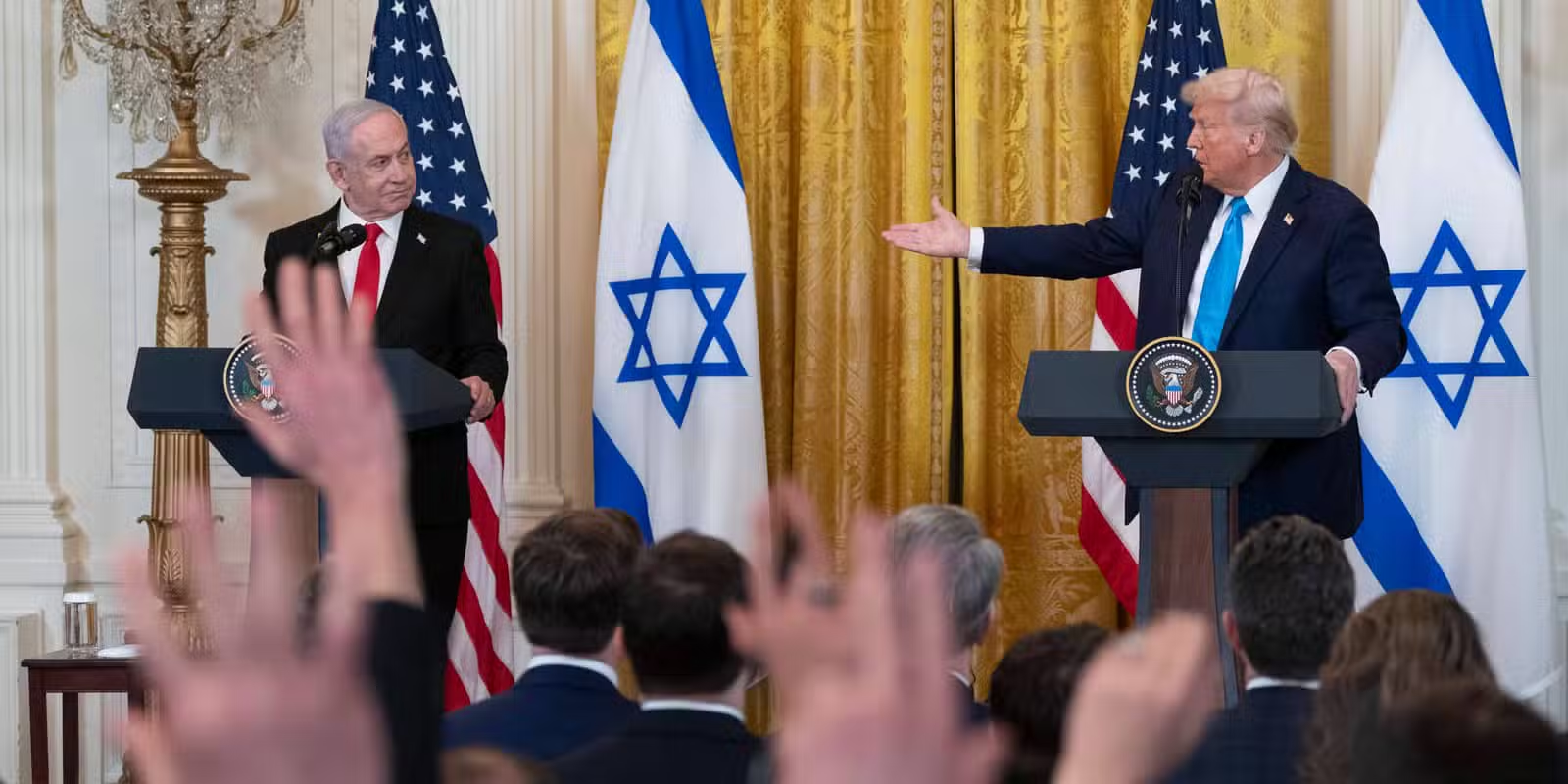


The special relationship between Israel and the United States has always reflected the shared values of two democracies committed to equality before the law and grounded in similar moral principles, and on a deep, enduring alignment of vital strategic interests. This alignment began after 1967, when Israel demonstrated its strategic value to Washington. The war against Iran has pushed the strategic dimension of U.S.–Israel relations to a new high.
Israel has established itself as a strategic partner of the United States. This is no longer simply a friendship between states, nor even between allies, such as the alliance between the members of NATO, which have again disappointed Washington, underscoring Israel’s strategic value. The alliance between Jerusalem and Washington is now a full strategic partnership between two states and two leaders who share a common view of the threat to global stability and act together to neutralize it. Many countries—such as the Gulf states—have good intentions but lack capabilities. Many others, particularly in Europe, possess those capabilities but lack the willingness to use them. While European states hesitate and deliberate, and at critical moments refrain from committing resources and force to defend the interests that underpin both their partners’ security and their own, Israel—far smaller than the United States’ “strategic” and natural partners—acts tirelessly and delivers proven operational results on the battlefield. In doing so, Israel has become a unique strategic partner for the United States: one that combines capability with a demonstrated willingness to assume risk in order to remove threats.
The gap between the positive American view of Israel and growing frustration with NATO allies is not merely rhetorical on the part of President Donald Trump. It reflects a structural shift in U.S. security thinking—one that may shape how regional states perceive Israel.
The U.S. call on major global powers—Japan, China, South Korea, the United Kingdom, and France, alongside the Gulf states—to join the international effort to safeguard freedom of navigation in the Strait of Hormuz rests on a simple reality: global energy stability depends on this region.
Many of these countries clearly recognize that a nuclear Iran armed with long-range missiles, a network of regional proxies, and the ability to conduct terrorism worldwide, poses a threat to them as well. Yet, at the moment of decision, their contribution has been limited, and some have even sought to undermine the U.S.-led effort.
Israel, by contrast, operates across the intelligence, technological, and operational domains against the power centers generating such threats. The difference is not merely one of scale, but of strategic approach: one approach manages risk; the other seeks to eliminate it.
Israel offers a different model: an ally capable of acting independently, gathering high-quality intelligence, making decisions under risk, and delivering operational results. It reduces the direct burden on the United States, improves the intelligence picture, and draws a clear dividing line in global foreign policy between those who generate value and those who make do with declarations—between partnerships grounded in responsibility and burden-sharing and those rooted in convenience. When White House Press Secretary Karoline Leavitt describes the depth of the partnership and states that U.S. intelligence, together with Israeli intelligence, is the best in the world, she is not offering a routine diplomatic compliment. She is acknowledging Israel’s role as a force multiplier for U.S. security. In that sense, Israel is not merely an ally but a strategic asset that delivers concrete outcomes for U.S. interests.
Israel’s capability and willingness to fight alongside the United States carry real consequences for its relations with regional states. Those states observe this strategic cooperation and recognize Israel as a reliable ally—a rare commodity in today’s international system, and particularly in the Middle East. (In this context, one should recall that Saudi Arabia and Iran agreed to restore diplomatic relations and activate a security agreement, and that Saudi Arabia recently signed a defense pact with Pakistan.) This marks a deeper shift with broad strategic implications: the very concept of alliances in the Middle East is changing. This emerging understanding is reflected in the words of Dr. Anwar Gargash, senior diplomatic adviser to the president of the United Arab Emirates, who stated: “Iran’s full-throttle attack on the Gulf states will actually strengthen the Israeli role in the Gulf, not diminish it… We will see an increase in Israeli influence in the Gulf, not a decline…”
The trend line is clear: the alliance with the United States is likely to deepen even under a president less aligned with Israel than Donald Trump. As the international system becomes more unstable in the face of the actions of China, Russia, and Iran, the value of reliable partnerships increases. Israel has repeatedly demonstrated that it is a reliable partner in a world where credibility between states has become a scarce resource.
The strategic lesson for Israel is clear: Jerusalem must preserve and deepen its strategic value and shared interests. It cannot rely on “shared values” alone. It must continue to act as a partner that delivers strategic outcomes for the United States and the broader international system.
JISS Policy Papers are published through the generosity of the Greg Rosshandler Family.
Source: https://jiss.org.il/en/rafaeli-how-israel-became-a-rising-actor-in-the-international-system/