
In early 2025, I was serving on the Foreign Affairs and Defense Committee when local security coordinators and members of emergency response teams in communities along the Egyptian border contacted me with accounts of the situation there that were at odds with what I knew at the time. They reported heavy drones loaded with weapons flying over the fence from Egypt while Egyptian forces on the other side stood by. Concerned by those reports, I convened two conferences to discuss the matter, one with think tank researchers in March 2025 and the other with field personnel and independent open-source intelligence researchers that July.
The defense establishment confirmed what people on the ground had been telling me. The official figures presented at a Foreign Affairs and Defense Committee meeting three months after the second conference showed 896 drone-smuggling attempts in just three months, nearly double the 464 recorded in the same period a year earlier. Those figures, and the troubling changes they showed along the Egyptian border, began to feature in media coverage just as debate intensified over how much of a role Egypt might play in various plans for postwar Gaza. Calls to put Egypt in charge of the Gaza Strip concerned me then and still do. Before entrusting Cairo with this sensitive border, we should ask a simple question. How has Egypt handled the border it already oversees?
A. Diplomacy as a Dynamic Tool: Between Peace and Military Vigilance
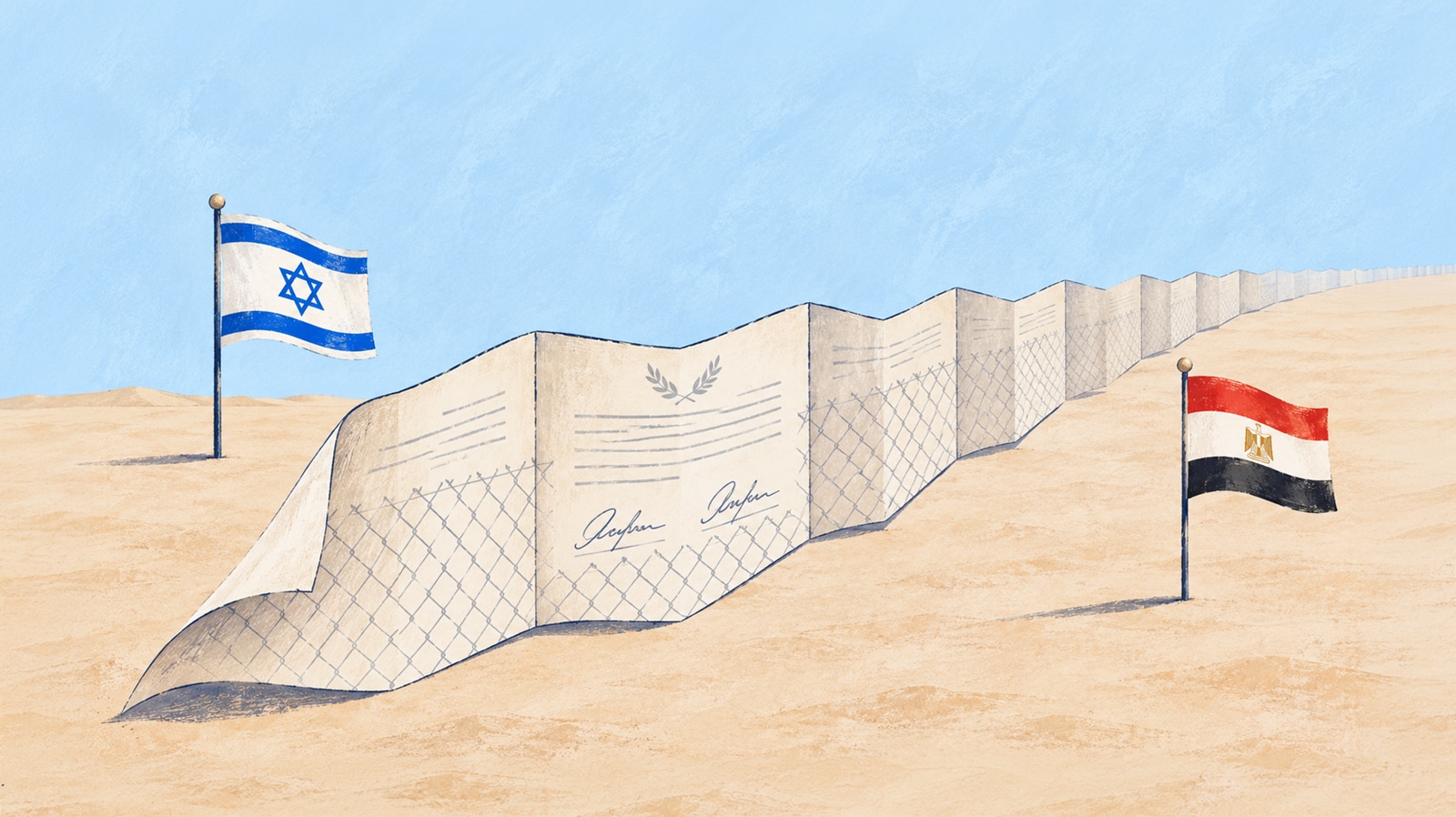
Two extremes tend to dominate public debate and discussion in Israeli defense circles when it comes to the peace treaty with Egypt. Some treat the peace treaty as a permanent insurance policy, so sacrosanct that nothing can be allowed to put it at risk. Others see Egypt as an immediate threat, an enemy preparing for direct confrontation. Yet diplomatic peace and military vigilance go hand in hand; each depends on the other, as international relations theory and experience in the Middle East show. A peace treaty is not a law of nature. It is a legal document that gives form to a convergence of the parties’ interests at a particular moment in history, and those interests can change.
The nature of alliances, as the philosopher Baruch Spinoza wrote, is that an agreement holds for as long as the reason for making it still applies, whether the parties feared harm or hoped to gain. Once that reason falls away, the agreement loses its force. The same applies to the peace treaty with Egypt. The stability of the treaty depends on the continued overlap in Cairo’s and Israel’s interests, not on the signatures on the treaty.
Cairo appears to have good reasons to preserve the peace. Egypt has close ties with Washington and is a key United States ally in the Middle East and was one of the mediators of the Gaza ceasefire agreement signed in Sharm el-Sheikh in October 2025. The gas deal signed that year, worth about $35 billion, gives Cairo a further stake in keeping the treaty in place. But a treaty holds only while it serves both sides. If interests change, neither the treaty itself nor today’s intentions offer a guarantee. What matters then is what each side can do when interests do change. The question is not only what Egypt intends to do in the near term, but what it could do if its interests changed, and how Israel is preparing for that possibility.
B. Two Ways a Treaty Loses Its Substance: Erosion and Shock
A peace treaty rarely ends with another signature. It can lose substance through gradual erosion or through a shock at home or abroad that puts it to the test all at once. Erosion happens a step at a time. Each step has its own explanation, but together they can hollow out the treaty without a formal breach. Nearly fifty years after the signing, the “cold peace” between Israel and Egypt has not led to broad cultural or economic normalization. On the diplomatic front, Egypt’s handling of the accreditation of Israel’s new ambassador is a clear example of erosion. The request to appoint him was submitted in April 2024, and Egypt delayed its approval for months. The erosion is clearer yet in the military sphere. The peace treaty’s military annex divides Sinai into zones, with tighter limits on Egyptian forces the closer they get to the border. In Zone C, next to Israel, it allows only Egyptian police and international forces. Since 2011, Israel has approved a series of temporary Egyptian reinforcements to fight ISIS and other terrorist groups in Sinai, using the Agreed Activities Mechanism in coordination with the Multinational Force and Observers. The security arrangements were formally amended in November 2021. Each approval had a justification at the time, but cumulatively they have resulted in a permanent Egyptian presence, with no demand that the troops withdraw. David Govrin, a former Israeli ambassador to Egypt, has warned that Cairo’s extensive military construction in Sinai exceeds what the treaty allows. He cites infrastructure for offensive, as well as defensive, operations, including airfield expansions, bunkers, ammunition and fuel depots, and tunnels under the Suez Canal. The treaty has eroded without being canceled.
Egypt has already provided an example of how abruptly a shock can change circumstances and how quickly intentions can shift. The Muslim Brotherhood’s Mohamed Morsi won the presidency in 2012 and took a complicated position on the peace treaty. He pledged in his inaugural address to honor Egypt’s international treaties but later linked the peace treaty to the Palestinian issue and to what he said was the need for Israel to honor its commitments to the Palestinians. The treaty survived his brief presidency, which ended in a military coup in July 2013. For a year, though, Egypt had a president who believed the agreement had yet to be fully implemented.
The Swords of Iron war brought another shock. Cairo made clear from the outset that it would reject any attempt to move Gazans into Sinai. Fears that refugees would flee Rafah in large numbers led to reports that Cairo was considering suspending the peace treaty if the Israel Defense Forces entered the city. Egypt was also taking a heavy economic hit as Houthi attacks on Red Sea shipping cut Suez Canal revenue by about 60 percent in 2024, leaving Cairo needing tens of billions of dollars in foreign aid and investment.
Both kinds of strain are playing out in Egypt at once. We cannot wait for a formal breach to recognize erosion, and a shock can change even a stable treaty in short order. It matters that Egypt remains committed to the treaty and still calls peace its strategic choice, but Israel must also look at Cairo’s actions.
C. The Test Is What Egypt Does on the Ground
Egypt went after the tunnels along the Gaza border between 2013 and 2015, chiefly when terrorism in Sinai threatened its own regime. Yet over the years, a substantial share of Hamas’s weapons and raw materials reached Gaza through tunnels under the Philadelphi Corridor, by sea from Sinai, and through the Salah al-Din Gate, where goods have entered Gaza without effective Israeli oversight since 2018. With Egyptian troops stationed permanently in the area, smuggling on that scale required Egypt at least to look the other way. That contrast shows that Cairo acts on its own interests rather than on the basis of Israel’s security needs.
The Negev border with Egypt presents a similar picture. According to Israeli sources, Egypt has more troops in Sinai than ever. Yet organized networks on both sides of the border use drones to smuggle weapons, some of which make their way to terrorist groups in Judea and Samaria. The smuggling is so extensive that the defense minister declared the area adjoining the border a closed military zone in November 2025. The problem appears to lie in Egypt’s priorities rather than its ability to act.
Meanwhile, Egypt’s military buildup in Sinai is proceeding. Israeli security officials and researchers say the infrastructure Egypt has built over the past decade exceeds what it needs to fight terrorism. This includes tunnels under the Suez Canal and bridges over it; fuel and ammunition depots, some underground; extended runways at air bases; and roads toward the border. Israel’s ambassador in Washington warned about bases designed for offensive operations, and the prime minister asked the Trump administration to press Cairo to scale back the buildup.
The current assessment is that Egypt has no intention of going to war, but intentions can change in weeks, while capabilities take years to build. The minimum warning Israel requires must therefore be a function of the time it needs to build the necessary response capabilities, not the time in which intentions may change. Thus, Israel must monitor Egypt’s capabilities and infrastructure continuously as it cannot rely on an assessment of “no current intent.” That is the konseptzia that was shattered on October 7.
Third-party guarantees are no substitute either. When Egypt demanded in May 1967 that the United Nations Emergency Force leave Sinai, the UN secretary-general agreed that same day and war broke out three weeks later. The UN Interim Force in Lebanon failed to keep Hezbollah from arming itself in southern Lebanon and as early as 2020, the Pentagon pushed to pull U.S. troops out of the Multinational Force and Observers in Sinai. They are only as strong as the guarantor’s political will when put to the test.
D. Conclusion: Setting Limits Prevents Confrontation Rather Than Provoking It
None of the above should be construed as a call for treating Egypt as an enemy; peace with Egypt is unequivocally a strategic asset. But the peace treaty alone cannot protect Israel. Its security rests on deterrence, intelligence, and operational readiness. Israel should keep track of Egypt’s conduct on the ground and its changing interests. It should set an expiration date and require a way to verify compliance whenever it allows Egyptian reinforcements in Sinai, and it should rule out giving Egypt more control along its borders, either in Gaza or along the Philadelphi Corridor. Enforcing the demilitarization terms is not a call for confrontation. It is the way to prevent confrontation. The voices from the southern border are already loud and clear. Will we listen in time?
Source: https://jiss.org.il/en/roll-signatures-alone-cannot-guarantee-peace-with-egypt/