

Introduction
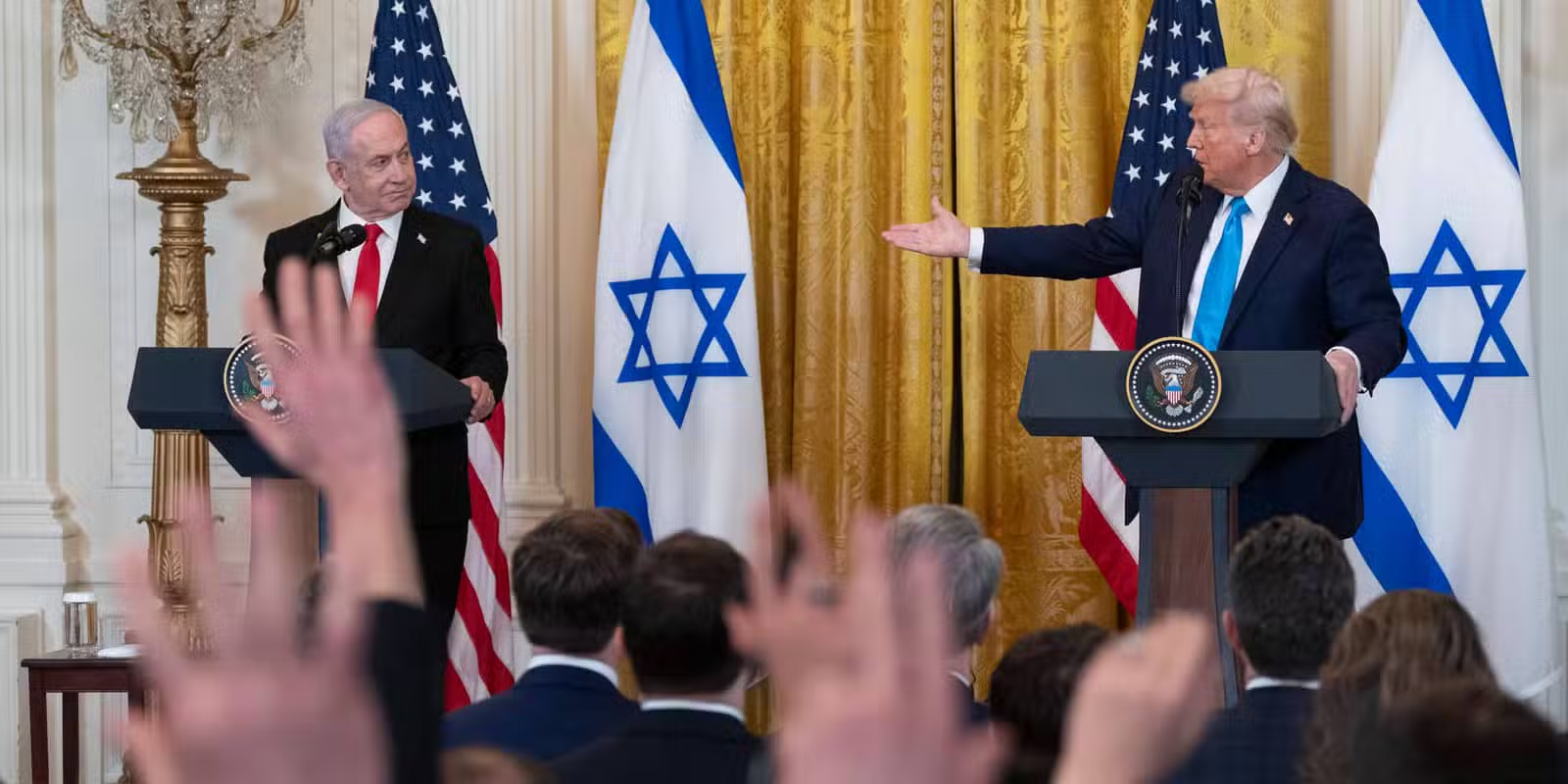
President Donald Trump’s extensive remarks about Turkey at the press conference following his meeting with the Prime Minister of Israel in Florida underscored the depth of his appreciation for President Erdoğan and for Turkey as an important, positive, and stabilizing actor in the new regional architecture he seeks to build. At the same time, they highlighted how Ankara’s role in the emerging order between the United States and Israel remains contested, particularly concerning Gaza and Syria—even if Trump believes these points of disagreement can be overcome.
Turkey is one of the most influential countries in the Middle East and the broader Islamic world. It has a population of approximately 85 million, a strategically vital geographic location, an imperial history, and a powerful military—the second largest in NATO and the ninth largest in the world. Despite internal challenges, Turkey aspires, in cooperation with Qatar and with the support of the United States, to become a dominant force in the Middle East and the Sunni Muslim world, including as a leader of the Muslim Brotherhood movement, both vis-à-vis Israel and vis-à-vis the Iranian axis.
Turkey’s approach toward Israel has escalated in recent years. Ankara now supports Hamas, hosts its leaders, and plays an active role in initiatives against Israel in international forums. Erdoğan has turned the Israeli–Palestinian conflict into a central component of his policy, employing harsh and inflammatory anti-Israel rhetoric to increase support among Muslims in general and within Turkey in particular.
This article reviews the development of relations between Turkey and Israel, seeks to trace the motivations behind the escalation, and proposes alternative courses of action for Israel.
Historical Background
The roots of modern Turkey lie in the Ottoman Empire, which was established in the fourteenth century by Osman I in Anatolia. The empire ruled the Middle East, the Balkans, and North Africa for roughly six hundred years. Its decline began in the nineteenth century, and World War I (1914–1918) ultimately sealed its fate. On October 29, 1923, the Turkish Republic was proclaimed. Mustafa Kemal Atatürk, the “founding father,” left a profound secular imprint: he abolished the caliphate (1924), adopted the Latin alphabet, granted women the right to vote (1934), and transformed Turkey into a secular-national state, with the military assuming the role of guardian of secularism.
Turkey’s relationship with the West is a complex story of strategic cooperation, political tensions, and regional expansion, beginning with its accession to NATO in 1952. As the organization’s first member from outside Western Europe, Turkey served as a geopolitical bridge between Europe and Asia and became a central actor in confronting Soviet threats during the Cold War. Membership in NATO provided Turkey with security and influence. In recent years, however, under Erdoğan, a form of “strategic ambivalence” has emerged—a balancing between West and East—which has become a source of tension with Western states. Added to this is friction with the European Union, as accession talks have stalled over issues such as the invasion of northern Cyprus, human rights violations, and claims of erosion of the rule of law under Erdoğan.
Relations between Turkey and Israel were established in 1949, after Turkey became the first Muslim country to recognize Israel, albeit cautiously, in order to preserve ties with the Arab world. The early decades were relatively stable, but economic crises in the 1970s and 1980s strengthened Islamist forces. During the 1980s, the Welfare Party promoted an “economic Islam” agenda as a counter to secularism. Erdoğan joined this movement as a teenager. He studied economics and Islamic politics and, in 1994, became mayor of Istanbul representing the party. In 2001, he founded the Justice and Development Party (AKP), which combined conservative Islam with economic reforms. In the 2002 general elections, the AKP won a majority, and Erdoğan became prime minister.
From 2007 onward, with his rise to the presidency, Islamization intensified, marked by the dismantling of secular education, the promotion of sharia-based legislation, and the curtailment of the opposition. The process reached a peak in 2016 with a failed coup attempt that led to a sweeping purge. A 2017 referendum transformed the constitution into a presidential republic and granted Erdoğan near-unlimited power. In 2023, he was reelected, despite a devastating earthquake that year that exposed extensive governmental corruption and multiple failures.
Relations between Turkey and Israel were initially positive and marked by economic cooperation during the 1950s. In the 1960s, as tensions grew between Turkey, Greece, and the West over control of Cyprus, ties with Israel deepened, with trade agreements signed and cooperation expanding in tourism and agriculture. The Six-Day War (1967) introduced strains, but during the 1970s cooperation resumed, including in the intelligence sphere. The Yom Kippur War (1973) halted this momentum, and under pressure from the Arab League, Ankara downgraded diplomatic relations. Even so, relations warmed again in the 1980s. During the 1990s, cooperation flourished across a range of security fields, including Israeli Air Force training in Turkey and the sale of weapons and intelligence systems. Bilateral trade reached approximately $3 billion annually, and tourism grew rapidly.
The rise of the AKP in 2002 altered the landscape. Erdoğan criticized Israel over the occupation while maintaining economic ties. The breaking point came with the Mavi Marmara flotilla in 2010, organized by a Turkish organization (I.H.H) with the aim of breaching the “naval blockade of Gaza.” During Israel’s takeover of the vessel, nine Turkish civilians were killed. In 2013, under pressure from President Obama, Prime Minister Benjamin Netanyahu issued an apology, and Israel paid $20 million in compensation to the families of the Turkish victims. Relations briefly improved. Ambassadors returned, and bilateral trade volumes climbed to roughly $6 billion.
Since 2018 however, relations have deteriorated to an unprecedented low. This decline unfolded against the backdrop of Turkey’s constitutional referendum, the Gaza border protests, and U.S. recognition of Jerusalem as Israel’s capital.
At the same time, a series of broader regional and international developments began to reshape the relationship. These include competition over influence in Syria under the new Jolani/al-Sharaa regime, Trump’s election to a second term in 2024, disagreements over the implementation of the Gaza ceasefire in 2025, the deepening of Israel’s ties with Greece and Cyprus, and Israel’s recognition of Somaliland.
Together, these dynamics create both challenges and opportunities for redefining relations between the two countries. Each views the other as a significant threat to its security interests, yet both remain cautious about translating this perception into direct confrontation.
Analysis of Motivations—Geopolitics, Security, Economics, and Domestic Politics
Turkey’s approach toward Israel reflects a combination of geopolitical ambitions, security considerations, economic interests, and domestic political calculations. Turkey seeks to position itself as a leading regional power, drawing on the legacy of the historical Ottoman Empire as part of a policy commonly described as “neo-Ottomanism”—an ambitious foreign policy aimed at establishing Ankara as a leading force in the Sunni and Islamic world.
Several core motivations shape Turkey’s conduct toward Israel: a geopolitical motive, centered on the drive to establish Turkey as a dominant regional power; a security motive; a religious motive; an economic motive; and a domestic political motive, namely to divert attention from Turkey’s internal challenges.
The geopolitical motive reflects Turkey’s longstanding dilemma as a bridge state between Europe and Asia, and between Western secularism and conservative Islam. Since joining NATO in 1952 and becoming a candidate for European Union membership in the 1980s, Turkey aspired to anchor itself in the West. Under Erdoğan, however, this orientation was reshaped into a model of “democratic Islam”—an effort to fuse a Sunni-Ottoman identity with global influence. With the rise of the Muslim Brotherhood in Egypt in 2011 and the outbreak and evolution of the Syrian civil war from that same year onward, Turkey increasingly came to view Israel as an obstacle to its regional ambitions. Framing its posture around the Palestinian issue, Turkey aligns itself with the Palestinians, supports their claims, maintains close ties with Hamas and with the Palestinian Authority, and sees itself as destined to play a central role in advancing settlements—both within the Palestinian arena and between Israel and the Palestinians.
Following the collapse of the Assad regime in Syria in December 2024, Turkey has moved to expand its influence not only in northern Syria but also in the country’s center and south. While Israel seeks to protect the Druze communities in southern Syria, Turkey, which seeks to weaken the Kurds in the north, favors a strong, centralized Syrian state under its influence. This creates a direct clash of interests between Ankara and Jerusalem. As Jolani’s principal backer, Turkey now effectively controls roughly 25 percent of Syrian territory, with approximately 10,000 troops deployed in the north and providing logistical support to the Syrian National Army.
In the Eastern Mediterranean, Turkey’s intervention in Libya in 2020, together with its close relationship with Qatar, has given Erdoğan additional leverage to push Turkey’s bid for regional hegemony. This has crystallized into a rivalry between the Turkey–Libya axis and the Israel–Egypt–Cyprus–Greece alignment. The gas agreement between Israel and Egypt, alongside Israel’s tightening security and strategic ties with Greece and Cyprus, has further sharpened this confrontation.
Ankara’s relations with the West add a further layer of complexity. Despite Turkey’s acquisition of advanced Russian S-400 air defense systems in 2019, it remains a core NATO member—a status that constrains how far hostility toward Israel can be translated into concrete policy. Following Donald Trump’s election to a second term as U.S. president, however, Erdoğan has sought to capitalize on the U.S. president’s “America First” doctrine to tighten ties with the White House and—backed by U.S. Ambassador to Turkey Tom Barrack—to convert that into American support for Turkey’s broader hegemonic ambitions, including those linked to friction with Israel.
Ultimately, Turkey leverages hostility toward Israel to position itself as the “true Muslim voice” in competition with Saudi Arabia and Egypt.
The security motive once formed the central bridge between Turkey and Israel, but over time it has eroded under the combined pressure of technological change and ideological hostility. Israeli Air Force training in Turkey (until 2010) and intelligence cooperation against Palestinian, Iranian, and Kurdish terrorism reinforced ties, as Turkey viewed Israel as a pragmatic partner against Islamist radicalism. By 2025, however, the security dimension itself had become a focal point of tension, particularly in relation to Syria and Gaza.
Turkey has built significant security autonomy, in part drawing on Israeli knowledge and technology—most notably in unmanned aerial systems—and no longer depends on Israeli capabilities. Turkey’s operations in Syria and its backing of the al-Jolani regime risk creating a direct threat to Israel along its eastern frontier. Nevertheless, both Israel and Turkey continue to maintain extensive cooperation with Azerbaijan.
Turkey’s economy, one of the largest in the Middle East and Eastern Europe, embodies a stark paradox. Sustained growth and sectoral diversification have positioned it as an emerging power, while high inflation, heavy external debt, and contested monetary policy exert persistent pressure that threatens to undermine growth.
In 2025, with a nominal GDP of approximately $1.565 trillion—ranking sixteenth globally and seventh in Europe—Turkey continues to attract foreign investment and expand its global trade, while grappling with exceptionally high inflation. Inflation stood at 31.1 percent in November 2025, down slightly from 32.87 percent in October but still far above official targets. The Turkish lira traded at roughly 42.5 to the U.S. dollar in December 2025, a depreciation of about 50 percent over the past decade, creating pressure on consumers and businesses.
Erdoğan’s economic policy, which began as a promise of rapid growth in the 2000s, has gradually hardened into a populist approach. Persistent opposition to high interest rates, expansive public spending—especially on infrastructure and subsidies—and sustained interference in the work of the central bank have come to define the “Turkish model.” In 2025, Erdoğan again expressed his rejection of “interest,” while approving a new three-year program targeting 4 percent growth, 17.5 percent inflation, and 8 percent unemployment.
Turkey’s economy currently sits uneasily between moderate growth—3.7 percent in the third quarter—and a tangible risk of slowdown, driven by inflation above 30 percent and a weakened currency. External shocks, led by the 2023 earthquake that caused an estimated $34 billion in damage, together with regional conflicts, have deepened economic strain. Even so, Erdoğan’s populist policies continue to provide short-term momentum. The International Monetary Fund projects 3.5 percent growth and 34.9 percent inflation for 2025, while the European Bank for Reconstruction and Development has raised its growth forecast to 3.1 percent.
Erdoğan’s domestic political motives reflect mounting pressure on him at home. Opposition to his rule has strengthened, and he has responded with increasingly forceful measures, including the arrest of his principal rival, Istanbul Mayor Ekrem İmamoğlu. In this context, Erdoğan has escalated his use of anti-Israel rhetoric. Since October 2023, he has labeled Israel’s prime minister a “modern Hitler” and accused Israel of genocide in Gaza—charges that have also served to divert attention from Turkey’s economic crisis.
Despite the sharpened rhetoric, trade with Israel has continued indirectly, primarily through Greece and Egypt, reflecting Turkey’s reliance on exports. In the first seven months of 2025, Turkish exports to Israel totaled approximately $520 million, compared with roughly $3.5 billion in 2024.
Policy Recommendations for Israel
Israel faces a complex challenge in its relations with Turkey. On the one hand, Turkey is not a direct military adversary like Iran, but a NATO member embedded in dense economic and geopolitical networks, including close ties with Western states, foremost among them the United States. On the other hand, under Erdoğan’s rule, Turkey has positioned itself as the leading force of the Muslim Brotherhood worldwide: backing Hamas, seeking influence among Israel’s Arab citizens and among Palestinians in Judea and Samaria, seeking to expand its foothold in Jerusalem and on the Temple Mount, tightening its grip in Syria, and wielding aggressive anti-Israel rhetoric to broaden its regional influence.
First, with regard to the direct threat emerging from Syria, Turkey’s presence and activity there compel Israel to act to prevent escalation and direct friction between the IDF and Turkish elements. This requires the clear separation and enforcement of spheres of influence in Syria, ensuring that southern Syria remains free of any Turkish presence. Ongoing talks aimed at a security arrangement in Syria present an opportunity to advance this objective, including through understandings with Turkey brokered by the United States.
With respect to Gaza, Israel must insist that there is no Turkish military presence in the Strip. This stems both from deep mistrust regarding Turkey’s willingness to disarm Hamas and from the risk of escalating tensions to the point of an inadvertent military clash between Israeli and Turkish forces on Gazan soil. The only area in which Israel can contemplate limited flexibility concerns civilian and economic aspects of Gaza, and even these should be kept to a minimum. Under no circumstances should Turkish security activity be permitted in the Strip.
Diplomacy is the most effective level available to Israel to deal with Turkey. Ankara’s NATO membership and its ambitions for global stature mean that it remains vulnerable to American and European pressure. Israel should apply pressure through Washington and NATO to force an end to Turkish support for Hamas, including the closure of Hamas offices in Ankara. Israel should frame such support as a violation of diplomatic norms and mobilize backing from Saudi Arabia and Egypt—states that view Turkey as a strategic rival, despite their recent tactical rapprochement with Ankara, as their fundamental hostility toward the Muslim Brotherhood persists.
Israel should also explore ways to leverage Turkey’s dependence on trade with Israel to moderate its conduct, including by expanding trade frameworks with Egypt, Greece, and Cyprus, including natural gas from the Leviathan reservoir. In addition, Israel should lobby for U.S. legislation targeting Turkish investments linked to Diyanet, the religious establishment that finances Islamist subversion. At the same time, Israel must work in cooperation with Greece and Cyprus to build a regional coalition to contain Erdoğan’s ambitions, including through joint naval exercises.
Recently, Trump has signaled openness to the sale of F-35 fighter jets to Turkey. Israel must make its principled opposition to such a move unequivocally clear, certainly as long as Ankara continues its inflammatory rhetoric against Israel and persists in supporting Hamas and the Muslim Brotherhood.
Conclusion—Challenge or Opportunity?
Turkey, as a central actor in Middle Eastern geopolitics, continues to pose a strategic challenge for Israel. It is a powerful regional force with an advanced military that has increasingly emerged as a potential threat: backing Hamas and Islamist terrorism, sustaining harsh anti-Israel rhetoric, and involved in the promotion of arrest warrants against Prime Minister Netanyahu and senior Israeli officials issued in November 2025. The core question is whether Turkey is a problem that must be addressed through a calculated confrontation, or whether rising tensions also create an opportunity for Israel to reshape the dynamic to its advantage.
In our assessment, Turkey’s vulnerabilities—above all its exposure and dependence on the West—can be leveraged to contain tensions with Ankara. This requires coordination with Europe and the United States, alongside the careful use of Turkey’s reliance on trade with Israel, despite formal restrictions. Turkey, a large state with expansive ambitions, oscillates between regional influence and religious zeal, yet its economic and political fragility leaves it susceptible to external pressure.
Israel once viewed Turkey as an ally; over time, however, Turkey has become a strategic challenge—as outlined above. Israel should avoid turning Turkey into an outright adversary and has no interest in opening additional fronts beyond those it already faces. The appropriate response is firm, disciplined diplomacy that defends Israel’s security interests.
JISS Policy Papers are published through the generosity of the Greg Rosshandler Family.
Source: https://jiss.org.il/en/siboni-winner-turkey-israel-relations/