


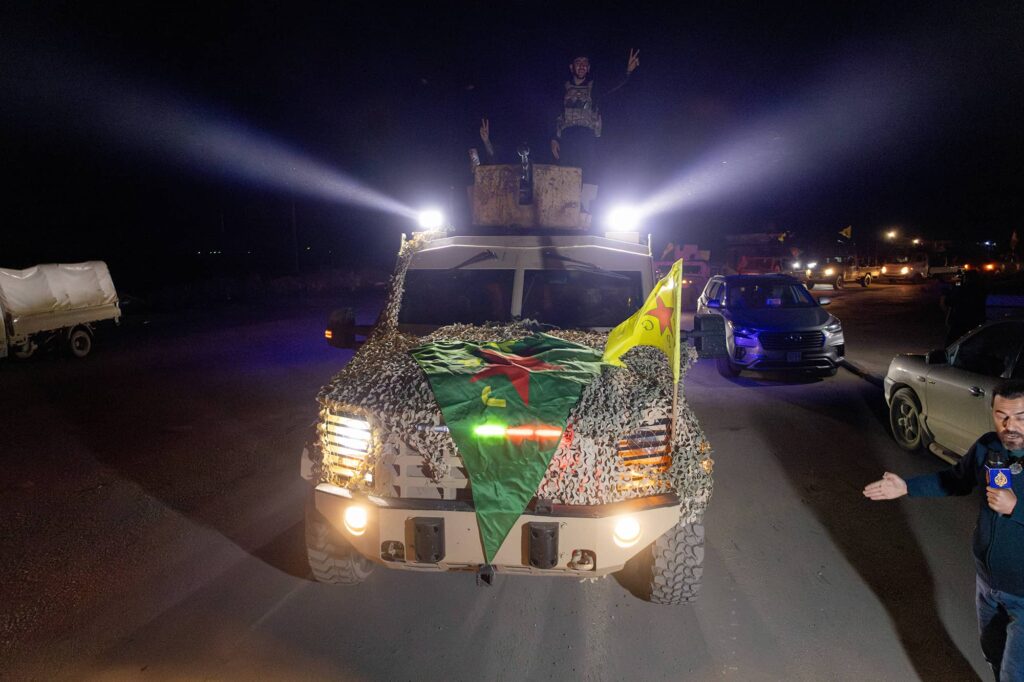
In early January 2026, forces loyal to the new Syrian regime, actively supported by Turkish troops, launched an aggressive campaign against the predominantly Kurdish “Syrian Democratic Forces” (SDF) in northern Syria. Beginning in Aleppo, and then further east, the SDF suffered significant reversals and were driven back to their strongholds in Kobani and Hasaka province. Following a brief ceasefire and faced with the prospect of heavy fighting in distinctly Kurdish areas, a new agreement was reached on January 30, replacing or supplementing the one signed on March 10, 2025. It calls for military disengagement but permits the introduction of Syrian internal security elements into Kurdish urban centers. This is to be followed by the integration of the SDF into the Syrian military —not as individual recruits, as the regime initially demanded, but in brigade formations, three in Hasaka and one in Kobani. Their organizational cohesion in this structure will presumably enable the Kurds to sustain the cultural and ethnic identity promised in the agreement, while upholding the principle of a unified Syrian state.
This is a painful compromise, imposed by force, and yet to face the test of implementation. Even so, events to date have already enabled Turkey to tighten its grip on Syria. While President Ahmed al-Sharaa may try to preserve his independence, others around him seem to be increasingly beholden to Turkish President Recep Tayyip Erdoğan and open to the prospect of “neo-Ottoman” hegemony. Turkey’s military role in the campaign further strengthens Ankara’s position.
From an Israeli perspective, this a clearly problematic development. Although Ankara is not an active enemy, and diplomatic relations have not been severed, its posture toward Israel is extremely hostile. Turkish dominance in Syria could eventually curtail Israel’s ability to operate in Syrian airspace when necessary. It could also intersect Turkish efforts to gain a hold in Gaza, and with the ongoing Turkish subversion in Jerusalem, potentially creating a new — and this time Sunni —“ring of Islamist fire” around Israel.
Generating a response amid a major crisis with Iran, given that the Trump administration has turned its back on its former allies in northern Syria, presents a significant challenge. Geographic constraints further limit Israel’s ability act in support of the Kurds. While Israel sympathizes with the Kurds, it does not share the same firm commitment to them that it has to the Druze in southern Syria. Still, Israel can and should make it clear to Damascus that further progress toward security stabilization will depend on whether the situation in Northern Syria reflects Turkish dominance beyond what can be reasonably justified as legitimate Turkish security concerns vis-à-vis the Kurds. There are avenues to mobilize support for the Kurds in Washington. Above all, Israel should make its concerns very clear to Washington, to al-Sharaa, and, using the Azeri channel, to Erdoğan.
The New Agreement and Its Background
Based on mediation efforts by the Trump Administration, then still in its early months in power, the new Syrian regime under Ahmed al-Sharaasigned an agreement with the Syrian Democratic Forces (SDF) on March 10, 2025. For well over a decade, the SDF— a largely Kurdish military organization—has protected the Kurdish autonomy in Northeastern Syria (the area the Kurds call “Rojava,” or “the west,” literally where the sun sets, the westernmost part of the Kurdish-majority lands).
The March 2025 agreement was designed to preserve the nominal unity of the Syrian state but retain Kurdish autonomy. In practice, however, it was never fully implemented. The SDF maintained a military presence— once backed by the United States, which still maintains a limited military contingent in these areas—across much of the northeast, including in two neighborhoods in Aleppo, as well as the in town of Raqqa, which had been the ISIL (Da’esh) capital during its brief ascendancy in Syria and Iraq.
The Kurds helped the coalition defeat Da’esh decisively, and this gave them a claim on U.S. support – or so they thought until the new Trump Administration came to power. With Tom Barrack, a close personal friend of President Trump since their days as young men in New York, serving as U.S. ambassador in Ankara and regularly reflecting Erdoğan’s perspectives, the balance began to shift, with both sides accusing each other of violating the March agreement.
For months, the Turkish government had threatened to intervene in Syria. Ankara views —or at least presents—the Kurdish People’s Protection Units (YPG), which are the backbone of the SDF, as a terrorist extension of the Kurdistan Workers’ Party (PKK). But with the PKK laying down their arms and Erdoğan seeking a rapprochement with Turkey’s Kurds (for internal political reasons) the urgency of such an intervention was diminished. When military action did come in January 2026, it took the form of advances by the Syrian military forces loyal to the new regime, reportedly reinforced by remnants of Jihadi groups, who regard the semi-socialist and egalitarian Rojava Kurds as “infidels.” These forces were advised and locally assisted by Turkish special forces.
The SDF rapidly lost its hold on parts of Aleppo, and the Kurdish neighborhoods were overrun (amid reports of acts of slaughter reminiscent of those witnessed in Sweida in 2025). The regime forces than advanced on Raqqa, while the Kurds withdrew from ethnically mixed areas to their strongholds in Kobani, Hasaka and Qamishli. The Kurds have signaled that they are willing to fight for these areas, no matter the costs.
After an uneasy and frequently violated ceasefire, a new agreement was reached on January 30, 2026. The agreement established a renewed ceasefire and “a phased process of military and administrative integration” with the following provisions:
- Military forces—i.e., both the Syrian military and the SDF—will withdraw from the existing lines of confrontation.
- Ministry of Interior security forces, not regular Syrian army units, will deploy to Kurdish urban areas such as Hasaka and Qamishli, This, in effect, symbolizes the assertion of Syrian national authority, paving the way for further integration.
- The SDF as a military force will be integrated into the Syrian military, not as individual recruits (as the regime had previously demanded) but rather as a division (three brigades) —presumably based in the Hasaka region —with an additional brigade in the Kobani area tied to the Aleppo regional administration. In effect, the SDF will retain a degree of structured existence although under overall national command.
- The governance of Rojava as an autonomous region will be brought into the structure of the Syrian state, retaining employees and maintaining stability (i.e., avoiding an external takeover).
- The Kurds as a people will be assured of their civil and educational (namely, language) rights.
- Displaced persons will be allowed to return. It remains unclear, however, if this applies to the Kurds of Afrin, who were displaced by the Turkish occupation forces.
It remains to be seen whether any of these provisions will in fact be implemented as outlined. Still, the very fact that the al-Sharaa government and its Turkish backers chose not to pursue their campaign to its conclusion indicates that the Kurds, despite the serious reverses they suffered and the American shift in posture, remain a significant actor. It further indicates that the regime in Damascus is wary of the full consequences of a destructive confrontation, at least at this fragile stage of stabilization.
Turkey’s Role and Its Implications for Israel
In terms of the far-reaching result of Turkey’s direct intervention and support for Syrian government forces, the agreement does not diminish the overall impact of the events of recent weeks,. Equally consequential has been the drastic change in the Trump administration’s position. Washington has explicitly cast off its obligations to the SDF and has given full-throated support to al-Sharaa’s bid to “unify Syria” — in effect endorsing Turkey’s role.
The participation of Turkish elements in the fighting in Aleppo and Raqqa further enhances Erdoğan’s influence – or rather, the firm grip that he now has over Syrian affairs. While al-Sharaa himself may still be trying to preserve his independent status, by courting the United States, Europe, and the Gulf states, and pursuing a security agreement with Israel, others in his government (reportedly including Foreign Minister Asaad Hasan al-Shaibani, despite his role in the direct talks with Israel) are increasingly associated with Turkey’s agenda in Syria.
Almost by definition, any expansion of Turkey’s hold over Syria has negative implications for Israel. While Turkish Foreign Minister Hakan Fidan may have recently voiced a willingness to resume trade with Israel (diplomatic relations were never cut off, although the level of representation was brought down) once the situation in Gaza changes, emphasizing that the rupture between the two countries is conditional rather than structural, experience since 2010, and more specifically since October 2023, has taught Israel to be wary of Ankara’s intentions. In a climate of active hostility, with government-dominated media spewing hatred and marking Israel as Turkey’s primary enemy, the possibility of neo-Ottoman dominance in Syria is bound to be problematic.
Among other potential effects, a Turkish air and air defense presence in Syria may hamper the ability of the IAF to use Syrian airspace if the need arises (as it did in June 2025) or to strike at attempts to resume supply lines to Hezbollah in Lebanon. Moreover, a Turkish foothold on Israel’s northeastern border, combined with Ankara’s bid to station troops in Gaza under the International Stabilization Force (or at least to play a major role in reconstruction and in the work of the “Board of Peace” in which Fidan is a member), alongside the ongoing activities of Turkish agencies among Palestinians in Jerusalem, could gradually amount to a “ring of (potential) fire” encircling Israel. In this case, it would be Sunni rather than Shi’ite as in the case of Iran, but it would be equally dangerous in the long run.
Despite the constraints discussed below, efforts must be made to reverse or at least delay such a Turkish sphere of influence.
Israel Faces Significant Constraints
For obvious reasons, Israel has limited capability to intervene and it cannot reverse the changes that have taken place on the ground
To begin with, Israel lacks geographic contiguity or even proximity that would enable it to intervene directly in northeastern Syria, as it did in the south in support of the Druze. Moral support has been expressed, in unambiguous terms, by Israel’s Foreign Minister Gid’on Saar as well as by opposition leader Yair Golan. Yet, in practical logistical terms, Israel’s ability to provide more than limited supplies is constrained.
Moreover, any Israel intervention is bound to run into a negative American response. Over the previous decade, the SDF played a major role in first checking the rise of ISIL (Da’esh) —most notably and heroically in the battle of Kobani in 2014—and later defeating the organization and detention its fighters (while their families were held in supervised camps). These efforts won them the support and loyal sentiments of American soldiers and several key political figures such as Senator Lindsay Graham. Nevertheless, even in his first term in office, President Trump considered pulling out the American troops who actively assisted the SDF in a highly hostile environment. Once he returned to office, Trump swept aside all remnants of past gratitude.
The principal executor for Trump in Syria is his Ambassador to Ankara, Tom Barrack, an old personal friend from their younger and wilder years in New York. Barrack is a firm supporter of Erdoğan generally and of his policy in Syria specifically. Echoing Ankara’s push for a unified Syria (a formulation that pertains only to a Syria led by Turkish-backed forces; during Bashar Assad’s reign Turkey actively defended the Idlib region as a rebel stronghold where the regime’s writ did not run), Barrack has openly stated that from Washington’s perspective, the SDF has outlived its utility. The U.S. military has been instructed to find alternative options for the detention of ISIL elements, preferably across the border in Iraq. This has made continuing reliance on the SDF irrelevant and signaled to the Syrian regime and to Turkey that the SDF has been left to its fate.
Senator Graham reacted angrily to this abandonment and initiated legislative action to reverse it. This political counterpressure helps explain the dynamics that led to the January 30 agreement. Even so, Israel cannot be expected to openly and directly defy or thwart a policy advocated and implemented by one of the president’s closest associates. This is particularly true at a time of heightened tensions over the future of Iran and a possible U.S. strike—circumstances that require an intimate dialogue between Washington and Jerusalem.
What can Still Be Done?
Despite these formidable obstacles, Israel is not entirely powerless to limit the rise of Turkish dominance in Syria; it can seek to do so by acting in a coordinated fashion across four interrelated channels:
- In a discreet and subtle manner, Israel should encourage further public and political pressure in the U.S., and in particular Congressional monitoring of the situation and of the regime’s compliance with the key terms of the January 30 agreement pertaining to Kurdish autonomy.
- While firmly resisting Turkish pressure to meddle in Gaza, Israel should engage with Ankara—directly or via Azerbaijan— and communicate clearly its concerns. These should include specific red lines, which, if ignored, may trigger a strong and dangerous response.
- In direct messages to the Syrian regime within the context of the ongoing negotiations with it over a security agreement, Israel should make clear that the regime’s attitude toward minorities in Syria (above all, but not exclusively, the Druze in the south) will have a bearing on its willingness to show flexibility. The same should apply to any signs that Syria is falling increasingly under Erdogan’s thumb.
- To complement the “stick,, Israel should offer “carrots” in the form of energy cooperation such as integration into the Eastern Mediterranean Gas Forum, some forms of direct but not highly visible assistance (for example, medical services and agriculture), and a coordinated effort with the UAE—a like-minded partner in this context—to enhance investment in the Syrian economy.
None of these strategic devices can guarantee success, given the chaotic conditions currently existing in Syria. Taken together, however, and, if used skillfully, they can have a mitigating effect (one that is already unfolding) on Turkey’s unbridled ambition.
JISS Policy Papers are published through the generosity of the Greg Rosshandler Family.