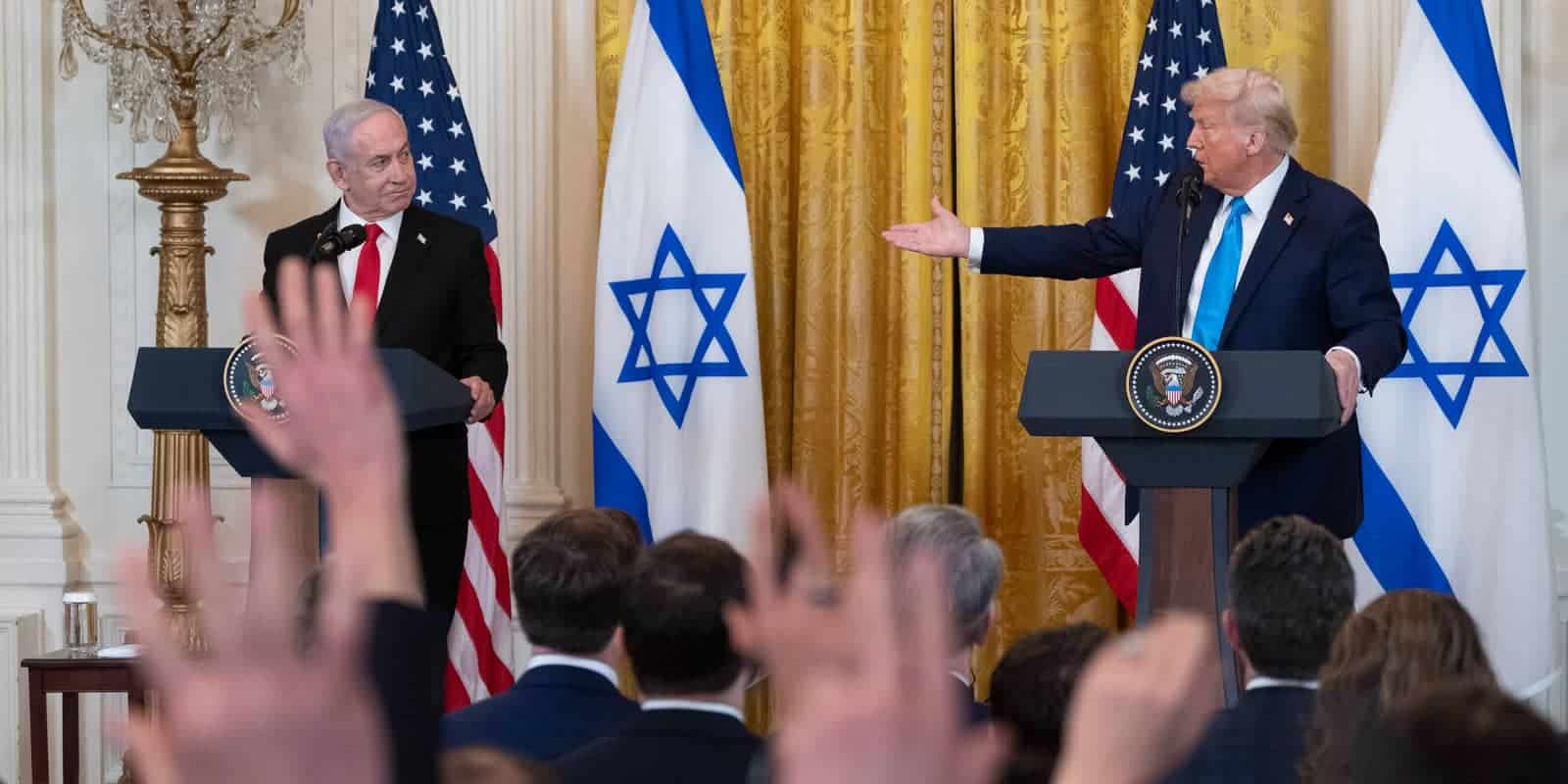



On February 19, Donald Trump convened his “Board of Peace” in Washington, an event meant to unveil a new vision for the Gaza Strip. Alongside senior officials from member countries, one attendee stood out: FIFA President Gianni Infantino.
His presence was not ceremonial. FIFA presented a detailed “day after” plan for Gaza that seeks to turn sport into a vehicle for civilian rehabilitation. The proposal includes building playing fields and training facilities, constructing a central stadium, launching soccer programs for boys and girls, and establishing a dedicated academy to develop the game.
The idea fits into Trump’s broader approach: replace terrorist infrastructure with a thriving civilian space. But the assumption that civilian development on its own can immunize a society against extremism does not hold up in Gaza. Civil institutions in the Strip operate under Hamas’s dominant control. Outside investment is never neutral; it is absorbed into a political and organizational system that uses community frameworks to entrench its authority.
Even when funds are not formally earmarked for terrorism, they can strengthen Hamas’s governing stability and deepen its hold. Soccer is no exception. Over the past decade, Palestinian sporting arenas have featured clear pro-terror messaging and, at times, open praise for Hamas leadership.
Sports clubs have served as platforms for ideological messaging and youth recruitment. This reflects a long-standing strategy of the Muslim Brotherhood—and its Palestinian branch, Hamas—to recruit activists and channel them into terrorism by embedding themselves in civil society institutions, including youth movements, sports clubs, and informal education networks.
The erroneous American belief that economic prosperity can overcome fundamentalist ideology leads to the unfounded assumption that high-profile sports initiatives can neutralize Islamist influence. In practice, such programs offer Hamas an additional recruitment arena. A glossy international academy will not change that dynamic unless it is accompanied by strict and genuinely independent oversight. Preventing misuse requires disarming Hamas, removing it and its personnel from governance and civilian administrative structures in Gaza, and launching a large-scale, quantifiable deradicalization process.
Another critical element is Qatari financing. For years, Qatar has operated in Gaza under the banner of humanitarian aid and infrastructure rehabilitation, demonstrating how civilian investment can be folded into a broader influence strategy. At the Board of Peace meeting in Washington, Qatar pledged to provide one billion dollars for the program, and, according to reports, is prepared to contribute far more.
As reported by Israel’s public broadcaster Kan News, is considering offering the largest contribution to Gaza’s reconstruction among all member states of Trump’s Board of Peace in order to expand its influence. Qatar already funds civilian mechanisms, from tent construction and charitable foundations to food kitchens and removal of rubble, in close coordination with Hamas, whose senior officials remain based in Doha. FIFA’s plan would integrate smoothly into this Qatari framework, particularly given that FIFA President Infantino resides in Qatar, owns a home in the capital, and whose children are enrolled in schools there.
These ties extend beyond the personal. Qatar has already demonstrated its ability to use sport as a diplomatic instrument. Hosting the 2022 World Cup was not merely a sporting celebration but a strategic move to shape its image and expand its influence.
In arenas such as UEFA and other international forums, Qatar has advanced political initiatives aimed at undermining Israel’s standing within sporting platforms. The very attempt to turn a soccer field into a venue for diplomatic pressure underscores how thin—if not nonexistent—the line between sport and politics has become. Reports detailing the corrupting influence of Qatari money within FIFA, along with ongoing corruption revelations, have illustrated how Qatar operates within the organization—and suggest it could wield similar influence over activity in Gaza.
Moreover, reports concerning Qatari funding flows to U.S. universities suggest that Doha seeks to position individuals aligned with its objectives in key roles. A similar dynamic in Gaza would mean that Qatari investment in a FIFA academy could be presented as support for Gaza’s children while, in practice, enabling the placement of Hamas-affiliated figures as coaches and instructors—allowing continued ideological indoctrination under a respectable façade.
For the reasons listed above, the initiative unveiled in Washington is not as benign as it may sound. Without full transparency and a complete separation from local mechanisms associated with Hamas, the risks are real.
Green fields and new stadiums will not suffice if, beneath the turf, the same forces continue to operate, exploiting every civilian space for political and organizational ends.
JISS Policy Papers are published through the generosity of the Greg Rosshandler Family.