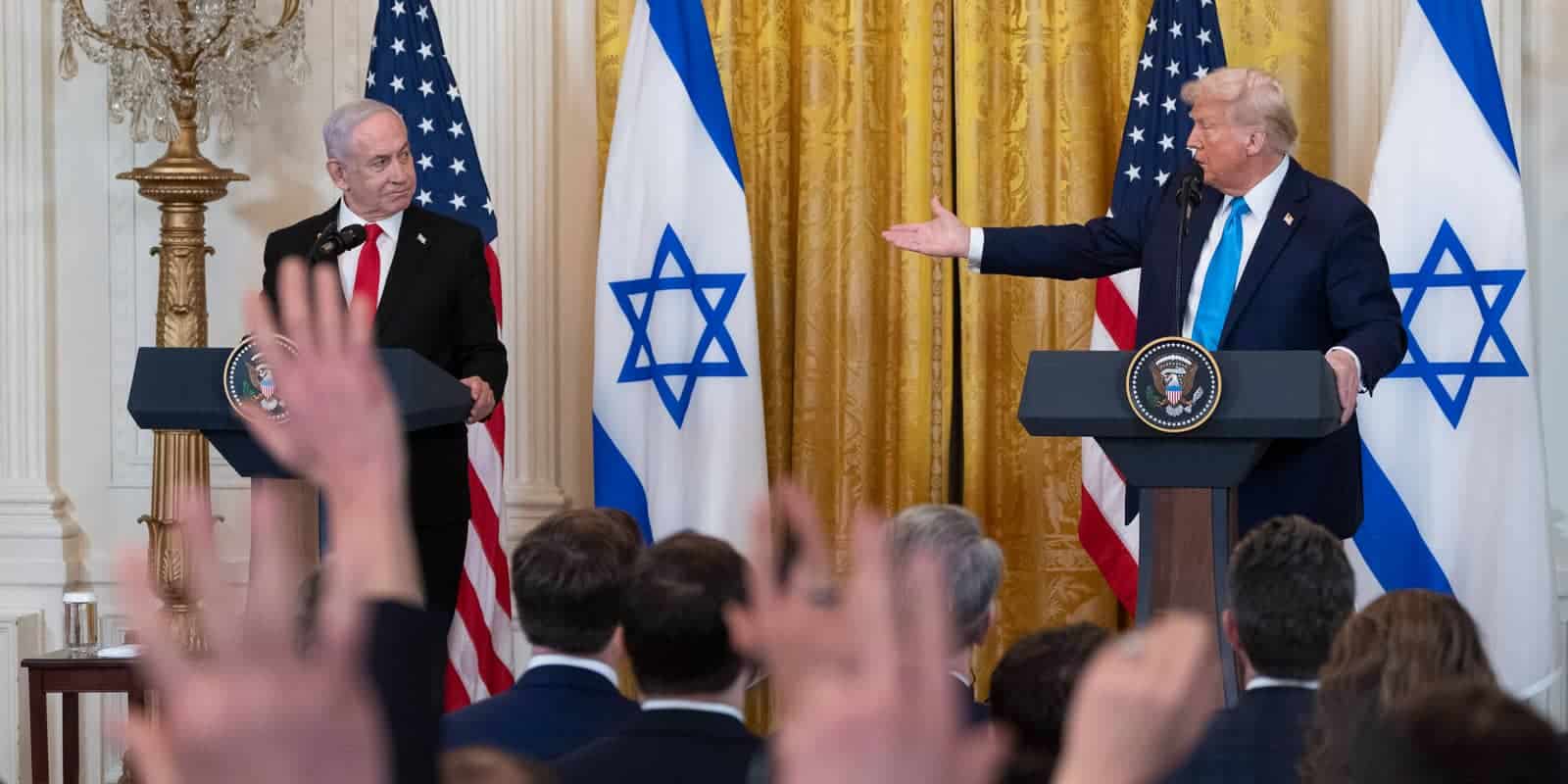

In a phone interview with Fox News on November 3, US midterm election day, US President Donald Trump said he and Prime Minister Benjamin Netanyahu had agreed to end the annual US military aid package to Israel. “Bibi Netanyahu and I have made a deal that we give Israel $4 billion a year, and we made a deal months ago that we’re stopping,” Trump said. “We’ve already agreed that by the end of this year we won’t be paying Israel. Now, we’ll help Israel if they need it.”
The current 10-year Memorandum of Understanding (MoU) provides Israel with $3.8 billion a year and does not expire until September 2028. Netanyahu has previously proposed phasing out US aid gradually, and in a January 2026 interview with The Economist he spoke of tapering it to zero over the next decade. According to Israeli media reports, Ministry of Defense Director General Maj. Gen. (res.) Amir Baram has been leading talks for months on moving the 2029–2038 framework “From Aid to Partnership.” However, Kan 11 and Army Radio reported that professional echelons in the IDF, the Ministry of Defense and the Ministry of Finance were caught off guard by the end-2026 timeline, coming weeks after an Israeli Ministry of Defense delegation met the US Army Security Assistance Command in Alabama on October 20 to plan future procurement.
A known decision, an unclear timetable
The principle itself was not new, according to Maj. Gen. (res.) Yaakov Amidror, Senior Fellow at the Jerusalem Institute for Strategy and Security and former National Security Advisor to Prime Minister Netanyahu and chairman of the National Security Council. Israel decided to forgo the aid in order to gain greater flexibility in its relations with the United States in light of social and political changes there, and to pre-empt future claims against Israel, especially if future Congresses prove hostile, he said. Amidror noted that he has regarded the decision as a mistake, and still does.
He distinguished between the substance of the decision and the way it was announced: “It is possible that the President’s statement, which remained unclear regarding the date on which the transfer of aid funds will end — that is, whether from tomorrow morning, from the end of the current agreement, or in a phased manner altogether — surprised officials in Israel, but not the matter itself, because the decision in principle had been known, as noted, for some time.”
In net economic terms, the concession is neither difficult nor very burdensome, Amidror said, amounting to roughly half a percent of GDP. What Israel does lose, he said, is planning certainty. US aid served as an anchor for the IDF’s work plans, particularly aircraft procurement for the Air Force, and that anchor is being replaced by the need to persuade the government to commit funds over ten-year periods, which is highly difficult to secure. The Finance Ministry, facing allocations, a considerable part of which are inflexible, will try not to replace the lost aid dollar for dollar, he assessed.
Amidror also sees a possible upside in the friction that will follow: “This process will add a lot of tension between the Finance Ministry and the Defense Ministry, but perhaps it will also bring savings, because for every dollar it will be necessary to make an effort, to justify it well and, as noted, to persuade.” He proposed giving Israel’s National Security Council a more significant role in the process, and strengthening its economic capabilities, as a body that sees the full range of needs and may therefore be able to balance them better.
Col. (res.) Dr. Eran Lerman, Vice President of the Jerusalem Institute for Strategy and Security, and former deputy director for foreign policy and international affairs at the National Security Council in the Israeli Prime Minister’s Office, focused on the manner and timing of the announcement. “The way in which Trump announced it — and even more so, the timing, in clear connection with the collapse of the Republicans in the US midterm elections — is not consistent with the orderly staff work required for a phased conversion of the aid format into a different model, centered on closer security, intelligence and technological cooperation than in the past,” Lerman said. He added that it remains unclear what will happen to procurement deals already concluded on the basis of the current MoU, and what the decision means for the administration’s legal obligation to maintain Israel’s qualitative military edge.
Lerman added that current political conditions in both Jerusalem and Washington will make it difficult to reach binding agreements. Even so, he said, detailed dialogue between the two defense establishments must continue, “one that will reflect, specifically, the far-reaching partnership built over the past two years.”
Is a year-end cutoff realistic?
Dr. Pnina Shuker, who specializes in national security, public opinion, and foreign policy issues, and serves as a researcher at the James J. Shasha Center for Strategic Studies at the Hebrew University of Jerusalem, assessed that a phased transition is likely in practice. While the MoU is not legally binding, Congress sets the aid levels in legislation through 2028 and allocates the money, and the President lacks the authority to hold back those funds unilaterally, she said.
Israel has also committed to multi-year procurement deals with the US defense industry, including fighter jets and munitions, that rely on aid funds, giving American industry a clear interest in continued funding, she noted. Shuker noted that negotiations on the next MoU, which began in June 2026, were defined from the outset as a gradual transition from aid to mutual partnership.
Even so, she warned, the presentation of the move carries a cost. “The move was presented as a unilateral American step intended to remove a political burden from the Republican Party, and it was evident that the [Israeli] Finance and Defense Ministries were surprised by it. This undermines the credibility of multi-year arrangements, creates an enormous budget gap at short notice, and the aid — which for decades was a bipartisan issue — becomes a partisan issue,” Shuker said. She also cautioned that Israel’s adversaries may read the move as a weakening of the American commitment, eroding Israeli deterrence, even though operational, intelligence and technological cooperation does not depend on the aid.
Full comments
Major General (res.) Yaakov Amidror, Senior Fellow at the Jerusalem Institute for Strategy and Security and former National Security Advisor to Prime Minister Netanyahu and chairman of the National Security Council:
“The aid agreement between the US and Israel is set to expire within two years. Israel decided to forgo it in the future so that it would have greater flexibility in its relations with the US in light of the social and political changes in the US. I believed in the past that forgoing it is a mistake (and that is still my view), but the Prime Minister decided that this is the right thing to do, in order to prevent claims against Israel in the future, especially if future Congresses are hostile to Israel. Over the years, Israel received the largest aid from the US, and even though all the money was used to buy weapons in the US, and in the US only, and the US gained no small amount of knowledge as a result of Israel’s use of American systems, there were claims in the US against funding Israel’s needs from US taxpayers’ money. This forgoing, following the forgoing of economic aid long ago, should make things easier for Israel with regard to claims of this kind.
The Ministries of Defense and Finance have been familiar with the Israeli decision for some time, and in my assessment quite a few discussions have even been held because of it, and thinking about alternatives has even begun, chiefly the search for joint projects, in order to strengthen relations in the security sphere (the Arrow project is a good example of this type of project: both sides pay and both sides benefit). It is possible that the President’s statement, which remained unclear regarding the date on which the transfer of aid funds will end — that is, whether from tomorrow morning, from the end of the current agreement, or in a phased manner altogether — surprised officials in Israel, but not the matter itself, because the decision in principle had been known, as noted, for some time.
If topics for cooperation in development are found, that will be very welcome, even if it will not be full compensation for the loss of the aid, which was an anchor in terms of the IDF’s work plans, especially with regard to aircraft procurement for the Air Force. This anchor has now been replaced by the need to persuade the government, chiefly the Finance Ministry and the Prime Minister, to allocate the funds over the long term. This will require a government commitment for periods of 10 years, a commitment that is very difficult to obtain under the conditions of the State of Israel. Perhaps the change will lead to the need for more serious discussions and deeper thought in order to understand, and to persuade, what is right to buy (and perhaps even where). This process will add a lot of tension between the Finance Ministry and the Defense Ministry, but perhaps it will also bring savings, because for every dollar it will be necessary to make an effort, to justify it well and, as noted, to persuade.
One of the ways to overcome future struggles of this kind is to involve the National Security Council in the process in a more significant way, and for that it will be necessary to strengthen it in the economic aspect, an aspect in which the National Security Council is very weak. The National Security Council is a neutral body within the government and it sees the full range of needs, and therefore may be able to balance more correctly between economic needs and security needs.
In net economic terms, the concession Israel is making is not a difficult or very burdensome concession, because it amounts to roughly half a percent of GDP ($720 billion) and about 1.5 [percent] of the state budget (NIS 850 billion). For the Finance Ministry this is a big change, because it touches on the allocations to the various ministries, a considerable part of which are not flexible (salaries, for example), and it will be hard for it to maneuver, even if this is a very low percentage. Therefore it will try to reduce the compensation for defense, and not to make up dollar for dollar for what is deducted because of the decision to forgo [the aid].
To sum up: Israel loses a planning anchor, weakens its ties with the US arms industries, which knew there was a budget for them guaranteed by the US government, and makes things harder for the state budget. On the other hand, it reduces dependence, gains room to maneuver in arms procurement (it is possible that more systems will be bought in Israel, because the advantage of buying in the US with aid money will be lost), and if joint development projects are found, perhaps our loss will even turn out to be our gain, at least to some extent.”
Colonel (res.) Dr. Eran Lerman, Vice President of the Jerusalem Institute for Strategy and Security, and former deputy director for foreign policy and international affairs at the National Security Council in the Israeli Prime Minister’s Office:
“The way in which Trump announced it — and even more so, the timing, in clear connection with the collapse of the Republicans in the US midterm elections — is not consistent with the orderly staff work required for a phased conversion of the aid format into a different model, centered on closer security, intelligence and technological cooperation than in the past. At this stage, it is unclear what the status is of procurement deals already concluded on the basis of the aid for the current fiscal year (until summer 2027), and what the decision means with regard to the obligation that applies to the administration, by law, to maintain Israel’s qualitative edge. Under the current political conditions, both here and in Washington, it will be difficult to reach binding agreements, although detailed dialogue between the defense establishments must continue — one that will reflect, specifically, the far-reaching partnership built over the past two years.
What is more worrying is the way in which the announcement is perceived not as a legitimate step stemming from the consolidation of Israel’s economic strength — it amounts, after all, to two-thirds of a percent of GDP today — [but] as a kind of political surrender by Trump to the pressure and rising power of the distinctly anti-Israeli circles (not to say antisemitic): an interpretation that will only whet their appetite.
The same applies to the results of the midterm elections: in normal times, a new reality in which Chuck Schumer is Senate Majority Leader and Hakeem Jeffries is Speaker of the House is not a disaster: the Woke camp has grown, but it still does not control the Democratic Party. The main difficulty at this stage lies in the dangerous interpretation being given to what happened — including by Trump — as a result of the unpopular war in Iran: and therefore also as an ‘Iranian victory’ (a statement by Trita Parsi, who should be seen as an arm of Iran in American academia). This only sharpens the need, certainly in the two months until the Congress is sworn in, to act forcefully to dismantle this perception.”
Dr. Pnina Shuker, who specializes in national security, public opinion, and foreign policy issues, and serves as a researcher at the James J. Shasha Center for Strategic Studies at the Hebrew University of Jerusalem:
“The meaning of the statement – President Trump’s statement that military aid to Israel will end as early as the end of 2026 ostensibly reflects a transition from the status of a supported state to the status of a partner – a direction that Prime Minister Netanyahu has declared in the past. However, the manner of the announcement harms Israel: the move was presented as a unilateral American step intended to remove a political burden from the Republican Party, and it was evident that the Finance and Defense Ministries were surprised by it. This undermines the credibility of multi-year arrangements, creates an enormous budget gap at short notice, and the aid — which for decades was a bipartisan issue — becomes a partisan issue. Attention should also be paid to the expected erosion of Israeli deterrence, since Israel’s adversaries may interpret the move as a weakening of the American commitment, despite the fact that operational, intelligence and technological cooperation is not dependent on the aid.
A phased transition – It is likely that in practice a phased transition will take place. The Memorandum of Understanding is not legally binding, but the aid levels are enshrined in legislation until 2028 and the funds are appropriated by Congress, whose decisions the President is not permitted to withhold unilaterally. In addition, Israel has committed to multi-year procurement deals in the American defense industry, including fighter jets and munitions, that rely on the aid funds, so the American defense industry has a clear interest in continued funding. It should be noted that the negotiations on the next Memorandum of Understanding, which opened in June 2026, were also defined from the outset as a gradual transition from aid to mutual partnership.
Risks and opportunities – Ending the aid may expand Israel’s freedom of action in procurement and in decision-making, strengthen the domestic defense industry, and especially munitions production, and deny Israel’s critics in the United States the ‘taxpayers’ money’ argument. On the other hand, the aid created permanent stakeholders in Congress, the Pentagon and industry, and without it relations may become more transactional and more dependent on the sitting president. There is also the concern that ‘partnership’ means full payment without priority in delivery, and that the budgetary burden will weigh on the Israeli economy at a time of high defense spending. It should be borne in mind that financial independence is not operational independence: Israel will continue to depend on American platforms and export approvals.
A Democratic-controlled Congress – The fact that from January 2027 Israel will be dealing with a Republican administration on the one hand, and a Congress with a Democratic majority in both of its houses on the other, has a dual effect. On the one hand, the Democratic leadership is expected to insist on Congress’s powers vis-à-vis unilateral steps by the President, and may thereby actually block an abrupt cutoff of the aid. On the other hand, the party’s base has moved away from Israel, and the new majority will use its budget and oversight powers to hold hearings, to impose conditions on the use of American weapons and to delay deals. Ending the aid will not free Israel from this oversight, since procurement financed by Israel is also subject to congressional review. Moreover, Israel’s identification with Trump, which has been strengthened in the wake of the statement, will make it harder even for moderate Democrats to support it openly.
Courses of action for Israel – Israel must take the lead in driving the process: obtain from the administration a written clarification of the scope of the decision and the timetable, formulate a unified position of the Prime Minister’s Office, the Ministry of Defense and the Ministry of Finance, and propose an orderly framework of three to five years that will protect existing deals and the funding of missile defense and will be integrated into the next Memorandum of Understanding. At the same time, it must open a direct channel with the Democratic leadership and with the committee chairs even before they take office, and make clear that the traditional partnership exists between the two countries and is not dependent on the identity of the president or the party dominant in Congress. In order to reduce conditionality, it would be better to establish proactive transparency mechanisms regarding the use of American weapons. Finally, it must shift the center of gravity of the relations from foreign aid to joint programs in the Pentagon budget, enshrine the qualitative edge and priority in delivery in the new agreement, and prepare to absorb the budget gap while expanding domestic defense production.”
Source: https://jiss.org.il/en/weekly-strategic-brief-061126/