


Dear Subscribers,
The past year drew to a close with a series of consequential events that will shape the political and security environment heading into 2026.
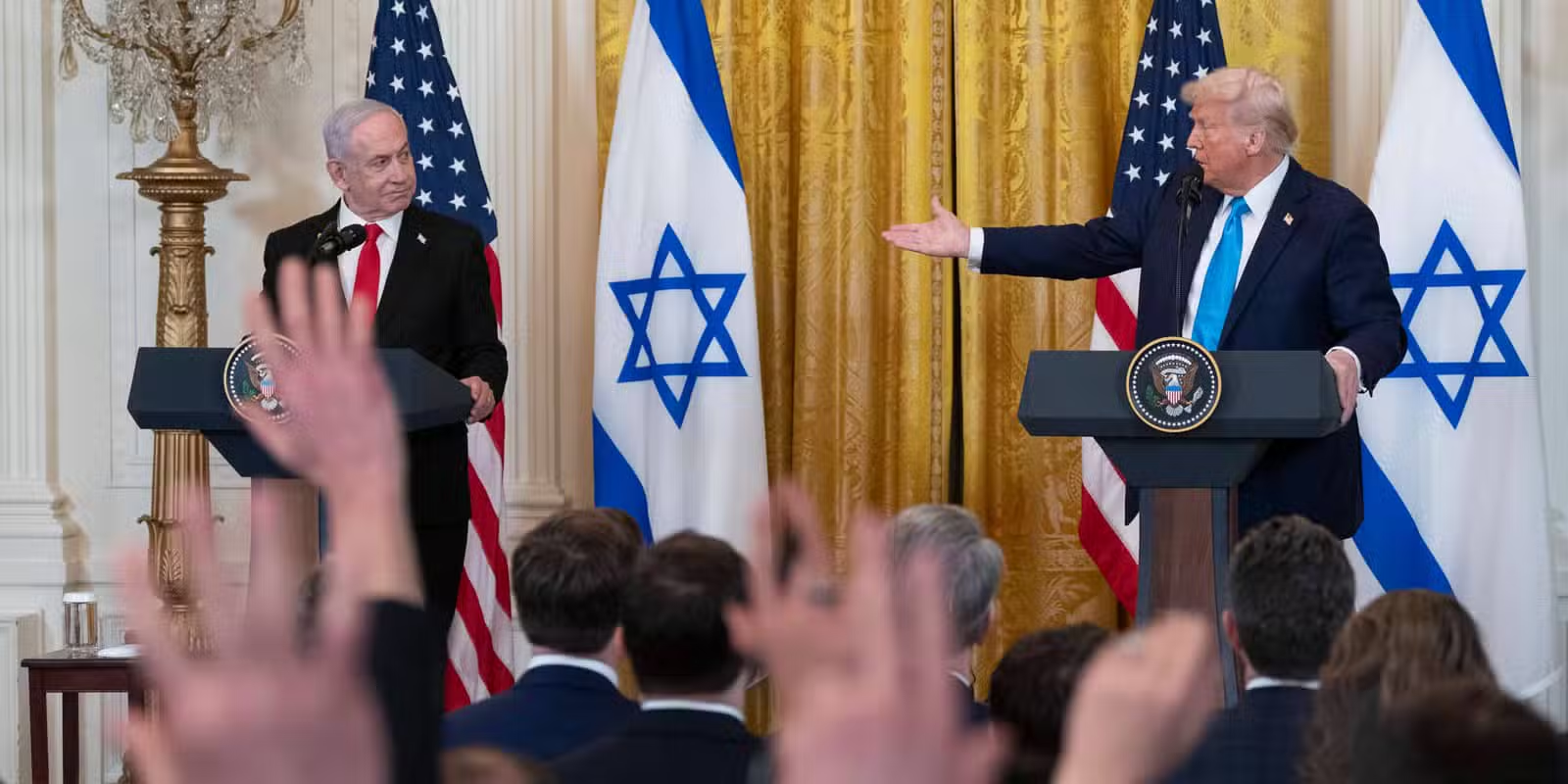
First, the meeting between U.S. President Donald Trump and Israeli Prime Minister Benjamin Netanyahu highlighted Washington and Jerusalem’s shared strategic objectives as they seek to convert the military gains of the past two years into lasting political outcomes. These include preventing Iran from reconstituting its military capabilities, disarming Hamas and Hezbollah, and advancing regional normalization and stability. At the same time, the meeting exposed points of divergence—most notably over Syria and Turkey, policy in Judea and Samaria, and potentially the sequencing and methods for pursuing shared goals. Washington’s raid to capture and arrest Venezuelan President Nicolás Maduro underscored its readiness to use force in pursuit of its interests, a posture also reflected in the participation of U.S. forces in the strike on Iran.
Second, the ongoing protests in Iran have exposed the regime’s vulnerability amid acute economic distress and mounting public opposition to continued rule by the ayatollahs, while also underscoring the opposition’s lack of organization. The regime’s fear of losing control—heightened by President Trump’s warning that the United States would protect demonstrators if Iranian security forces opened fire—has increased pressure on the Supreme Leader to choose between limited accommodation with the West to ease sanctions, or escalation against Israel and the United States to project strength both at home and abroad while suppressing the protests in Iran.
Third, the antisemitic Islamist terrorist attack targeting a Hanukkah celebration in Sydney, in which fifteen people, most of them Jewish, were murdered, demonstrated with lethal clarity the convergence between radical Islam and anti-Israel hostility in parts of the Western left. The electoral victory of Mamdani in the New York City mayoral race is a further reflection of this political dynamic.
Fourth, a series of diplomatic and strategic moves—the Israeli recognition of Somaliland, the trilateral summit among the leaders of Israel, Greece, and Cyprus, the gas agreement with Egypt, the sale of Arrow-3 missile defense systems to Germany, and the launch of civilian talks between Israel and Lebanon—illustrated the potential created by the war for positive shifts in the regional and international landscape. At the same time, Iran and its proxies are working to rebuild their military capabilities, while Turkey, backed by the United States and Qatar, is expanding its regional footprint, particularly in Syria, Lebanon, and the Palestinian arena. The result has been a sharpening of tensions both between Israel and Iran and between Israel and Turkey.
Over the past two months, the Jerusalem Institute for Strategy and Security (JISS) has focused on deepening analysis across these domains, assessing their implications for Israel, and sharing its findings with decision-makers and the broader public—while continuing to provide a platform for additional experts and perspectives.
Within this broader strategic assessment, Anne and Greg Roshandler senior fellow Maj. Gen. (res.) Yaakov Amidror reviewed two years of war, examining Israel’s achievements alongside the challenges that remain. Frank Melloul, an expert in communications and international relations and CEO of i24NEWS, joined the Institute’s research team and outlined a strategy for advancing normalization as a pathway toward breaking entrenched paradigms of hatred in the Middle East. Col. (res.) Prof. Gabi Siboni and Brig. Gen. (res.) Erez Winner, building on their work on the concept of “peace through strength,” clarified the distinction between decisive military outcome and victory and examined the question, “What happened to the IDF?” We also convened a dedicated session with Israel’s National Security Council to present our assessment of the changes required in Israel’s national security doctrine in light of the war.
The Trump–Netanyahu summit, and the lead-up to it, were accompanied by Institute webinars and publications. Following the summit, we convened a webinar assessing its outcomes and implications, with the participation of Prof. Eytan Gilboa, Col. (res.) Dr. Eran Lerman, and Gabi Siboni. Ahead of the summit, I published an article in Israel Hayom and on the Institute’s website addressing the growing need for decisive action in the Gaza and Lebanon arenas. Separately, on Channel 12 and on the Institute’s website, I examined Iran’s deepening distress and the complex dilemmas confronting Iran, Israel, and the United States.
The Palestinian arena received sustained attention through articles by Prof. Efraim Inbar, Dr. Eran Lerman, Prof. Hillel Frisch, Siboni and Winner, and in particular Major (res.) Avi Tal, who examined the issue from multiple angles.
Iran-related issues were addressed from a range of perspectives by Dr. Avi Davidi and Major (res.) Alex Grinberg, including Iran’s use of artificial intelligence and influence operations, its covert activity in the West, its ties with Russia and the post-Soviet space, and Kazakhstan’s accession to the Abraham Accords.
The spread of antisemitism in the West has received increasing attention from the Institute. Following a webinar held in late July warning of the phenomenon’s implications, the issue featured prominently in our strategic dialogue with Australia in the second half of October. The warning signs were clear, yet insufficient action was taken to prevent the Bondi Beach attack. In its aftermath, we convened a webinar examining strategies for combating antisemitism, with the participation of Minister for Diaspora Affairs and Combating Antisemitism Amichai Chikli; Danny Lamm, president of the Institute’s executive board and a leader of Australian Jewry; Maj. Gen. (res.) Amidror; and Jacob Dallal, a JISS research fellow specializing in the field.
On the regional front, the Institute continued to identify strategic opportunities. In addition to Frank Melloul’s work, Dr. Emmanuel Navon analyzed the implications of the gas agreement with Egypt, Israel’s recognition of Somaliland, and the case for responding positively to Kabylia’s declaration of independence from Algeria. Eran Lerman examined cooperation with Greece and Cyprus and prospects for closer engagement with the European Union through regional initiatives. Dr. Ariel Admoni, a JISS research fellow, appeared frequently in the media, focusing in particular on Qatar, and published an analysis of the implications of initial U.S. steps to designate certain branches of the Muslim Brotherhood as terrorist organizations.
This activity generated growing public and media interest, reflected in the following figures:
- 117,000 website users in 2025 (a 30% increase over 2024)
- 158 articles published in English
- 129 articles published in Hebrew
- 3 in-depth research studies in English
- 4 in-depth research studies in Hebrew
- A Jerusalem Paper in Hebrew and English
- 27 events held
- 258 appearances in Israeli media reported on the website
- 222 appearances in international media reported on the website
Brig. Gen. (res.) Yossi Kuperwasser
Head of the Jerusalem Institute for Strategy and Security