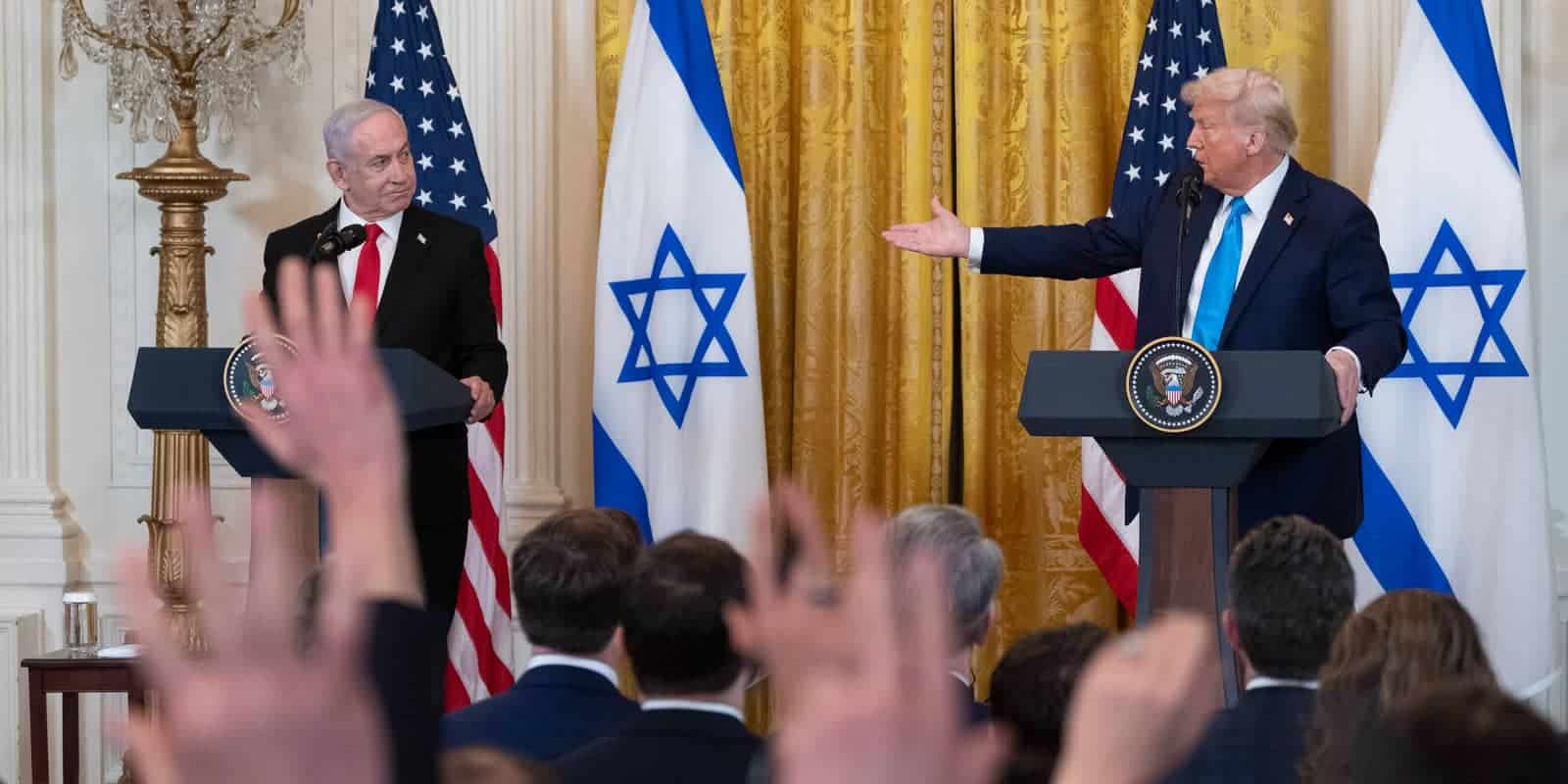



The prolonged war between Israel and its regional adversaries is currently on a relative “low flame,” though its intensity is growing, with all eyes on Prime Minister Benjamin Netanyahu’s visit to the United States, where the path forward will be determined.
Across all theaters, Israel has achieved significant gains in the aftermath of the blow it suffered on October 7. It has struck its enemies forcefully and, with American assistance, compelled Hamas and Hezbollah to take steps they had initially refused—most notably the release of hostages while the IDF remains in the Gaza Strip, and the cessation of fire from Lebanon undertaken in solidarity with Hamas, despite Israel’s continued freedom of action in Lebanon and its ground presence at five points along the border.
Under U.S. leadership, and with the backing of Arab states and the international community, a framework has emerged for arrangements favorable to Israel—most notably the Trump plan for Gaza, which mandates Hamas’s disarmament, alongside the Lebanon ceasefire agreement and a parallel plan for the Lebanese army to disarm Hezbollah.
However significant these achievements may be, they do not in themselves guarantee a lasting or strategically meaningful transformation of the regional landscape. Achieving such a shift—which would amount to victory in the war—requires the complete disarmament of Hamas and either the disarmament of Hezbollah or, at a minimum, preventing it from reconstituting its forces and returning to southern Lebanon.
Realizing these objectives is far more difficult than attaining the goals achieved thus far, because for Hamas and Hezbollah the issue is no longer whether to absorb heavy losses in order to survive and safeguard strategic assets, but whether to make concessions of existential consequence. These demands require both organizations to relinquish a core element of their identity and their control over territory, and would effectively force Hamas to acknowledge that the October 7 attack was a mistake—accepting that, in Palestinian national memory, the operation that once mobilized the Palestinian public will be remembered as a disaster and a grave strategic error.
Because Hamas and Hezbollah refuse to disarm, Israel is seeking to intensify pressure on them to compel their agreement. It is doing so by threatening the use of overwhelming force against them. For such a threat to be effective, it must be credible—that is, they must understand that Israel is prepared to carry it out and that the United States would back such an Israeli move. Securing American support for this course of action is therefore the prime minister’s most urgent task during his visit to the United States.
In the meantime, however, a reality is taking shape on the ground in which Hamas and Hezbollah continue to retain their weapons and status and are doing everything possible to rebuild their capabilities. Israel, for its part—while also using the time to regroup and rearm—is acting in a targeted but increasingly escalatory manner to impede this process (for example, through the targeted killings of Hezbollah’s chief of staff, Haitham Ali Tabatabai, and Hamas’s second-in-command in Gaza, Raad Saad), taking advantage of the freedom of action afforded to it by the rules of the game created by the Trump plan and the Lebanon ceasefire agreement.
The impression is that the U.S. administration has yet to decide whether to back the use of forceful Israeli measures that would make it possible to complete Hamas’s collapse, or to prefer—consistent with its current inclination—to begin implementing Phase Two of the plan (perhaps even without waiting for the return of Ran Gvili’s body), at least in areas under IDF control, without disarming Hamas.
Each path faces numerous obstacles due to the plan’s ambiguity, which requires agreement on small details, the parties’ differing interpretations of the plan’s intent, the multiplicity of parties meant to be involved, and above all – President Trump’s eagerness to demonstrate progress and strengthen the message that the war has ended, even when conditions on the ground actually indicate difficulty in advancing the plan.
To avoid being forced into a strategic decision between completing the war’s objectives and leveraging the successes to date to shape a better security reality for the coming years, on the one hand, and avoiding an unwanted confrontation with an especially friendly U.S. president who nonetheless operates from his own motivations—advancing the U.S. economy, shifting focus to other theaters, and the prospect of a Nobel Prize—which are not identical to ours, even if there is substantial overlap, on the other, Israel must make a supreme effort to persuade Trump that backing Israel to finish the job also serves his interests, among other reasons because it could lead to an expansion of the Abraham Accords. One way to do so is to forge a broad Israeli front on this issue that extends beyond the government. After all, the dispute over the hostages is already behind us.
JISS Policy Papers are published through the generosity of the Greg Rosshandler Family.