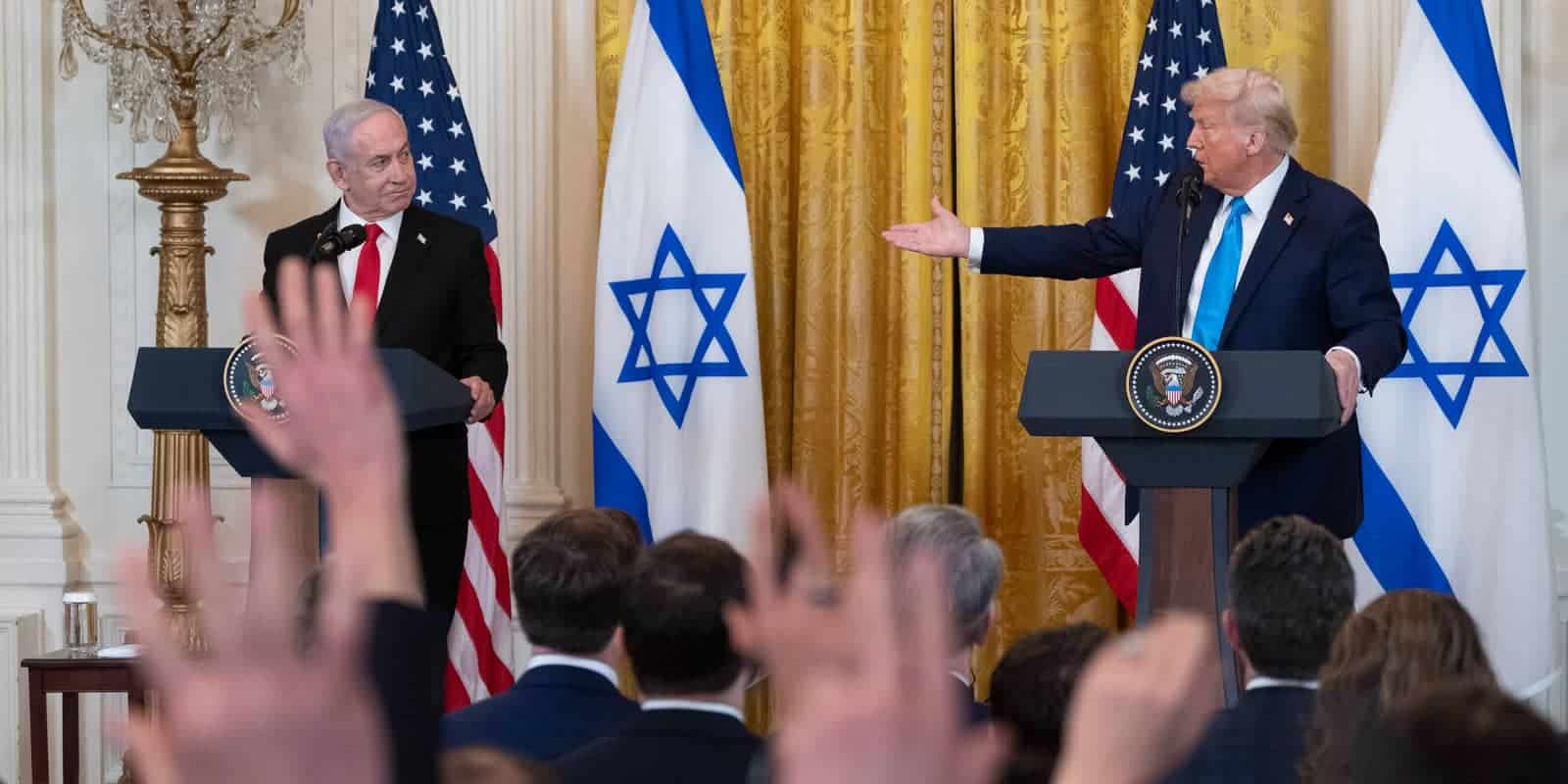


In recent days, Iran has conducted military exercises that included the launch of several missiles. In response, Prime Minister Benjamin Netanyahu stated that Israel would respond forcefully to any Iranian action. According to media reports, he is expected to present President Donald Trump, at their upcoming meeting, with operational plans targeting Iran’s expanding missile array and to request American support for such a move.
These developments must be understood against the broader reality confronting the Iranian regime, which is facing a convergence of pressures unprecedented in scope. Israel and the United States have inflicted extensive damage on Iran’s nuclear program. The missile project has also been hit, and while it has demonstrated an ability to strike Israel, it failed to deter Israel and the United States from striking Iran. Iran’s air-defense systems have been decimated, and since October 7 the regional Iranian axis has suffered severe setbacks. It is now struggling to maintain its viability amid mounting pressure on its main arms—Hamas, Hezbollah, and the pro-Iranian militias in Iraq—to disarm. This is compounded by acute economic distress, reflected in shortages of water and electricity, a rapid depreciation of the rial, and difficulties in stabilizing the digital currency market, all as Western sanctions on Iran continue to intensify.
At the same time, Iran can rely on China’s willingness to continue purchasing nearly all of its oil exports, ensuring annual revenues of approximately $35 billion, as well as on fragmentation within the opposition and widespread public fear of the regime’s security apparatus. As long as China continues to buy Iranian oil, the regime retains sufficient resources to remain solvent, revive its missile program, and assist its proxy organizations in rebuilding and withstanding international pressure.
The regime is also deeply concerned by its strategic and economic situation. It is acutely aware of the hostility directed at it by a majority of the public and fears that a further deterioration in economic conditions, combined with the exposure of its weakness vis-à-vis its adversaries, could ultimately undermine its stability and possibly even its survival. Against this background, the debate between the pragmatic camp and the conservative camp within the circles surrounding Supreme Leader Khamenei has intensified.
The pragmatists stress the need for greater flexibility in order to secure the removal of sanctions, or at least their easing, so that the regime can stabilize itself and, in due course, renew its efforts to export the revolution and bring about the destruction of the State of Israel.
The conservatives, whose power base lies in the Islamic Revolutionary Guard Corps, argue instead that any display of flexibility would be interpreted as weakness, threaten the regime’s survival, and prevent the Iranian revolution from fulfilling its mission—namely, the spread of Shiite Islam and the destruction of Israel. Accordingly, they advocate projecting strength and issuing threats of escalation, and possibly even engaging in actual escalation, in order to compel the lifting of sanctions and obtain international legitimacy for the resumption of uranium enrichment in Iran, even if under restrictions.
At this stage Iran’s demand to resume enrichment is largely symbolic, since damage to its uranium conversion facility and other infrastructure currently blocks its path to a nuclear weapon; over time, however, conceding on this issue could once again reopen Iran’s route to the military nuclear capability.
For now, Khamenei is deferring a decision and focusing on rebuilding Iran’s military capabilities in preparation for the possibility of renewed fighting, with particular emphasis on strengthening ballistic capabilities. This reflects his assessment that such capabilities offer the most effective compensation for the loss of backing from its proxies in the “Axis of Resistance” and the blows dealt to the nuclear program.
He allows conservative hardliners to issue threats and act in ways intended to project strength domestically, deter Israel and the United States, embarrass Israel through offensive activity in the cyber and influence domains (including the hacking of former prime minister Naftali Bennett’s cellphone and the wholesale recruitment of Israeli agents). This is also aimed at providing cover for efforts by the pragmatic camp to advance dialogue with the West that is not conditioned on abandoning uranium enrichment.
The problem with this approach is that it increases the likelihood of escalation. This is due both to the presence of actors in Iran who view escalation as the preferred means of escaping the current predicament and to Israel’s updated security concept after October 7, which prioritizes preventing the emergence of threats rather than containing them, as had been the case previously, alongside statements by Israeli officials threatening action against Iran.
Moreover, Israel and the United States have already crossed the psychological threshold that once deterred them from striking inside Iran; having concluded that the risks are manageable, they no longer face the same inhibitions that in the past allowed Iran’s nuclear and missile programs to reach the scale they had attained before the war.
Has the Time Come for a Preemptive Strike?
Israel therefore faces a difficult dilemma: whether to act now to halt missile production in Iran or to defer such action for the time being. Two developments could ease this decision. The first would be an Iranian offensive initiative that would compel an Israeli response. At this stage, Khamenei appears to have authorized the development of a capability for such action, while exercising caution in approving its actual use. The second would be success in preventing further progress in Iran’s ballistic project through covert means, or actions for which Israeli involvement can be plausibly denied, while enlisting the United States to participate in this effort.
Since the 12-day war in June, there have been reports of damage to stockpiles of raw materials used in missile fuel production, seizure of vessels transporting prohibited materials from China to Iran, and a series of explosions at facilities across Iran. The prevailing impression, however, is that while these actions may have delayed the realization of Iranian intentions, they have not stopped them. Accordingly, the dilemma remains unresolved.
The arguments in favor of an early strike are clear. The longer action is delayed, the greater the threat will grow, and the more Iran’s air-defense capabilities will improve. Iran does not conceal that its missiles are directed first and foremost at Israel, and preventive logic dictates that it is therefore preferable to act swiftly to address the threat.
Moreover, the future is unlikely to present a better opportunity. The axis is at a low point in terms of its ability to mobilize a deterrent response against Israel, and the Iranian regime itself is under significant strain, such that a strike on its ballistic capabilities could serve as a trigger for destabilizing its rule. An additional blow to Iran at this stage would further complicate its efforts to rebuild its regional axis.
In any event, from an operational perspective Israel has already demonstrated its ability to inflict significant damage on Iran at a painful, although not strategically decisive cost, and it is likely that the longer Israel waits, the higher the price it will be required to pay when it does act.
At the same time, there are considerations in favor of a measured delay. First, American backing for such an operation is of critical importance and, at present, is not assured. The United States was responsible for brokering the ceasefire between Israel and Iran and viewed with concern Israel’s intention to mount a broad response to the last Iranian attack of the twelve-day conflict. Washington appears to prefer exhausting the potential of economic pressure and efforts to disrupt Iran’s attempts to accelerate missile production, rather than risking a resumption of hostilities—after having touted its success in bringing about de-escalation (or “peace,” in President Trump’s words). Second, Israel faces several tasks that are no less urgent, foremost among them the disarmament of Hamas and Hezbollah. Third, this remains a highly complex undertaking.
Even during Operation Rising Lion, the damage inflicted on Iran’s missile arsenal was only partial. Many facilities in its production and storage network are underground, and it is unclear how complete Israel’s intelligence picture is or whether it currently has the operational capability to neutralize them. Neither is it clear to what extent Israel’s missile-interceptor stockpiles have been replenished ahead of a renewed confrontation. Moreover, segments of the Israeli public would like to see a continuation of the relative calm recently following two years of war.
While it is not difficult to justify a strike in light of Iranian threats, it is less clear to what extent the “Begin Doctrine”—under which Israel will not allow its regional adversaries to acquire nuclear weapons—applies to a preemptive strike against the threat of a large missile arsenal. It is also the case that changes in the severity of the threat are gradual, and that a limited period of waiting would not lead to a dramatic deterioration—unless Iran were to decide to operationalize the threat.
On balance, the considerations favoring a strike appear more compelling than those supporting delay, not least because such a strategy risks prolonged postponement, ultimately allowing the threat to grow into a far more serious one. In any event, it is essential to secure an American green light from President Trump for such a far-reaching move, in part because this would not be a one-off strike.
It is equally important to exhaust alternative courses of action—economic pressure, diplomatic activity, and above all covert efforts—and to make clear to Iran that any escalatory response on its part would lead Israel to expand its target set to include economic and regime assets. At the same time, Israel should improve its missile-defense capabilities as much as possible and be prepared for the possibility that Iran initiates the next round of fighting.
The article was originally published in Hebrew on N12.
JISS Policy Papers are published through the generosity of the Greg Rosshandler Family.
Source: https://jiss.org.il/en/kuperwasser-to-strike-or-not-to-strike/