
Introduction
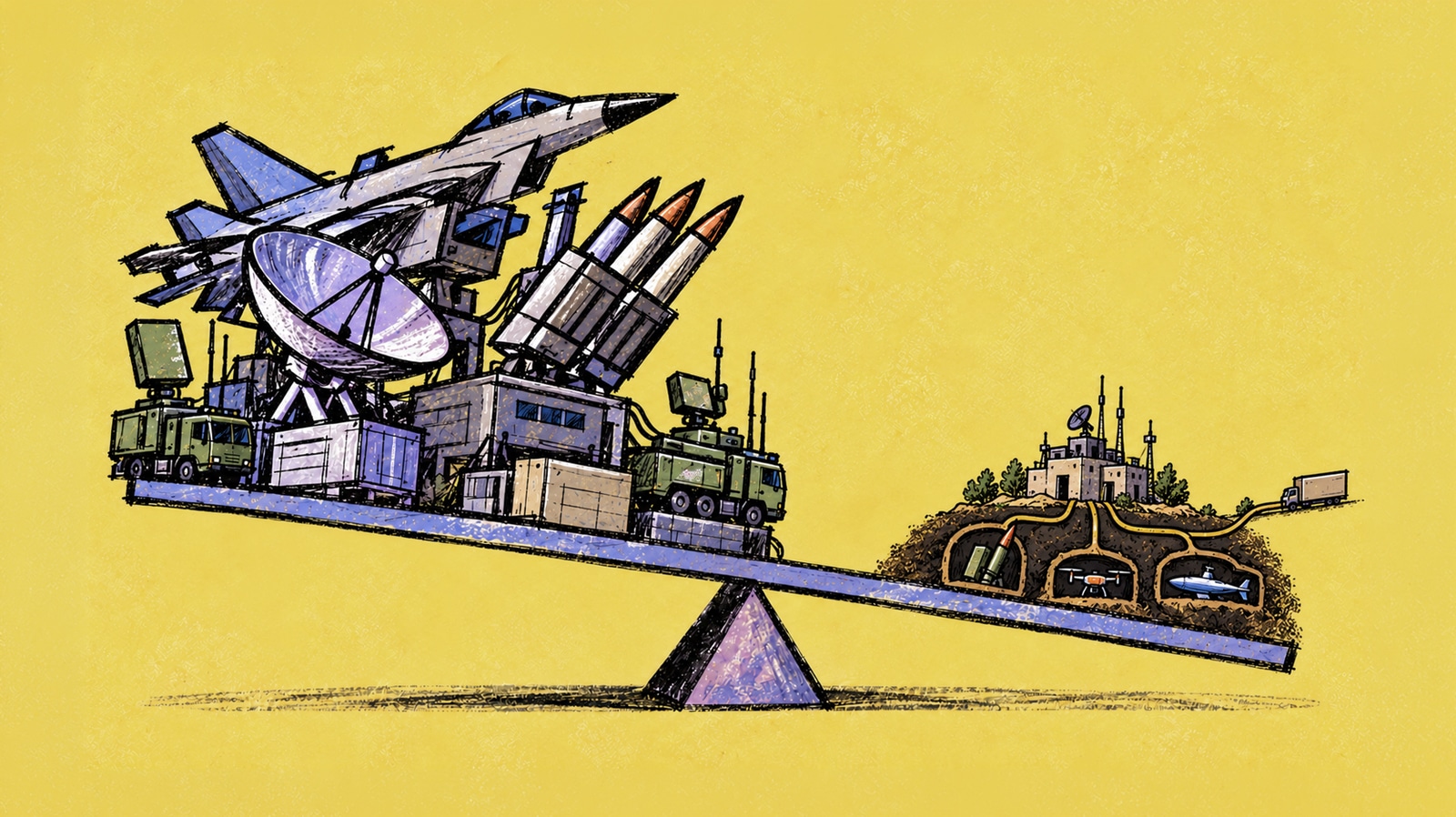
The ongoing fighting between the Houthis and Saudi Arabia illustrates a familiar problem: a wealthy country with advanced fighter aircraft, air defenses, and even security partnerships with other states is struggling to confront a determined terrorist organization with state-like capabilities The Saudi failure does not mean technology has become less important. What it shows is that technology without fighting spirit or a relevant operational doctrine guarantees neither decisive victory nor even adequate protection.
The Houthi crisis is a test of the Gulf security order. It exposes the gap between grandiose declarations, such as the Mecca Alliance, and the actual ability to provide efficient defense. The Houthis are more than an Iranian proxy controlled from afar or just another local militia. They are an armed governing entity with mechanisms for recruitment and resource extraction, control over a population, a territorial foothold, and access to advanced Iranian knowledge and technology. They have territorial depth and political flexibility. They possess a range of missiles, unmanned aircraft, and naval weapons. They employ information warfare and benefit from outside assistance. They can absorb strikes, rebuild their capabilities, and choose when to attack. Even after heavy strikes, the Houthis retained their launch capability and continued to threaten Israel and Red Sea shipping.[1] The central question, then, is not simply how many targets can be destroyed, but how to turn tactical gains into systemic change.
Saudi Arabia faces economic strain alongside Houthi military pressure. Riyadh’s situation is best described as a crisis of priorities rather than collapse. It must simultaneously fund its Vision 2030 projects, sustain high defense spending, and protect energy facilities, ports, and shipping routes despite fluctuating oil revenues. The 2026 budget projects a $44 billion deficit, following on from an estimated deficit of $66 billion in 2025,[2] with public debt rising in 2026 to $433 billion.
A State-Like Terrorist Organization Versus a Major Defense Spender
The Houthis gain an advantage by combining guerrilla warfare with the practices of a state. They can disperse launchers and depots among civilians, conceal infrastructure, move quickly between launch sites, and store weapons in civilian areas. At the same time, they wield capabilities once reserved for states. The U.S. Defense Intelligence Agency has documented similarities between Iranian systems and the missiles and unmanned aircraft used by the Houthis.[3] This combination gives the organization a dual advantage: it enjoys the relative immunity of a nonstate actor while functioning, in practice, as a state with a large regular army and substantial firepower at multiple ranges.
A second advantage lies in the economics of war. An advanced interceptor missile can cost far more than the aircraft it targets. Even a successful interception requires the defender to maintain radars, control centers, crews, readiness, and stockpiles over time. The attacker chooses when to launch, from which direction, and with what combination of weapons. It can send slow drones ahead of fast missiles, target airports, ports, energy facilities, and urban centers, and pursue disruption as well as destruction. Every hour an airport remains closed, every ship diverted, and every increase in insurance premiums represents a gain. Interception rates alone can therefore give a misleading picture of success. The real test is whether the country can maintain functional continuity.
A further advantage is the Houthis ability to link conflicts across theaters. A single attack on Saudi Arabia can advance their struggle inside Yemen, send a message to Iran, put pressure on the United States, threaten global trade, and weaken the Saudi crown prince’s standing. Their campaign reaches beyond physical damage to shape perceptions, undermine confidence in the regime, and erode economic stability. They need not seize Saudi territory to achieve this: demonstrating that they can set the agenda and undermine the government’s promise of security is enough.
For years, Saudi Arabia has devoted vast sums to force buildup. The United States supplied Saudi Arabia and the United Arab Emirates with at least $54.6 billion in military equipment between 2015 and 2021. But buying equipment does not necessarily make a force ready for combat. A modern army needs more than weapons and platforms: it needs troops with the will to fight and an operational doctrine to guide them.
The campaign also demonstrates the limits of defense. No system can guarantee complete protection, particularly against combined salvos, hard-to-detect threats, and sustained attacks. Defense must be multilayered, but it must also be selective. Command centers, energy infrastructure, aviation facilities, ports, bases, and population centers must receive priority. Hardening, redundancy, dispersal, rapid repair capabilities, and plans to continue operating under fire are also necessary. A defender seeking to intercept every threat at any price may win each individual engagement while losing the economic campaign.
Saudi Arabia’s Vision 2030 makes the problem more acute. The kingdom seeks to diversify its economy, expand tourism, attract capital, and build vast infrastructure. All depend on a sense of stability. The Houthis are therefore attacking more than military targets: they are attacking the premise on which the entire Saudi undertaking rests. Even limited damage can lead to canceled flights, postponed investments, soaring insurance costs, and reputational harm. Home-front defense thus becomes an integral part of economic strategy.
The Hollow Mecca Alliance
A mutual defense agreement has meaning only when it creates certainty for adversaries and partners alike. The Mecca Alliance between Saudi Arabia, Turkey, and Pakistan may look impressive on paper. Turkey contributes a vast military, a developed defense industry, operational experience, and production capacity; Pakistan contributes nuclear capability, military depth, personnel, and extensive experience; Saudi Arabia contributes resources, location, and influence. But bringing three powers together does not create an integrated system. In the face of Houthi attacks, the declaration that an attack on one alliance member is an attack on all remains no more than a slogan.
The test is not whether alliance leaders act against the Houthis, but who provides warning, intercepts attacks, strikes the sources of fire, replenishes stocks, and bears the costs of escalation. There is also a difficult political question: Will Turkey and Pakistan risk a confrontation with Iran to defend Saudi Arabia? Would they act if the circumstances of an attack were unclear, if the Houthis denied responsibility, or if a response threatened to widen the war? Unless the members agree on the answers beforehand, the alliance may prove hollow just when it is needed.
The Mecca Alliance and Saudi relations with the United States must be considered in the context of a broader shift. The international system is becoming multipolar and competitive. Great powers sometimes prefer to provide weapons, intelligence, and political support while avoiding an automatic commitment to fight for their partners. Middle powers respond by spreading their risks: they buy weapons from several suppliers, maintain ties with rival camps, and preserve the option of changing course. This approach offers flexibility in peacetime but can create ambiguity in the event of war or conflict.
A credible alliance requires more than a temporary overlap of interests. It requires a shared understanding of the threat, mutual dependence, and the ability to bear costs. Saudi Arabia can maintain ties with Washington, Ankara, Islamabad, Beijing, and even Tehran, but when those relationships are tested, it needs to know which will translate into action. Its partners also need to know what is expected of them. As long as these questions remain open, multiple partnerships do not necessarily mean greater strength.
The Gulf Cooperation Council faces similar issues. Statements supporting Saudi Arabia carry political weight, but they cannot replace integrated defense. The council’s statement following the Houthi attacks emphasized that the Gulf states stood with Riyadh. Yet condemnations cannot intercept a missile or repair damage to an airport. Turning solidarity into security requires linked radar networks, regional warning, assigned sectors, common standards, and the ability to transfer interceptors and spare parts quickly.
The confrontation with the Houthis is more than another limited round of fighting between Saudi Arabia and a local force in Yemen. It is part of a long struggle over the future shape of the Middle East. Recent decades have seen a model of quasi-sovereign organizations emerge in the region. They control populations and territory, maintain firepower, conduct international relations, and run economies, yet do not bear all the obligations of a state. This ambiguity works to their advantage. They can demand recognition when it suits them while disavowing responsibility for the damage they cause. They receive assistance from a patron state but retain enough autonomy to let that patron deny direct responsibility.
In this respect, the Houthis represent an advanced stage in the evolution of the Iranian threat. Tehran need not control every decision in Sanaa to benefit from the very existence of an armed force that threatens Saudi Arabia, Israel, and shipping routes. It is enough for their interests to align at critical moments and for Iran to provide knowledge, components, and political support. Iran thereby extends its influence without bearing all the associated costs or placing itself on the front line. The result is a regional system in which the boundaries between war and peace, proxy and partner, and state and organizational responsibility become blurred.
Saudi Arabia’s Choice
Saudi Arabia faces a choice between models of national security rather than between the United States and regional alternatives. One option for Riyadh is to rely on Washington for weapons, intelligence, logistical support, and diplomatic backing. The advantage here is that American support offers depth and quality; the shortcoming of this model however is that it depends on political will in Washington, which can change, as Israel experienced during the War of Redemption. Another option is to rely on flexible regional alliances. The advantage here is that it offers partners who are closer to home and more readily available, though gaps in their capabilities, conflicting interests, and distrust limit what they can provide. The third model is greater defense autonomy, however that would take years of investment in personnel, industry, intelligence, command capabilities, and, above all, developing human capital.
Saudi Arabia must develop a security concept suited to its needs, because ultimate responsibility for its security remains its own. Relying on a single ally to solve its problem will therefore always pose difficulties. Partners can offer different forms of help. The United States can provide advanced systems and logistical support, while Turkey can assist with drone production and procurement and with tactical defense. Pakistan can contribute personnel and experience, and Egypt is essential to Red Sea security. Israel can offer unique experience in layered defense, intelligence, home-front protection, and operations against missile systems.
The lesson of the Saudi experience is not that a modern military fails against cheap weapons. It is that turning material advantage into diplomatic influence requires matching the means to the objective. Saudi Arabia seeks to restore Yemen to central government control, push the Houthis away from its border, sever their ties to Iran, or bring about their dismantlement. Each objective requires a different operational response. When objectives accumulate without priorities, military action becomes a substitute for a political decision rather than a means of achieving it.
The Houthis pose a threat to Saudi Arabia that extends beyond direct damage. They seek to undermine confidence in the vision for the kingdom’s development and portray major investments, tourism, and infrastructure as vulnerable to disruption. The lesson is clear: In a modern economy, resilience requires more than the ability to recover and return to prosperity once the fighting has ended: essential functions must continue during the fighting as well. A country that cannot sustain aviation, energy, communications, health services, and trade under pressure will struggle to preserve its diplomatic freedom of action over time.
Lessons for Israel
Israel obviously has a direct interest in weakening the Houthis. They have fired missiles and unmanned aircraft at Israel, threatened Eilat and shipping routes, and joined Iran’s campaign across multiple theaters. Israel should therefore make full use of the opportunities presented by the Saudi–Houthi confrontation. The Houthis remain a threat: they belong to a network that destabilizes the region through operations across several theaters, and Israel must prepare accordingly on a broad front. Yet that threat also gives Israel an opening. It shows regional governments the limits of diplomatic declarations and the need for meaningful operational partnerships. Israel’s diplomatic and security experience creates several possible avenues of cooperation.
1. Intelligence and operational cooperation: Develop a shared picture of the threat that enables regional countries to counter the networks through which Iran’s proxy axis extends its influence and builds military strength.
2. Regional security architecture and integrated defense: Advance a collective security framework based on information sharing, regional early warning, and close political and security coordination against cross-border threats.
3. Strengthening partnerships and securing trade routes: Safeguard freedom of navigation and protect the arteries of the regional and global economy from disruption by substate actors.
4. A regional diplomatic track: Leverage the shared threat to gradually build a regional framework in which security and professional cooperation provide the foundation for greater stability in the Middle East.
A prolonged campaign across multiple theaters quickly reveals how much depends on the rate at which interceptors, precision munitions, spare parts, and electronic components can be produced. Israel must develop the ability to expand production in times of war, stockpile raw materials and critical components, disperse production sites, and establish alternative procurement channels. Cooperation with the United States and other partners is essential, but it must supplement an Israeli industrial base rather than replace it. This degree of independence does not eliminate dependence, but it reduces the extent to which external constraints can determine a campaign’s duration and intensity.
The threat to Eilat and shipping routes requires Israel to treat the sea as a permanent theater of operations rather than a secondary front. It needs a shared maritime picture with regional and international partners, protection for port infrastructure, the ability to escort commercial traffic when necessary, and coordination among intelligence, the air force, and the navy. At the same time, Israel must reduce its economy’s dependence on a single route through logistical alternatives, adequate stockpiles, and arrangements with additional ports in the Mediterranean region.
Cooperation among Israel, Saudi Arabia, and other states can develop even without a full public alliance; practical arrangements are also valuable. These could be implemented in stages and may include sharing of alerts, coordinating flights, identifying threats, synchronizing detection systems, conducting exercises to defend infrastructure, and exchanging expertise. Israel should offer capabilities that create mutual dependence, while taking care not to promise more than it can deliver in a crisis. The modern battlefield also demands national resilience. A state can preserve its freedom to make political decisions and resist the dictates of substate organizations or their patrons only if it has the national resilience to keep its economy, energy systems, and infrastructure operating under fire.
Israel’s ability to provide an area defense umbrella, or at least help create one, strengthens its position and its role in regional projects such as the India–Middle East–Europe Economic Corridor (IMEC).
Conclusion
The Saudi–Houthi conflict shows that material and technological superiority guarantees neither deterrence nor decisive victory. The Houthis are an armed governing entity that can absorb attacks, rebuild its capabilities, and operate under Iranian patronage. Countering such an adversary requires using force in pursuit of a clear political objective. It also requires disrupting the adversary’s force buildup and changing the cost-benefit calculations of both the enemy and its patrons.
The Saudi experience also exposes the limits of alliances built on declarations, procurement, and dependence on external suppliers. Sustainable national security requires a shared operational doctrine, warning and coordination mechanisms, stockpiles of munitions and components, emergency production and rebuilding capabilities, and selective defense that keeps the military, the economy, and essential infrastructure functioning under fire.
The Houthi threat requires Israel to treat the Red Sea as a permanent theater of operations, strengthen its industrial independence, expand protection for the home front and trade routes, and develop regional partnerships grounded in practical arrangements rather than promises. Israel can leverage the shared threat to advance intelligence cooperation, regional defense, and deeper ties with Saudi Arabia and other countries. Its success will be measured not only by the number of threats it intercepts or targets it strikes, but also by its ability to preserve freedom of political action, keep the country functioning, and turn operational gains into a more stable regional order.
[1] United Nations Security Council, “Final Report of the Panel of Experts on Yemen Established pursuant to Security Council Resolution 2140 (2014)”, S/2025/650, October 17, 2025.
[2] Timour Azhari and Rachna Uppal, Saudi Arabia forecasts deficit of $44 billion in 2026 budget, Reuters, December 2, 2025.
[3] USA, Defense Intelligence Agency, “Iran: Enabling Houthi Attacks Across the Middle East”, February 6, 2024.
Source: https://jiss.org.il/en/siboni-winner-hollow-alliances-a-changing-battlefield-and-opportunities-for-israel/