

Introduction
For years, the West treated the Iranian threat too narrowly, looking at it primarily as a problem of nuclear proliferation. The debate centered on centrifuge numbers, enrichment levels, breakout time, IAEA oversight, and the terms of successive agreements. As IAEA reports make clear, that framework was too limited.[1] It allowed Iran to turn the nuclear issue into a recurring diplomatic contest in which every tactical retreat could be presented as an achievement and every violation as a response to external pressure. Iran, however, is not simply a state using its nuclear program as a bargaining tool. It is a revolutionary regime that sees itself as pursuing a religious and ideological mission. The nuclear program is thus only one component of a broader system of power, regime survival, coercion, and projection of influence.
For that reason, the campaign against Iran cannot end with the suspension of its nuclear program or the destruction of nuclear facilities. Even a deep, highly precise, and powerful strike on those facilities would only buy time; it would not remove the source of the threat. Nor would an agreement with the ayatollah regime. The threat does not originate in the centrifuges, the tunnels in Isfahan, the enriched-uranium stockpile, or in Iran’s missiles. It originates in the Iranian regime itself—a murderous revolutionary and ideological regime that has made its nuclear program, ballistic missiles, and proxy network central instruments to ensure its survival and expand its influence.
The nuclear program is the regime’s most dangerous manifestation, but it is not the underlying problem. That problem is the worldview of a regime that regards confrontation with Israel and the West, and the export of its own form of radical Islam, as its core purpose, as a means of mobilizing loyalty at home and abroad, and as justification for maintaining its powerful mechanisms of repression. As long as nuclear capability remains tied to regime survival, no technical agreement can provide a permanent solution. Even a stringent inspection regime, if one can be achieved, would still face a state intent on concealment, delay, and the exploitation of loopholes. The key question is not only how many centrifuges are dismantled, but who retains the power to decide that they should be rebuilt.
U.S. policy toward Iran contains a basic tension between limited policy objectives and a much broader diagnosis of the Iranian challenge. Washington has traditionally defined its goals in narrow terms: preventing Tehran from obtaining nuclear weapons, imposing sanctions, maintaining deterrence, and preserving the option of renewed negotiations. Even when the United States uses force, it tends to present military action as a means of changing Iranian behavior rather than necessarily overthrowing the regime. Yet official U.S. policy documents describe the challenge much more broadly, linking the nuclear program to terrorism, missiles, the Islamic Revolutionary Guard Corps, domestic repression, and Iran’s efforts to undermine the regional order.[2] The contradiction is clear. If the source of the threat lies in the nature of the regime rather than in any single technical capability, a policy limited to delay, inspections, or economic punishment leaves intact the machinery that can ultimately rebuild the threat.[3]
The United States is an essential partner for Israel, but Jerusalem cannot assume that Washington’s goals will be identical to its aims. The United States has recently emphasized that it too seeks regime change, primarily through economic pressure, yet it may ultimately settle for weakening Iran and forcing it back to the negotiating table. Israel cannot afford to stop there. The war is not only about Iran’s nuclear facilities, but also the regime that has integrated those facilities, its proxies, and its missiles into a unified purpose.
As long as the regime remains in place, damage to the nuclear program can provide only a temporary reprieve. Accumulated knowledge cannot be erased and scientists and engineers will be recruited to replace those who have been eliminated. Industrial capacity will be rebuilt, and more of the program will be moved deeper underground and into more clandestine frameworks. Air strikes can destroy facilities, but they cannot eliminate Iranian intent or determination. Neutralizing the nuclear threat therefore requires confronting not only the physical program, but also the intent behind it, the mechanisms that reproduce it, and the regime that nurtures it.
The Lesson of Iraq: Destroying the Program Is Not Enough
The Iraqi nuclear project did not end with the June 1981 strike.[4] After the 1991 Gulf War, compulsory international inspections exposed the scale of Iraq’s clandestine nuclear program and dismantled its nuclear capabilities. Saddam’s regime, however, survived for another twelve years, until it was overthrown following the US-led invasion of Iraq in 2003. In this broader sense, the Iraqi nuclear threat ended only with the fall of the regime that had pursued it. Only when the regime behind the project ceased to exist did the threat lose its political, organizational, and coercive foundations. The Iraqi precedent should therefore not be reduced to the destruction of a single reactor. Israel did not strike Osirak and thereby solve the problem; it would be more accurate to say that Israel set off a long-term struggle against a hostile nuclear project that was only finally ended when the regime pursuing it collapsed.
Iran is a more dangerous and far more complex challenge than Iraq was in 1981. Its nuclear program is dispersed and fortified, rests on a broad domestic knowledge base, and is supported by industrial and military infrastructure built over many years. It is also integrated with Iran’s ballistic-missile forces, air-defense systems, intelligence apparatus, and regional proxy network. Osirak was a clearly defined target; Iran’s nuclear program is a complete system, and the response must therefore address the system as a whole.[5] Striking nuclear sites is necessary but not sufficient. Such attacks can create a window of opportunity, but only sustained political, economic, information, and military pressure aimed at destabilizing the regime can turn that opening into the desired outcome.
A successful air campaign can destroy facilities, damage enrichment systems, demolish conversion infrastructure, strike stockpiles of sensitive equipment, kill scientists and commanders, and disrupt chains of command and control. It can weaken the regime, puncture its sense of immunity, expose its vulnerability, and shatter the narrative of unshakeable resistance. In Iran’s case, these achievements may be essential. What air power cannot do is substitute for a durable strategic outcome. An air campaign, however, cannot erase knowledge, eliminate an ideology, dismantle the secret police, dissolve the Revolutionary Guards, or ensure that the regime will not rebuild what strikes have destroyed.
The relevant measure of a campaign against Iran’s nuclear program is therefore not only the scale of the physical damage, but the political end state it produces. The objective is not simply to strike facilities, but to deny the Iranian regime the ability, determination, and legitimacy to rebuild the program. That requires sustained action on several fronts: broad military attacks on Iran’s economic infrastructure alongside continued economic pressure; diplomatic isolation; overt support for opposition forces and civil society in Iran; action against the mechanisms of repression; and an international framework of legitimacy that makes clear that the problem is not only the nuclear program, but the continued existence of a revolutionary regime seeking weapons of mass destruction.
Why Military Strikes Alone Are Insufficient and Why the Regime Must Fall
One of the recurring failures of Western policy toward Iran has been to treat its nuclear program, missile arsenal, terrorism, and domestic repression as separate problems rather than as interconnected elements of the same system. In fact, they are arms of the same system. The Islamic Revolutionary Guard Corps is not simply another military organization within the state; it is a state within the state, wielding economic, intelligence, military, and ideological control.[6] It operates the Quds Force beyond Iran’s borders and the Basij at home while controlling economic networks that finance both arenas. A campaign confined to military targets and infrastructure therefore leaves intact the organizational engine capable of rebuilding the project.
Some claim that regime change is too far-reaching an objective. But the opposite is true as a regime that has invested decades and vast resources in a nuclear program, ballistic missiles, and a proxy network will not willingly abandon them just because several facilities have been damaged. The Iranian regime has already shown that it is prepared to sacrifice the welfare of its citizens, its economy, and regional stability to preserve its power. It will not dismantle itself voluntarily. Pressure must therefore be applied systematically and over time, on the understanding that the regime itself is the center of gravity.
Regime change need not mean a full-scale foreign occupation of Iran. The country is large and complex, and any attempt by an outside force to occupy parts of it or impose direct control could prove disastrous. But the choice is not between occupation and limited strikes. A wide range of measures lies between them. Pressure can and should be directed at the regime’s coercive machinery: the Revolutionary Guards, Basij bases, domestic intelligence services, the economic infrastructure serving the ruling elite, and the regime’s ability to finance the forces through which it exercises power. At the same time, the Iranian people should understand that the outside world seeks to free them from a regime that has made them hostages to a nuclear project, foreign wars, and domestic repression.
Regime change also has a moral dimension. A regime that executes opponents, represses women, persecutes minorities, finances terrorism, and repeatedly declares its desire to erase Israel cannot credibly claim immunity in the name of stability. The stability it offers is an illusion built on fear, corruption, and the export of violence. Its removal is therefore not only an Israeli interest, but a regional and international one. It could open the way for a different Iran—one that returns to its rich culture, sustains a functioning economy, and maintains good relations with its neighbors rather than serving as a revolutionary base for exporting chaos.
The contest over public perception is also important. The regime presents the Iranian public with a narrative of resistance to external enemies while in reality placing Iran itself at risk and condemning its citizens to poverty, isolation, sanctions, and continuing wars. The campaign should therefore be framed not as a war against Iran, but as a war against a regime that has taken control of Iran. This is more than mere messaging. It is integrative to the campaign as unless the regime’s domestic legitimacy is undermined, Tehran may be able to turn even military failure into a narrative of sacrifice and victory.
The Ring of Fire, the Nuclear Question, and a Window of Opportunity
Iran’s ring of fire around Israel was built up over decades. Hezbollah in Lebanon; Hamas and Palestinian Islamic Jihad in the Gaza Strip and Judea and Samaria; the Shiite militias in Iraq and Syria; and the Houthis in Yemen formed part of an integrated Iranian strategy that was never a collection of separate local projects. Its purpose was to keep war away from Iran’s borders, wear Israel down through proxies, build deterrence, and preserve the regime in Tehran as the center of power. The proxies were intended to shield Iran on the day Israel moved against the nuclear program, while nuclear capability was meant to place the proxy network under an umbrella of immunity. Under that umbrella, Iran could intensify proxy activity, deter Israel and the United States, and force the region to contend with a terror state that had become a nuclear power—or at least a nuclear-threshold state.
The regional axis served two purposes: protecting the regime and attacking Israel. For years, Tehran preferred to fight to the last drop of Lebanese, Palestinian, Syrian, Iraqi, or Yemeni blood, provided Iran itself did not have to pay a direct price. That logic broke down when the war reached the very heart of Iran. Once the regime understood that its proxies were no longer shielding it but were instead drawing fire toward Iran itself, an important crack appeared in the regime’s strategy. That fissure, however, will matter only if its full potential is exploited. Iran’s response is predictable: rebuild, conceal, accelerate, and portray mere survival as proof of victory. Israel and the United States must therefore deny the regime the ability to convert survival into a cognitive victory.
The campaign against Iran’s proxies and the campaign against its nuclear program are therefore inseparable. Dismantling Hamas, weakening Hezbollah, striking the militias, blocking smuggling routes through Syria and Iraq, and containing the Houthis in the Red Sea are all parts of the same effort. Iran’s nuclear threat cannot be neutralized without dismantling the proxies that protect it, just as the proxy network cannot be dismantled without striking the center that finances, arms, trains, and directs it. The campaign must consequently operate on two levels at once: against the regime, its nuclear facilities, missile forces, and command centers; and against its proxies, transfer routes, economic infrastructure, and information systems.
Iran has suffered severe blows far beyond the strikes on its nuclear sites. Key parts of its military and logistical machinery have been dismantled, including the command echelon, air-defense systems, portions of its missile and UAV infrastructure, domestic security institutions, intelligence services, and some of the economic arteries that sustain the regime. The attacks exposed the weakness of Iran’s defense-in-depth doctrine. Capabilities built over years around dispersal, redundancy, and presumed immunity proved vulnerable when confronted with real-time intelligence, air superiority, precision weapons, and advanced cyber capabilities. The damage to Iran’s air-defense systems and air force was equally important: systems designed to protect the regime’s core assets proved inadequate against the combination of intelligence, precision fire, and air superiority. The regime’s security and economic mechanisms were also hit.[7]
These blows do not mean that the regime has lost its capacity for repression or its ability to inflict damage. They have, however, opened a window for sustained pressure. The regime remains in place, but it is weaker, more exposed, more dependent on outside assistance, and more vulnerable to domestic, economic, and diplomatic pressure. Regional states are also reassessing their relations with Tehran and their place in the emerging regional order. This is a moment that demands strategic courage and long-term thinking. History teaches us that hesitant statesmen see windows of opportunity slam shut. A wounded, disoriented, and isolated hostile regime should face greater pressure, not relief. A premature ceasefire, a weak interim agreement, or economic relief granted without the genuine dismantling of capabilities would give the regime precious time to recover.
Under these conditions, a diplomatic agreement or compromise could easily become a vehicle for recovery rather than a solution. An arrangement that limits enrichment while leaving the missile infrastructure intact, fails to expose all nuclear stockpiles, preserves the proxy network, and leaves the regime’s mechanisms of repression untouched will only postpone the problem under worse conditions. The regime will learn from the attack, conceal and disperse its assets more effectively, place facilities deeper underground, and eventually return to the breakout threshold from a stronger position. The relevant test is therefore not whether to strike or negotiate, but whether each military or diplomatic step advances the objective of regime change—or at least the deep destabilization of the regime.
The crisis in international monitoring makes this problem more acute. Recent IAEA reporting, together with assessments by research institutes tracking the issue, points to a serious erosion in the ability to verify what is happening at Iran’s nuclear sites, stockpiles that cannot be fully accounted for, and restrictions on access to sensitive information and facilities.[8] Under these conditions, a return to a discourse of inspections and agreements risks creating a false sense of security. If there is no reliable way to determine where Iran’s nuclear material is located, the condition of its centrifuges, or the pace at which Tehran is rehabilitating its nuclear program, a new Iranian commitment has limited value. What matters is not another signed document, but a change in the balance of power that deprives the regime of the ability to violate an agreement.
Courses of Action
The central policy question is the campaign’s end state. The United States does seek regime change and hopes to achieve it through sustained economic pressure. Yet Washington may still regard halting Iran’s nuclear project and reopening the Strait of Hormuz to free navigation as sufficient objectives and may therefore prefer a relatively rapid end to the fighting based on deterrence, inspections, sanctions, and arrangements ostensibly designed to prevent Iran from returning to a nuclear-weapons breakout path. That position may reflect recognition of both the difficulty of overthrowing the regime and a desire to avoid high oil prices, a prolonged military entanglement, and uncontrolled regional instability. But as this analysis shows, the regime would in any event seek to rebuild its capabilities, conceal its assets more effectively, place more infrastructure deep underground, and gradually return to its previous course. For Israel, halting the nuclear project therefore cannot be a sufficient end state.
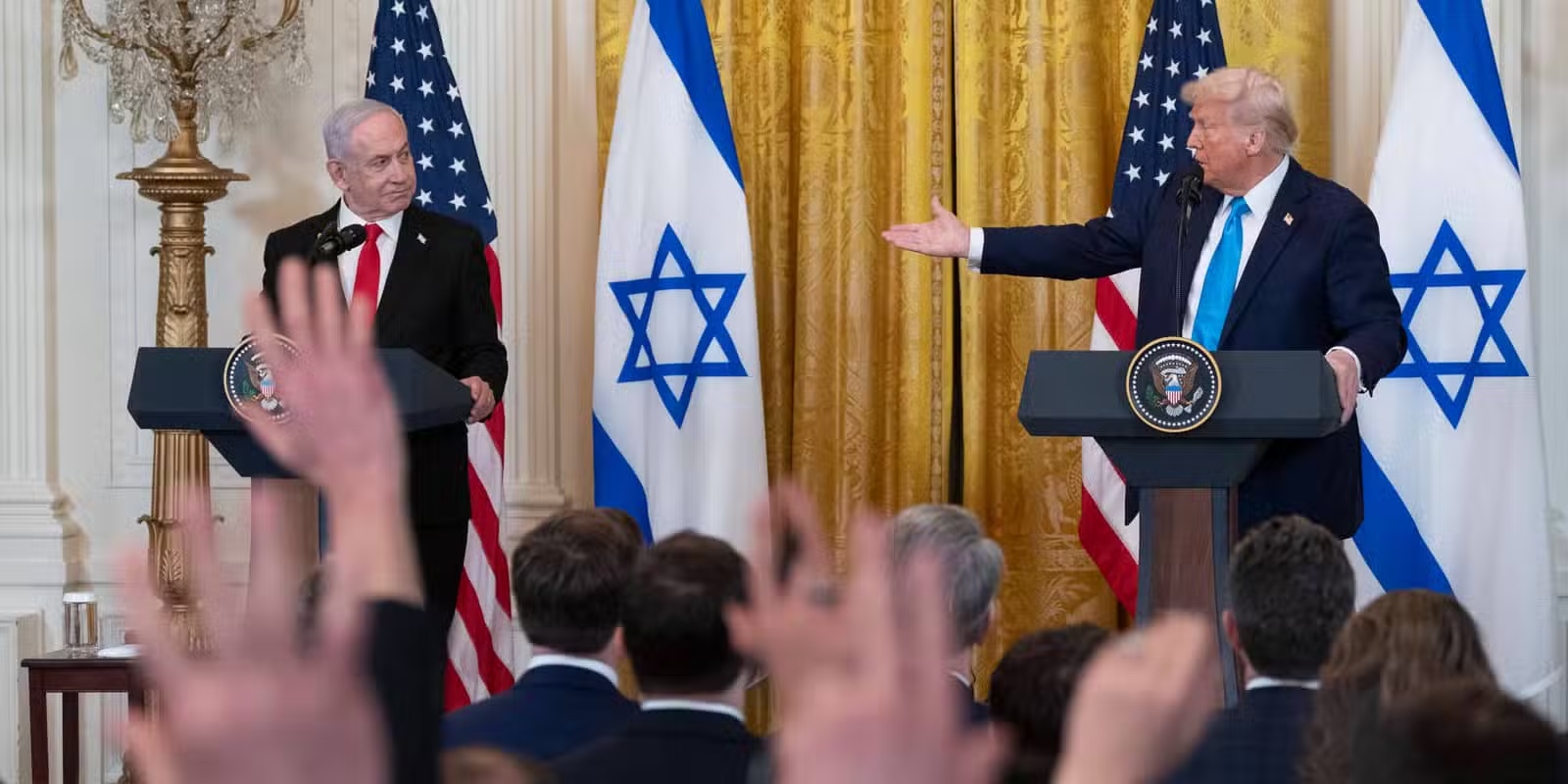
Internal U.S. contradictions over the Iran issue are themselves difficult to resolve. President Trump said in an interview that an agreement with Iran is not worth the paper it is written on,[9] while almost simultaneously his treasury secretary said that the U.S. objective is to create the conditions that will make the Iranians want to return to the negotiating table.[10] Israel must regard the overthrow of the regime, or, at minimum, the deep and irreversible destabilization of its power structures, as the campaign’s overriding objective. That difference in end states should define Israel’s approach: close coordination with Washington, but without surrendering an independent and clearly defined Israeli objective.
Israel should translate that objective into a clear operational concept. First, publicly and in closed discussions, it should define the campaign’s purpose as eliminating the Iranian threat at its source rather than delaying the nuclear program for several years. Second, it should coordinate with the United States on the objectives of renewed military action if and when it occurs. Those objectives should include a sustained campaign to destroy Iran’s economic infrastructure through repeated strikes, attacks on industrial infrastructure, disruption of reconstruction efforts, and continuous intelligence monitoring, alongside crippling sanctions. Third, Israel should strike at the core of the regime’s power: the Revolutionary Guards, the Basij, the intelligence apparatus, and the units responsible for domestic repression and operation of proxies. Fourth, it should conduct an information campaign that clearly distinguishes between the Iranian people and the regime, emphasizing that Israel’s enemy is not the Iranian people but the regime holding them hostage. Fifth, Israel should work with regional states to prevent Iran from rebuilding its ring of fire and, separately, to block other axes involving Turkey, Qatar, or other actors that seek to threaten it.
A further line of effort is practical cooperation with elements of the Iranian opposition capable of operating against the regime. Introducing organized Kurdish forces into western Iran could create an internal ground front while the regime’s command, security, and military structures are already under pressure. This option was blocked during the most recent campaign because of opposition from the Turkish president, whose pressure led Trump to back away from the plan. Israel should nevertheless seek to advance such moves. Their significance would lie not only in the ability to seize territory or strike Revolutionary Guard units, but above all in their cognitive effect. An armed anti-regime presence inside Iran could puncture Tehran’s image of absolute control, force the regime to divide its forces, and demonstrate to Kurdish, Baluchi, Azeri, and Arab communities, and to opponents of the regime in the major cities, that an uprising is a real possibility. It could also reinvigorate opposition forces and turn dispersed protest into a cumulative challenge to the regime’s hold on power.
Campaign success should not be measured simply by the number of facilities destroyed. The more meaningful indicators are political and organizational: whether the regime has lost the ability to command its forces; whether the organs of repression are struggling to control the streets; whether the Revolutionary Guards’ economic base has been damaged; whether the proxies have lost their flow of funding and weapons; whether Iranians increasingly believe that the regime endangers them more than it protects them; and whether the international community recognizes that any arrangement that fails to address the regime at the root of the problem can only be temporary.
Meanwhile, planning for the period after the regime has been destabilized must begin in advance. The purpose is not to prescribe Iran’s future for the Iranian people, but to establish several principles: preserving Iran’s territorial integrity; preventing the Revolutionary Guards from reasserting control; dismantling the military nuclear program; ending funding for the proxy network; opening Iran to investment and normal regional relations; and supporting a domestic process that allows the Iranian public to choose a leadership that does not threaten its neighbors. These principles are necessary both to prevent a dangerous vacuum and to demonstrate to Iranians that a viable alternative to the ayatollah regime exists.
Conclusion
The debate over Iran has reached a decisive point. The world can longer be taken in by the illusion that the Iranian threat can be managed through temporary agreements, partial inspections, and even limited strikes. A regime that has turned its nuclear program into an insurance policy, missiles into instruments of coercion, and proxies into a regional offensive system will not voluntarily surrender those assets. If Israel and the United States launch a new military campaign against Iran, they must therefore be prepared to continue it until the regime has been destabilized, its power structures dismantled, and its leadership brought to justice. The Iraqi precedent shows that fighter aircraft can open the way, but only the fall of the regime can bring the process to completion. In Iraq, regime change ultimately came through a U.S.-led coalition ground invasion. That does not mean that Iran’s regime could be brought down only through a ground campaign; a popular uprising could also bring it down. In Iran, the objective is not revenge, but national security, regional stability, and the prevention of an existential threat. What begins with Israeli strikes on Iran’s nuclear sites must end with the end of the rule of the ayatollahs.
Success against Iran will not be measured the day after a strike, but by what remains of the machinery that has threatened Israel and destabilized the region for decades. If the regime remains secure, the Revolutionary Guards rebuild their capabilities, and the West returns to offering relief in exchange for promises, the attack will become only another chapter in a continuing struggle. If, by contrast, the campaign treats the nuclear program, missiles, proxies, and domestic repression as parts of a single system, this moment could become a historic turning point. The objective will not be easy to achieve, but it is the correct one. Israel cannot afford a policy that merely postpones the threat. Against a revolutionary regime seeking nuclear immunity, the objective must be to eliminate the threat at its source.
[1] David Albright et al., Analysis of IAEA Iran Verification and Monitoring and NPT Safeguards Reports – June 2026. ISIS Report, June 9, 2026.
[2] The Administration of Donald J. Trump, “National Security Presidential Memorandum on Imposing Maximum Pressure on the Government of the Islamic Republic of Iran, Denying Iran All Paths to a Nuclear Weapon, and Countering Iran’s Malign Influence,” February 4, 2025.
[3] Clayton Thomas, “Iran: Background and U.S. Policy,” Congressional Research Service, May 22, 2025.
[4] Battle, J., & Burr, W. (Eds.). (2021). Israeli Attack on Iraq’s Osirak 1981: Setback or Impetus for Nuclear Weapons? 2021.
[5] Eisenstadt et al., Attacking Iran’s nuclear program”, The Washington Institute for Near East Policy Notes, No. 157, 2025.
[6] Economic Fury Ramps Up Pressure on Iran’s Islamic Revolutionary Guard Corps Oil Operations, U.S. Department of the Treasury, May 11, 2026.
[7] Gabi Siboni and Erez Winner, “The Waning of the Iranian Crescent,” JISS, April 13, 2026.
[8] Implementation of the NPT Safeguards Agreement and relevant provisions of the United Nations Security Council resolutions in the Islamic Republic of Iran, IAEA, GOV/2026/33, June 4, 2026.
[9] Trump: An Agreement with Iran Isn’t Worth the Paper It’s Written On, Iranwire, September 2, 2026.
[10] Bessent sets four conditions for US-Iran talks, JNS, September 1, 2026.
JISS Policy Papers are published through the generosity of the Greg Rosshandler Family.
Source: https://jiss.org.il/en/siboni-winner-neutralizing-the-iranian-threat/