


Introduction
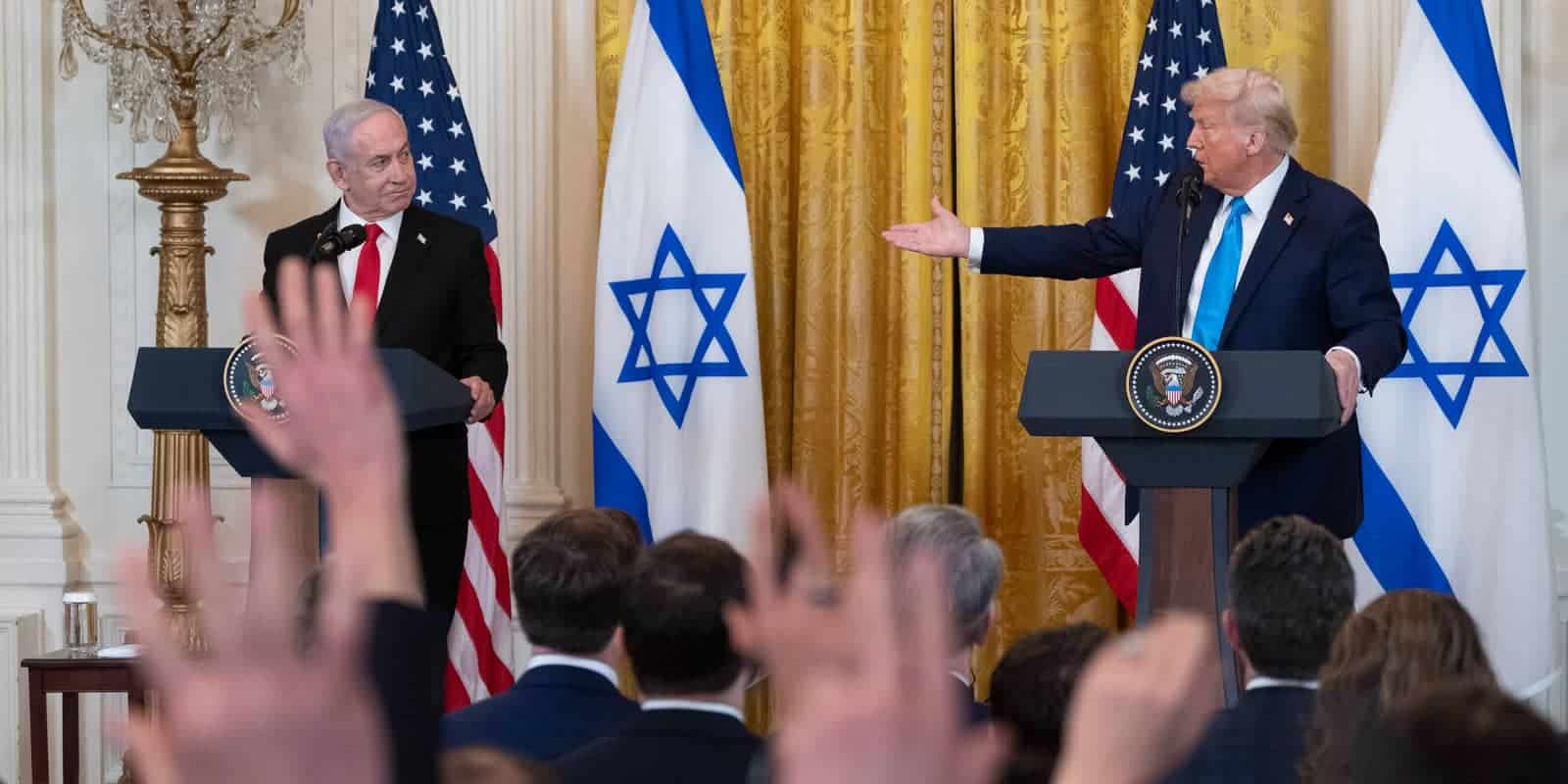
On September 29, 2025, United States President Donald Trump presented a comprehensive plan to end the war in Gaza. The plan, referred to as the “Trump Plan,” received broad international support, including from Arab and Muslim states, and was adopted by the UN Security Council in Resolution 2308. The plan is a 20-point roadmap aimed at securing the release of the hostages (as of the time of writing, all living hostages have been freed and only one dead hostage remains), transforming the Gaza Strip into a demilitarized area free of terrorism, and enabling economic reconstruction and development for its residents, while ensuring the security of the State of Israel and preparing the ground for expanding the Abraham Accords.
The agreement was designed as a phased process, with clearly defined stages and benchmarks for moving from one stage to the next. Oversight of implementation was entrusted to the United States, with Trump himself heading the “Board of Peace”— the international body supervising the process—together with former British Prime Minister Tony Blair. Responsibility for security in the Strip will be assigned to an international stabilization force, whose authorities and composition have yet to be determined.
The Security Council resolution approving the agreement transferred overall responsibility from the UN to the Board of Peace. In addition, the plan effectively prevents the Palestinian Authority from governing the Strip until it undertakes far-reaching reforms.
This article seeks to examine the agreement, analyzing its advantages and disadvantages on the eve of the possible transition to the second phase—a transition that carries the potential for disagreements between Israel and the United States over the disarmament of Hamas and the start of the reconstruction process. It also seeks to show how Israel can maximize its gains while fully realizing the objectives of the war. In our view, the agreement creates historic opportunities alongside risks that require Israel to insist on strict implementation of its various stages. As President Trump himself said in his address to the Knesset on October 13, 2025: “Gaza will be demilitarized, Hamas will be disarmed—and Israel’s security will no longer be threatened.”
Analysis of the Agreement: Details, Advantages, and Disadvantages
The plan consists of 20 clauses divided into clearly defined, incremental phases, with binding conditions for moving between them. The main points are as follows: The first phase, most of which has already been carried out, focused on a ceasefire and the release of hostages. This phase, however, has not yet been completed, as the body of the fallen soldier Ran Gvili has still not been returned. Israel, for its part, released 250 prisoners serving life sentences and another 1,700 Gazans detained after October 7, 2023. In addition, for each fallen soldier returned, Israel handed over 15 bodies of Gazans.
The agreement also stipulates that Hamas will be disarmed and Gaza demilitarized. Implementing this provision is the true test of the plan. Article 13 of the agreement requires that All military, terror, and offensive infrastructure, including tunnels and weapon production facilities, will be destroyed and not rebuilt. There will be a process of demilitarization of Gaza under the supervision of independent monitors, which will include placing weapons permanently beyond use through an agreed process of decommissioning, and supported by an internationally funded buy back and reintegration programme.” Yet, Hamas is strengthening its grip in the areas it controls, and it does not appear to have any intention of disarming.
Hamas and the other factions committed not to participate in any form in the administration of Gaza; all terrorist infrastructure is to be destroyed and not rebuilt, and the demilitarization process will be conducted under international supervision. After the release of all the hostages, Hamas members may lay down their arms and receive amnesty, and those who wish to leave the Strip will be given the option of safe passage to other countries.
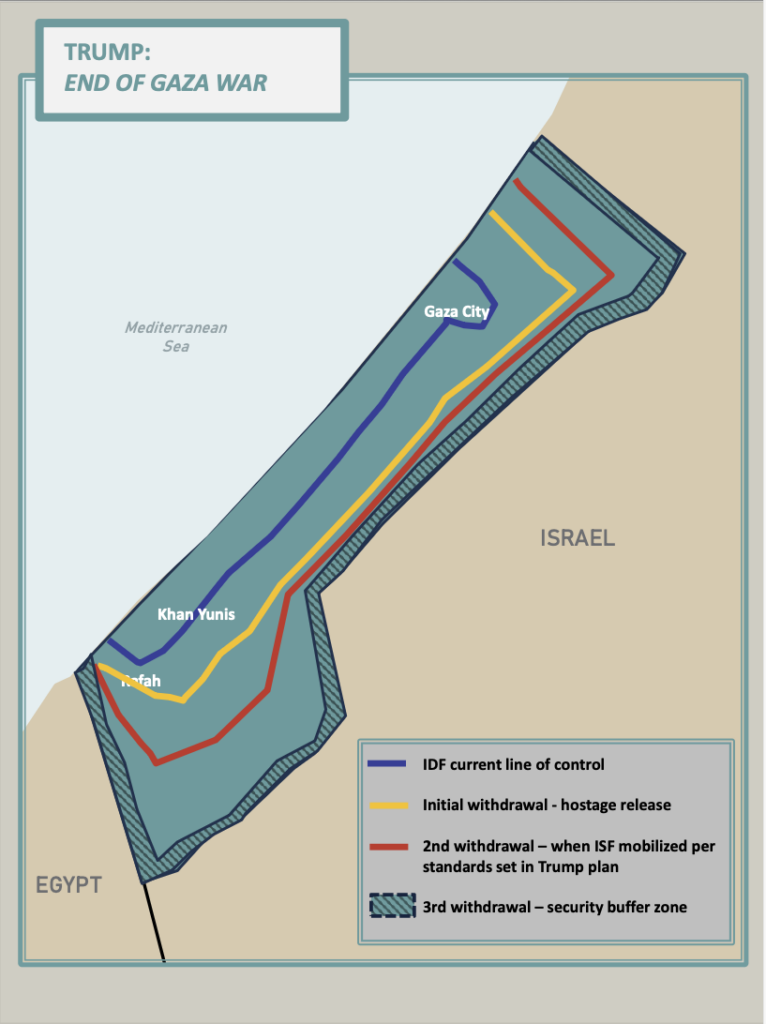
The agreement states that the war will end once IDF forces withdraw to agreed lines. Humanitarian aid will be increased and provided in large quantities, at least at the levels stipulated in the January 19, 2025 agreement, including infrastructure rehabilitation (water, electricity, and sewage), rehabilitation of hospitals and bakeries, and the entry of equipment for debris removal and road clearance. It is further stipulated that aid distribution will be carried out through the UN and its agencies, the Red Crescent, and additional international organizations not affiliated with either side.
The agreement also offers an economic plan for the reconstruction and development of Gaza. The Strip will be temporarily administered by a Palestinian technocratic and apolitical committee that will provide civil services and operate under the supervision of a new international transitional body—the Board of Peace—headed by President Donald Trump, with the participation of additional leaders, including former British Prime Minister Tony Blair. This body will set the framework for rehabilitation of the Strip and manage funding until such time as the Palestinian Authority completes the reforms required of it. Article 17 of the agreement clarifies what will occur in the event of noncompliance: “If Hamas delays the implementation of its disarmament, the aid operation will continue in terror-free areas transferred from the IDF to the international stabilization force.”
The agreement also stipulates that the United States will work to establish a temporary international stabilization force that will enter the Gaza Strip. Articles 14–16 include regional guarantees, an international stabilization force supported by Jordan and Egypt, and a gradual IDF withdrawal—but only after full demilitarization. The stabilization force will train and support Palestinian police forces who undergo vetting and will coordinate its activities with Jordan and Egypt. The force will work with Israel and Egypt to secure the borders and prevent weapons smuggling, while facilitating the rapid and safe movement of goods.
Regarding migration, Article 12 guarantees freedom of movement: “No one will be forced to leave Gaza, and those who wish to leave will be free to do so and free to return.” The agreement states that Israel will not annex Gaza and that the IDF will withdraw according to milestones and conditions determined in consultation between the IDF, the international force, Arab states, and the U.S. As for a future Palestinian state, the plan notes that once reforms in the Palestinian Authority are implemented, conditions may be in place for a credible pathway to Palestinian self-determination and statehood. Articles 10–11 include a development plan led by experts from the Gulf states, a special economic zone with reduced tariffs, and the encouragement of investment.
Advantages and Disadvantages of the Agreement
Before discussing the agreement’s advantages and disadvantages, we must be clear and state that this agreement is the lesser of two evils. Our view is that it would have been preferable for Israel to conquer Gaza fully, impose a temporary military government in the Strip, and work to dismantle Hamas militarily and administratively— this in fact was the first of the war objectives originally set by the Israeli government. However, the IDF did not wish to, or failed over the course of two years, to achieve anything approaching this, despite the nation’s resources being placed at its disposal. The plan should only be analyzed with this taken into account.
The agreement offers Israel many advantages, some of which have already materialized.
First and foremost, the release of the hostages. This issue was a wound at the heart of Israeli society, and the success in securing the release of all the living hostages and the overwhelming majority of the dead hostages is a historic achievement that many did not believe could be attained. It is not only the end of the families’ suffering but also a highly significant psychological achievement that brings Israel closer to absolute victory.
Second, the international consensus on disarming Hamas and excluding it from any role in governing the Strip. Although this has yet to materialize, Israel is well-positioned to pursue this war objective. The agreement forces Hamas to relinquish control of the Strip and ensures the destruction of all terrorist infrastructure. However, it remains unclear how this will be implemented. No international actor is willing to enter the Strip and undertake Hamas’s disarmament. Hamas will attempt to deceive, as it always does, and Israel will have to ensure it is fully disarmed. It is important, in our view, to clarify that there are voices already interpreting “disarmament” as referring only to heavy weapons. The essence of the agreement is the complete demilitarization of the Strip, including small arms, and it is essential that Israel insist on this.
Moreover, maintaining the IDF’s presence inside the Strip, surrounding the areas controlled by Hamas, is essential for ensuring the implementation of the agreement’s security components and for guaranteeing that Gaza will no longer pose a threat to the State of Israel. The insistence on maintaining a presence in the Philadelphi Corridor is also a major achievement. Israel’s experience in the wake of the 2005 disengagement from Gaza was that international guarantees have no value when it comes to preventing weapons smuggling into the Strip. Maintaining a presence along the Gaza perimeter is a vital security asset. The agreement conditions Israeli withdrawal on progress in its implementation. Unlike past agreements, there will be no Israeli withdrawal without full implementation of each stage. The agreement also grants Israel the right to maintain a “security perimeter presence that will remain until Gaza is properly secure from any resurgent terror threat.” Thus, Article 16 effectively anchors the long-term presence of the IDF along the entire perimeter of the Gaza Strip.
Another advantage is that the plan insists on tightly supervised reconstruction of the Strip, with aid limited to areas free of Hamas presence. In our view, Israel must insist on Hamas’s disarmament before any reconstruction process begins. The issue of migration is also on the table. Allowing Gaza residents to leave the Strip under broad international agreement, including that of Egypt—which is the gateway for large-scale departure from the Strip—is another important achievement. This presents an opportunity to work directly with the population to enable emigration to other countries, on the assumption that recipient states will be found and willing to take in significant numbers as part of the agreement.
Another important advantage is the fact that the UN will play no substantive role in Gaza (aside from participating in food distribution and humanitarian aid). The Security Council resolution effectively transferred responsibility from the UN to the Board of Peace, headed by President Trump. The agreement also severs the failed Palestinian Authority from the Strip until far-reaching reforms are implemented. It is unclear whether the PA will be able to meet the reforms required for it to function effectively—the cessation of incitement, the end of support for terrorism, and the end of funding for terrorists who carried out attacks against Israelis and their families.
The broad international legitimacy for the agreement presents Israel with an opportunity to achieve its war aims and, together with the U.S., to activate the political component of Israel’s strategy—“peace through strength.” International involvement does indeed come with costs, but it must be remembered that Israel has the right to determine which states will participate in the technocratic civil administration and constitute the temporary stabilization body. Israel will oppose the inclusion of Qatar and Turkey, supporters of the Muslim Brotherhood, in this body.
Despite the advantages listed above, the risks in the agreement require Israel’s political and military leadership to maintain vigilance. First, Hamas’s refusal to disarm could lead to renewed fighting. The organization continues to rebuild and deepen its hold over the areas under its control, as well as its hold over the Gazan population. We have witnessed executions in areas from which the IDF has withdrawn, the collection of taxes from merchants, and the takeover of aid entering areas under Hamas control.
Turkey, Qatar, and Egypt are pushing for what they call “flexibility,” but in practice such “flexibility” would lead to erosion of the agreement. This is a critical risk, and Israel must insist on strict compliance with the agreement. These states will attempt in every way possible to enable Hamas to play a role in governing the Strip behind the scenes. Allowing them to do so will cast a shadow on the functioning of any technocratic committee established to administer Gaza.
The mention of a Palestinian state in the agreement (Article 19) constitutes a serious political landmine for Israel. Integration of the Palestinian Authority as past of the governing framework in the Strip is conditioned on broad reforms. Yet here too there is cause for concern about pressures to erode the agreement. Israel has not demonstrated great success in meeting the requirements of the Oslo Accords, including its consent—under American pressure—to include Hamas in the elections, the establishment of the heavily armed Dayton Force, again under American pressure and funding, and more. There is concern that Israel will not withstand pressure to return the failing Palestinian Authority to center stage under the lip service of “reforms.” Israel failed to ensure that the obligations of the Oslo Accords were fulfilled—for example, under American pressure, it agreed to allow Hamas to participate in elections, and the creation of the heavily armed U.S-funded Dayton Force.
Finally, bringing international actors to the heart of the conflict, with the United States responsible for implementing the plan and foreign forces operating in the Strip, could on the one hand lead to unwanted frictions between Israel and these states, and on the other hand serve as a model for other contexts related to the Israeli–Palestinian conflict. This is a dangerous precedent for Israel and constitutes a risk to Israel’s ability to ensure its security independently.
Israel’s Courses of Action
The key test of the agreement lies in the transition to the second phase, in which Hamas is meant to disarm and relinquish its rule as a condition for Gaza’s reconstruction to commence. Hamas’s opposition to giving up its weapons effectively guarantees that this phase will not proceed as planned. In terms of governance, Hamas is working to manufacture a façade of separation between the organization and the technocrat committee that will administer the Strip.
Hamas is attempting to implement Hezbollah’s model in Lebanon, where the Iranian proxy pulls the strings from behind the scenes. Since all the states expected to contribute forces to the stabilization mission have openly declared that they will not deploy their troops to disarm Hamas, then, if Hamas does not change its nature and agree to disarm, either the current temporary situation will become the long-term reality, or the task of disarming Hamas will fall to the IDF. This time, however, Israel would be able to carry out the mission without the pressure and constraints imposed by the presence of Israeli hostages. Moreover, it will do so while it already controls all the commanding ground in the Strip.
This time, now that the previous Military Advocate General, who opposed the imposition of a siege and impeded the use of force, is no longer in her post, we hope that Israel will be able to act professionally (and legally) to move the civilian population out of areas where it intends to fight, thus freeing it of any obligation to bring in humanitarian aid. This will make it easier to capture territory and destroy Hamas with less risk to our troops.
The agreement anticipated this scenario, and it is addressed in Article 17:
“In the event Hamas delays or rejects this proposal, the above, including the scaled-up aid operation, will proceed in the terror-free areas handed over from the IDF to the ISF. “In other words, reconstruction and civilian support will begin in the areas currently under IDF control that have already been cleared of Hamas infrastructure.
Advanced preparations are underway to implement the first phase of reconstruction in the area under Israeli control, in order to create an attractive alternative for the population living in the areas controlled by Hamas. This is in addition to establishing an exit route from Gaza for anyone who wishes to leave—and many will.
Once the process begins, we will see more and more residents wanting to leave Hamas-controlled areas—and others who would gladly depart the Strip entirely if given the possibility. A quiet process along these lines has been unfolding in recent weeks, though the numbers leaving Gaza so far are only in the low hundreds. A higher rate of departure depends primarily on finding a receiving country willing to accept Gazans seeking to leave in substantial numbers.
Within the coming month we will likely see the first elements of the multinational force arriving in the Strip. The force is slated to commence establishing “model cities”—urban zones with improved living infrastructure and support systems administered by the Board of Peace. This will create significant pressure on Hamas and encourage residents to leave the areas under its control.
Conclusion
The Trump Plan marks a historic turning point: the return home of the hostages, the prospect of demilitarization and reconstruction, broad international support, and the potential expansion of Israel’s alliances with numerous Arab and Muslim states. These are immense opportunities that could reshape the Middle East and strengthen Israel’s position as a regional power. Yet the risks—chiefly the possibility of failure in demilitarizing and dismantling Hamas, along with regional pressures—require firmness and resolve from Israel’s leadership.
From the outset, the plan was met with criticism of its perceived weaknesses in safeguarding Israel’s interests. In practice, however, the agreement grants Israel the authority to determine which countries will send troops to the multinational force and who will certify Hamas’s compliance at every stage. Contrary to alarmist claims, no Qatari or Turkish troops will join the stabilization force without Israel’s approval. Israel retains veto power vis-à-vis the United States on every critical provision of the agreement.
Even the less favorable clauses from Israel’s perspective—such as references to the Palestinian Authority playing a role in Gaza and to a Palestinian state—are constrained by significant conditions. These ensure that before the PA can participate in the process, it must undergo profound change and, in effect, alter the Palestinian narrative.
At this stage, the IDF maintains full control over the entire perimeter of the Strip and all controlling ground. All of the lines of withdrawal are conditional on complete Hamas compliance. For example, the first withdrawal is contingent on Hamas being disarmed and removed from power in Gaza.
This is not an attempt to paint a rosy picture, but an effort to offer a sober assessment. Naturally, there are, and will continue to be, significant pressures from the states that signed the agreement, led by Turkey, Qatar, and Egypt, to give up on certain demands, accelerate reconstruction, soften the definition of technocratic governance, or relax criteria for full disarmament.
Insisting on full compliance with the agreement and continued enforcement against every Hamas violation—as is happening today—is essential to completing the agreement and maximizing its gains. So far, Israel has held its ground, and the United States sees most issues eye-to-eye with Israel. To maintain this trajectory, it is crucial that the agreement be upheld to the letter and that Israel project strength, as it has until now.
Israel’s insistence on the elimination or surrender of the terrorists trapped underground in southeastern Rafah was crucial for precisely this reason. Despite pressure from the mediators, and despite the American desire to move forward and avoid what Washington viewed as a marginal issue, Israel held its ground and demonstrated resolve—and rightly so. Here too, media briefings and public outcry predicted surrender and concessions, yet with time it has become clear that Israel did not yield at all, and those terrorists are dying or surrendering one after another.
This sends a message to the Arab world and to the international community: Israel in 2025 acts and conducts itself differently from Israel in 2023. Israel is enforcing its security requirements on its enemies and holding firm even in the face of intense external pressure. “Peace through strength” is not a mere slogan—it is a reality that requires continuous enforcement. With UN approval and American support, Israel stands before a genuine opportunity, but only if it ensures that the agreement is upheld to the letter. The major test— Hamas’s disarmament—will determine whether risk or opportunity triumphs.
JISS Policy Papers are published through the generosity of the Greg Rosshandler Family.