


Introduction
Iran and Venezuela are two countries that, at first glance, appear fundamentally distant—geographically, culturally, and politically. Yet over the past two decades, their relationship has steadily deepened into what can best be described as a shadow strategic partnership, built on shared isolation, common adversaries, and aligned interests. Despite different historical trajectories, both regimes face similar structural pressures: international sanctions, limited access to global financial channels, and growing incentives to bypass Western-controlled systems.
What began as diplomatic convergence has increasingly evolved into an operational alliance, structured around concrete mechanisms designed to preserve regime resilience and expand strategic room for maneuver. Tehran and Caracas have not merely exchanged political support; they have progressively developed a layered ecosystem—financial, logistical, and informational—aimed at reducing the impact of sanctions and enabling alternative channels of cooperation. For Iran, Venezuela offers a permissive foothold in the Western Hemisphere. For Venezuela, Iran provides expertise, networks, and tools that help sustain economic continuity under pressure.
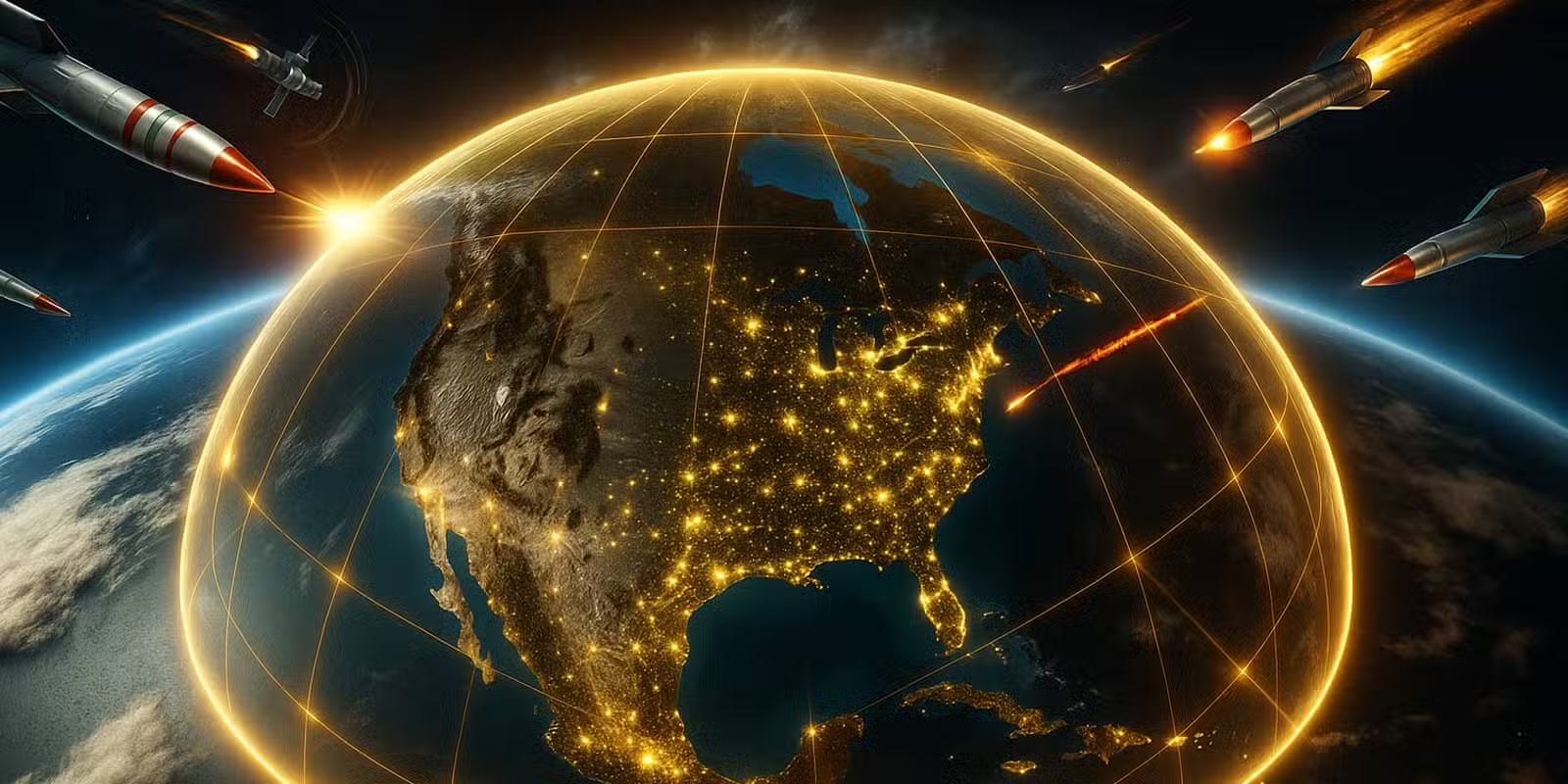
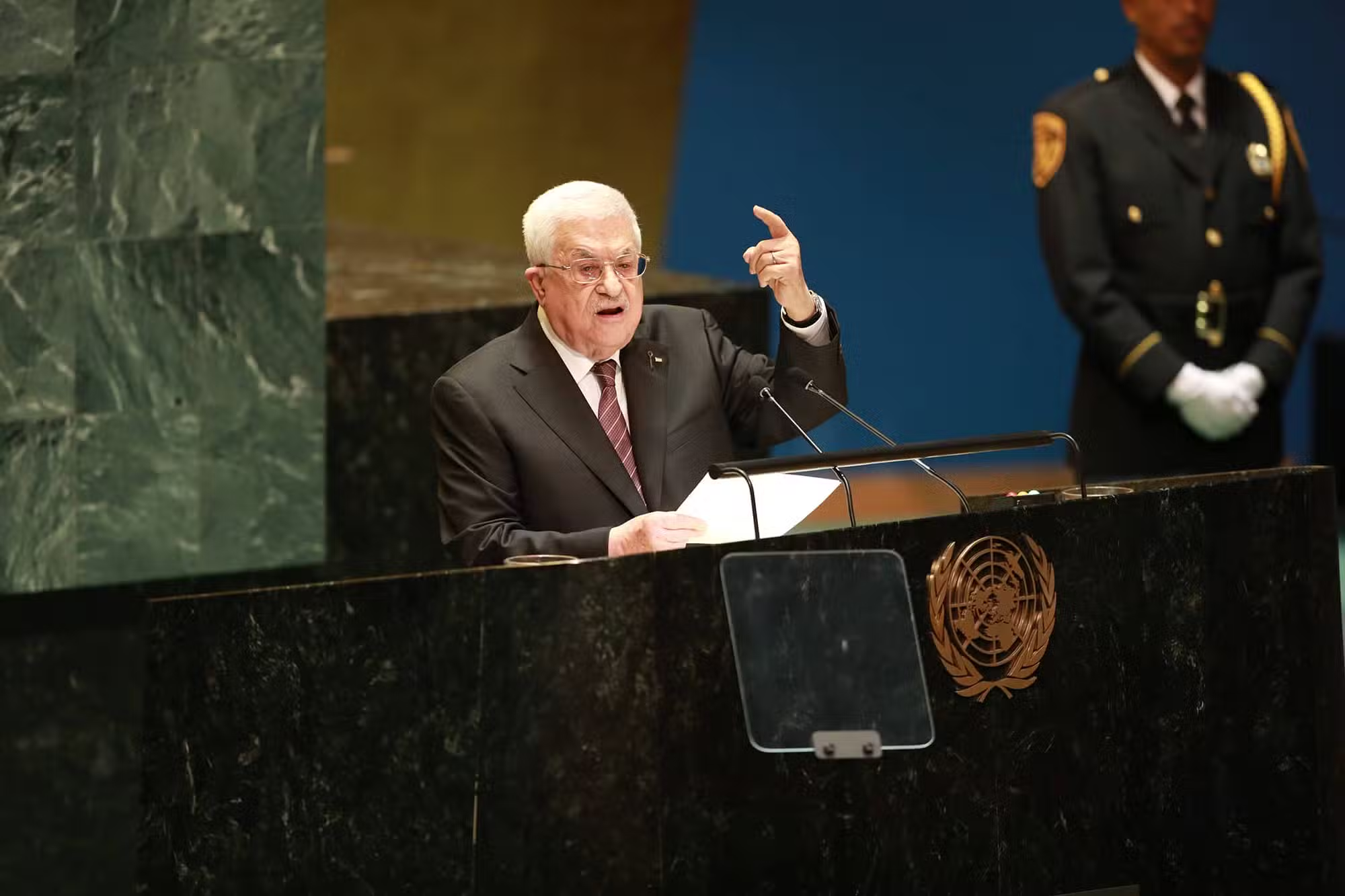
In Venezuela, the capture of Nicolás Maduro by U.S. forces triggered an abrupt political rupture, but not institutional collapse. Hours later, Delcy Rodríguez was sworn in as interim president, and the state apparatus continued functioning—suggesting a transition phase where continuity and internal competition coexist. In parallel, Iran, since late December 2025, has faced its most significant unrest in years, with large-scale repression, mounting fatalities, and open warnings of retaliation against Israel and U.S. bases should Washington intervene militarily. In other words, the Iran-Venezuela axis is not only a case study about bilateral cooperation; it is a test of how external partnerships behave when one partner faces political disruption abroad while the other faces existential pressure at home.
This case study is grounded in targeted analytical research designed to map the operational reality of the Iran–Venezuela axis. Beyond the public diplomatic narrative, this work aims to identify the concrete mechanics that sustain the partnership: the corridors it relies on, the actors who enable it, and the methods used to preserve strategic flexibility under pressure. Rather than treating the relationship as symbolic alignment, the research highlights how it functions as an ecosystem structured around finance, logistics, connectivity, and security-linked facilitation.
Taken together, the findings provide a multidomain picture of how the axis works in practice. They outline the infrastructure that supports cooperation across maritime routes, aviation corridors, and intermediary networks; they also show how enforcement gaps and monitoring blind spots create space for resilient activity. Particular attention is given to alternative settlement mechanisms—especially stablecoins—which can reduce dependence on traditional banking channels and increase transactional adaptability. Overall, this report seeks to clarify why the Iran–Venezuela relationship has remained strategically valuable over time and—crucially—how its trajectory may shift following Maduro’s removal and amid Iran’s escalating internal unrest and external confrontation dynamics. This paper looks at three scenarios that may characterize how Iran can continue to gain strategically from its cooperation with Venezuela following Maduro’s arrest and clarifies that in order to build upon this development to minimize these gains the United States must demand that Venezuela cease cooperation with Iran.
How will the capture of Nicolás Maduro reshape the Iran–Venezuela axis as an operational partnership and how might this affect Iran’s capabilities and regime stability alongside the implications for U.S. and Israeli strategic calculations amid Iran’s current internal unrest and escalating confrontation dynamics?
To answer this question, the report first traces the historical evolution of Iran–Venezuela ties and the sanctions-driven shift toward operational cooperation (I). It then examines the strategic interests on both sides (II) and maps the alliance’s core mechanisms across finance, logistics, security, and influence (III). A dedicated section focuses on crypto—particularly stablecoins—as a sanctions-evasion force multiplier (IV). Finally, the report moves beyond description to assess what this axis really represents strategically and how it may evolve, including the implications of Maduro’s capture and broader regional dynamics (V–VI).
I. Historical Background: From Ideological Partnership to Operational Alliance
Iran and Venezuela’s relationship initially grew out of energy diplomacy, tracing back to their shared status as founding members of OPEC in 1960, which created an early channel for political coordination around oil policy. For decades, however, this connection remained relatively limited and did not translate into a deep bilateral partnership.
The relationship entered a new phase in the early 2000s, particularly under the then presidents of Venezuela and Iran, Hugo Chávez and Mahmoud Ahmadinejad, with cooperation extending well beyond petroleum coordination. During this period, Iran and Venezuela moved toward a more explicit political alignment and deeper bilateral ties that reflected both ideological affinity and growing friction with Western pressure.
These ties did not diminish after Chávez. The partnership continued under Nicolás Maduro and successive Iranian administrations, increasingly shaped by a shared environment of sanctions and international isolation. Over time, the relationship became more durable and institutionalized, as reflected in the announcement of a 20-year cooperation framework spanning multiple sectors. The framework signaled that both sides viewed the partnership as a strategic asset rather than an episodic alignment.
Beyond bilateral ties, Iran and Venezuela have also reinforced their alignment through multilateral positioning, including joint support for the G77 Ministerial Declaration (2024), which criticizes unilateral coercive economic measures and calls for their removal. Taken together, these developments show a gradual shift from symbolic political solidarity toward a more operational relationship shaped by sanctions-driven incentives.
This historical trajectory sets the stage for the next section, which examines the concrete strategic interests each side derives from the partnership—and why Tehran and Caracas continue to treat it as a valuable asset today.
Two key questions shape the analysis going forward: Is this axis institutionalized beyond individual leaders and, if so, to what extent, and which mechanisms—finance, logistics, or crypto—form its true center of gravity. Answering these questions requires moving from historical evolution to the concrete strategic incentives driving both sides.
II. Strategic Interests: Why Both Sides Need the Partnership
Although Iran and Venezuela are geographically distant, their partnership is sustained by a clear strategic logic: both regimes operate under heavy international pressure, and both benefit from building alternative channels of resilience and leverage. Over time, what began as political alignment has increasingly functioned as an enabler relationship, where each side supplies what the other struggles to access through conventional systems.
A. Iran’s strategic incentives
For Tehran, Venezuela provides more than a diplomatic partner: it offers a permissive foothold in the Western Hemisphere—symbolically and strategically close to U.S. space. This proximity matters not only as a geopolitical message, but as a strategic asset: it allows Iran to maintain a forward presence beyond its traditional theaters and to build relationships, routes, and networks in an environment that Washington considers highly sensitive. From a U.S. security perspective, policy voices such as Roger Noriega have long framed the Iran–Venezuela relationship as part of a broader asymmetric posture, in which external partnerships and infrastructure abroad can support objectives that go beyond routine diplomacy.
A second Iranian incentive lies in the ability to leverage Venezuela as an operational platform—supporting maritime workarounds, opaque routing, aviation connectivity, and alternative financial channels. But beyond these practical elements, Iran also sees Venezuela as a regional gateway: a stable political anchor through which Tehran can expand its presence across Latin America more broadly. Specialist research on Iran’s public diplomacy highlights that Tehran’s strategy in the region is not improvised; it is a structured effort to strengthen influence through embassies, cultural institutions, media outreach, and political alliances with ideologically aligned governments.
Finally, the partnership has an ideological and influence dimension that is often underestimated. Iran’s outreach in Latin America includes soft-power and narrative tools designed to build sympathy, normalize Iranian positions, and amplify anti-U.S. messaging in Spanish-speaking audiences through channels such as state-linked media ecosystems and coordinated narratives. In that sense, Venezuela not only helps Iran survive pressure; it can function as a hub for projection, allowing Tehran to strengthen networks, spread messaging, and position itself as an alternative pole of influence in the Western Hemisphere.
B. Venezuela’s strategic incentives
For Caracas, the partnership with Iran is ultimately less about finding a buyer for Venezuelan oil and more about ensuring the regime can monetize exports under sanctions constraints—securing payments, maintaining liquidity, and limiting exposure to restricted banking channels. This is where alternative settlement mechanisms, including crypto-based rails, become strategically useful. Put simply, Venezuela may be able to sell oil to many actors in theory, but under sanctions it cannot always sell safely, get paid reliably, and move revenue efficiently. In that sense, the relationship is fundamentally transactional: it provides a practical way to keep money flowing to the state and to the power structures that depend on those revenues. Past arrangements have reportedly relied on barter-like mechanisms, including fuel deliveries from Iran in exchange for Venezuelan gold or crude-linked swaps, which highlights that the partnership is often shaped by payment constraints rather than political symbolism.
Beyond revenue, the relationship also supports energy-sector continuity and operational resilience. Having large reserves does not automatically translate into usable capacity: refining infrastructure, spare parts, technical expertise, and reliable supply chains can all become bottlenecks under international pressure. In that context, cooperation with Iran functions not merely as commercial exchange, but as a stabilization tool, helping Caracas preserve continuity in critical energy operations and reduce internal vulnerability during periods of disruption.
At the political-security level, Tehran is also a partner willing to operate in conditions where many other states or private actors hesitate, whether due to reputational risk, legal exposure, or sanctions compliance. Analysts such as Martín Rodil have argued that Venezuela has historically offered Iran permissive conditions—including alleged facilitation through infrastructure and documentation-related channels—precisely because the partnership serves regime protection and insulation, not only economic survival. This reinforces the broader conclusion that the axis is sustained by mutual utility under pressure, where external partnerships become instruments of endurance and strategic shielding.
III. How the Alliance Works: Operational Architecture
What makes the Iran–Venezuela axis strategically significant is not only political alignment, but the presence of repeatable operational mechanisms that allow both regimes to cooperate under sustained pressure. Based on the research reviewed for this case study, the partnership functions through a set of interconnected pillars—financial facilitation, logistical corridors, and security-linked channels—held together by deliberate opacity and deniable intermediaries.
A structured mapping of the alliance’s key “pillars” follows below:
A. Financial networks and facilitators
A central pillar is the use of front companies, intermediaries, and informal financial structures designed to hide beneficial ownership and reduce exposure to Western enforcement. Recent analytical findings how modern sanctions evasion increasingly resembles an upgraded “shadow banking” ecosystem, blending nominee structures and cross-jurisdictional entities with digital rails.
In practice, these systems exploit transaction opacity and enforcement gaps, allowing sanctioned actors to move value while limiting traceability—especially when paired with third-country nodes and layered commercial cover.
B. Energy and maritime logistics
The maritime domain functions as the central artery of the axis. Both regimes rely on a “shadow fleet” of reflagged or dark vessels, using concealment tactics such as AIS spoofing, oil blending, ship-to-ship transfers, and forged documentation to maintain export flows and sustain revenue.
A key feature of this ecosystem is adaptability: when enforcement tightens, methods shift rather than disappear. Routing through third countries, trade camouflage, and documentation tactics allow cargoes to remain mobile even under heightened scrutiny—making maritime logistics a decisive space where pressure, evasion, and countermeasures interact in real time.
C. Aviation as a logistics corridor
Alongside maritime transport, civil aviation appears to function as a high-sensitivity corridor. The evidence assessed suggests a Tehran–Caracas air bridge shaped around sanctioned carriers and patterns consistent with dual-use logistics: technicians, equipment, opaque cargo flows, and aircraft transfers that embed Iranian-linked aviation capabilities into Venezuelan fleets.
The corridor’s significance lies in its deniability: branded as commercial connectivity, it nevertheless raises concerns about undeclared cargo and potential use for restricted goods or specialized personnel.
Beyond personnel and cargo movement, this aviation corridor has been described as part of a broader triangulation system linking Iran, Venezuela, and external partners. Analysts note that sanctioned aircraft routes can function as flexible logistical bridges, enabling discreet transfer of equipment, technical expertise, or high-sensitivity materials under the cover of commercial connectivity.
D. Security and proxy-linked channels
Security cooperation deepens the alliance beyond economics. The findings reviewed indicate defense-industrial interaction that may include Iranian-linked support to Venezuelan capabilities—such as local production arrangements and infrastructure connected to UAV-related know-how.
Venezuela is frequently described by specialists as more than a permissive environment: it functions as a forward operating space where Iranian and Hezbollah-linked networks can overlap, coordinate, and operate with reduced scrutiny. Analytical briefings highlight that Caracas has served as a sanctuary for logistics, financial facilitation, and covert networking, including money laundering activities conducted under the cover of joint industrial or commercial ventures. This ecosystem creates conditions where illicit finance, intelligence facilitation, and proxy-linked logistics can coexist inside otherwise legitimate economic structures.
Hezbollah’s presence in the region is not limited to ideological influence; it is closely tied to transnational criminal finance. Specialist analysis describes networks that interact with organized crime syndicates to move illicit goods, launder cartel revenue, and sustain corruption protection mechanisms. These activities generate funding streams that support Hezbollah operations abroad while simultaneously providing logistical infrastructure that can be leveraged for covert planning and facilitation.
In parallel, available assessments raise concerns around proxy-linked facilitation networks, including Hezbollah-linked figures and alleged logistical/financial enabling roles, positioning Venezuela as a potential node within wider Iranian influence architecture in the hemisphere.
The Meir Amit Intelligence and Terrorism Information Center (ITIC) stresses that Hezbollah’s footprint in Venezuela has gone beyond ideological proximity, evolving into a practical enabling environment involving logistics and facilitation networks under Chávez and Maduro. It also highlights operational enablers such as documentation channels and references to training infrastructure, including testimony citing alleged camps on Margarita Island, illustrating how the Venezuela node can support covert mobility and asymmetric reach.
E. Information influence and narrative coordination
The partnership is also sustained through narrative projection and influence activity. In addition to logistics and finance, the research highlights messaging ecosystems that amplify pro-Iranian narratives in parts of Latin America and contribute to political normalization of the relationship, particularly in audiences predisposed to anti-U.S. or anti-Western framing.
This influence layer goes beyond messaging and includes structured propaganda and ideological outreach. Iran has invested in Spanish-language media such as HispanTV, described by the Foundation for Defense of Democracies as a key tool of Iranian propaganda in Latin America. In parallel, educational and religious channels contribute to longer-term ideological footprint-building: the U.S. Treasury sanctioned Al-Mustafa International University in 2020, explicitly alleging it functions as a recruitment platform linked to IRGC-QF operations and noting it has branches worldwide.
This matters strategically because the axis is not only about moving oil or money; it also helps shape perception, legitimize cooperation, and build political sympathy networks. In that sense, Venezuela is not just a logistical partner, but a potential regional hub through which Tehran can expand influence across the continent.
Beyond media projection, influence activity can extend into long-term ideological infrastructure. Specialist assessments point to religious, educational, and cultural initiatives that cultivate loyalty networks and narrative alignment within diaspora communities. These ecosystems—ranging from educational programs to clerical outreach—serve as force multipliers by embedding influence gradually, normalizing Iranian messaging, and sustaining community-level engagement over time.
Iran’s influence strategy in Latin America also extends into soft-power and ideological outreach: institutions connected to Tehran, such as branches of Al-Mustafa International University, offer educational programs and scholarships that expose students from the region to Islamic Revolutionary principles, and some graduates return home to take up roles in local religious and cultural centers promoting Iranian political and ideological narratives.
Some analytical reporting also highlights recruitment pipelines tied to educational and clerical outreach, where cultural exchange programs and religious training function as soft-power entry points. These mechanisms are framed publicly as academic or spiritual engagement, yet they can simultaneously reinforce ideological alignment and long-term network cohesion.
F. Covert operations, smuggling, and “kinetic risk” (and why these matter for Israel)
Beyond trade and messaging, the operational value of the Tehran–Caracas relationship is that it may enable covert reach—including smuggling facilitation and the ability to support or coordinate high-risk activities across Latin America. This is where the axis becomes strategically relevant for Israel’s security, not only for U.S. enforcement policy.
In November 2025, a U.S. official stated that Iran’s IRGC plotted to assassinate Israel’s ambassador to Mexico, a plan described as contained after being active from late 2024 through mid-2025. Mexico publicly denied having information about such a plot, but the episode still illustrates a core analytical point: without a permissive regional ecosystem—facilitators, documentation channels, networks, and cover—such operations would be significantly harder to stage and sustain at distance.
In short, the Iran–Venezuela relationship matters not only because it supports commerce and influence, but because it can lower the operational barriers for transnational covert activity, making Latin America a potential extension zone for Iran’s broader confrontation with Israeli and Western interests.
Recent Reuters reporting suggests that Iran’s Western Hemisphere posture extends beyond Venezuela alone. The United States has reportedly pressed Bolivia to expel suspected Iranian intelligence operatives and to designate the IRGC, Hezbollah, and Hamas as terrorist organizations, highlighting how Tehran’s regional presence can rely on multiple permissive environments rather than a single hub.
IV. Crypto as a Force Multiplier for Sanctions Evasion.
Crypto matters in this case because it does not replace the oil trade, rather it reshapes how oil transactions are settled under sanctions. Evidence suggests that Petróleos de Venezuela, S.A., the state-owned oil and gas company of Venezuela, increasingly required payments in USDT, making stablecoins a practical instrument for monetizing exports while reducing reliance on traditional banking channels. Unlike volatile assets such as Bitcoin, stablecoins are typically pegged to the U.S. dollar, offering the stability of the dollar while enabling fast cross-border transfers that are harder to obstruct through standard compliance chokepoints.
At the same time, the most sensitive part of this ecosystem is not the blockchain transfer itself but the conversion layer, where crypto is turned into usable money or routed through intermediaries. In practice, this relies on OTC brokers, informal exchangers, and third-country facilitators that provide liquidity, deniability, and a way to structure transactions outside heavily regulated platforms. Available indicators further suggest that stablecoin usage has expanded domestically, supporting liquidity and normalizing crypto as a “parallel” settlement tool in addition to state-level transactions.
This weakens traditional sanctions enforcement because it shifts key activity away from banks and into fragmented, fast-moving networks that are harder to monitor and disrupt. Rather than blocking a single payment rail, enforcement actors must contend with rotating wallets, intermediary substitution, and decentralized conversion points. As a result, stablecoins function as a force multiplier for sanctions evasion: they make payment settlement more resilient, increase operational flexibility, and reduce the effectiveness of financial pressure applied through conventional banking systems.
V. Analytical Assessment: What This Axis Really Represents
The Iran–Venezuela relationship is not mainly a political alliance—it is a practical survival system built to function under sanctions. The key objective is simple: keep exporting oil, get paid, and move the revenue despite financial restrictions. This is why the partnership matters strategically: it provides tools and channels that reduce dependence on Western-controlled systems.
In practice, the axis relies on two core mechanisms. First, maritime and trade concealment helps maintain oil exports through shadow shipping practices and intermediary routing. Second, crypto settlement (especially USDT) helps solve the payment problem by allowing transactions to bypass traditional banking chokepoints. The most sensitive part of this crypto system is not the transfer itself, but the conversion layer—OTC brokers and intermediaries that turn crypto into usable money and provide liquidity and deniability.
The main analytical question is whether this system depends on a single leader or whether it has become embedded in institutions and networks. If it is institutionalized—through state structures and facilitators—it can survive political shocks through adaptation. If it remains leadership-driven, then disruption or regime change could weaken the axis by exposing or dismantling its key channels. Overall, the axis appears resilient because it is multi-channel, but it remains vulnerable at specific chokepoints: shipping enablers and crypto conversion networks.
VI. Forward Outlook: Does Maduro’s Capture Change the Axis?
International relations often operate in a frustrating paradox: the events that look revolutionary are not always the ones that reshape reality. Grand speeches rarely produce the consequences they promise, and moments that feel like history being rewritten sometimes leave the deeper structures untouched. For now, Maduro’s capture fits that pattern. It was celebrated by many Venezuelans and by defenders of democracy worldwide, but in the weeks since January 3, the immediate reality has been one of continuity rather than rupture.
Reuters reporting shows that Delcy Rodríguez was swiftly sworn in as interim president, ensuring institutional continuity and limiting the risk of immediate collapse. At the same time, Washington framed the post-capture period not as a symbolic victory but as a leverage-driven phase: Trump stated that he canceled a second wave of strikes after Venezuela “cooperated,” including through the release of prisoners. This matters because it suggests the operation was not only about Maduro personally, but about the broader ecosystem—power, oil governance, criminal networks, and foreign hostile facilitation routes—that Washington wants to reshape over time.
Against that background, the question is not whether the Iran–Venezuela relationship “ends.” The question is whether the axis survives intact, becomes exposed and disruptable, or evolves under Iran’s own escalating crisis—a crisis that now includes open talk of U.S. military moves and Iranian retaliation against Israel.
Scenario 1 — Continuity: the headline changes, but the system survives (and the axis goes quieter)
In the first scenario, Maduro’s capture changes the face of power, not the architecture of power. Venezuela’s leadership transition would hold, state mechanisms would keep functioning, and the Iran–Venezuela relationship would persist because it is embedded in repeatable operational habits rather than personal chemistry. This logic is reinforced by Reuters reporting that Delcy Rodríguez has actively moved to consolidate control, installing loyalists while simultaneously navigating U.S. demands related to stability and production.
For Iran, this is the best-case outcome: Venezuela remains a permissive platform, but the axis becomes lower visibility—more intermediaries, more deniability, less public signaling. In such a setting, the strategic risk for the U.S. and Israel is not dramatic escalation, but complacency. The removal of Maduro can produce a false sense of resolution, while the networks that matter—logistics, facilitators, influence infrastructure—continue operating under a quieter posture. This reinforces the idea that even if the Venezuela node becomes more contested after Maduro’s capture, Iran retains alternative regional footholds, as illustrated by U.S. pressure on Bolivia over suspected Iranian operatives and Tehran-linked networks.
The recommendation implied by this scenario is therefore structural and long-term: for Washington, the success of Maduro’s capture only becomes real if the U.S. continues to pressure the system behind him; and for Israel, the key priority is persistent regional awareness rather than episodic attention. The point is not to “militarize Latin America,” but to avoid blind spots, because if the ecosystem survives, the axis remains a platform of potential reach even when the Middle East becomes the main theater again.
Scenario 2 — Exposure and disruption: transition creates a window to map and break networks
The second scenario is rooted in a historical pattern: transitions rarely break a system instantly, but they often create a window in which hidden networks become observable. Rivalries intensify, insiders bargain, channels leak, and intermediaries become less disciplined. Reuters reporting on internal division and consolidation moves by Delcy Rodríguez suggests exactly this kind of post-shock environment, where continuity exists, but political stability is being actively managed and is not guaranteed.
This is where Maduro’s capture can become strategically decisive—not as a one-off operation, but as the beginning of a longer campaign. Concrete U.S. behavior already signals that this is not “over”: AP reporting shows the U.S. is escalating maritime action connected to narcotrafficking routes, including strikes on suspected drug-smuggling boats in the weeks following Maduro’s capture. In parallel, Washington is also shaping control over Venezuelan oil flows through seizures and pressure mechanisms, reinforcing the idea that the U.S. is targeting the broader revenue-and-logistics structure, not only a particular leader.
In this scenario, the recommendation is straightforward: the U.S. should exploit the transition window for intelligence mapping and disruption of enablers, while Israel should treat the same moment as a prevention opportunity, as this is when external facilitation networks can be identified before they re-harden. The risk is that without follow-through, the window closes, networks adapt, and the axis becomes harder to penetrate than it was before Maduro’s removal.
This is also the scenario where Iran’s behavior can become opportunistic: exposure can weaken networks, but instability can also create a marketplace for influence. If Venezuelan elites compete for protection and resources, Tehran may try to preserve access by shifting to new intermediaries rather than losing its foothold entirely.
Scenario 3 — Iran changes everything: regime stress + U.S. posture + Israeli exposure (escalation becomes credible)
The third scenario is the most consequential because it is driven less by Caracas than by Tehran. The Iran–Venezuela axis becomes strategically volatile when Iran itself enters a high-pressure cycle: internal crisis, external threats, and the temptation to escalate as a show of strength. Here, we are no longer talking about hypothetical signals; there are concrete markers of regime stress and confrontation dynamics.
A first, unusually tangible indicator of elite anxiety is the reported asylum request in Switzerland by Alireza Jeyrani Hokmabad, described as the deputy head of Iran’s UN mission in Geneva. This is not a street-level protest story, it is a senior-insider move that suggests instability is being felt even within official circles.
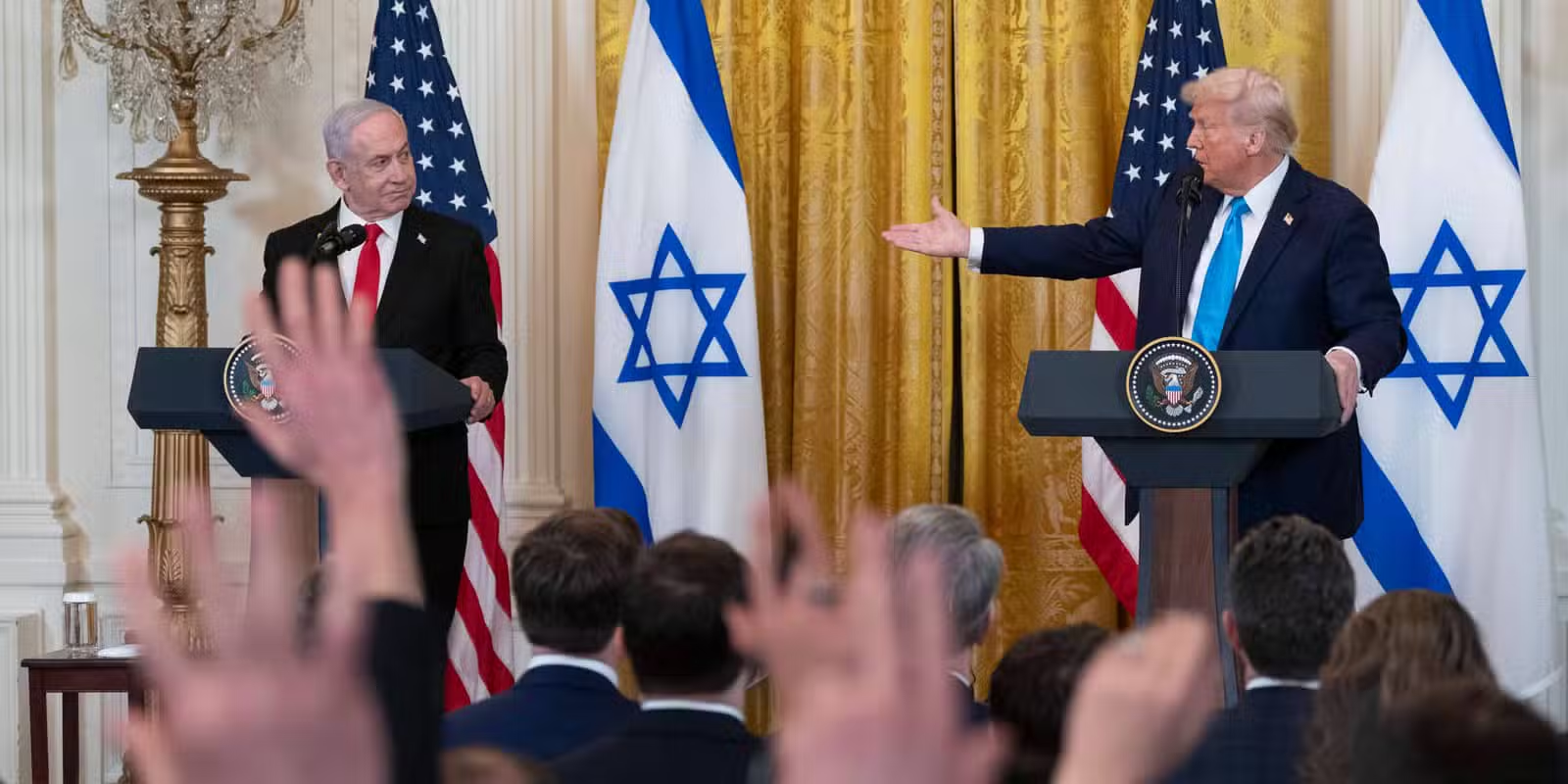
A second concrete marker is the re-emergence of open confrontation rhetoric and military positioning. Reuters reported that Trump said a U.S. “armada” was heading toward Iran, including the aircraft carrier USS Abraham Lincoln and guided-missile destroyers, even as he publicly expressed hope it would not be needed. Iran’s response was explicit: Reuters also reported Iranian messaging warning that any U.S. attack would trigger retaliation against Israel and regional U.S. bases, treating them as legitimate targets. AP reporting reinforces the same escalation environment, describing heightened U.S. military presence and Iranian signals of readiness amid the protest crackdown.
A third concrete reference point—and the clearest reason Israel must take the hemisphere dimension seriously—is the Reuters report that Iran’s IRGC plotted to assassinate Israel’s ambassador to Mexico, a plot said to have been active from late 2024 into mid-2025 before being contained. Even if details remain limited and denial narratives exist, the lesson is operational: Iran has demonstrated intent to target Israeli interests abroad, and such intent becomes more dangerous when the regime feels pressured at home and threatened externally.
In this scenario, the recommendation is therefore not simply “prepare for war.” It is to recognize that a destabilized regime is not automatically a less dangerous regime. If Tehran believes it is cornered, it may seek deterrence through escalation, and it may look for asymmetric options beyond the immediate battlefield. The U.S. must clarify to the leaders of Venezuela that they have to stop cooperating with Iran and that the consequences of not doing so may be severe. For Israel, it means treating the external network issue as part of homeland security logic: tightening intelligence cooperation with partners in Latin America, increasing awareness around covert facilitation patterns, and preparing for the possibility that Iran’s confrontation strategy could expand geographically.
Conclusion
Overall, the Iran–Venezuela axis is best understood as a pragmatic partnership that has evolved into an operational ecosystem rather than a purely ideological alignment. Over time, Tehran and Caracas have built repeatable mechanisms—spanning logistics, facilitators, covert connectivity, and influence activity—that allow cooperation to persist even under sustained international pressure.
This framework now faces a major shock. In early January 2026, U.S. forces captured Nicolás Maduro, and Delcy Rodríguez was formally sworn in as interim president, keeping the state apparatus running while the political balance in Caracas recalibrates. Trump later claimed he canceled a second wave of strikes in the wake of Venezuelan “cooperation,” including prisoner releases—suggesting Washington is trying to control escalation while shaping the post-Maduro transition.
Looking ahead, the Iran file is simultaneously becoming more volatile. Iran has faced mass unrest since late December 2025, with thousands reportedly killed and the regime escalating repression amid persistent accusations of foreign interference. At the same time, external tensions have intensified: Reuters reported that Iran warned any U.S. attack would trigger retaliation against Israel and regional U.S. bases, while Washington began withdrawing some personnel from key Middle East positions as a precaution.
Opening outlook: What may ultimately reshape this entire geopolitical landscape is not Venezuela, but Iran itself. As domestic destabilization deepens, the regime may face a strategic choice between inward consolidation and outward escalation. Trump’s public signaling of large-scale U.S. military positioning, coupled with Tehran’s explicit threats against Israel in the event of a strike, raises the credibility of a rapid escalation cycle. In that context, the Iran–Venezuela axis matters not only as a platform of endurance, but as a potential enabling environment for Iranian reach abroad—especially given the Reuters report that the IRGC plotted to assassinate Israel’s ambassador to Mexico, illustrating how external networks can translate into operational risk beyond the Middle East. The decisive question for the months ahead is therefore whether Iran’s internal crisis weakens the regime from within—or pushes it toward external confrontation, creating the conditions for a broader U.S.–Israel–Iran escalation with global spillover effects. The U.S. must clarify to the new leaders of Venezuela that they have to put an end to their cooperation with Iran and make sure that Iran does not operate from their territory. Israel should convey this message to Washington, while taking the necessary precautions against Iranian attempts to hit Israeli targets in Latin America.
Nathan Mamou is a research intern at the Jerusalem Institute for Strategy and Security. He graduated with a BA in Public Law and Political Science from the Catholic University of Paris where he served as president of the Union of French Jewish Students.
Sources:
- https://www.terrorism-info.org.il/en/hezbollahs-activity-in-venezuela-and-how-the-recent-american-arrest-of-maduro-may-affect-it/
- https://jewishonliner.org/p/irans-hidden-war-machine-in-venezuela
- https://www.reuters.com/world/americas/delcy-rodriguez-formally-sworn-venezuelas-interim-president-2026-01-05/
- https://www.reuters.com/world/americas/trump-cancels-second-wave-attacks-venezuela-after-cooperation-2026-01-09/
- https://www.reuters.com/world/americas/families-anxiously-wait-prisoners-be-released-venezuela-just-nine-freed-2026-01-09/
- https://www.reuters.com/business/energy/venezuelas-top-lawmaker-says-oil-reform-will-add-partnership-model-2026-01-20/
- https://www.reuters.com/world/middle-east/iran-warns-washington-it-will-retaliate-against-any-attack-2026-01-11/
- https://www.reuters.com/world/middle-east/iran-warns-retaliation-if-trump-strikes-us-withdraws-some-personnel-bases-2026-01-14/
- https://www.reuters.com/world/middle-east/iran-will-treat-any-attack-all-out-war-against-us-says-senior-iran-official-2026-01-24/
- https://www.reuters.com/world/americas/iranian-plot-kill-israels-ambassador-mexico-contained-us-official-says-2025-11-07/
- https://www.reuters.com/world/americas/us-presses-bolivia-expel-suspected-iranian-spies-harden-approach-militant-groups-2026-01-24/
- https://www.reuters.com/world/middle-east/us-military-assets-heading-middle-east-even-trump-backs-off-toughest-iran-2026-01-22/
- https://www.reuters.com/world/middle-east/us-withdrawing-troops-key-middle-east-bases-precaution-us-official-says-2026-01-14/
- https://www.reuters.com/world/china/iran-protests-abate-after-deadly-crackdown-residents-rights-group-say-2026-01-16/
- https://apnews.com/article/328b0aa74fcdc9186cab683b6a6b7f96
- https://apnews.com/article/4b2ceb8aff9dc448036341e86023b6c8
- https://apnews.com/article/af363f997081aeec85f10effe83631e6
- https://apnews.com/article/086d42db3d56f0e952014f97fa30faaf
- https://www.iranintl.com/en/202601185483
- https://www.iranintl.com/en/202511106921
- https://www.iranintl.com/en/202601186707
- https://www.fdd.org/analysis/2023/10/31/hispantv-is-irans-propaganda-arm-in-latin-america-why-is-it-still-being-broadcast/
- https://home.treasury.gov/news/press-releases/sm1205
- https://www.inss.org.il/publication/iran-tv/
- https://www.atlanticcouncil.org/in-depth-research-reports/issue-brief/the-maduro-hezbollah-nexus-how-iran-backed-networks-prop-up-the-venezuelan-regime/
- https://news.sky.com/story/iran-warns-any-attack-will-mean-all-out-war-after-trump-says-us-armada-on-its-way-13498251
- https://www.nbcnews.com/world/iran/trump-armada-iran-death-toll-protest-crackdown-executions-rcna255547
- https://m.economictimes.com/news/international/world-news/at-least-5000-killed-in-iranian-unrest-official-says-as-judiciary-hints-at-executions/articleshow/126643486.cms
- https://youtu.be/bzik9ZKNVLE
- https://www.americafirstpolicy.com/issues/the-axis-across-the-atlantic-irans-influence-in-the-western-hemisphere?utm_source=chatgpt.com
JISS Policy Papers are published through the generosity of the Greg Rosshandler Family.