

Introduction: A Staunch Ally Drifts East
There is something peculiar about watching a country switch sides without ever announcing it. Georgia, which after the 2003 Rose Revolution became one of Washington’s most dependable partners in the Black Sea region—the largest per-capita non-NATO contributor to the wars in Iraq and Afghanistan, a loyal counterterrorism collaborator, and a state that once arrested and extradited an Iranian arms dealer to the United States—has been quietly turning toward the very regime it once helped Washington contain. This reversal is not the work of the Georgian people, who remain overwhelmingly pro-Western, but of the ruling Georgian Dream party, whose drift toward authoritarianism at home has been matched by a realignment abroad—away from Brussels and Washington and toward Moscow and Tehran.
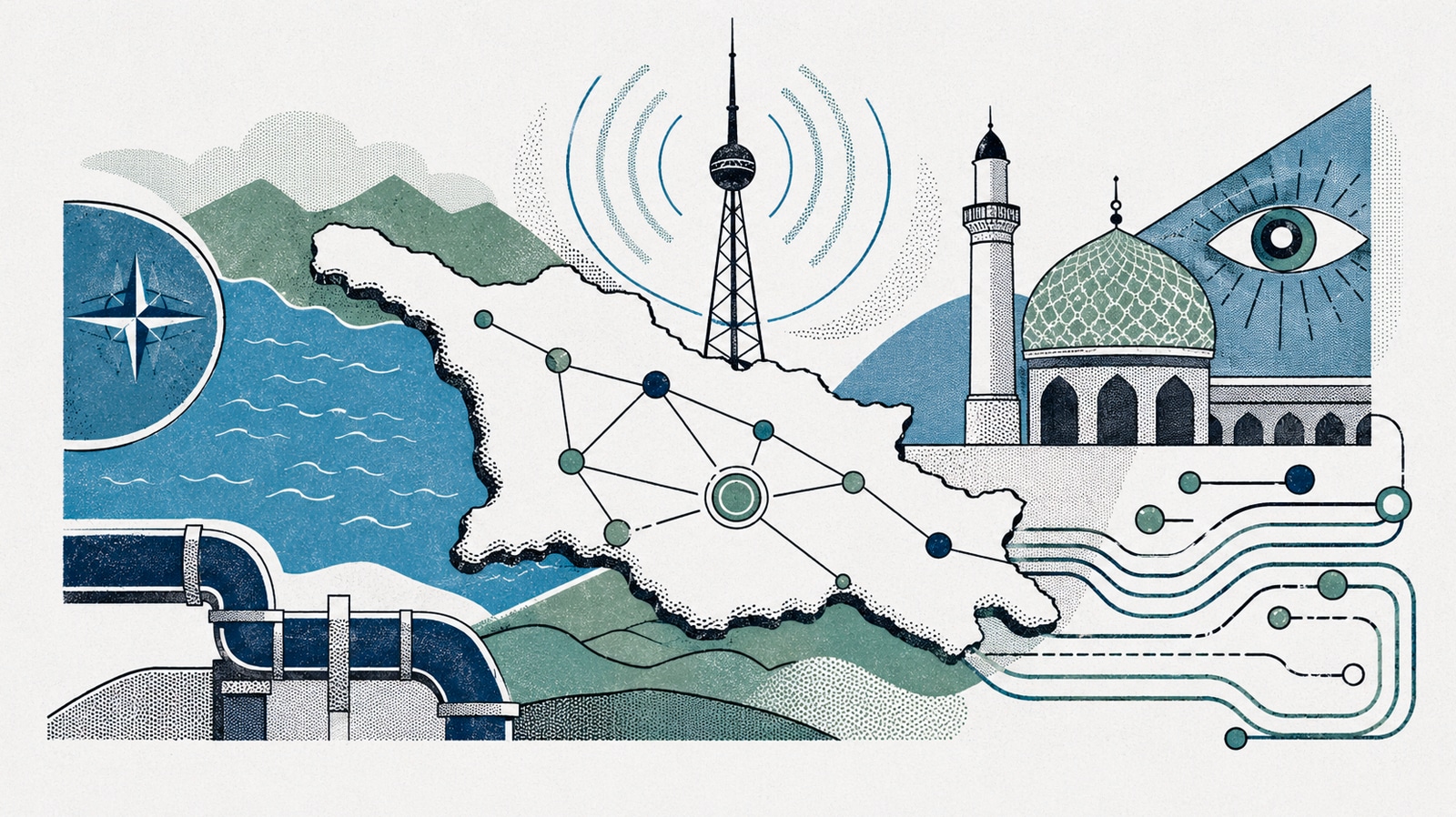
The symbolism has become almost ostentatious. In December 2024, the United States suspended the US-Georgia Strategic Partnership Charter and sanctioned Georgian Dream’s founder, Bidzina Ivanishvili. Prime Minister Irakli Kobakhidze traveled to Iran twice in 2024,once for the funeral of President Ebrahim Raisi, where he shared a frame with the leaders of Hamas and Hezbollah, and again for the inauguration of Masoud Pezeshkian. In February 2026, at the embassy’s request, the Tbilisi TV Tower was lit in the red, white, and green of the Iranian flag. These gestures are not those of a NATO aspirant.
The diplomatic theater matters less than the infrastructure beneath it. Tehran has built a layered network of religious, educational, charitable, and media institutions across Georgia, aimed at the country’s ethnic Azerbaijani Shia minority. This is the same soft architecture the Islamic Republic has used from Latin America to West Africa.Moreover, itis exactly the kind of architecture that can be repurposed for harder purposes: sanctions evasion, the spread of anti-American ideology and antisemitism, and, ultimately, the identification and recruitment of human sources, including those targeting Israel.
The Community at the Center
Iran’s strategy in Georgia is unintelligible without understanding the population it targets. According to Georgia’s 2014 census, 233,024 ethnic Azerbaijanis live in Georgia, acounting for 6.3 percent of the population and constituting the country’s largest ethnic minority. Ethnic Azerbaijanis are concentrated in the southern region of Kvemo Kartli, the historical Borchali, where in Marneuli they make up 83.8 percent of the population, with comparable densities in Dmanisi, Bolnisi, and Gardabani. They are overwhelmingly rural; many speak little Georgian; and, according to researchers who study them, they remain politically and culturally marginalized from the Georgian mainstream.
The decisive variable, however, is religion. Roughly 80 percent of Georgia’s Azerbaijanis are Shia Muslims. This is the opening Iran exploits, and the reason is worth stating precisely. The Islamic Republic’s claim to transnational authority rests not on Persian ethnicity—which would alienate Turkic Azerbaijanis—but on Twelver Shiism and the doctrine of velayat-e faqih, the guardianship of the religious jurist, which positions Iran’s Supreme Leader as the political-religious referent for all Shia, no matter where they are located. A Sunni or secular Turkic population would be largely impervious to this appeal; indeed, Iranian outreach in Borchali has generated friction precisely with local Sunni Azerbaijanis who reject the Iranian version of Shiism. But a compact, devout, underserved Shia community, separated from secular Baku’s influence and from Tbilisi’s administration alike, is fertile soil for the Islamic regime. Tehran began cultivating it in the mid-1990s, exploiting the post-Soviet religious vacuum, and accelerated after 2013–2014, when the Georgian Dream government’s security service allegedly pressured Georgia’s independent-minded Shia sheik, Vagif Akperov, into resigning, clearing the path for Tehran-aligned clerics.
There is an irony that the Islamic Republic never acknowledges. At home, in its own provinces of East and West Azerbaijan, Iran suppresses precisely the Azeri linguistic and cultural identity it courts abroad. The roughly 16 percent of Iran’s population that is ethnically Azerbaijani—the country’s largest minority—is, in the words of a 2023 EuropeanCommission statement, subject to “assimilation policies, demeaning stereotyping and forced relocation.” Tehran’s solicitude for Azeri religious feeling ends at its own border.
How Tehran Sees Them: The View from the Seminary
Iran’s interest in Georgia’s Shia is neither a defensive reflex nor a benign exercise in spreading Persian culture or Shia piety. It is instrumental. The regime regards this community as a political resource to be cultivated and, when useful, mobilized in service of its strategic aims — aims that, as the Islamic Republic’s record across three continents demonstrates, include anti-Americanism, antisemitism, and the sponsorship of terrorism. Framing the activity as mere religious outreach is precisely the cover the regime relies on. The work is doctrinal in vocabulary and operational in purpose, and the regime discusses it openly. Iranian and Iran-aligned media, such as the wire services Mehr, IRNA, and Tasnim, and the Howzeh (Shia madrasa or seminary)-linked Ahlul-Bayt News Agency (ABNA), frame Borchali’s Azerbaijanis as a population to be cultivated and defended. The flagship instrument is Sahar TV, the Azeri-language arm of the state broadcaster IRIB’s Sahar Universal Network, which broadcasts to the Caucasus and is described by Azerbaijani analysts as a propaganda channel that “alternates normal, regular, neutral news with anti-Azerbaijani fakes” and trades in antisemitic and anti-Western tropes.
This media attention stems from a clerical doctrine. The leadership of the Ahl al-Bayt World Assembly speaks frankly about a “soft power” strategy exercised through Shia networks and “cyberspace,” reaching, in the words of its Secretary-General, Ayatollah Reza Ramezani, audiences once limited to “twenty or one hundred people” via the mosque pulpit and now numbering in the millions online. When senior Iranian clerics speak of the duty to “introduce the religion” to “co-religionists” in marginalized communities, they mean Georgia’s Azerbaijanis. For years, the regime’s analysts have described the Caucasus as a theater of confrontation with “NATO and Zionism” — a frame in which a loyal Shia community in Georgia is a strategic asset to be developed, not a courtesy to be extended.
The Anatomy of an Influence Network
The network’s layered design is the whole point, and it deservesclose reading. At the apex sits the Office of the Supreme Leader. From it, two great ”transmission belts” convey Iran’s messaging to the Shia world: Al-Mustafa International University and the Ahl al-Bayt World Assembly. Both are present in Georgia. Both, according to multiple Western governments, serve as fronts for the Islamic Revolutionary Guard Corps and its Quds Force. Beneath them runs a cascade of madrasas, mosques, charities, youth groups, and media outlets that terminates in the target population—with the IRGC-Quds Force as the operational beneficiary and, at the violent extreme, a criminal-kinetic layer capable of murder.
Al-Mustafa International University (AMIU) is the educational spine. Founded by decree of Ali Khamenei and operating under the direct supervision of the Supreme Leader’s office, headquartered in Qom and headed by Sheik Ali Abbasi, it claims branches in over 50 countries. In December 2020, the United States Treasury designated it under Executive Order 13224, stating that the university “enables [IRGC-QF] intelligence operations by allowing its student body … to serve as an international recruitment network” and that the Quds Force uses it “to develop student exchanges with foreign universities for the purposes of indoctrinating and recruiting foreign sources.” Crucially, the Treasury added that AMIU “has facilitated unwitting tourists from western countries to come to Iran, from whom IRGC-QF members sought to collect intelligence.” Canada sanctioned it in 2022; Germany’s domestic intelligence service investigated its Berlin affiliate, examining some 700 individuals across three lists for ties to espionage. In Georgia, AMIU runs three campuses—in Gardabani (the Al-Hikmet madrasa), Marneuli (Imam Reza), and Tbilisi (Ponichala)—offering free instruction in Shia theology, Persian, and Islamic studies. Georgian authorities do not accredit these campuses but send graduates on to Qom.
The Ahl al-Bayt World Assembly (ABWA), established under Khamenei’s personal supervision and currently led by Ayatollah Reza Ramezani, serves as the clerical-organizational spine. In 2015 congressional testimony, former CIA officer Scott Modell described it bluntly: ABWA “has also served as an effective cover for assisting with intelligence-gathering; spotting and recruiting foreign students; and moving money and materiel destined for QudsForce (and MOIS) operations.” Its Georgian branch is the Ahlibeyt (Ahlul-Bayt) Cultural-Educational Society in Marneuli, founded by Haji Rasim Mamedov, a Qom-educated cleric who serves as ABWA’s representative in Georgia and, according to the DFRLab, maintains close ties to the Iranian embassy; a parallel Alul Beyt society operates in Tbilisi. The Hudson Institute counts four Shia madrasas under this umbrella.
Beneath these two pillars lies the mosque-and-akhund (Islamic preacher) network that translates doctrine into the rhythm of daily life. The community hub is the Imam Reza Mosque in Marneuli; at the Imam Ali Mosque, the cleric Haji Hajiyev used a February 2026 sermon to call the United States “the biggest terrorist in the region,” displaying portraits of Khamenei and eulogizing Hamas figures killed by Israel as “martyrs.” Layered onto the mosques are youth-mobilization structures—the Georgian Muslim Youth Union and the Union of Georgian Students in Qom—and Iran-linked charities that provide welfare while binding recipients into the network. A dedicated media-propaganda cluster—the website Ahlibeyt.ge, local outlets, and Sahar TV’s Azeri broadcasts—saturates the community with Tehran’s narrative.
The whole edifice is crowned by the Iranian Embassy in Tbilisi, led by Ambassador Mahmoud Adib, and its cultural center, which has hosted commemorations for Qassem Soleimani, the Quds Force commander killed by the United States in 2020, and arranged for the Tbilisi TV Tower to be lit in Iranian colors. Presiding over it all with studied indifference is the Georgian state itself, in the form of the State Agency for Religious Issues under Zaza Vashakmadze, which has quietly accepted the network’s expansion and even received ABWA’s Ramezani at an official level.
The recruitment logic runs through this structure like a current. A young man from Marneuli attends a free AMIU course; he is sent to Qom; he joins the Union of Georgian Students in Qom; he travels on the Arbaeen pilgrimage through Iran and Iraq, where, as the Hudson report documents, the IRGC uses the trips “for recruitment, indoctrination, and intelligence spotting.” A Georgian Azerbaijani interviewed by RFE/RL recounted being approached by an IRGC operative during such a pilgrimage, who asked whether he was prepared to die for Khamenei; the operativenamed a Georgian Shia cleric close to the government as the man who had referred him.
The Comparative Case: From Soft Networks to Hard Operations
Skeptics could argue this is religious outreach, not espionage, and that the distinction matters. It does,but the Islamic Republic has spent two decades demonstrating that the two are points on a single continuum, and the comparative record leaves no doubt about where that continuum leads.
Consider AMIU and ABWA outside Georgia. The Quds Force used AMIU’s Qom campus as a recruitment hub for the Zaynabiyoun and Fatemiyoun brigades, the Pakistani and Afghan Shia militias deployed to fight in Syria. A 2025 RAND study found that AMIU graduates were directing Iran’s anti-US campaign in Latin America. Canada revoked the charitable status of ABWA’s local affiliate for facilitating the parent body’s operational goals. The pattern—seminary, charity, and cultural center as the visible face; intelligence gathering and logistics as the hidden function—is not a Georgian anomaly. It is the template, and Georgia is its newest theater.
The violent end of the network lies in the hands of ethnic Azerbaijanis. In October 2025, a federal court in New York sentenced Rafat Amirov and Polad Omarov to 25 years for an IRGC-directed plot to assassinate Iranian-American journalist Masih Alinejad at her Brooklyn home for a $500,000 bounty. Omarov is a Georgian national; both were senior figures in an Azerbaijani faction of the post-Soviet “thieves-in-law” underworld founded by Nadir “Lotu Guli” Salifov, the Georgia-born ethnic Azerbaijani crime boss assassinated in Antalya in 2020. Omarov was the right-hand man of Nadir’s brother, Namiq Salifov, whom the United Kingdom sanctioned in May 2026 for “hostile activity” on behalf of Iran, including plotting attacks in Britain. In a separate case in early 2025, Azerbaijan’s security service arrested Agil Aslanov, a Georgian drug trafficker recruited by the Quds Force and offered $200,000 to assassinate Rabbi Shneor Segal, the Chabad emissary in Baku; Aslanov recruited a local accomplice, Jeyhun Ismayilov, to surveil the target. Note the recurring profile: ethnic Azerbaijanis, often from Georgia, embedded in criminal networks and tasked by the Quds Force against dissidents and Jews.
This brings the argument to its analytical core and to a body of evidence that should change how the Georgian network is read. The recently published academic study by Grigorij Serscikov, “Recruit, deploy, discard: Jewish Israelis in Iranian espionage operations,” examines more than thirty documented cases of Israeli citizens recruited for spying and sabotage on behalf of Iran. Its findings are sobering. Iranian intelligence has shifted to what Serscikov calls “low-effort, high-volume recruitment conducted as a rule through platforms like Telegram,” targeting “socially and economically marginalized groups, including ultra-Orthodox communities and immigrants from the former Soviet Union.”
This is recruitment by trawling—thousands of messages offering money for “easy tasks,” handlers operating under aliases and front channels, presenting themselves, in the words of a former Shin Bet officer, as “a very wide network … using fake profiles.” The scale is no longer marginal: the Shin Bet’s January 2026 annual report found that the number of Iranian plots to use Israelis as spies “jumped 400% in 2025 compared with 2024,” with 25 Israelis and foreign residents indicted and 120 separate Iranian spying incidents thwarted in 2025 alone, part of a longer arc in which the Washington Institute documented 39 Iranian operations in Israel between 2013 and 2025, some 31 of which involved Israeli citizens.
While Israeli and other media wonder how Israeli Jewish citizens could be collaborating with Iranian intelligence, they often miss the basics of HUMINT craft. It means that no intelligence service attempts to recruit human agents by posing as the enemy’s intelligence service. At the initial stage, an “object” may not know who the recruiters are. In other words, those Israelis might not know at the outset that they are working with the Iranians. Iranian intelligence may use ethnic Azerbaijanis or other ethnicities in other countries as case officers to create contacts.
Itis important to note here that the Republic of Azerbaijan cannot control ethnic Azerbaijanis, given that they are citizens of another country. Baku closely monitors and controls its territory, preventing Iranian penetration; however, Tbilisi keeps ignoring Baku’s requirement to do the same to counter Iranian disruption.
The decisive insight is one the U.S. Treasury’s phrase about “unwitting tourists” already anticipated: the recruited person, initially at least, often does notknow that he is working for Iranian intelligence. He thinks he has answered a job ad, befriended an activist, and taken money from a businessman. This is not incidental tradecraft; it is the essence of professional intelligence work. No competent service announces its true identity at the moment of recruitment. The cut-out, the front organization, the false flag, the intermediary allexist precisely so that the source can be spotted, assessed, and developed before he understands whom he serves, and so that the sponsor retains deniability if he is caught.
Set that insight against the Georgian map drawn above, and its danger comes into focus. A cultural society, a free seminary, a charity distributing welfare, a youth club, a pilgrimage tour operator, a friendly cleric — these are the ideal apparatus for spotting and assessing human material. They identify the devout, the indebted, the marginalized, the ambitious; they sort them; they pass the promising ones up the chain to where the Quds Force or the Ministry of Intelligence waits. The Georgian network is, in intelligence terms, a spotting-and-assessment environment of considerable richness, sitting astride a population whose members hold visa-friendly Georgian passports and can travel freely into Europe. The same machinery that produces an anti-American banner in a Marneuli procession can, with no change of personnel, produce a surveillance photograph of a synagogue, an Israeli embassy, or a pipeline. The criminal-kinetic layer—the Salifov network, the Aslanov case—is simply what this continuum looks like at its lethal end. To assume that a network demonstrably used to murder a rabbi in Baku and to stalk a journalist in Brooklyn would, on principle, refrain from being leveraged against Israeli or Western targets is to misunderstand the regime entirely.
Conclusion: Laissez-faire as Complicity
The most damning feature of Georgia’s Iranian turn is not that Tehran built this network—Tehran builds such networks wherever it can—but that Georgian authorities have allowed it to operate. When a serious think-tank report documented the network, the Georgian Dream government’s instinct was not to investigate the IRGC’s footprint but to open a state-security probe against the report’s Georgian co-author and to summon critics for questioning. That reaction reveals everything about where the government’s priorities lie.
The State Agency for Religious Issues accepts the expansion; the Georgian Dream leadership signs condolence books at the Iranian embassy and lights the capital’s tower in Iranian colors. Whether this reflects active sympathy or merely the cynical calculation that an inert, Iran-managed Shia minority is easier to govern than an assertive one, the effect is the same: a NATO aspirant is hosting, with official forbearance, the soft infrastructure of a regime that exports revolution and outsources assassination. For the United States and NATO, this erodes strategic depth in the Black Sea and Caspian, opens a sanctions-evasion corridor, and normalizes anti-American ideology near critical pipeline routes. For Israel, it means a hostile intelligence service is steadily deepening its recruitment and spotting capability among a population a few hundred kilometers from its enemies’ reach—a capability whose previous products include a plot against a rabbi in Baku. The lesson from the Islamic Republic’s conduct is that it neither waits for permission nor telegraphs its intentions. Neither should those it targets wait for the network to mature before treating it as what it is.
Recommendations
- Washington should treat Georgia’s turn toward Iran as a security issue, not a footnote to democracy. The immediate, concrete step is to designate the AMIU and ABWA presence in Georgia as a subject of bilateral pressure, conditioning the restoration of any element of the suspended Strategic Partnership Charter on Tbilisi’s willingness to scrutinize U.S.-sanctioned entities operating on its soil. The policy should change when the benchmark is met: the closure or genuine regulation of the three AMIU campuses and the Marneuli/Tbilisi ABWA societies.
- Apply secondary-sanctions logic to the financial layer. Given the documented surge in Iranian-linked company registrations and imports, the U.S. Treasury should map and target the Georgia-based front companies and hawala channels that move Iranian funds, and prepare designations of Georgian Dream-linked financiers who profit from them—the trigger for escalation: evidence of continued oil and fuel trade with sanctioned Iranian entities.
- Israel should treat the Georgian Shia network as a counterintelligence priority, not merely a propaganda nuisance. The Serscikov findings on Telegram-driven cut-out recruitment should be read alongside the Georgian spotting environment. Protective security for Israeli and Jewish sites in the South Caucasus and for Israeli travelers in Georgia should be calibrated accordingly with the threshold for elevated concern being any recurrence of the Aslanov/Baku pattern involving Georgian-based operatives.
- Support the targeted population; do not abandon it. The strategic response to Iranian indoctrination of Borchali’s Azerbaijanis is integration in the form of, for example, Georgian-language education, political representation, and economic opportunity that Tbilisi has long withheld. Western assistance should flow to civic and educational programs in Kvemo Kartli that compete with the free madrasa financed by Iran.
JISS Policy Papers are published through the generosity of the Greg Rosshandler Family.