


The fate of the “deal of the century” is uncertain because it is still unclear whether and when the Trump administration will give Israel a green light to implement part of the deal despite its rejection by the Palestinians. The deal, which is meant to be negotiated between Israel and the Palestinians, suggests land swaps in which Israel would annex about 30% of the West Bank. If the deal remains moot due to the Palestinians’ refusal to negotiate, can Israel enjoy its territorial benefits until the Palestinians change their mind (if they ever do)? The deal’s 181 pages provide no answer to that question, and therefore Israel cannot act without a nod from the Trump administration. If such a nod is not given before the November 2020 election and if that election is won by a Democrat, the deal will become letter morte.
While Israel should secure US support for the deal’s partial implementation in the absence of negotiations, it must also pre-empt and mitigate the opposition of the European Union (EU) and of the United Kingdom. This must be done not only by neutralizing unanimous decisions from the EU’s foreign affairs council thanks to the votes of European governments sympathetic to Israel, but also by convincing European leaders and opinion makers that the “deal of the century” is not, in fact, inconsistent with international law and with the two-state solution.
Early European reactions to the deal provide an indication on how and where Israel should invest its diplomatic efforts. Josep Borrell, the EU’s high representative for foreign affairs and security policy, issued a statement in which he claimed that the Trump plan “departs from … internationally agreed parameters” and warned that Israeli annexations in the West Bank would “not pass unchallenged.” France said it welcomed President Trump’s efforts, would “study” his plan, and reiterated its commitment to a two-state solution and to international law. The British government welcomed the Trump plan and called it “a serious proposal,” encouraging Israelis and Palestinians to negotiate on its basis and insisting that it was for them to determine if the plan suits their aspirations and concerns. Germany was more lukewarm, welcoming on the one hand the plan’s endorsement of a two-state solution but questioning on the other hand the plan’s compatibility with international law. Poland said it saw in the plan a “valuable basis” for future negotiations between Israel and the Palestinians, and Hungary vaguely said that it supports “all efforts” aimed at solving the Israeli-Palestinian conflict.
Thanks to the votes of Italy, Austria, Hungary, and the Czech Republic, the EU’s foreign affairs council was not able to pass a resolution that was meant to criticize the Trump plan and to warn Israel not to proceed with annexations in the West Bank. Israel’s “divide-and-rule” tactic among EU members was successful once again. But Israel must also influence European public opinions and decision makers of the plan’s advantages and of its consistency with international law.
Europe’s leading opinion makers and mainstream media are mostly hostile to the Trump plan. Britain offers a typical example: while the British government was forthcoming, most British newspapers are aghast. The Economist asserted that the plan “will not bring peace” and “may spell the end of the two-state solution.” A Guardian columnist wrote that the deal must be rejected because it allegedly goes against “countless UN resolutions, the Oslo accords of 1993, the Arab peace initiative of 2002 and the fundamental idea that Palestinians, like Israelis, have the inalienable right to self-determination.”
Israel must fence-off these arguments and hammer the following ones to European audiences.
The ultimate outcome of the Oslo accords was meant to be a “final status” but that status was not pre-determined. The accords’ signatory on behalf of Israel, the late prime minister Yitzhak Rabin, did spell-out shortly before his assassination what this “final status” should look like: a demilitarized Palestinian state with limited sovereignty over about 70% of the West Bank (and the entire Gaza Strip), and Israeli sovereignty over united Jerusalem as well as over the Jordan valley and settlement blocs.
The “deal of the century” implements Rabin’s vision, but with one major difference to the Palestinians’ advantage: reciprocal territorial swaps between Israel and the Palestinian state (something Rabin would never have dreamed of, let alone approved). Israel shall annex about 30% of the West Bank, and the Palestinian state shall annex a territory similar in size within pre-1967 Israel (in the Judean desert, in the Negev at the border with Egypt, and north of the West Bank) so that the territory of the Palestinian state “encompasses territory reasonably comparable in size to the territory of the West Bank and Gaza pre-1967” (page 12). The plan guarantees the contiguity of the Palestinian state within the West Bank (via bridges and tunnels) and between the West Bank and the Gaza Strip (via a tunnel).
Hence does the Trump plan fulfil the requirements of Security Council resolution 2334, adopted in December 2016 during the Obama administration’s last days. While President Trump had denounced this resolution (as did many US lawmakers), his plan abides by it. UNSC 2334 constituted a setback for Israel because it does “not recognize any changes to June 4, 1967 lines, including with regard to Jerusalem, other than those agreed by the parties through negotiations.” Since the Palestinians do not agree to changes to the 1967 lines without land swaps, UNSC 2334 in effect denies Israel the territorial gains that were possible under the more flexible Security Council resolution 242 (which did not require from Israel to withdraw to those lines). By including land swaps of similar sizes, the plan is consistent with UNSC 2334. As for other “countless UN resolutions,” adopted by the General Assembly, they are non-binding and they lack moral authority since they passed thanks to a political “automatic majority” of autocracies that trample the rule of law and whose human rights record is dismal.
Finally, the plan does not deny the Palestinians’ right to self-determination. It sticks to the two-state solution and aims at achieving “mutual recognition of the State of Israel as the nation state of the Jewish people, and the State of Palestine as the nation-state of the Palestinian people, in each case with equal civil rights for all citizens within each state” (page 7). That state shall be demilitarized, and its sovereignty shall be limited so as not to endanger Israel’s security. On the other hand, the Palestinian state will be lavished with a $50 billion “Marshall Plan” to build its infrastructure and boost its economy. The US is offering the Palestinians the deal offered to the Germans and the Japanese after World War Two: trade your destructive ideology for economic prowess.
This destructive ideology feeds policies incompatible with peace: the payment of salaries to families of terrorists, the demonization of Jews in schoolbooks and in the media and feeding the illusion that the descendants of the 1948 Arab refuges have a “right of return” to Israel. The Trump plan sets the historical record strait by reminding that the 1948 war produced both Arab and Jewish refugees (in similar numbers), that UNRWA keeps alive the refugee problem instead of solving it by integrating them in their host countries.
The plan provides a strong argument for maintaining Jerusalem united under Israel’s sovereignty: only Israel (unlike Jordan before 1967) has guaranteed religious freedom and the preservation of all religious sites in the old city. Precisely because the plan recognizes the city’s importance to the three monotheistic religions, in insists on maintaining it under the sovereignty of the region’s only country that respects religious freedom and the rule of law. At the same time, the city’s neighbourhoods outside the security fence shall be under Palestinian sovereignty and constitute the capital of the Palestinian state.
The Palestinians have already rejected the plan outright even before seeing it, thus being consistent with their rejectionist position since partition was first proposed in 1937. If the Palestinians persist in rejecting negotiations, Israel will likely proceed with annexations that the EU opposes. The only way for Europe to stop that is by convincing the Palestinians to negotiate with Israel an imperfect deal that would give them a demilitarized state on a territory similar in size to the pre-1967 West Bank and Gaza Strip and whose economy will be rebuilt and boosted by a $50 billion investment.
JISS Policy Papers are published through the generosity of the Greg Rosshandler Family.
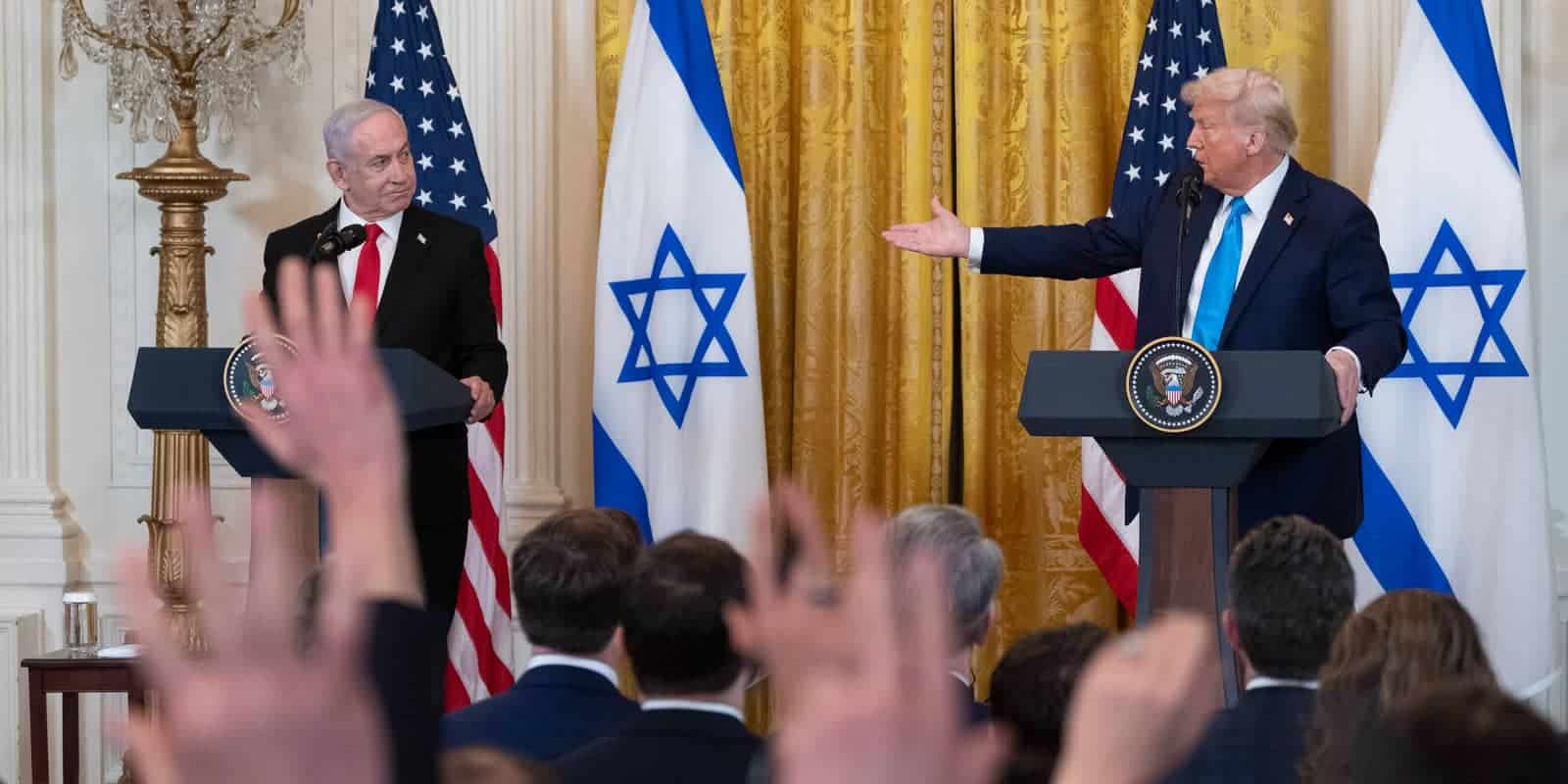
photo: The White House from Washington, DC [Public domain]