A Policy-Oriented Think Tank Addressing Foreign Policy and National Security Issues for a Safe Israel

Jerusalem is the test of US leadership in the Middle East

The Arab League’s Chairman, Ahmed Abul Gheit, has warned President Trump that recognizing Jerusalem as Israel’s capital would do a disservice to the Israeli-Palestinian peace process as well as ignite violence in the Middle-East. Given the absence of a peace process and given the abundance of violence in the Middle-East, Mr. Aboul-Gheit’s warning does not even pass the laughing test.
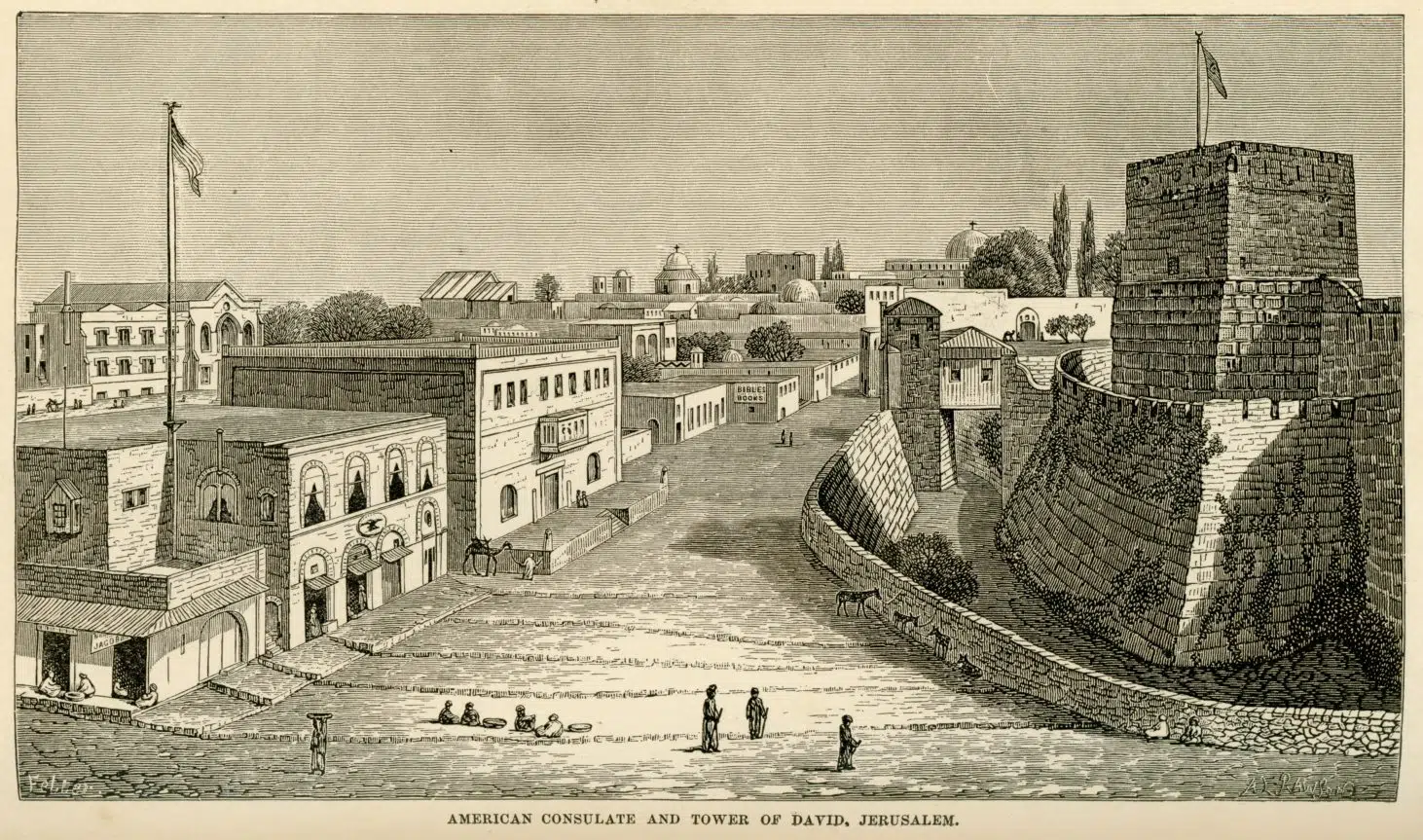
דגל ארצות הברית מתנוסס מעל ביתה הראשון של הקונסוליה האמריקנית בשער יפו, 1857 בערך

The 1947 UN partition plan had recommended the internationalization of Jerusalem, but this recommendation was never implemented. The Arab League launched a war against the newly declared State of Israel, and the 1949 armistice agreements divided the city between Israel (in the west) and Jordan (in the east). This de facto partition of Jerusalem was never recognized by the international community.

In September 1949, the UN General Assembly voted again in favor of the internationalization of Jerusalem. Both Israel and Jordan ignored that resolution. In December 1950 Israel declared Jerusalem its capital, and Jordan annexed East Jerusalem. No country recognized those annexations (only Pakistan recognized Jordan’s annexation of East Jerusalem). Only in 1952 did the UN General Assembly drop the internationalization of Jerusalem from its agenda. The status quo became tacitly accepted but never legally endorsed.

The Six Day War of June 1967 brought East Jerusalem under Israel’s control. Hitherto ignored, the status of Jerusalem became hotly contested. Israel’s sovereignty over East Jerusalem is challenged, but its sovereignty over West Jerusalem was never recognized. The US government still refuses to register US citizens born in Jerusalem (including in West Jerusalem) as “born in Israel” (a refusal that was upheld by the US Supreme Court in June 2015). Successive US governments have claimed that they will recognize whatever Israel and the Palestinians agree upon. Yet such agreement has so far been beyond reach, and the gap between the parties is likely to remain unbridgeable.

During the negotiations at Camp David (July 2000) and in Taba (January 2001), the Palestinians denied the existence of the Jerusalem Temples and, therefore, any Jewish claim to the Temple Mount. Yet Jerusalem is commonly designated in Islamic sources as Bayit al-Maqdis, which is the Arabic transliteration of the Hebrew Beit Hamikdash (which means “temple”). A travel guide published by the Supreme Muslim Council in 1924 described the Temple Mount as the ancient site of Solomon’s Temple. The Palestinians’ “Temple denial” is therefore a new phenomenon that contradicts Muslim tradition. It flies in the face of historical evidence (such as Flavius Josephus’ The Jewish War) and it is deeply offensive to the Jewish faith.

The Palestinians’ historical denials were and remain one major obstacle to an agreement on the final status of Jerusalem. Disrespect for other faiths leads to the desecration of their holy places. When East Jerusalem was under Jordanian rule (between 1949 and 1967), Jews were denied access to the Western Wall, dozens of synagogues were destroyed (including the landmark “Hurva” synagogue), and the Mount of Olives cemetery was desecrated. In the 1990s, the Palestinian Authority (PA) vandalized Jewish antiquities underneath the Temple Mount as it built two large mosques there.

By contrast, only Israeli sovereignty has guaranteed religious freedom for all and the preservation of the holy places of the three monotheistic religions. The record of Israel must be weighed against that of Jordan and of the PA while discussing the final status of Jerusalem.

President Trump can recognize Jerusalem as Israel’s capital without precluding the final status of the holy places or possible future changes in the city’s boundaries. Russia was the first country to de facto recognize Israel’s sovereignty in West Jerusalem (in April 2017, the Russian foreign ministry declared: “We view West Jerusalem as the capital of Israel”). If Russia can recognize Israel’s sovereignty in West Jerusalem, why can’t the United States?

It is time for the United States to show leadership in the Middle-East. Ending a seventy-year-old anomaly, while rewarding the only country in the region that upholds religious freedom and the rule of law, is a good way to start.


Published in The Times of Israel, 6.12.2017


JISS Policy Papers are published through the generosity of the Greg Rosshandler Family.


photo: American Consulate Jerusalem. Old City 1857, Public Domain, via Wikimedia Commons

Picture of Dr. Emmanuel Navon

Dr. Emmanuel Navon

Senior Fellow on leave | Expert in international relations, diplomacy, and Israeli foreign policy

Dr. Emmanuel Navon is an international relations scholar, author, and diplomat. As of August 2026, he is on leave from the Jerusalem Institute for Strategy and Security while serving as Israel’s Ambassador to Japan.

At JISS, Dr. Navon’s research has focused on Israel’s foreign policy, European–Middle East relations, the changing international order, energy security, and the strategic challenges facing democratic states. He has contributed policy papers, strategic analyses, public lectures, and media commentary aimed at informing both Israeli and international policy debates.

Dr. Navon taught international relations and diplomatic studies at Tel Aviv University for twenty-four years. His courses addressed Israel’s foreign policy, diplomacy, geopolitics, globalization, European foreign policy, and the evolution of the international system. In 2022, he received the Faculty of Social Sciences Award for Excellence in Teaching. His university teaching career began at Bar-Ilan University, and he subsequently taught at Reichman University and Israel’s National Security College.

He is the author of four published books and numerous academic and policy articles. His work has appeared in peer-reviewed journals including Review of International Studies and the Israel Journal of Foreign Affairs, as well as in international publications such as Le Monde and Newsweek. His book The Star and the Scepter: A Diplomatic History of Israel (Jewish Publication Society/University of Nebraska Press, 2020) has been translated into Hebrew, Chinese, Japanese, French, and Italian. He has also completed The Continent and the High Seas, a study of the historical and structural forces reshaping the international system and the global balance of power.

Dr. Navon has addressed government officials, diplomats, military officers, policy experts, and academic audiences across Europe, North America, Asia, and Africa. His speaking engagements have included the American Enterprise Institute, AIPAC, the Jewish Federations of North America, Georgetown University, Columbia University, and Rice University. He has appeared regularly in American, French, Israeli, and international media, including Voice of America, France 24, i24NEWS, and the Knesset Channel.

Alongside his academic career, Dr. Navon held senior leadership positions in public policy and international affairs. He served as CEO of ELNET-Israel, as head of the Political Science and Communication programme at the Jerusalem Haredi College, as CEO of the Business Network for International Cooperation, and as a founding partner of the Navon-Levy Group. From January to July 2026, he founded and served as CEO of the Euro-Med Middle East Council, a policy institute devoted to strategic cooperation between Europe, Israel, and partners across the Mediterranean.

Born in Paris in 1971, Dr. Navon graduated from Sciences Po and earned his doctorate in international relations from the Hebrew University of Jerusalem. He immigrated to Israel in 1993 and served in the Israel Defense Forces. He is fluent in Hebrew, English, and French, has working knowledge of Italian and German, and is learning Japanese. He is married, a father and grandfather, and an active triathlete.

Recent publications

Security Through Economics: Regional Infrastructure as a Lever for Stability

Long-term security depends not only on preventing threats but also on shaping shared interests. Economics,...

Mapping the Middle East’s Game of Camps

The multi-front war has altered the balance within and between the region’s rival camps, requiring...

Halting Arms Sales to Qatar Is Only the First Step

Israel’s decision to end defense exports to Qatar addresses only part of the problem. Doha...

By signing up, you agree to our user agreement (including the class action waiver and arbitration provisions), our privacy policy and cookie statement, and to receive marketing and billing emails from jiss. You can unsubscribe at any time.

Sign up for the newsletter

For up-to-date analysis and commentary.

Are You In?

Join 8,000+ Subscribers who enjoy our weekly digest

0
Would love your thoughts, please comment.x
()
x