

Iran’s stance towards de-stabilization in Jordan
Back in November 2014, following Operation “Protective Edge”, Iran’s Supreme Leader ‘Ali Khamenei published a tweet explaining, in nine questions and answers, why and how Israel (“the fake Zionist regime”) should be (in his own language) eliminated. As an answer to Question Seven– “What is the most urgent action to take for militarily confront Israel” (the lame English is his) – he stipulated that “The West Bank should be armed like Gaza and those who are interested in Palestine’s destiny [i.e., Iran] should take action to arm the people of the West Bank so that the sorrows and grieves of the Palestinian people will reduce in the light of their powerful hands and the weakness of the Zionist enemy”.
Clearly, for this goal and plan to be fulfilled, access to the West Bank must be established in a manner similar to the extensive smuggling operations established under the Gaza border with Egypt over the years (due to either negligence or worse on the part of the Egyptian authorities). Given both aspects of the terrain and of the professional abilities of the Jordanian security forces, this cannot be easily achieved – and indeed has not been achieved to any degree approaching the situation which prevailed in Gaza until 7 October 2023 – unless the overall stability and governmental capacity of the Hashemite Kingdom would be overwhelmed. Only through the creation of an active base of support in Jordan can the situation in the West Bank (where the people, as he pointed out in the answer to Question Nine, have “only stones” in their hands) be transformed so as to bring about Israel’s destruction.
Nearly ten years later, and against the background of a multi-front war led by Iran, the Supreme Leader’s design seems to be underway. The Islamic Republic’s proxy organization, Palestinian Islamic Jihad, is a prominent element in the northern parts of Samaria (mainly Nablus and Jenin); across the river, in Jordan, they apparently have been cultivating relations with the Muslim Brotherhood, encouraging escalating protests against the presence of an Israeli embassy in Amman – and raising questions about the ability of the regime to restrain the growing anger as the war goes on.
Cross-Border Smuggling: Drugs and Weapons
Most significantly, as the arrests in March 2024 indicate, the Iranian regime and the proxies and allies working for it on Syrian soil are actively engaged in organizing traffic across the long and relatively porous Syrian border with Jordan. This frontier is liable to become a crucial point of tension as the Jordanian authorities seek to stem the flood of drugs and weapons aimed at destabilizing Jordanian society.
Since early 2022, it has become increasingly clear that state interests are involved in generating a steady flow of the synthetic drug Captagon from Syria – identified as a key center of production – into Jordan and through it to the Gulf. In June 2024, a massive haul was foiled on its way to Saudi Arabia. The regime of Syrian president Bashar Assad takes its own cut, a significant source of income amidst the ruin brought about by the civil war. But the key player behind the smuggling networks is Iran, and the escalating violence – in 2022 alone, the Jordanian security forces killed at least 35 smugglers, and in May 2023 they attacked a key drug “boss” and his family in a raid inside Syria – serves strategic purposes as well as generating billions of dollars in illicit income.
Alongside drugs, the channels leading into Jordan enable Iran (and Hezbollah, according to Jordanian sources) to run guns and explosives, meant to reach either Iran’s proxies in the West Bank – mainly Palestinian Islamic Jihad – or subversive elements in Jordan itself. Agents of influence are also active, seeking to translate the anger and frustrations of Jordan’s Palestinian population, in the face of the images coming out of Gaza, into active protests and the delegitimization of the Hashemite regime. While the Jordanian Intelligence Department (J.I.D.) has shown a remarkable capacity to deal with domestic threats, the challenges it now faces may well be the most severe in recent years.
Moreover, the Iranian regime now has all the more reason to seek the destabilization of the Hashemite Kingdom. While never officially acknowledged, Jordan’s role supporting the joint effort to foil Iran’s drone, cruise and ballistic missile attack is well known; many of the incoming threats were intercepted in Jordan’s air space. As one of America’s most consistent partners in the region (except for a period of affiliation with Saddam Hussein during the Gulf crisis of 1990-1991), Jordan is viewed in Tehran not only as a physical barrier on the road to the West Bank but also as a sworn ideological and strategic enemy.
What Should Israel (and the U.S.) Do?
There are many aspects of Jordanian behavior which irritate and anger Israelis (and Americans) – ranging from its voting at the UN General Assembly to giving shelter to murderous terrorists and the harassment of Orthodox Jews at border crossings into the country. Discreet ways should and can be found, from a position of friendship, to raise these issues with the Jordanian authorities at the appropriate moment. But at this delicate and decisive point in time, it is of the highest importance to focus on lending support to the Jordanian authorities as they face up to Iran’s campaign of subversion.
At the level of intelligence cooperation, all efforts should be made to monitor, and where possible jointly foil, Iran’s efforts to run munitions, drugs, and subversive elements into Jordan. As indicated above, the security forces are quite willing to use force when necessary: what the J.I.D. and the Jordanian leadership need is to be on constant alert against inventive Iranian and Hezbollah methods.
At the same time, Iran should be denied to opportunities to “fish in muddy waters”: where possible, Jordan should be supported in economic terms, and with generous arrangements for the supply of gas and water from Israel. Given Jordan’s economic limitations, U.S. aid must remain a mainstay of the regime’s ability to use Jordan-centered policies to reduce social tensions.
This, in turn, requires Israel to mobilize its base of support in the U.S. Congress and lend support to aid to Jordan, and to raise awareness of the issue and its implications. Ultimately, it should be made clear that now as in 1970, Israel cannot accept hostile control of Jordan – with all that such a warning could imply, particularly if backed by a firm American message.
JISS Policy Papers are published through the generosity of the Greg Rosshandler Family.
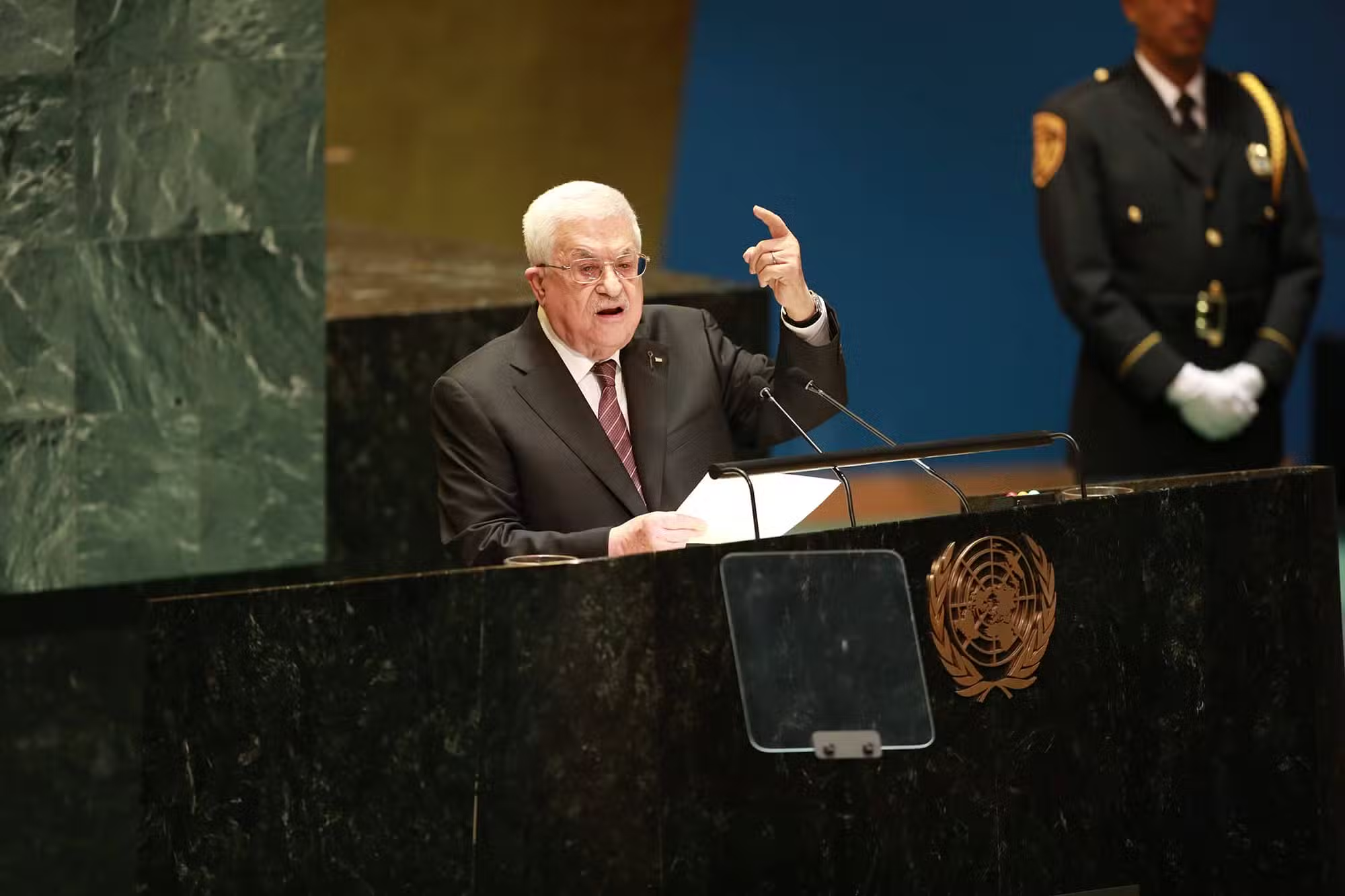
Photo: IMAGO / APAimages
Source: https://jiss.org.il/en/lerman-iranian-subversive-efforts-in-jordan/