


The Collapse of Iran’s Pivot to Central Asia
In recent years, the Iranian regime repeatedly touted its expanding ties with Central Asian states. Iran was not just boasting; its diplomacy did produce tangible gains. In 2025, a free-trade agreement between the Islamic Republic and the Eurasian Economic Union entered into force. Kazakhstan increased grain exports through Iran’s Amirabad port, and the two sides were moving toward a target of $3 billion in bilateral trade. Trade between Iran and Tajikistan quadrupled over a relatively short period. Turkmenistan was negotiating with Iran over rail transit and barter arrangements involving gas in exchange for food. The war that began on February 28, 2026, brought this momentum to a halt.
The military operations launched against Iran , especially the American-led Operation Epic Fury and Israel’s “Operation Roaring Lion,” did more than degrade the Islamic Revolutionary Guard Corps’ tactical capabilities. They effectively shattered the strategic architecture of the “Iranian Corridor,” a project into which Tehran had invested decades of diplomatic and economic capital to bind the five Central Asian republics—Uzbekistan, Kazakhstan, Turkmenistan, Tajikistan, and Kyrgyzstan—to its sphere of influence. For Central Asian states, the war became a moment of strategic clarification, accelerating their shift from traditional multi-vector diplomacy toward greater distance from a regime that has proven itself to be a “tiger without teeth or claws.”
The destruction of Iran’s military-industrial complex and the subsequent maritime blockade of its ports have not only neutralized the Iranian nuclear threat but also rendered the “Southern Corridor” uninsurable and unpredictable. As air traffic between Europe and Asia shifts toward a northern arc through the South Caucasus and Central Asia, regional states increasingly view Iran less as a bridge to global markets than as a major source of instability.
The Strategic Fragility of the Islamic Republic: A Postwar Assessment
Understanding the impact on Central Asia requires first assessing the nature of the Iranian regime’s failure. The Islamic Republic’s regional policy rested on a “decentralized mosaic defense” doctrine intended to preserve operational continuity even if the central leadership was compromised.
The 2026 conflict showed, however, that this doctrine may provide a measure of military resilience, but it confers endurance rather than victory. It is also largely irrelevant to the economic requirements of international trade, which depend on complex supply chains and reliable logistics. When the regime’s senior leadership was degraded in February 2026, local IRGC units, operating without unified command, launched a campaign of strikes against neighboring states, including the UAE and Azerbaijan, in an attempt to overwhelm American air defense systems. This behavior underscores how little weight the IRGC gives to Iran’s long-term national interests.
That conduct critically undermined the internal logic of Iran’s Central Asian pivot. Tehran’s attempt to pressure its neighbors through energy disruptions and “drone coercion diplomacy” accelerated its isolation. Rebuilding the ballistic missile program and its associated logistics hubs cannot be done through emergency measures; it requires a complex industrial supply chain that has been systematically dismantled. Consequently, the Central Asian republics are no longer planning for a “temporary disruption” but for a post-Iranian geopolitical environment.
1. Uzbekistan
The Pragmatic Pivot and the Crisis of Essential Supplies
Uzbekistan’s response to the 2026 conflict illustrates the broader regional shift from cautious cooperation with Iran to urgent distancing. Under Shavkat Mirziyoyev’s leadership, Tashkent had spent the previous two years cultivating a pragmatic relationship with Tehran, viewing Iranian transit routes as a critical shortcut to the Indian Ocean and a means to reduce dependence on northern routes. Once hostilities began and Iranian infrastructure came under attack, those assets immediately became strategic liabilities.
Humanitarian and Logistical Collapse
Uzbekistan’s immediate challenge was humanitarian. In the first weeks of the war, the Uzbek Ministry of Foreign Affairs had to organize a large-scale evacuation of citizens trapped in Iran and the Gulf. Unlike in previous regional crises, when Tashkent might have looked to Tehran for coordination, this operation was conducted through a new “Central Asia Plus” framework that explicitly excluded Iran. The Uzbek embassy in Ashgabat intensified coordination with Turkmen authorities, designating the border city of Serakhs as the primary assembly point for evacuees. The choice was symbolic: Serakhs, once a gateway for trade, became a gateway for evacuation, as embassy vehicles were mobilized to transport citizens away from the Iranian border as quickly as possible.
Economic Disruptions and Food Self-Sufficiency
The economic fallout for Uzbekistan has been severe, especially in the consumer sector. Although Iran was not among Uzbekistan’s ten largest trade partners by volume, it was a critical supplier of affordable dairy products, oils, and household goods. The halt in these shipments has created a grocery-supply emergency in the domestic market.
The disruption of the Southern Corridor has been particularly damaging because it has increased the cost of re-exporting goods from Dubai’s Jebel Ali port, a major gateway for Uzbekistan. With the Strait of Hormuz effectively closed to routine commercial traffic due to the American blockade and Iranian threats to mine the strait, the “just-in-time” logistics on which Uzbek feed and consumer industries rely have collapsed.
The Green Corridor and the Turkic Alignment
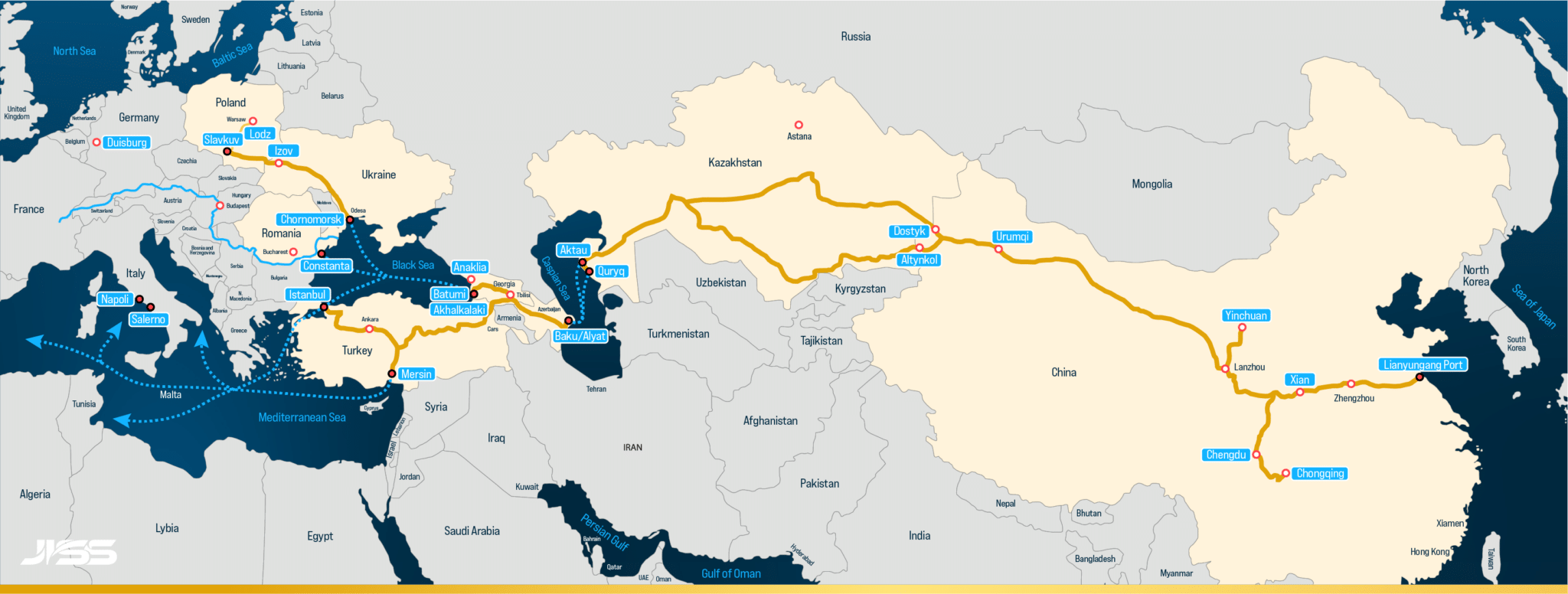
Uzbekistan’s longer-term response can be seen in its acceleration of the “Green Corridor” energy project. By April 2026, Tashkent had deepened its partnership with the Asian Development Bank (ADB) and the European Union to modernize its electricity supply and decarbonize its economy. The Green Corridor is not merely an environmental project; it is a strategic move to link Central Asian power systems to Europe via Azerbaijan, bypassing the instability of the Iranian plateau. The Uzbek Foreign Ministry has increasingly emphasized the “Middle Corridor” as its top transit priority, reflecting a growing view that the Iranian corridor may still exist on paper but no longer belongs at the center of regional planning.
Uzbek Agriculture Minister Ibrohim Abdurakhmonov said that Central Asian countries are working together to deepen regional trade ties and reduce their shared exposure to instability in the Middle East.
2. Kazakhstan
From Strategic Partner to Turkic Sentinel
Kazakhstan has emerged as Central Asia’s most vocal critic of Iranian aggression, particularly after the Iranian drone strike on Azerbaijan’s Nakhchivan exclave on March 5, 2026. For Astana, the war has prompted a comprehensive reevaluation of its multi-vector policy. Although President Kassym-Jomart Tokayev initially adopted a balanced tone, Iran’s combination of bluster and fragility has pushed Kazakhstan toward a decisive break with Tehran.
The Freeze of Strategic Projects and the Logistics Pivot
In April 2026, Kazakhstan officially suspended several high-profile joint projects with Iran. The decision effectively ended the ambitions announced in December 2025 to increase bilateral trade to $3 billion. Deputy Foreign Minister Arman Issetov said the “very complicated situation” had forced Kazakh businesses to adopt a wait-and-see position. Still, the underlying reality is a permanent shift of capital toward the Middle Corridor.
Kazakhstan’s trade with Iran, which reached about $430 million in 2025, has effectively collapsed. Agriculture, which accounted for 90 percent of Kazakhstan’s exports to Iran, primarily wheat and barley, has been hit by Iranian importers’ refusal to sign new contracts amid the banking and insurance crisis. The grain carrier Bellatrix, which arrived from Kazakhstan at Iran’s Amirabad port in early March 2026, was forced to anchor offshore, symbolizing the total halt of the Caspian grain trade.
The Nakhchivan Strike and the Collective Security Realignment
The strike on Nakhchivan was the psychological turning point for Astana. By targeting civilian infrastructure in a fellow Turkic state, Tehran demonstrated that its regional behavior is no longer constrained by the norms of Muslim solidarity but by desperate, “unprovoked” aggression. President Tokayev’s decisive condemnation of the attack and his subsequent orders to reinforce Kazakhstan’s air defenses suggest that Astana now views Iran as a systemic threat to regional stability. This has led to deeper integration with the Organization of Turkic States(OTS), with Kazakhstan and Azerbaijan positioned at the center of an emerging Eurasian security architecture that is explicitly non-Iranian.
It is worth noting that President Kassym-Jomart Tokayev of Kazakhstan was among those who most firmly condemned Iran’s strikes on the Arab states. He also openly pointed out the problematic nature of the situation in Iran, where political power has effectively been taken over by IRGC generals, pushing the government to the sidelines:
“I welcomed his [Pezeshkian’s] statement that Iran would not attack the Arab states of the Gulf. He even offered an apology on Iran’s behalf in this regard. But then his statements were disavowed — —essentially nullified. Iran attacked and continues to attack the Arab Gulf states. This shows that the president of Iran does not possess full authority. That is a fact.”
3. Turkmenistan
The Hostage of Geography and the Price of Neutrality
Turkmenistan remains the Central Asian state most directly exposed to Iran’s collapse. Sharing a 1,148-kilometer border with Iran, Ashgabat’s “neutrality” has been tested as its western provinces face a supply-side crisis.
The Balkan Province Crisis and Market Disintegration
The war’s impact has been felt most acutely in Turkmenistan’s Balkan region,which depends heavily on Iranian imports of food and household goods. Following the closure of the Sarakhs border crossing and disruption of Caspian logistics, markets in the region have reported severe shortages.
For a population with an average salary of 2,500 manats, approximately $1,470, this level of imported inflation is unsustainable. The Berdimuhamedov regime, while publicly neutral, has been forced to coordinate with Azerbaijan and the United States to secure alternative supply lines. Turkmenistan’s participation in the B5+1 summit in Washington in early 2026 signaled an effort to identify new economic anchors to replace Iran.
Strategic Hedging and the Failure of Gas Swaps
The war has also disrupted the intricate gas-swap arrangements that had become a pillar of Turkmenistan’s energy diplomacy. With Iranian infrastructure under fire and Tehran unable to function as a reliable regional transit hub, Ashgabat has pivoted toward China and the Middle Corridor. The unprecedented regional power vacuum created by Iran’s weakening has pushed Turkmenistan with no choice but to align more closely with the Turkic-Western axis, even as it maintains its characteristic strategic silence.
4. Tajikistan
Linguistic Bonds vs. Geopolitical Survival
Tajikistan presents the region’s most complex case. As the only Persian-speaking republic in Central Asia, it has long been a target of Iranian cultural diplomacy and ideological outreach. Tehran spent decades seeking to leverage the shared heritage of the Persianate world to build a loyal proxy state in Dushanbe. The 2026 war has exposed the limits of that cultural playbook.
The End of the “Safest” Route and the Rise of Secular Anxiety
Before the war, Dushanbe viewed Iran as its shortest and safest route to international waters, an alternative to unstable Afghan routes and sanctioned Russian ones. The 23 memoranda of understanding signed in January 2025 during President Masoud Pezeshkian’s visit were meant to mark a new era of energy and infrastructure cooperation. The war has rendered these agreements obsolete. The Southern Corridor, which Tajikistan had hoped would connect it to Chabahar Port, is now unviable, leaving the country without the outlet it had sought.
President Emomali Rahmon’s secular government, always wary of Iranian religious conservatism, has used the war as a pretext to distance itself from Tehran’s “ideological baggage” Tajikistan’s observer status in the Organization of Turkic States and its growing interest in the Middle Corridor suggest that Persian heritage is a weaker bond than the practical need for roads, railways, and ports, which the Turkic model can provide.
The Proxy Risk and the Sunni-Shia Divide
A significant factor in Tajikistan’s distancing is the fear of being caught in the crosscurrents of the U.S.-Iran confrontation. The IRGC’s history of employing proxies has made the Tajik leadership wary of Iranian-backed destabilization inside its own borders. By aligning more closely with Turkic states and the Trump Route for International Peace and Prosperity(TRIPP), Dushanbe is seeking a modern, geopolitically autonomous trade architecture that prioritizes stability over revolutionary fervor.
5. Kyrgyzstan
Inflation and the Breakdown of the Post-2020 Order
Kyrgyzstan, though geographically the farthest Central Asian state from Iran, has felt the ripple effects of the war through its membership in the Eurasian Economic Union (EAEU). The disruption of global supply chains has created an intricate web of vulnerabilities for Kyrgyzstan’s landlocked economy.
The main impact has been imported inflation, especially in fuel, transportation, and fertilizer. Urea prices surged by 46 percent from February to March 2026, threatening the livelihoods of Kyrgyz farmers and turning a foreign war into a domestic economic problem. The dismissal of Kyrgyzstan’s security chief in early 2026 dismantled the power-sharing arrangement that had defined the post-2020 order, leaving the country less resilient to external shocks.
Like its neighbors, Kyrgyzstan has officially welcomed the ceasefire while privately recalibrating its trade strategy to minimize exposure to the Iranian market, which it no longer sees as a viable long-term partner.
The Battle of Corridors: The Death of the INSTC and the Triumph of the Middle Corridor
The most profound long-term impact of the 2026 war is the collapse of the International North-South Transport Corridor (INSTC) as a viable global project. For years, Iran and Russia promoted the corridor as a challenge to the Western-led maritime order. The war has shown that a corridor is only as reliable as its weakest link, and that link has now been severed.
The Strategic Necessity of the Trans-Caspian Route
The Middle Corridor, or Trans-Caspian International Transport Route (TITR), which bypasses both Russia and Iran, has become a strategic necessity. Central Asian governments, once hesitant to commit fully to the costly Caspian crossing, now view it as their only geopolitically flexible option.
Iran’s attempt to undermine the Middle Corridor by investing in cultural diplomacy and proxy networks has failed. The more transactional style of Turkic engagement, focused on roads and pipelines rather than religious indoctrination, has proven easier for Central Asian states to absorb.
6. The View from Tehran: A Mirror of Desperation
Persian-language sources suggest that the Iranian regime is acutely aware of its strategic losses. While official outlets such as IRNA try to project business as usual, more professional Iranian outlets, including the economic daily Donya-e Eqtesad and Tabnak, discuss the post-war trade map in far darker terms.
The regime’s internal discourse has shifted from “regional hegemony” to “survival against the blockade.” There is growing recognition that the Arab world—particularly the UAE and Bahrain—has emerged as a major loser in infrastructure yet remains a strategic winner through its deepening reliance on the American and Israeli security architecture. Iranian analysts are now openly worried that Central Asia and the Caucasus have “stabbed a crooked knife into Iran’s back” by allowing the United States to establish a presence on Iran’s northern borders through the “Trump Corridor.”
7. Conclusions and Strategic Recommendations
The 2026 Iran war has deepened the Islamic Republic’s strategic isolation from its near abroad. After witnessing Iran’s bluster and fragility, Central Asian republics have crossed a geopolitical threshold. They no longer view Iran merely as a neighbor in the traditional sense, but as a source of systemic and long-term risk.
- The Irreversibility of the Middle Corridor: The shift toward the Trans-Caspian International Transport Route is no longer only a policy choice but an “increasingly irreversible” path-dependent reality. Central Asian states should continue harmonizing their regulatory frameworks with Azerbaijan and Turkey to ensure that the Middle Corridor can handle high-value goods and support regional trade integration.
- The Failure of Cultural Diplomacy: Iran’s Persianate heritage project is dead. The secular elites of Tajikistan and the Turkic republics have successfully countered Iranian soft power by emphasizing national identity and Turkic agency.
- The New Security Architecture: The Nakhchivan strike has paved the way for deeper security integration between Central Asia and the West. Kazakhstan and Uzbekistan should continue pursuing multi-vector diplomacy while prioritizing the Abraham Accords and the B5+1 format as buffers against Iranian instability.
- The Economic Post-Mortem: The Southern Corridor may still exist on paper, but it has become a ghost corridor. Any Iranian attempt to resume these projects after a ceasefire will face skepticism from insurers and global financiers, who now view the Persian route as a logistical nightmare. Finally, the 2026 war has shown that “taking out the tiger’s teeth” can produce a lasting strategic shift. Central Asian states are moving toward a future in which the map of usable trade routes is smaller but more resilient, and that map no longer includes the Islamic Republic of Iran.
- Iran is in no position at present to offer new agreements to Central Asian states. Its influence in the region has declined primarily due to economic losses and transport isolation. Central Asia is using the situation to diversify ties and reduce dependence on its southern neighbor. If the ceasefire proves durable, Iran may seek to resume its earlier projects, but doing so will require considerable time and resources, both of which it currently lacks.
- Israel should pay close attention to Iran’s weakening standing in Central Asia and the Caucasus. The shift opens diplomatic space, improves opportunities for intelligence access, and creates room for deeper ties with Azerbaijan and select Central Asian states. At the same time, Turkey is also benefiting from this realignment, meaning any Israeli move must be calibrated against sharper competition with Ankara.
- Turkey is already expanding its influence through Azerbaijan and broader Turkic connectivity projects. That makes Ankara a useful partner in some settings and a strategic rival in others, especially when Turkish influence grows at Israel’s expense. Israel should therefore avoid treating Iran’s decline as an automatic gain. The resulting vacuum may be filled first by Turkey.
A smarter Israeli approach would be selective: deepen ties where interests align, but resist any regional architecture that leaves Turkey dominant. In the Caucasus and Central Asia, Israel’s goal should be to reduce Iranian leverage without enabling a Turkish monopoly.
JISS Policy Papers are published through the generosity of the Greg Rosshandler Family.