
Geopolitical and Structural Reasons
Iran’s Fuel Shortage Is Becoming a Geopolitical Stress Test
Iran’s widening gasoline deficit is no longer simply a question of refinery output or domestic consumption. It has become a measure of how war damage, sanctions pressure, import bottlenecks, and subsidy politics are converging on one of the Islamic Republic’s most sensitive vulnerabilities: the daily movement of people, goods, and security forces across the country.
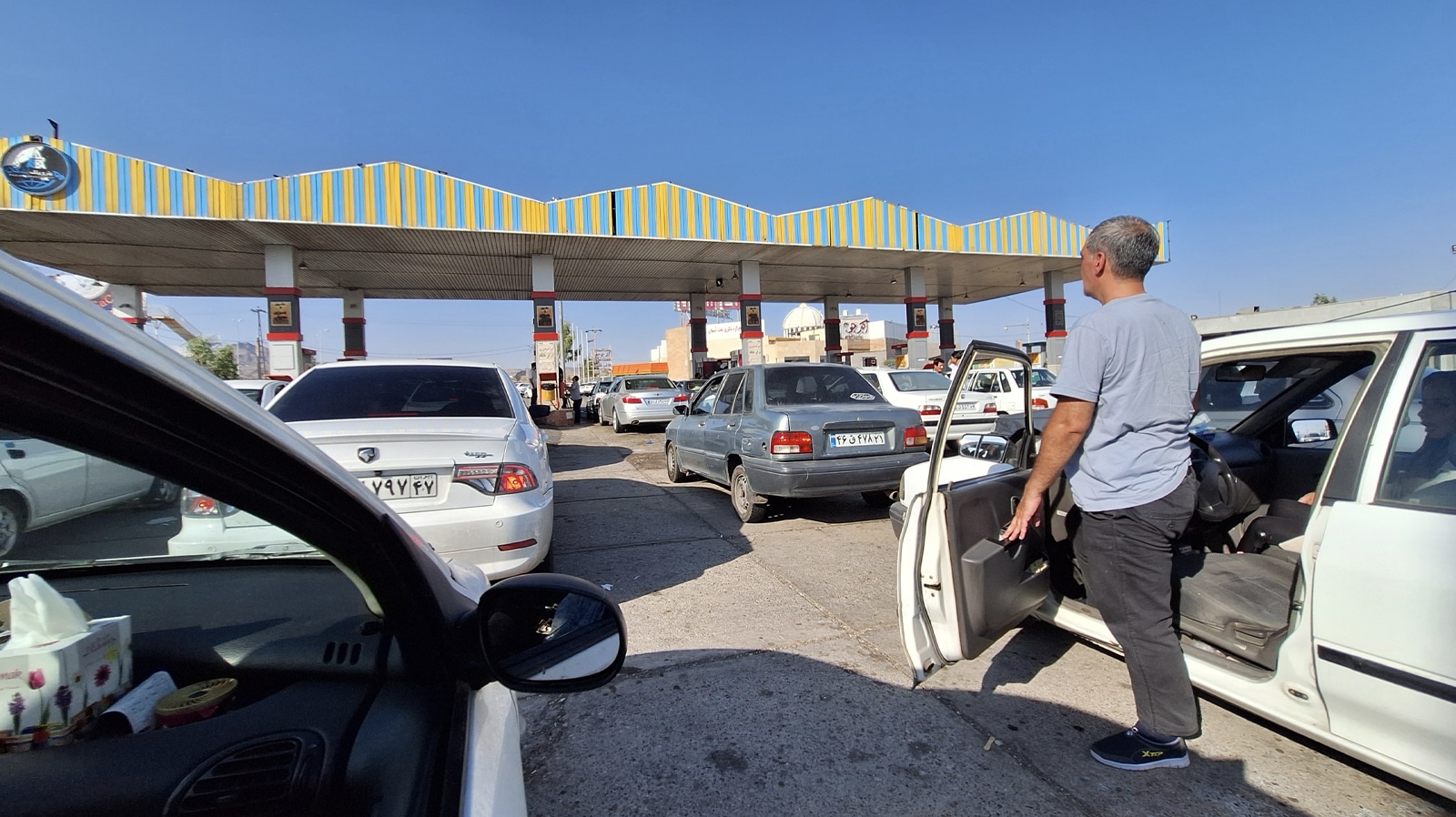
According to a spokesman for the Union of Oil, Gas and Petrochemical Products Exporters, Iran faces a daily gasoline shortfall of about 20 million liters. On July 26, Hamid Hosseini, spokesman and board member for the Iranian Oil, Gas and Petrochemical Products Exporters’ Association (OPEX), said regional and international constraints had prevented Iran from importing enough fuel to close the gap. He said the country’s refineries can produce about 110 million liters per day at full capacity, while daily consumption has reached roughly 130 million liters.
In May, Vice President Esmail Saqab-Esfahani, who also serves as Head of the Optimization and Strategic Management Organization for Energy Affairs, said Iran’s daily gasoline consumption was 130–135 million liters, compared with domestic production of about 110 million liters per day. He added that gasoline output had declined after reported damage to several refineries in U.S.-Israeli strikes.
A structural energy imbalance, sharpened by conflict
The shortage did not emerge overnight. Iranian economic press describes the country’s gasoline problem as stemming from a long-standing imbalance between production and consumption, driven by population growth, urbanization, rising vehicle ownership, and increased road travel. In geopolitical terms, this matters because a chronic domestic imbalance leaves Tehran more exposed when external shocks restrict access to imports or disrupt critical infrastructure.
Recent regional developments have turned that structural weakness into a sharper strategic liability. Damage to energy facilities during the recent war has disrupted parts of the fuel production chain. At the same time, import restrictions have made it harder for Iran to offset domestic shortages. The result is a narrowing margin between normal consumption and system-wide stress.
Hosseini said Iran had previously relied on fuel imports to meet part of domestic demand, but recent developments had severely limited that option. Importing fuel had become “not only extremely difficult but, in some cases, almost impossible,” he said, and alternative supply routes were no longer as viable.
Russia has also become a less reliable source. Hosseini cited repeated Ukrainian attacks on Russian refineries and oil tankers, which he said had affected Russia’s production and exports of refined petroleum products. As a result, he said, Moscow no longer had a significant surplus for export, further limiting Iran’s import options.
Energy expert Mehdi Mohseni said that, if Iran’s daily import requirement was about 20 million liters, nearly 15 million liters had previously entered through the southern borders. He warned that replacing this volume would be difficult as long as the current blockade imposed by the United States remained in place.
For Tehran, this creates a strategic squeeze. The country’s fuel market depends on domestic refining, imports, cross-border logistics, and subsidy-managed demand. When several of these pillars weaken at once, the issue moves beyond economics and becomes a test of state capacity under pressure.
Why Iran’s fuel system is vulnerable
Iran has expanded domestic refining capacity in recent years, but capacity alone has not eliminated vulnerability. On October 26, 2025, the country’s daily gasoline production capacity exceeded 114 million liters.
The same report identified the Persian Gulf Star Refinery as Iran’s largest gasoline producer, with a daily output of 45 million liters of Euro 5 gasoline, and noted that the Mehr Persian Gulf Refinery produces 13 million liters of Euro 5 gasoline per day. These facilities are central to Iran’s claim of partial fuel self-sufficiency.
Yet the supply chain supporting that capacity remains fragile. The Persian Gulf Star Refinery relies entirely on gas condensate feedstock from the South Pars field. Damage to South Pars facilities during the war has reduced condensate production and transfer, thereby lowering the feedstock available to refineries.
Attacks on oil storage facilities in Tehran and Alborz provinces have also affected fuel storage and distribution capacity. Damage to fuel pipelines has likewise complicated the transport of supplies to high-consumption areas. Import restrictions related to the conflict have further strained gasoline supplies.
Hosseini said that some petrochemical plants that had previously been taken offline had resumed operations and were now helping supply part of Iran’s gasoline and diesel needs. However, he said the additional output remained insufficient to close the gap between production and consumption. That distinction matters: temporary industrial workarounds may ease pressure, but they do not address the underlying strategic dependence on vulnerable feedstock, storage, and distribution networks.
The vulnerability therefore extends beyond total refining capacity. It stems from the concentration of key production assets, dependence on specific feedstock flows, exposure to infrastructure strikes, and the political limits on demand-side reform.
Subsidies, consumption and the politics of restraint
The authorities have responded with measures to reduce gasoline consumption without triggering the kind of social backlash that can follow a broad fuel-price increase. This balancing act reflects the political sensitivity of gasoline in Iran: fuel policy is both an energy-management tool and a domestic stability issue.
One of the latest measures was introduced by the National Iranian Oil Refining and Distribution Company, which began offering free compressed natural gas (CNG) at more than 1,000 filling stations nationwide starting July 24. The measure aims to encourage drivers to switch from gasoline to CNG. According to the semi-official ISNA news agency, Iran has about 4.2 million dual-fuel vehicles and a CNG network capable of supplying more than 35 million cubic meters of fuel per day.
The government has also stepped up efforts to combat fuel smuggling while repeatedly warning about high gasoline consumption. Despite authorizing high-octane gasoline imports in 2025, it has struggled to curb demand because low domestic fuel prices continue to encourage heavy use.
On August 1, Government Spokeswoman Fatemeh Mohajerani said recent changes to gasoline distribution were intended to manage fuel supplies during the conflict and protect energy security, and that subsidized quotas had not changed. The monthly first-tier quota for private vehicles remains 60 liters at 15,000 rials ($0.008) per liter, and the second-tier rate has also remained unchanged.
At the same time, the government has gradually reduced the second-tier gasoline quota from an initial 100 liters to 70 liters and then to 50 liters, while also restricting the use of unrestricted fuel cards at filling stations. Although the price of subsidized gasoline has not increased, reductions in higher-tier quotas have limited access to lower-priced fuel. These reductions could push higher-consumption motorists to buy gasoline at the unsubsidized rate.
Mohseni said the government’s options for increasing supply were limited because refineries were already operating near capacity and imports faced major constraints. He argued that managing consumption through measures such as raising higher-tier gasoline prices or reducing quotas was more realistic than a broad price increase. Still, he said any reform should be accompanied by efforts to modernize Iran’s vehicle fleet and encourage the use of more fuel-efficient cars.
Iran’s fuel shortage therefore illustrates a broader geopolitical problem: a state can possess large hydrocarbon resources yet still face acute fuel insecurity when domestic demand, infrastructure vulnerabilities, import constraints, and subsidy politics collide. The crisis leaves Tehran little room to maneuver. It can ration more aggressively, shift drivers to CNG, try to suppress smuggling, and pursue incremental price reform. But each option carries operational, economic, or political costs. The shortage ultimately underscores that Iran’s energy resilience depends not only on barrels and refineries, but also on secure supply chains, credible import routes, and the government’s ability to manage public expectations under pressure.
Political Reasons and Implications
Iran’s recurring fuel crisis is not simply a technical shortage; it is also a political-economic symptom of a distorted energy system. Domestic gasoline consumption has exceeded refinery capacity, leaving a daily shortfall of roughly 15–20 million liters that must be covered by imports or reserves. At the same time, the official subsidized price remains far below the real cost of production and well below prices in neighboring markets. This gap makes cheap gasoline less a form of social protection and more as a driver of waste, overconsumption, smuggling, and fiscal pressure, as reflected in reporting on the Iran gasoline crisis and domestic supply shortfalls.
The logic is straightforward: when consumers pay only a fraction of the real cost of fuel, the price signal that normally encourages conservation disappears. Subsidies are allocated according to consumption rather than need, so households and firms that use more fuel receive more public support. At the same time, inefficient domestic vehicles, weak public transportation alternatives, and the arbitrage opportunity created by much higher regional prices reinforce excessive consumption and organized smuggling. This is why the subsidy regime itself has become one of the causes of the crisis, rather than simply a response to it, a pattern reflected in analyses by various Iranian media outlets.
Yet the Islamic Republic is also trapped by the politics of reform. Removing or sharply reducing fuel subsidies would likely raise transportation costs and fuel inflation and quickly hit lower-income households, even if the current system disproportionately benefits heavier consumers. The regime’s fear is grounded in precedent: the 2010 targeted subsidy plan was later described as socially and economically damaging, and gasoline price increases have previously triggered unrest, most notably in November 2019. Recent hesitation over higher-priced gasoline pilots and quota changes shows that Tehran views fuel reform not merely as an economic decision but as a genuine domestic-security risk.
The practical answer, therefore, may be a credible transition rather than the sudden abolition of subsidies: gradual price correction, transparent compensation for vulnerable households, investment in public transportation and fuel-efficient vehicles, tighter anti-smuggling enforcement, and a shift from consumption-based subsidies to need-based support. Without such a package, Iran will remain caught between two dangers: continuing a costly subsidy model that deepens shortages and waste, or pursuing abrupt reform that could ignite the very social backlash the regime fears most.
Under the current circumstances, however, the regime cannot implement such measures in full without destroying what remains of its legitimacy and its capacity to run the country. Current discussions of quota redesign and individual fuel allowances therefore matter less as technical fixes than as tests of whether the state can reform without provoking another legitimacy crisis.
Pezeshkian frames consumption reform as a political necessity
The government cannot openly acknowledge that the fuel crisis stems as much from a legitimacy trap as from refinery capacity, import constraints, or inefficient consumption. It must nevertheless act and therefore presents politically sensitive reforms as technocratic corrections to waste and “real needs.” On May 20, President Massoud Pezeshkian issued two directives to senior Oil Ministry officials, including a call to “prioritize gas allocation to high-revenue-generating sectors” to boost exports and to reform Iran’s energy consumption model through new, presumably reduced, provincial quotas based on “real needs.”
By calling for “a realistic explanation of the current conditions” surrounding Iran’s wasteful energy use, Pezeshkian acknowledged “constraints in the supply of petrol and other energy sources” while placing part of the burden on public behavior and cooperation. The message seeks to prepare society for rationing discipline without admitting that the subsidy regime itself has become unsustainable.
Pezeshkian also demanded “reform of the consumption model,” warning against the “unnecessary” use of cars and singling out single-occupant vehicles as a symbol of profligate consumption. He urged people to act “responsibly” and argued that fuel savings could be redirected to improve living standards through better allocation of scarce resources. This framing casts the state as the guardian of national resources. At the same time, it exposes the political dilemma: Tehran needs society to consume less while avoiding a confrontation over the low-price bargain that has long helped contain public anger.
The economic daily Donya-e Eqtesad highlighted Iran’s wasteful fuel consumption, noting that demand had outstripped production in the run-up to 2018, creating deficits of 9 million liters per day in 2016, when consumption reached 75 million liters, and 4 million liters in 2017, when consumption rose to 81 million liters. The report said Iran achieved fuel self-sufficiency between 2018 and 2022 after the Setareh Khalij-e Fars refinery came on stream, turning the country into a net exporter. However, it said consumption had once again overtaken production, eroding earlier gains, with daily demand exceeding 130 million liters in 2025 while production stabilized at around 115 million liters.
Its recommendations included renewing Iran’s aging, fuel-inefficient vehicle fleet and removing state subsidies that distort prices and weaken incentives for consumers to economize. These prescriptions underscore the political economy of the crisis: meaningful reform requires the state to reduce privileges embedded in cheap fuel, spend resources it does not have, or impose behavioral discipline on a population already exposed to inflation, sanctions pressure, and wartime disruption.
Pilot scheme: a low-visibility instrument of control
The same political logic is evident in the government’s preference for incremental administrative measures over explicit price reform. On May 18, Keramat Veiskarami, the head of the National Iranian Oil Products Distribution Company, said a pilot scheme would be launched at two Tehran gasoline stations to make transactions using “emergency fuel cards” traceable, allowing authorities to identify users and their details.
Emergency cards were introduced for motorists who had forgotten or damaged their fuel cards, but their anonymity has made them vulnerable to abuse, allowing users to bypass quota limits, obscure consumption, or exploit heavily subsidized fuel. The broader multi-tiered pricing system also creates opportunities for smuggling because cheap fuel can be sold abroad at much higher regional prices.
On the same day, mainstream media treated Veiskarami’s comments as the backdrop to a government decision to raise prices to 50,000 rials per liter. Whether or not such a measure is formally adopted, the reporting illustrates how even small administrative changes are interpreted through the prism of potential price increases and future unrest.
Ali Mahmoudian, the head of the National Union of Alternative Fuels and Related Services, urged caution. Although his sector would benefit from a more rational fuel market, he framed reform as a problem of managing social risk rather than a purely economic adjustment.
Mahmoudian warned that “during periods of instability, a [reform-based] price shock can bear heavy social and psychological consequences,” but added that phasing in price reforms must not mean postponing them altogether. He did not specify the consequences he had in mind, but the reference is politically intelligible given the unrest that followed fuel price reforms in 2019. Mahmoudian also argued that “neither a simplistic reduction in quotas can be a solution on its own nor moral recommendations and direct pressure on the public,” instead urging a “multi-tiered and step-wise package.” This formulation captures the central problem for Tehran: the government knows that moral appeals, surveillance of fuel cards, and quota redesign can only partially contain demand, but a direct price shock could transform an energy-management problem into another test of regime authority.
The war damaged the power system
The electricity-generation sector has also come under recent media scrutiny, particularly during the war. On May 19, Energy Minister Abbas Aliabadi said that more than 4,200 MW of Iran’s power generation capacity had been affected by the recent war.
He underscored the scale of infrastructure damage to an already-strained grid, noting that the electricity sector had recently generated a 10,000 MW surplus while demand had declined through consumption management. Aliabadi added that shifting office hours could save nearly 2,000 MW as authorities seek to avoid summer blackouts amid wartime fuel and power disruptions.
Political resistance turns Pezeshkian’s fuel reform into a legitimacy contest
Opposition within Iran’s political establishment has meanwhile hardened against the plan. Most lawmakers have warned the government against any further increase in gasoline prices, framing their resistance not as a rejection of reform itself but as a demand for a different method of distributing subsidized fuel. This distinction matters: parliament is not denying the fuel imbalance, but it is trying to prevent the executive from resolving it through a price shock that could be politically explosive.
Rouhollah Motefakker-Azad, a member of parliament’s presidium, read a statement addressed to President Pezeshkian during the August 9 parliamentary session. According to Motefakker-Azad, MPs had warned the government in November 2025 against introducing a third gasoline tariff of 50,000 rials per liter, arguing that the authorities should first exhaust non-price measures. He said the subsequent increase had failed to curb demand, with consumption now exceeding 135 million liters a day and about one-third of gasoline still being purchased with filling-station fuel cards. The statement added that wartime conditions and the blockade had further complicated access to imported gasoline and warned that financing imports would widen Iran’s budget deficit, increase pressure on foreign-currency reserves, and add another inflationary channel to an already strained economy.
MPs suggest national ID-based quotas
The MPs urged the government to link fuel quotas to bank cards tied to individuals’ national ID numbers, expand the use of CNG, electricity, and LPG, and gradually shift energy subsidies to a system based on household size. Their proposal seeks to recast subsidy reform as an equity measure rather than a price increase, giving parliament politically safer language to intervene in the fuel market.
They argued that the current vehicle-based system is inequitable because households with multiple vehicles can receive more subsidized fuel, while families without a vehicle receive no direct fuel benefit. The statement said there was “no alternative” to establishing the infrastructure for national ID-based quotas and called for the country’s aging smart fuel system to be upgraded. This framing allows MPs to criticize the existing allocation model while avoiding direct endorsement of higher prices, reflecting the political sensitivity of any measure perceived as reducing popular entitlements.
Government denials deepen the political cost of reform
Pezeshkian presents his plan as reform, but many political actors and much of the public expect reform in practice to mean another price increase, leaving the government vulnerable to accusations that it is retreating from earlier assurances. The issue is therefore also one of executive credibility at a moment when public trust is already limited.
On July 28, Deputy Speaker Ali Nikzad said that Plan and Budget Organization chief Hamid Pourmohammadi had told MPs that a petrol price increase had been ruled out and that the government would instead pursue changes to fuel quotas. Such assurances may buy the government temporary political space. Still, they also narrow its future options: the more firmly it denies price reform, the more destabilizing any later reversal is likely to be.
Broad opposition to price increases
Hardline social media users opposed to President Massoud Pezeshkian’s government appeared to be the harshest critics of the proposed move, accusing it of broader fuel mismanagement and portraying it as a broken promise or as deliberate pressure on the public.
Meanwhile, some “reformist” or “professional” voices who support Pezeshkian argued that some form of price adjustment or tighter rationing was economically necessary to reduce waste, smuggling, and the unsustainable cost of the subsidy. An X user argued that most Iranians would not even reach a level of daily fuel consumption that would require them to purchase gasoline at the suggested higher price.
Some posts across the political spectrum expressed concern about shortages, long lines, and the risk of social fallout similar to the 2019 fuel protests, when a sudden fuel price hike triggered widespread, deadly anti-government demonstrations. An anti-regime user said the gasoline shortage was a a crisis that could trigger a chain of events and “very quickly lead from the gas pump to the economy, to the streets and ultimately to the destruction of the regime.”
The regime is therefore caught between economic necessity and political risk. The IRGC junta blames Pezeshkian and his government, using them as a lightning rod to deflect popular ire, while the government and professionals recognize the need to end subsidies or at least reform fuel distribution. Yet ruling IRGC officers and politicians also know that reform could jeopardize the regime’s already shaky stability. Repression remains the regime’s top priority. Even official Iranian media acknowledge that the war and ensuing emergency have exacerbated existing problems, while leaving the crisis unresolved could deepen dissatisfaction and trigger the protests the regime fears most.
JISS Policy Papers are published through the generosity of the Greg Rosshandler Family.
Source: https://jiss.org.il/en/grinberg-irans-fuel-crisis-is-more-than-an-energy-problem/