


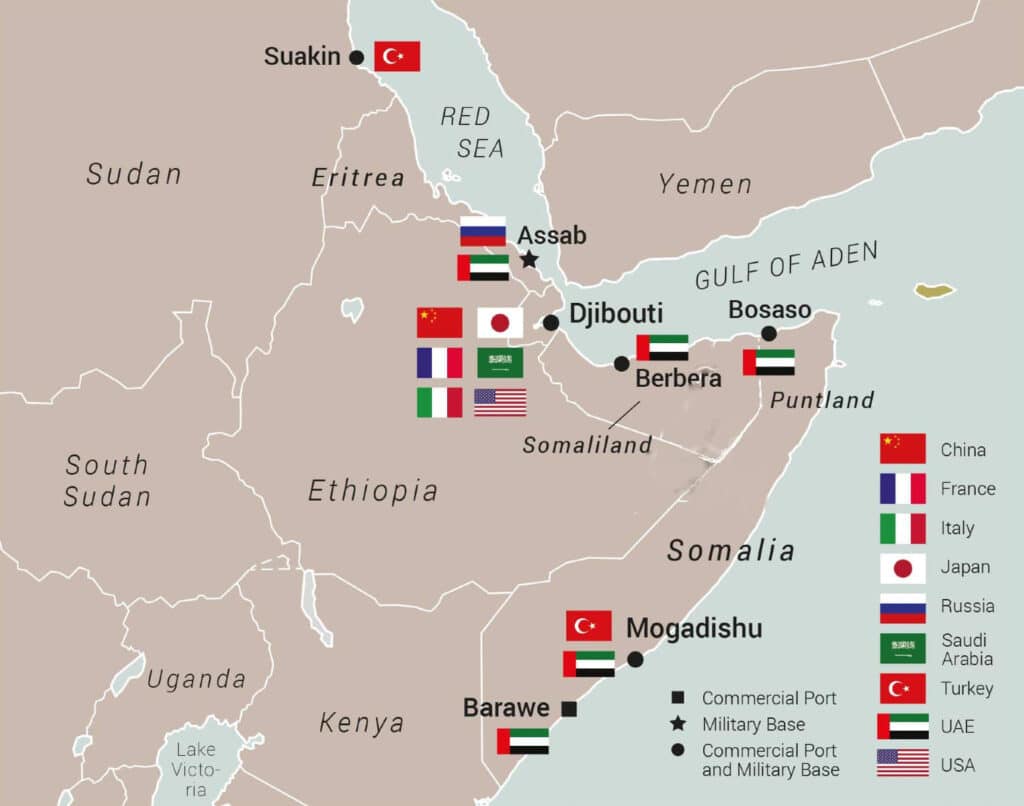
In recent decades, the Horn of Africa has become an increasingly important focal point of foreign involvement, reflecting the growing strategic significance of its location at the junction of Africa, the Middle East, and international maritime trade routes. Its proximity to the Red Sea and the Bab el-Mandeb Strait—one of the world’s most critical chokepoints—has turned the region into an arena in which the security, economic, and political interests of global and regional powers converge (and at times collide). Foreign involvement has heightened the region’s strategic importance, while also intensifying competition, external dependence, and, at times, instability. The following is a brief overview of the activities of the principal states engaged in the region, along with an analysis of their interests.
The United States
The United States’ primary interest in the Horn of Africa is security driven. Washington views the region as a central arena for countering jihadist terrorism, ensuring freedom of international navigation, and preserving its hegemonic position in the face of China’s and Russia’s expanding presence. U.S. activity in the Horn of Africa is concentrated primarily in Somalia—a key theater in operations against al‑Shabaab—and in Djibouti, where it maintains a large and active military presence at Camp Lemonnier. In parallel, the United States employs diplomatic tools and economic assistance to bolster regimes perceived as partners in regional stability and maintains intelligence cooperation with them (Somalia, Kenya, Ethiopia, and Djibouti). This cooperation includes information sharing, professional training, the establishment of joint coordination mechanisms, and, at times, the integration of local forces into intelligence-led operational activity.
U.S. involvement in the Horn of Africa forms part of a broader strategy of great-power competition. The United States seeks to preserve its strategic advantage amid the deepening presence of China and Russia in the region and to constrain the expansion of their influence, which could undermine long-term American interests. To this end, Washington works to entrench its presence at geo-strategic nodes. Its base in Djibouti enables monitoring of the movement of forces, goods, and weapons across the Red Sea and the Bab el-Mandeb Strait, while limiting China’s and Russia’s ability to operate freely and establish a military foothold in the area. In parallel, the United States advances intelligence, security, and economic cooperation with regional states, designed to balance and diversify their reliance on China and Russia.
China
China’s interest in the Horn of Africa is first and foremost economic-strategic, reflecting the region’s role as a central link in the Belt and Road Initiative, which is intended to ensure continuity of trade routes, access to resources, and the opening of new markets. Accordingly, China has invested vast sums—approximately $29 billion in 2024 alone—in transportation infrastructure, ports, energy, and communications, primarily in Ethiopia, Djibouti, and Eritrea, which it views as key nodes linking the African interior to international maritime routes. In parallel, China has worked to expand its economic presence and influence in the region through the provision of state-backed loans, the expansion of trade volumes (becoming a leading trading partner), and deeper involvement in state infrastructure, including communications, logistics, and transportation. These activities deepen the economic dependence of regional states on China and provide Beijing with political leverage over them. China has also expanded its security presence in the Horn of Africa by establishing a military base in Djibouti—its first overseas base—intended to protect its economic and civilian interests in the region and located roughly ten kilometers from the U.S. base there. It should be emphasized that China offers an alternative to the Western model of conditional assistance, an approach that has proven attractive to a number of African states.
Russia
Africa’s importance has grown in Russia’s strategic outlook following its invasion of Ukraine and deteriorating relations with Western states, emerging as a peripheral arena in which Moscow identifies opportunities to expand its influence and challenge Western dominance. In the Horn of Africa, Russia has sought to establish a military and political foothold at relatively low cost, appealing to regimes seeking alternatives to Western pressure on human rights and democratization. It has done so through measures that allow it to accumulate political influence without requiring extensive economic engagement, such as arms sales, security cooperation agreements, training of local forces, and activity through private military companies. In this context, the Africa Corps—which replaced the Wagner Group as part of a new Russian policy of “official military presence” in Africa—is currently active in the Sahel, including Mali, the Central African Republic, Burkina Faso, Niger, and Libya. Whereas the Wagner Group previously operated in Sudan (engaging in mining activities and ties with the military), the Africa Corps has not received authorization to deploy forces there at present. Nevertheless, Russia remains highly active in the Sudanese arena, including the provision of military support to the Sudanese Armed Forces (SAF) during the country’s civil war, as part of efforts to strengthen its influence in exchange for access to a naval base at Port Sudan. Establishing a military base on the Red Sea constitutes a significant security interest for Russia, particularly following the fall of the Assad regime in Syria and the resulting damage to Russia’s military posture in the Middle East.
Turkey
Turkey’s interests in the Horn of Africa stem from ideological, security, and economic considerations; it views the region as an important arena for advancing its ambitions as a regional power and as a leader in the Sunni Muslim world. Its activities there combine elements of “soft power” (aid, education, and religious engagement) with “hard power” (military presence) to expand its political influence. Turkish involvement is particularly prominent in Somalia, where it has established a military base, invested in civilian infrastructure (the Port of Mogadishu and the international airport), and engaged in humanitarian assistance. In this way, Turkey has established a distinctive foothold in an area adjacent to the Red Sea and international maritime routes, expanding its influence in a relatively weak state where competition with other powers is ongoing.
Saudi Arabia
Saudi Arabia’s involvement in the Horn of Africa forms part of its broader policy toward East Africa and the Indian Ocean, combining geo-strategic, religious, and economic interests. Stability in the Horn of Africa is vital for safeguarding the kingdom’s trade and energy routes and for preventing the entrenchment of hostile actors near its maritime borders. Accordingly, Saudi activity in the region focuses on investment, economic assistance, and the strengthening of diplomatic ties with coastal states. In this context, Saudi Arabia is involved in economic and infrastructure projects across a range of sectors—including energy, agriculture, infrastructure, and transportation—as part of a broader economic effort to expand its influence in Africa without relying on a direct military presence. In addition, the Horn of Africa provides Saudi Arabia with an opportunity to preserve its influence within the Sunni Muslim sphere (for example, in Somalia and Sudan) and to forge political and economic linkages aimed at constraining Iranian (and Turkish) influence, at times competing with the United Arab Emirates for regional influence.
United Arab Emirates
The United Arab Emirates’ interest in the Horn of Africa is distinctly geo-economic, centered on control and influence over networks of ports and international trade routes. The UAE has adopted an aggressive and highly focused approach in the Horn of Africa, combining soft-power assets, economic investment, security presence, and diplomatic influence. This activity runs in parallel with its broader policy across the Indian Ocean, East Africa, and the Red Sea, as part of a competition for influence with Turkey, Saudi Arabia, and Western actors. The Horn of Africa fits into a wider strategy aimed at transforming the UAE into a global commercial hub. Accordingly, it invests in ports and logistics infrastructure, maintains a limited security presence (along the Somali coast and the Red Sea coastline), and develops close ties with local regimes (Sudan, Somalia, and Somaliland). This activity—combining military influence, economic investment, humanitarian assistance, and strategic diplomacy—strengthens the UAE’s influence in the Sunni arena and provides it with political and economic/strategic leverage in the region, enabling it to compete with regional actors such as Turkey and Saudi Arabia while maintaining a relatively low military profile.
Egypt
Egypt’s interests in the Horn of Africa are first and foremost connected to national water security. The issue of the Grand Ethiopian Renaissance Dam has turned Ethiopia and its surroundings into a central focus of Egyptian foreign policy. Cairo employs diplomacy to mobilize regional and international support for its position, strengthens ties with states in the Horn of Africa, and seeks to prevent strategic isolation. Moreover, Egypt views the Horn of Africa—particularly the Somali coastline and the Red Sea—as vital to the protection of key trade routes and to maintaining its regional standing in East Africa and the Indian Ocean. Accordingly, Cairo invests in a limited but strategic security presence in the region, including the strengthening of naval forces in the Red Sea and the Bab el-Mandeb Strait, technical assistance and training for security forces in countries such as Somalia and Sudan (against piracy and terrorist organizations), and cooperation with Western states in maritime operations. Egypt’s influence in the Horn of Africa rests on a combination of naval military capability, economic investment (maritime transport and logistics projects), and political influence exercised through alliances with local governments (Ethiopia and Sudan).
Iran
Iran views the Horn of Africa as a secondary but important arena within its broader strategic struggle against the United States, Israel, Saudi Arabia, and their partners. The region enables Iran to expand its influence, circumvent sanctions, and operate in proximity to strategic maritime routes. Iran’s activity is characterized by a relatively low profile and includes ties with local regimes and actors, limited maritime activity, and efforts to establish a presence along the Red Sea coastline. Iran employs a strategy of religious soft power that combines support for Shiite communities (in Somalia and Sudan), the establishment of mosques and educational centers that reinforce its presence, support for social organizations, and so forth. This approach allows Iran to build a long-term base of influence even in the absence of extensive military presence or large-scale economic projects. In contrast to China or Turkey, Iran does not invest heavily in physical infrastructure or logistics projects due to its limited resources, but it is involved in projects in agriculture and light industry in the region. These activities are intended to strengthen political ties and secure access to strategic resources, rather than to generate significant economic profit. In addition, some states in the Horn of Africa (such as Somalia and Sudan) are used by Iran as transit points for arms smuggling to its proxies in the Middle East (including Hamas, the Houthis, and others), thereby creating leverage against its regional rivals (Saudi Arabia, Turkey, the UAE, and Israel).
Foreign Actors in the Horn of Africa: Interests and Modes of Engagement
| Actor | Primary Interests | Key Modes of Engagement |
| United States | Security, counterterrorism, protection of freedom of navigation | Military bases (Djibouti), operations against al-Shabab, security and intelligence cooperation; diplomatic and economic assistance |
| China | Economic-strategic interests linked to the “Belt and Road,” securing trade routes, access to resources and markets | Infrastructure investment, state-to-state loans; expansion of trade ties, creation of economic dependence |
| Russia | Expansion of influence, erosion of Western dominance | Arms sales, security cooperation agreements, training of local forces; deployment of private military contractors (Africa Corps) |
| Turkey | Influence in Sunni regions, economic and security | Military bases in Somalia, infrastructure investment; humanitarian assistance, soft and hard power |
| Saudi Arabia | Protection of trade and energy routes, influence in Sunni regions | Economic and infrastructure investment, financial assistance, diplomatic engagement, economic pressure |
| United Arab Emirates | Geo-economic, control over trade routes | Investment in ports and logistics, limited security presence; ties with local regimes, diplomatic influence |
| Egypt | Water security; GERD, trade routes | Limited naval presence, security training and assistance, maritime cooperation with Western nations, regional ties |
| Iran | Sanctions circumvention, access to maritime routes, smuggling of arms to proxies | Religious soft power, ties with local regimes, proxies |
Israel’s Recognition of Somaliland as a State and Its Impact on the Dynamics of the Horn of Africa
A Primer on Somaliland
Somaliland is a de facto political entity in the northern Horn of Africa that declared independence in 1991 but has not been formally recognized as a state by the international community. It is located in northwestern Somalia, along hundreds of kilometers of coastline on the Gulf of Aden, directly opposite Yemen, bordering Djibouti and Ethiopia. Its capital is Hargeisa, and its population is estimated at approximately six million. From 1884 to 1960, it existed as a British colony (“British Somaliland”); from 1960 to 1991, it was part of the Somali state following its unification with Italian Somaliland. In 1991, following the collapse of Siad Barre’s regime in Somalia, it declared unilateral secession. Since then, it has maintained continuous self-rule without international recognition. Somaliland maintains that it is restoring previous sovereignty rather than creating a new state.
The country is a presidential republic, with a distinctive political structure that combines modern democratic institutions with traditional clan-based mechanisms (notably a council of elders). Governance in Somaliland has been relatively stable compared to the rest of Somalia, and political transitions there have been non-violent. The population is predominantly Sunni Muslim and ethnically Somali; nevertheless, a distinct “Somaliland” identity has developed, alongside a strong aspiration for independence from Somalia. The economy is weak (with GDP per capita estimated at approximately $1,361 in 2025) but relatively stable and is based primarily on livestock exports (mainly to the Gulf), remittances from the diaspora, and the Berbera Port.
Although it is not recognized by the United Nations, Somaliland maintains informal relations with Ethiopia, the United Arab Emirates, the United Kingdom, and other Western states. It seeks full international recognition, arguing that it is more stable, democratic, and functional than much of the surrounding region.
A Brief Analysis of Israel’s Recognition of Somaliland
From Israel’s perspective, the security and strategic importance of the Red Sea lie at the heart of the move. Somaliland holds geo-strategic significance due to its proximity to the Bab el-Mandeb Strait, a critical maritime chokepoint accounting for approximately 12–15 percent of global trade and a key maritime gateway to Israel (to Eilat via the Indian Ocean). Recent years have seen intensified security threats in this area, primarily from the Houthis in Yemen through attacks on commercial shipping, and Iranian arms smuggling, and maritime terrorism. Israel views Somaliland as an important node along the Red Sea routes that could provide it with strategic depth against regional threats—particularly the Houthis and Iranian/Hezbollah activity in the area. Recognition of Somaliland enables Israel to partner in this arena with a stable and non-hostile actor, facilitating intelligence cooperation and potential future logistical access (not necessarily in the form of military bases).
Additional considerations behind the Israeli move are regional (a widening competition for influence with Turkey, which seeks to establish a strategic foothold in Somalia and the broader area), political (expanding Israel’s circle of partnerships and advancing normalization with Muslim states in the spirit of the Abraham Accords), and economic (creating opportunities for economic cooperation across a range of fields, including agriculture, health, technology, and the broader economy).
In practice, Israel’s recognition of Somaliland is far more than an extraordinary diplomatic measure; it constitutes a strategic move with wide-ranging implications in the African and Arab arenas. Recognition strengthens Israel’s political presence in the Horn of Africa, underscores its ability to operate in arenas where major powers are active, and sends a signal to both rivals and partners. It establishes a direct political linkage between Israel and a stable governing entity, without reliance on fragmented Somalia or less stable regimes in the region. In addition, recognition of Somaliland provides Israel with an anchor in a critical arena that is not directly dependent on power struggles in Yemen yet can be leveraged for monitoring or protecting trade routes.
How Does Israel’s Recognition Intersect with the Region’s Key Actors?
Israel’s recognition of Somaliland has become a significant geopolitical point of contention, centered on strategic interests in the Gulf region and the Horn of Africa. The responses of regional actors have been shaped by assessments of how the recognition affects their respective interests, as well as by the problematic and sensitive dimension it entails for many of them—namely, the granting of legitimacy to a secessionist entity and the potential erosion of established norms of state sovereignty. Accordingly, a division can be identified between camps supporting or opposing the move, influenced by these considerations.
Explicit Opposition
Strong condemnation of the recognition came from actors directly affected or weakened by it—most notably Somalia and the African Union, which fears a domino effect of fragmentation across the continent—as well as from states concerned about secessionist precedents within their own territories, such as China and Russia. Opposition also emerged from countries whose regional interests are directly challenged by the move: Turkey, which sees Israel’s action as part of a broader contest with it for influence in Africa and as undermining its role as Somalia’s ally; Saudi Arabia, which views the recognition as strengthening the position of its regional competitor, the United Arab Emirates, in the Horn of Africa; and Egypt, which is concerned about the deepening Israeli military presence in the Red Sea and the weakening of its ally Somalia in their shared confrontation with Ethiopia over the Grand Ethiopian Renaissance Dam.
Cautious Responses
States with broader maritime and economic interests in Africa, and in the international arena more generally, appear to have opted for a more cautious and restrained response, stopping short of endorsement and expressing reservations regarding the recognition. India, for example, has a growing interest in the Red Sea and in trade routes, including an interest in deepening its presence in Africa without becoming politically entangled. At the same time, it has refrained from recognizing Somaliland as a state, seeking to avoid setting a secessionist precedent within its own territory (Kashmir). This position was reflected in a statement by India’s Ministry of External Affairs on January 9, emphasizing the importance of respecting Somalia’s territorial integrity.
The United States has likewise adopted a cautious approach to Israel’s recognition of Somaliland, seeking to preserve regional stability and avoid escalation while balancing its ties with Israel against its commitment to the existing international order. On the one hand, Washington views unilateral recognition of Somaliland as problematic, as it runs counter to prevailing U.S. and international policy toward Somalia. In this vein, President Donald Trump expressed reservations about recognizing Somaliland and made clear that the United States does not intend to follow Israel’s lead. At the same time, the United States has provided a measure of political cover for the Israeli move. During an emergency session of the UN Security Council on December 29, Washington defended Israel’s right to make independent decisions regarding diplomatic recognition, drawing a comparison to past unilateral recognition in the Palestinian context. Moreover, the commander of U.S. Africa Command (AFRICOM) visited Somaliland on January 1 to discuss security issues in the Horn of Africa and the Red Sea, including potential security cooperation agreements, ahead of an anticipated visit by senior Somaliland officials to Washington. Taken together, these signals suggest that the U.S. position on Somaliland may yet change.
Pragmatic Responses
The final group comprises actors that have identified Israel’s recognition as serving their interests and have therefore adopted a pragmatic—and in some cases positive—stance toward the move.
The United Arab Emirates, which maintains direct investments and close political ties with Somaliland, stands to benefit from the strengthening of Somaliland’s legitimacy. Israel’s recognition also aligns with Emirati efforts to support the Horn of Africa economically and in security terms, particularly in response to maritime transport risks and Houthi threats. From Abu Dhabi’s perspective, Somaliland is viewed primarily as an economic-strategic anchor rather than as a legal question; accordingly, the UAE responded to the Israeli move by calling for dialogue and political solutions while emphasizing the importance of regional stability.
The Israeli move also serves the interests of Ethiopia, which views Somaliland’s stability and consolidation as important due to its location along Ethiopia’s eastern border and the depth of ties between the two. These ties are driven primarily by Ethiopia’s need for maritime access through the Port of Berbera and by its interest in preventing the strengthening of hostile actors in the area. At the same time, Ethiopia remains concerned about potential damage to regional cohesion and the risk of confrontation with Somalia and Egypt and therefore refrained from issuing an official response to the Israeli move.
Somaliland itself welcomed the Israeli statement, viewing it as a breakthrough toward legitimacy, an opportunity for security and economic cooperation, and a reinforcement of a distinct state identity. At the same time, there are concerns that certain African or Arab states may reduce economic ties with Somaliland as part of broader efforts to exert pressure on it to ward off its secessionist aspirations.
| Camp | Actors | Core Interests |
| Explicit Opposition | Somalia; African Union (AU); IGAD; China; Russia; Egypt; Saudi Arabia; Turkey; Organization of Islamic Cooperation (OIC) | Preservation of sovereignty, prevention of secessionist precedents |
| Cautious Responses | United States; India | Balancing interests, prevention of escalation |
| Pragmatic Responses | Ethiopia; Somaliland; United Arab Emirates | Trade, security, maritime control |
Conclusion: Implications for Israel
An analysis of how the various actors currently active in the Horn of Africa have responded to the Israeli move, and of its effects on them, points to several implications for the State of Israel.
Risks to Be Managed
While recognition of Somaliland serves a significant Israeli security interest by challenging Iranian and Houthi presence in the Red Sea, it also creates a new focal point of tension in Israel’s relations with other regional actors, who view the move as a threat to their interests. Recognition has placed Israel on a collision course with its regional rival Turkey in an additional arena after Syria, as well as with Somalia. It has also heightened tensions with Egypt and undermined the potential for advancing normalization with Saudi Arabia, since the recognition serves the interests of Saudi Arabia’s regional rival, the United Arab Emirates. In practice, Israel’s recognition of Somaliland could alter the regional balance of power by granting Hargeisa an economic or security advantage and by reshaping the way in which Saudi Arabia and the UAE compete for influence in the region.
Recognition does not appear to have disrupted existing normalization with the Abraham Accords states, which responded negatively but with relative caution and chose to frame the move as an African, rather than Arab–Palestinian, issue. Nevertheless, Israel’s conduct may reinforce an element of distrust among Arab states that do not maintain deep ties with Israel, such as Morocco and Bahrain.
Opportunities for Leverage
Israel’s recognition of Somaliland can be seen as part of its diplomatic toolbox for advancing geopolitical and strategic objectives. It creates opportunities to strengthen security, economic, and diplomatic ties in Africa—first and foremost with Somaliland, but also with the United Arab Emirates, Ethiopia, the United States, and other Western states—particularly through the joint development of infrastructure and trade links.
Although some actors have shown understanding for Israel’s move (the United States, India, and Eastern European states), concerns over secessionism and the fear of setting a precedent within their own territories prevent them from following Israel’s lead. Even so, the move may encourage them to increase their engagement in the Horn of Africa, as they view the region as significant for the security of Red Sea trade routes. Moreover, Israel’s move may align with Western efforts to deepen influence on the African continent as a response and counterbalance to the activities of China and Russia, while projecting Israeli diplomatic agency as an initiator of action on the international stage.
This is evident in the fact that India stands to benefit from the Israeli move insofar as it indirectly advances its objectives in the region: an interest in regional stability, protection of trade routes, and the creation of a secure operating environment for investment and security presence. This is because Israeli recognition strengthens Somaliland’s autonomy and creates a more stable framework for regional cooperation, while balancing the presence of actors competing with India in the region, such as China and Russia.
JISS Policy Papers are published through the generosity of the Greg Rosshandler Family.