

Executive Summary
The ongoing destabilization of Iran poses one of the most complex strategic dilemmas faced by Turkey in the twenty-first century. This assessment is far from self-evident, as it conflicts with the widespread perception of Ankara and Tehran as historical rivals.
Turkey fears a resumption of Iran’s disruption and meddling in Syria. For its part, Iran fears Turkey’s growing influence in the Caucasus, which it views as detrimental to its strategic interests. Following the fall of the Bashar Assad regime in Syria, Iran accused Turkey and Israel of a joint anti-Iranian conspiracy. Other arenas of contest between Turkey and Iran also exist.
However, regarding current events, a range of geopolitical calculations shapes Turkey’s stance on the anti-regime protests in Iran American threats to act against the regime. This paper posits that Ankara is gripped by a “Crisis of Calculation.” The Turkish political and security establishment views the potential collapse of the Islamic Republic not as an opportunity for regional advancement but as a prelude to ethno-sectarian fragmentation that could irreparably damage Turkey’s territorial integrity and demographic stability.
Israeli or American assessments arguing that the removal of the primary engine of regional terror in Tehran would naturally benefit Turkey, fail to account for the specific pathologies of Turkish strategic culture. Ankara suffers from three interconnected fears: Its deeply entrenched, antisemitism-driven paranoia of Israeli hegemony; the empowerment of Kurdish separatism through a power vacuum; and a demographic inundation of refugees, that would exceed by far even the influx in the wake of the Syrian crisis.
The Turkish response reveals a split between a cautious, neutral diplomatic posture and a frantic, conspiratorial domestic information campaign. While Foreign Minister Hakan Fidan articulates a doctrine of “regional ownership” and non-intervention, Turkey’s state-aligned media apparatus is aggressively framing the anti-regime protests in Iran as a “Zionist-American” plot. This narrative is not merely domestic propaganda; it reflects genuine geopolitical anxiety that a post-Islamist Iran would realign with the West, leaving Turkey isolated and encircled. By engaging with the specific arguments of Turkish strategists, journalists, and military officials, this analysis exposes the fragility of the Turkey-Iran modus vivendi and the limits of Ankara’s capacity to shape outcomes in its immediate neighborhood.
Calculated Ambivalence: The Architecture of Official Neutrality
The official Turkish response to the uprising in Iran has been marked by disciplined “strategic silence,” punctuated by carefully calibrated statements that support stability. This posture, described in Turkish analytical writing as a “cautious or balanced stance” (ititdali / temkenli duruş), is a deliberate diplomatic maneuver to insulate Turkey from the unpredictable shockwaves of its neighbor’s internal collapse.
1.1 The Erdoğan-Pezeshkian Channel: Stability Above All
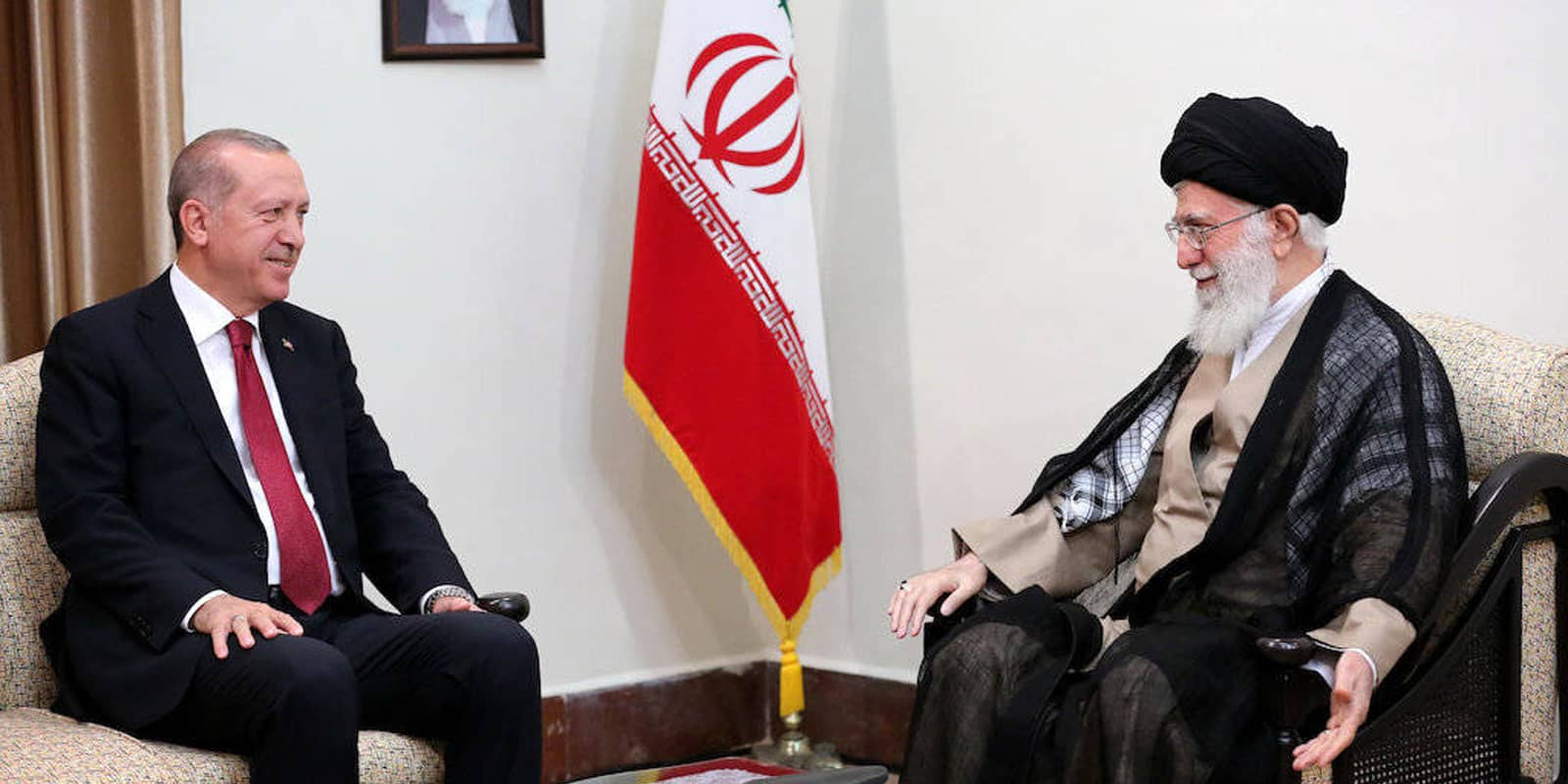
The crystallization of this policy was evident in the high-level diplomatic engagement between President Recep Tayyip Erdoğan and his Iranian counterpart, Masoud Pezeshkian. On January 22, 2026, amid widening protests, the two leaders held a critical telephone consultation. The readout of this call serves as a primary source for understanding Ankara’s priorities. Erdoğan explicitly stated that Turkey “attaches great importance to the peace and stability of Iran.”
This emphasis on “stability” is the diplomatic code for regime survival. For Erdoğan, preserving central authority in Tehran—regardless of its ideological complexion—is preferable to the uncertainty of a revolutionary transition. In the same conversation, Erdoğan stated that Ankara “has never approached scenarios of external intervention in Iran positively.”This statement serves multiple strategic functions:
- Anti-Imperialist Signaling: It reinforces Erdoğan’s domestic brand as a leader who opposes Western efforts to shape the Middle East.
- Regime Assurance: It signals to Tehran that Turkey will not serve as a staging ground for Western intelligence or military operations to topple the regime, a crucial assurance given Turkey’s NATO membership.
- Preventive Diplomacy: It aims to forestall any Iranian accusation of Turkish complicity, thereby protecting bilateral trade and energy ties during the crisis.
President Pezeshkian used this channel to advance the regime’s standard defense, claiming that “trained terror groups”—a standard Iranian reference to any opposition elements—had hijacked legitimate economic grievances with the backing of the United States and Israel. Notably, the Turkish readout did not challenge this characterization, implicitly validating the Iranian narrative of foreign interference by remaining silent.
1.2 The Fidan Doctrine: “Regional Solutions for Regional Problems”
Foreign Minister Hakan Fidan has been the architect of the operational side of this policy. His statements reflect deep skepticism of Western motives. In his annual foreign policy assessment, Fidan warned that the protests could “harm regional stability” and serve as a pretext for foreign intervention. His axiom that “Iran should solve its problems on its own” rejects the “Responsibility to Protect” (R2P) doctrine often invoked by Western powers.
Fidan’s rhetoric has, at times, veered into open accusation. On January 18, 2025, he explicitly linked the unrest to external manipulation, stating that Iran’s “rivals” were seeking to “shape events.”His direct naming of the Mossad—”The Mossad does not even try to hide it; it encourages the Iranian people to rebel against the regime”—indicates that Ankara views Israeli intelligence activities in Iran not as a parallel effort against a common enemy but as a destabilizing force that threatens Turkey’s flank. This aligns with Fidan’s broader worldview, as articulated in his 2025 assessment, in which he described the global system as having “failed the class” in Gaza, thereby lacking the moral authority to intervene in Iran.
1.3 The “Compass” of Turkish Strategy
To understand the intellectual underpinnings of this official stance, one must look to analyses by figures such as Sevil Nuriyeva, a columnist for the pro-government Türkiye Gazetesi newspaper. Nuriyeva outlines a strategic “compass” for Ankara that prioritizes “real results” over “ideological readings.” She argues that Turkey must avoid positioning itself “for or against any side” because the costs of miscalculation are too high.
Nuriyeva’s analysis reveals a deep-seated fear of contagion. She argues that Iran lacks a “unified societal voice” and that the current unrest contains the seeds of “a new civil war.” In her view, the “pro-regime masses” (rejim yanlısı kitlelerin) are a formidable reality that Western analysts often overlook. A conflict between these masses and the protesters would not lead to a swift democratic transition but to protracted bloodletting that would inevitably spill across borders. Thus, Turkey’s neutrality is not born of indifference but of a desperate desire to keep the geopolitical tectonic plates from shifting.
The Kurdish Dilemma: The Existential Core of Strategic Anxiety
While Turkish official statements focus on “stability” in the abstract, the specific, tangible threat driving Turkish anxiety is the “Kurdish Question.” For Turkey, the Kurds are not merely a primary factor shaping its stance on Iran but the dominant variable in the security equation.
2.1 The Transnational Kurdish Nexus
Turkey views the Iranian protests through the lens of its forty-year conflict with the PKK (Kurdistan Workers’ Party). For Ankara, the distinction between Iranian Kurdish groups and the PKK is a distinction without a difference. The PJAK (Party of Free Life of Kurdistan), which has been active in the Iranian protests, is structurally and ideologically affiliated with the PKK.
Namık Durukan, a veteran journalist covering Kurdish issues for the independent T24 website, reports that Kurdish organizations in Iran have shifted from passive support for the protests to active mobilization. He notes that the PJAK and the PDKI (Democratic Party of Iranian Kurdistan) have issued declarations supporting the “legitimate demands of the people” and, crucially, calling for international intervention.
For Turkey, this is a nightmare scenario. The collapse of central authority in Tehran would likely lead to the emergence of a de facto autonomous Kurdish region in northwestern Iran (Eastern Kurdistan / Rojhilat). This entity would abut the Kurdistan Regional Government (KRG) in Iraq and potentially link with the YPG-controlled territories in northeast Syria. The nightmare is a contiguous “terror corridor” stretching from the Mediterranean to the Zagros Mountains, effectively encircling Turkey’s southern and eastern borders with Kurdish entities backed by Western airpower and political support.
2.2 The “Leaderless” Insurrection and the Security Vacuum
Oral Toğa, an analyst at the Ankara-based Center for Iranian Studies (İRAM), offers a critical assessment that heightens this fear. He notes that unlike the 2009 Green Movement which had clear leadership—Mir-Hossein Mousavi, former Prime Minister of Iran, and Mehdi Karroubi, former Speaker of the Majlis—the current protests are “leaderless” and “horizontal.” While this makes the movement harder for the regime to decapitate, it also makes the outcome more chaotic.
Toğa argues that the Iranian regime views this as a “war of existence” and has deployed its most loyal units, the Revolutionary Guards (IRGC) and the Basij, to suppress it. However, reports indicate that the regime has specifically militarized the Kurdish regions, deploying heavy weaponry to preempt an armed uprising.Ankara fears that if the regime’s center holds, the periphery could fragment, leaving the Kurdish regions as zones of lawlessness where the PKK/PJAK could operate freely, much like Northern Iraq in the 1990s or Northern Syria post-2011.
2.3 The “Western Coordination” Conspiracy
The fear is not just of Kurdish autonomy but of Western-sponsored Kurdish autonomy. Melih Altınok, writing for the pro-government mouthpiece Sabah, articulated this specific anxiety: “Iran, identified strategically with the United States and Israel [in a post-regime-change scenario], could turn the Kurdish issue into an overt lever of pressure with Western coordination.”
This reflects a deep suspicion that the West prefers Kurdish actors as reliable proxies over the mercurial and often hostile Turkish ally. Altınok reinforces this in another article, arguing that “only Turkey” can save the Kurds from the catastrophe of being used as pawns by imperial powers. He points to the perceived betrayal of the YPG by the U.S. in Syria as evidence that Kurdish groups are being “led to disaster” by relying on Western promises. This rhetoric delegitimizes Kurdish aspirations in Iran as merely another chapter in a cynical Western game, thereby justifying Turkey’s opposition to their success.
The Specter of Migration: The “Worse Than Syria” Syndrome
If the Kurdish issue is a security threat, the potential refugee crisis is an existential socioeconomic threat. Having hosted nearly four million Syrian refugees for over a decade, Turkey’s social fabric is stretched to the breaking point. The political cost of hosting refugees has become the single most potent driver of Turkish domestic politics, significantly eroding support for the AKP government.
3.1 Demographic Inundation
Retired Major General Rafet Kılıç, speaking to the opposition newspaper Sözcü, issued a stark warning that encapsulates the military’s assessment: a mass exodus from Iran could “overshadow even the Syrian experience.” Kılıç’s calculus rests on sheer numbers. Iran has a population of approximately 90 million, compared with Syria’s pre-war population of 22 million. Furthermore, Iran already hosts millions of Afghan refugees who would likely join any westward exodus.
“The destruction such a wave would cause in the country… cannot be overstated,” Kılıç argues. He notes that Turkey’s economy is currently fragile, grappling with high inflation and currency devaluation. The arrival of millions of Iranians would collapse the social welfare system and likely trigger massive civil unrest within Turkey.
3.2 Ethnic Fault Lines and the “Azeri” Factor
Kılıç also introduces a nuanced ethnic dimension often overlooked by Western observers, noting that Iran is home to approximately 30 million people of Turkic origin (Azeris). While one might assume Turkey would welcome these “ethnic kin,” the reality is more complex. A sudden influx of millions of Azeris would shift the demographic balance in Turkey’s eastern provinces, potentially reigniting sectarian (Alevi-Sunni) or ethnic tensions. Furthermore, destabilization in Iran’s Azeri regions could draw Turkey into a conflict with Armenia or Russia in the Caucasus, expanding the theater of crisis.
3.3 The Wall and the Militarized Border
In response to these fears, the Turkish state has shifted from passive monitoring to active fortification. On January 15, the Ministry of Defense announced it was taking “measures along the long border with Iran (approx. 530 km).” These measures include not only physical walls—which Turkey has been building for years—but also increased electronic surveillance, drone patrols, and the deployment of special forces.
The newspaper Hürriyet has classified illegal migration as the “most real risk” for Turkey. This securitization of the border is a rare point of consensus in Turkish politics. The main opposition Republican People’s Party (CHP) has submitted parliamentary inquiries demanding to know what preparations are underway to stop the influx, effectively pressuring the government to adopt an even harder line. Thus, for Ankara, the humanitarian plight of the Iranian people is secondary to the imperative of the “fortress state.”
Information Warfare: The “Zionist-American” Conspiracy Narrative
While diplomats speak of “stability” and generals worry about borders, the Turkish media machine is engaged in a fierce information-warfare campaign. This campaign externalizes the causes of the Iranian unrest, attributing agency not to the Iranian people but to a “Zionist-American” conspiracy. This narrative is crucial in order to cultivate an anti-American and anti-Israeli ideology among the Turkish public.
4.1 The “Dirty Game” and the “CIA-Mossad” Axis
The pro-government news channel A Haber has been a vanguard in this effort, branding the protests as a “dirty game” (kirli oyun) targeting the “Middle East’s last fortress”. Their coverage explicitly links the protests to “terror groups supported by the CIA”. This framing serves a dual purpose: it delegitimizes the protesters as foreign agents and reinforces the government’s narrative that the region is under attack by imperialist powers.
As noted above, Foreign Minister Fidan himself has fueled this narrative, claiming that Mossad “encourages the Iranian people to rebel.” By casting Israel as the puppet master, the Turkish leadership taps into widespread antisemitic sentiment to rally the public against the protests. The pro-government conservative Yeni Şafak daily blames the U.S. and Israel for igniting a revolution in Iran through non-military means.
4.2 The “Zionist Security Belt” Theory
The most elaborate version of this conspiracy is articulated by Retired Admiral Cihat Yaycı, the architect of Turkey’s “Blue Homeland” naval doctrine. In a TVNET interview, Yaycı argued that Israel’s strategic goal is to create a “Zionist security belt” of fractured states.
According to this theory, Israel seeks to balkanize the Middle East along ethnic and sectarian lines. A fragmented Iran would create a patchwork of weak statelets—a Kurdish state, a Baluch state, an Azeri state—all dependent on Israeli security assistance. This would effectively encircle Turkey, cutting it off from the Islamic world and the Turkic republics of Central Asia. Yaycı’s views represent the “Eurasianist” wing of the Turkish state, which views the West and Israel as the primary threat and advocates closer ties with Russia, Iran, and China.
4.3 The Fear of Being “Left Alone”
Underpinning these conspiracies is a profound geopolitical insecurity: the fear of isolation. Mehmet Öğütçü, a former diplomat and energy expert, warns that a “weakened Iran” would pose “more risks for Ankara,” leaving Turkey “alone” to balance Israel in the region.
This argument holds that, despite the rivalry, a strong Iran serves Turkey by absorbing American and Israeli pressure. If Iran falls, Turkey will become the sole target for Western “disciplining.” This reflects the “Sèvres Syndrome“—the historical trauma stemming from Western powers’ constant plotting to carve up Anatolia. Consequently, the Iranian regime’s survival is viewed as a necessary buffer for Turkish sovereignty.
Geopolitics of the Void: The “Great Game” Redux
Beyond the immediate threats, Turkish strategists are analyzing the Iranian crisis through the lens of global power competition, particularly the U.S.-China rivalry.
5.1 The “Great Iran” vs. The China Trade Route
Sevil Nuriyeva introduces a critical geoeconomic dimension to the analysis. She argues that the U.S. “Great Iran” rhetoric—implying a pro-Western regime change—is strategically intended to “sabotage the China-Iran trade line.”
Iran is a key node in China’s Belt and Road Initiative (BRI). Nuriyeva suggests that Washington seeks to bring the Strait of Hormuz into its own sphere of influence to strangle China’s energy supply. Turkey, which has positioned itself as the “Middle Corridor” for East-West trade, fears becoming collateral damage in this titanic struggle. If Iran becomes a U.S. client state or a zone of chaos, the trade routes that bypass Russia and pass through Turkey could be jeopardized.
5.2 The Vacuum and the Balance of Power
The “vacuum theory” is pervasive in Turkish strategic thought. As noted by Sabah columnist Bercan Tutar, “the West is behind the situation in Iran.” The belief is that the West intends to create a vacuum it can then fill with its own proxies.
However, the reality on the ground, as argued by the Center for Iranian Studies, suggests that the West might not fill the vacuum but instead plunge into chaos. IRAM analyst Oral Toğa notes that the regime’s security apparatus remains “very strong and loyal.” This implies that any attempt to force regime change would not produce a swift transition but instead a massive, Syrian-style civil war. Turkey, which shares a long border with Iran, would be the primary recipient of this instability.
The Israeli Angle: Beyond Conspiracies, the Turkish Assessment Is Plausible.
Despite its conspiracy-theory tone, the Turkish assessment, including the Israeli angle, is generally logical. Israel should analyze it carefully and draw strategic conclusions. One such conclusion is that the collapse of the Islamist regime in Iran, or at least the loss of its strategic capacities, is seen in Ankara as a vital interest for Israel, even if it does not lead to regime change.
6.1 The Zero-Sum Game
From Jerusalem’s perspective, the end of the Islamic Republic removes a regime committed to Israel’s destruction. From Ankara’s perspective, it removes a necessary counterweight. Turkish analysts like Öğütçü explicitly frame this as a zero-sum game: if Israel’s influence increases, Turkey’s decreases. Although Turkish media and officials never voice it publicly, it seems Turkey needs the Iranian regime as a pretext for expanding its control over Syria: The Turkish narrative holds that Turkey’s presence in Syria denies Iran a strategic foothold there. In the event of the Iranian regime’s fall, Turkey will have to find another pretext. If Iran ends its hostile stance toward Israel, Israel’s influence in the region will indeed grow stronger.
The Turkish belief that “the collapse of the Iranian regime will increase Israel’s influence” is accurate. A post-revolutionary Iran would likely restore ties with Israel and the West, potentially becoming a competitor with Turkey for Western affection and investment. Turkey currently enjoys a unique status as the only NATO ally bordering the Middle East and the only Muslim power with relations with both Israel (strained) and the West. A secular, pro-Western Iran would dilute Turkey’s strategic value.
6.2 Israel as a Boogeyman Prevents Reconciliation
Blaming Mossad for the protests sets a ceiling on Turkey-Israel reconciliation. Even as trade continues, strategic mistrust is deepening, fueled by the objective conflict of interests over the Iranian crisis. Fidan’s statement that Turkey may resume trade with Israel once the war in Gaza is over should be seen as an effort not to appear too hostile toward Israel in the eyes of the U.S. administration.
Conclusion: The Fortress Mentality
A deep-seated defensive realism mixed with paranoia shapes Turkey’s stance on the protests in Iran. Ankara is acting not as an ambitious neo-Ottoman power seeking to expand its influence, but as a nervous nation-state fortifying its ramparts against a gathering storm.
Not only the Erdogan administration but also Turkish journalists, experts, and pundits view the survival of the Iranian regime—despite its Shiite expansionism and regional rivalry—as the “least bad” option. The collapse of the regime is associated with three unacceptable risks:
- Territorial Risk: The creation of a Kurdish statelet in Iran that links to Iraqi and Syrian Kurdistan.
- Demographic Risk: A refugee wave of biblical proportions that would shatter Turkey’s economy.
- Geopolitical Risk: The total ascendancy of an American-Israeli axis in the Middle East would leave Turkey isolated, damaging Turkish interests in Syria.
Consequently, Turkey has retreated into a “Fortress Mentality.” It walls off its borders, inoculates its public with antisemitic and anti-Western conspiracy theories, and uses its diplomatic channels to advocate for the status quo. In doing so, Turkey finds itself in the paradoxical position of being a NATO member that tacitly roots for the survival of one of the West’s greatest adversaries, driven by the harrowing fear that the fall of the Ayatollahs will have implications harmful to Turkey.
JISS Policy Papers are published through the generosity of the Greg Rosshandler Family.