
When Azerbaijan recently revised its school uniform policy and introduced a unified dress code for all students that removed the hijab from schools, a routine administrative measure rapidly escalated into an international issue as Azerbaijan’s adversaries seized the opportunity to exploit it. Within weeks, coordinated information campaigns in Persian, Russian, and Turkish targeted Baku. Each campaign appropriated the language of faith and rights, imposed its own historical lens, and ultimately resorted to antisemitism as a political tool.
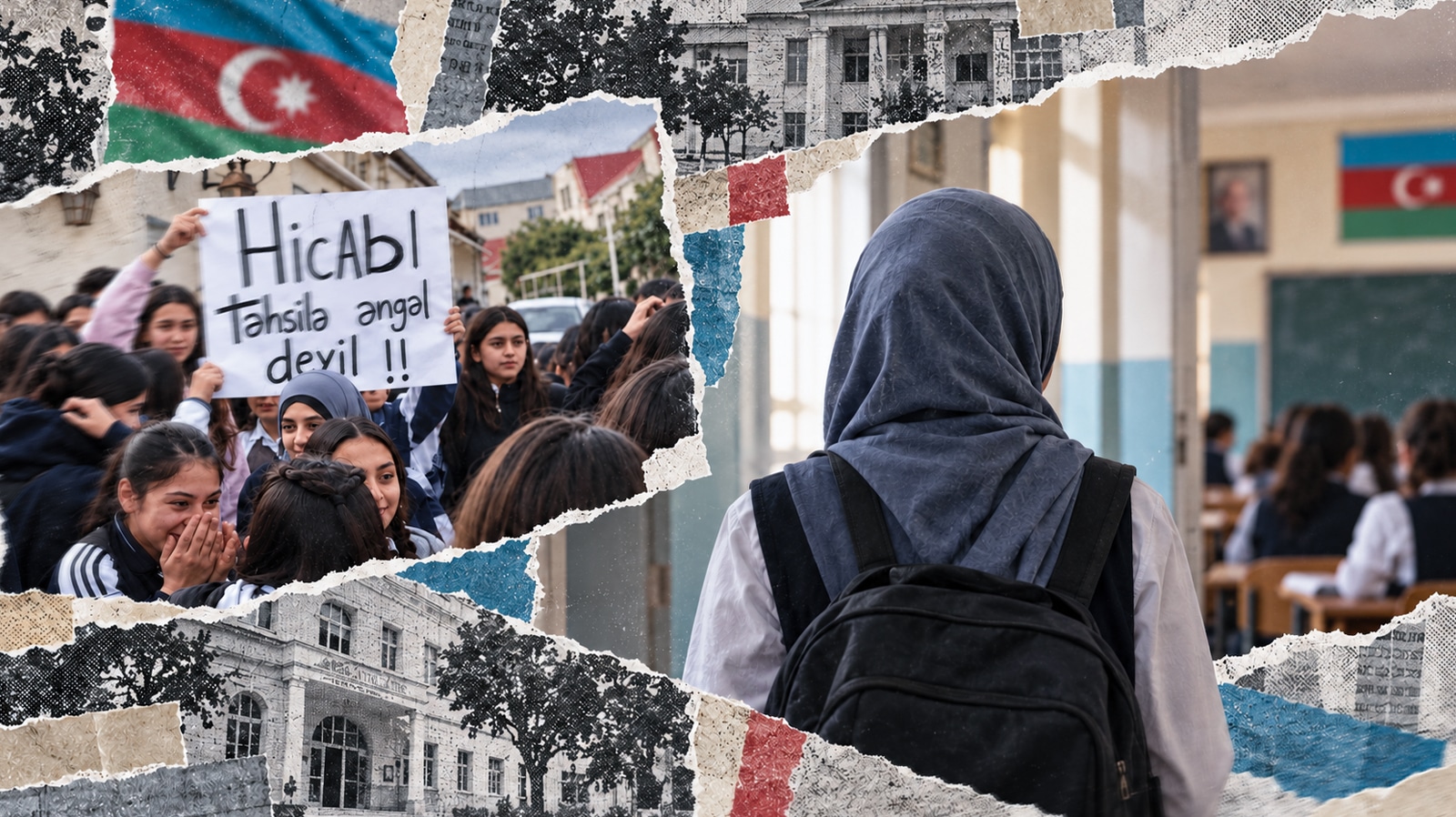
The rules, announced on September 21, don’t explicitly exclude the hijab; in fact, they don’t mention it at all. This is not a new bill but rather the implementation of constitutional law. The rules aim to enforce a standard uniform for all students, underscoring Baku’s continued commitment to secular principles as the cornerstone of its educational policy.
The Constitution of the Republic of Azerbaijan stipulates that “In the Republic of Azerbaijan, education is a strategically important priority area that is secular and continuous in nature, reflecting the interests of the individual, society, and the state.” Thus, Azerbaijan does not have a blanket prohibition on the hijab. The restrictions apply only to schools; universities remain unaffected, and female students may continue to wear religious head coverings. The rationale is secular: children should not be subject to adult religious choices while their own views are forming.
Claims of curtailed religious freedom in Azerbaijan, often advanced by Islamist sources, do not withstand scrutiny. Notably, the Qatar-funded Middle East Eye amplified this narrative with an insinuating article by Soumaya Ghannoushi, the daughter of Rashid Ghanoushi, the founder of Ennahda, the Tunisian offshoot of the Muslim Brotherhood.
Similar restrictions on religious dress in schools have long been in effect in other countries, including those with predominantly Muslim populations. Kazakhstan enshrined its school-uniform requirements in 2016, and Uzbekistan did the same in 2018. Tajikistan went further: on June 20, 2024, President Emomali Rahmon signed a law banning clothing deemed alien to the national culture in public places, including the hijab.
Particularly telling is the example of the self-proclaimed Turkish Republic of Northern Cyprus, recognized only by Ankara and deeply dependent on Turkey politically, economically, and militarily. In September 2025, its Constitutional Court struck down a government decision permitting schoolgirls to wear the hijab, thereby reinstating earlier restrictions. Mass demonstrations in defense of secular education preceded the ruling. On April 8, 2025, alone, some 13,000 people, including members of teachers’ unions, civic organizations, and political parties, took to the streets of North Nicosia.
The legal basis for the Azeri rule change is Cabinet Resolution No. 309, signed by Prime Minister Ali Asadov, which implements a July 2026 amendment to the Law on General Education. It bars clothing that disrupts the uniformity of school dress or fails to conform “to the principle of the secular nature of general education;” the word “hijab” does not appear in it. Resolution No. 325 of October 6 extended the requirement to teachers. Enforcement began on September 28, when officials turned away girls in headscarves at School No. 6 in Sumgait, and by mid-October the dispute had brought protesters into the streets of Baku. Azerbaijan’s supreme Islamic authority, the Sheikh-ul-Islam, Allahshukur Pashazade, summed up the official position in one sentence: wearing the hijab in Azerbaijan is not prohibited.
Iran: Clerics, Cartoons, and Staged Protests
The Islamic Republic responded with the full weight of its media and clerical establishment. On October 13, Tasnim, the news agency affiliated with the Islamic Revolutionary Guard Corps (IRGC), declared, referring to the Azeri president, that “today Aliyev is prescribing in the Republic of Azerbaijan the same failed recipe of Atatürk and Reza Shah, in the name of freedom,” likening the school rule to the former king Reza Shah’s forced unveiling, kashf-e hijab, of 1936. The hardline daily Kayhan went further. Because of its “strategic, security, and economic cooperation with the Zionist regime,” it wrote, the government in Baku has become known as ʿamaleh-ye Netanyahu, “Netanyahu’s hired hand.” In another item, it claimed that Azerbaijanis regard the new rules as an Israeli dictate to Ilham Aliyev. The Fars news agency, also affiliated with the IRGC, posed a rhetorical question to its 1.7 million Telegram subscribers: did they know that while headscarves are banned for schoolgirls, the Jewish kippah is allowed in Azerbaijani schools?
From there, the leap to an antisemitic cartoon was short. The Iranian outlet Safheh Siasat, republished by the aggregator Khabar Pu, illustrated its account of the “relationship with Israel” behind the ban with an image of Aliyev as a rabbi. ANA, the news agency of the Islamic Azad University, circulated a cartoon on the ban by Kamal Sharaf, the Houthi-aligned Yemeni cartoonist, while a poster branding President Aliyev “the staunch enemy of Islam” spread across Persian-language accounts on X. The imagery is not new. In December 2022, a cartoon of Aliyev with an exaggerated nose, sidelocks, and a yarmulke circulated on Iranian social media. In February 2023, the daily Javan ran a front-page caricature of the Azerbaijani leader as a hook-nosed Jew, with Netanyahu standing behind him.
Each segment of the Iranian establishment found its own angle. The clergy spoke in the language of divine command and historical retribution. Ayatollah Mohammad Javad Fazel Lankarani, a prominent hardline cleric, urged Baku to “take a lesson from the fate of those who opposed religion in the era of taghut [idolatry] and were destroyed.” Ayatollah Mohammad-Taqi Pourmohammadi, East Azerbaijan’s representative in the Assembly of Experts, called Azerbaijan, by population, “the second Shia country in the Islamic world.” He warned that, just as the Pahlavi policies of forced unveiling and hostility to religion “were rejected,” Baku’s officials should beware of “public discontent and a deviation from their own historical identity.” Former parliamentarian Ali Motahari predicted that Aliyev should “await the fate of the Shah” and claimed that Heydar Aliyev, Ilham’s father and predecessor, had once asked for his land to “join its mother, Iran.” Hamshahri, the daily of the Tehran municipality, dismissed Sheikh-ul-Islam Pashazade as a “court mullah” who had remained silent about the demolition of a seminary in Nardaran and the arrests of Azerbaijani “defenders of the shrines” in Syria. Shia authorities in Iraq joined the chorus. Grand Ayatollah Mohammad Yaqubi demanded that Baku revoke the decision, and the influential cleric Muqtada al-Sadr called for a protest in every Iraqi school and university.
Other voices preferred the language of rights. Mehr asked where the defenders of women’s rights had gone and compared Azerbaijan’s rule to the Taliban’s exclusion of girls from education. Kayhan turned the affair against Iran’s own reformists, mocking their “fast of silence” on Baku while they denounce compulsory veiling at home. The Tehran government kept a softer tone. Foreign Ministry spokesman Esmaeil Baqaei confined himself to praising “the brave and perceptive people” of Azerbaijan.
Tehran also extended the campaign into the streets of Europe. On October 16, Tasnim covered a protest outside the Azerbaijani embassy in London featuring the Egyptian preacher Fadel Soliman; participants vowed to return “every Friday until further notice.” Two days later, Azerbaijani media exposed a rally staged by Iranian agents in Germany against the single school uniform. Its organizers raised the Islamic Republic’s state flags and portraits of Iran’s religious leaders while the Azerbaijani national anthem played in the background. Few participants were foreign nationals. Fars stitched these events into a single narrative of protests stretching “from Turkey to London,” and in Tehran a “popular student rally” gathered outside the Azerbaijani embassy. Iran’s Azerbaijani-language Sahar TV went a step further, presenting footage of a rally in Diyarbakır, Turkey, as a pro-hijab demonstration in Azerbaijan. Baku’s Media and Broadcasting Council blacklisted the channel on October 14. Meanwhile, the Iranian embassy in Baku described any attempt to link Tehran to the protests as “a baseless claim, entirely devoid of truth.”
Tehran’s motives are layered. The first is Israel. After two wars with Israel and the United States, the Islamic Republic regards Azerbaijan as Israel’s strategic partner on its northern border. Fars has cited Israeli research on Baku’s cooperation with Tel Aviv against Tehran. Casting the dress code as an Israeli dictate turns that partnership into an offense against Islam. It also challenges Baku’s bid to host the Organization of Islamic Cooperation summit in 2027, a point the former Iranian foreign minister and now senior advisor to the Supreme Leader Ali Akbar Velayati raised. The second motive is domestic. The image of Azerbaijani girls fighting to wear the hijab inverts that of Iranian women fighting to remove it, and it hands hardliners a rare argument against their reformist rivals. The comparison is sensitive enough that Abdolhossein Khosropanah, secretary of the Supreme Council of the Cultural Revolution, warned Iranians against drawing it too directly. The third motive is the protection of the clerical and seminary networks that Iran has cultivated among Azerbaijan’s Shia. The fourth concerns Iran’s own Azerbaijani provinces: when clerics in Tabriz, Ardabil, and Marand speak for “both banks of the Aras,” they address their own flock as much as Baku. Finally, hardliners use the affair to constrain President Masoud Pezeshkian’s détente with Baku. Kayhan denounced a deputy foreign minister’s visit to the Azerbaijani capital as “a questionable trip.”
Russia: Many Voices, One Grievance
The Russian-language campaign began earliest and spread farthest. On September 23, two days after Azerbaijan adopted Resolution No. 309, the Islamic portal Sahwa relayed local reports that the secularism clause was aimed “first and foremost against the hijab.” Within two weeks, Russian-speaking Muslim and regional pages with audiences in the hundreds of thousands, including Dnevnik musulmanki (329,000 followers), Muslims Online (227,000), and the Dagestani city page Makhachkala (343,000), turned the dress code into a story of persecution.
Antisemitism followed almost immediately. On October 3, a text titled “Азербайджан. Кипа дозволена, платок — нет” (“Azerbaijan. Kippah allowed; headscarf not”) spread verbatim across several accounts. It claimed that Jewish pupils attend a state school, “Chabad–Or Avner,” wearing kippahs, while for a Muslim girl the headscarf is “banned by law, and this in a Muslim country.” The next day, five accounts posted the same text over footage of Aliyev cutting the ribbon at the Chabad Or Avner educational center, which he opened in 2010. The text said there were “rumors that the dictator Ilham Aliyev is a Khazar Jew” (“является хазарским евреем”) and explained his support for Israel through alleged “Jewish roots on his mother’s side.” Muslims Online ran a report on a protest in Istanbul featuring a caricature of Aliyev with an exaggerated hooked nose, Hasidic sidelocks, and a scarf combining the Israeli, Azerbaijani, and Turkish flags. Dnevnik musulmanki ran a cover showing a Caucasian Highlander beside a Hasidic Jew under the headline “Azerbaijan and Israel: Friendship Forever?” Its caption asked whether it was “a pattern or a coincidence” that headscarf bans appear wherever Israel builds close alliances with Muslim countries. Readers took the cue. Under one reel, comments read “Носатый илюшка” (“Big-nosed Ilyushka”) and “Я думал он человек, а оказывается он еврей” (“I thought he was a human being, but it turns out he’s a Jew”). The Russian-language Israeli outlet Vesty documented further cartoons: Aliyev with a “Jewish” nose and a kippah as “Netanyahu’s lackey,” and Aliyev on all fours barking at schoolgirls in hijabs while Netanyahu holds a leash.
As in Iran, each segment of the Russian-language space advanced its own narrative. For Islamist pages, the dress code was portrayed as a war on Islam waged by “the Aliyev regime” on behalf of foreign masters. Muslims Online signed its posts with a revealing slogan: “Творят США и Израиль — снимаем мы” (“The US and Israel do it; we film it”). A Shia community on VKontakte framed the issue as a legal double standard, asking, “Why are Jews allowed everything in Azerbaijan, and Muslims nothing?” Regional Dagestani media used the occasion to praise Russia. Makhachkala reminded its readers that Russia is “a secular state where freedom of religion is guaranteed by the Constitution” and that Azerbaijan “is clearly choosing the wrong course.”
Pro-Kremlin commentators took a geopolitical view. Svobodnaya Pressa wrote that “Moscow will be avenged for the disrespect” Baku showed and that “it is in Moscow’s interest to see the success of a school Islamized Maidan in Azerbaijan.” EADaily, quoting a Russian Telegram commentator, concluded that Azerbaijan “has landed itself in a mess by pleasing the West and Israel.” It later reminded Baku that Russia, Turkey, and Iran possess “enough economic and domestic levers to destabilize the Aliyev regime.” Kavkazar, the Caucasus channel of the military blogger outlet Rybar, portrayed Azerbaijani secularism as besieged by Turkish Islamists and warned: “От светскости до халифата — один шаг” (“From secularism to the caliphate is one step”). Armenian Russian-language Telegram channels, part of a relay network that amplifies pro-Russian content, added a security angle. In a widely forwarded commentary, Alpha News editor Tigran Kocharyan argued that the ban served to “нейтрализовать людей с наиболее активной проиранской ориентацией” (“neutralize the people with the most actively pro-Iranian orientation”) ahead of possible Israeli action against Iran. Russian nationalists, finally, applauded the ban and turned it against migrants at home. “Тут вам не Россия” (“This isn’t Russia for you”), the nationalist Dzen channel wrote approvingly.
The Kremlin itself kept its distance. Vladimir Putin and Ilham Aliyev spoke by phone on October 7 and expressed satisfaction with the development of relations. Ramzan Kadyrov visited Baku on October 10, calling the trip “a visit to brothers, not neighbors.” The commentariat, however, kept the pressure on, and the reasons are not hard to find. Relations have carried a heavy burden since the downing of an Azerbaijan Airlines plane in December 2024, the deaths of two Azerbaijanis during a police raid in Yekaterinburg in June 2025, and the arrest of Russian nationals working for Sputnik in Baku, an act Oleg Tsarev, a pro-Kremlin former Ukrainian lawmaker and separatist figure, described as hostage-taking. Baku’s turn toward the West and Israel, along with transit projects that bypass Russia, adds to the tensions between the countries. The hijab affair also resonates with Russia’s own disputes over religious dress in schools and migration. At home, nationalist voices such as Readovka insist that minorities “не получится диктовать, как одеваться русскому народу” (“will not be able to dictate how the Russian people dress”).
Turkey: Brotherhood Betrayed
Of the three campaigns, the Turkish one was the most personal because it came from the “brother.” Heydar Aliyev’s formula, “one nation, two states,” has defined the relationship for three decades. In October 2026, Islamist civil society, opposition parties, and the pro-government press in Turkey turned that formula against his son.
The antisemitic motif traveled into Turkish with ease. An X account posted a cartoon of Netanyahu in Baku, with the city’s famed “Flame Towers” behind him, a road sign reading “BAKÜ,” and a “HAV HAV” (“woof, woof”) bursting from below. It is the same image of Aliyev as Netanyahu’s dog that the Israeli website Ynet documented under the headline “On Netanyahu’s leash.” The pro-government site Haber7 ran the headline “BAŞÖRTÜLÜYE ÇIK DIŞARI! KİPALIYA HOŞ GELDİN” (“Headscarved girl, get out! Kippah-wearer, welcome!”). The Islamist daily İstiklal followed with a column titled “Azerbaycan’da Yahudi Çocuklara Kipa Serbest, Müslüman Kızlara Başörtüsü Engeli!” (“In Azerbaijan, the Kippah Is Free for Jewish Children, the Headscarf Barred for Muslim Girls!”). In Yeni Akit, columnist Yüksel Tokur writes, “nerede başörtüsü yasağı varsa, mutlaka Siyonist parmağı vardır” (“wherever there is a headscarf ban, there is always a Zionist finger”). Protesters outside the Azerbaijani embassy in Ankara chanted “Siyonist dostu kukla Aliyev!” (“Aliyev, the Zionist-friendly puppet!”) and spoke of the “gasıp Yahudi varlığı” (“the usurping Jewish entity”). Fatih Erbakan, leader of the New Welfare Party, accused Aliyev of hosting “Siyonist katil Herzog” (“the Zionist murderer Herzog”) in Baku. The Şanlıurfa columnist Celal Çiftçi added an AI-generated image of Aliyev toppling from his throne, captioned “Sonunda devrileceksin ey zalim!” (“You will be toppled in the end, O tyrant!”). Baku answered with an international arrest warrant.
Every camp in Turkish politics found its own reading of the affair. For the Islamist association Özgür-Der, which protested at the Azerbaijani consulate in Istanbul on October 3, the issue was faith over ethnicity. Because of its “seküler dayatmacılığı, İslam düşmanlığı” (“secular impositions, hostility to Islam”) and its cooperation with “Siyonist zalimler” (“Zionist oppressors”), its speaker said, “bu yönetim bizim kardeşimiz olamaz” (“this government cannot be our brother”). A fellow activist added that “28 Şubat’ın ikna odaları şimdi ‘Pedagoji Şuraları’ adıyla hortlatılıyor” (“the persuasion rooms of February 28 are being resurrected under the name of ‘Pedagogy Councils’”). The reference is to the “post-modern coup” of 1997, when headscarved students in Turkey were pressured in special rooms to remove them. Köklü Değişim, the Turkish front of Hizb ut-Tahrir, carried the argument to its eschatological conclusion. It warned that “Raşidi Hilafet Devleti kurulduğunda” (“when the Rightly Guided Caliphate is established”), every injustice against Muslims would be called to account. It also turned on the governing party: would the AKP abandon today’s Muslims as Turkey abandoned Soviet refugees at the Boraltan Bridge in 1945?
The Islamist parties cloaked their criticism in kinship language. Saadet Party leader Mahmut Arıkan opened his letter to Aliyev with “İki devlet, tek millet” (“Two states, one nation”). He invoked the wounds of February 28 and reminded Aliyev that among the girls turned away were the children of the martyrs of the Karabakh war. Yeni Akit used a mocking colloquial address, “Gardaş şaşırma” (“Don’t lose your way, brother”), and blamed the ban on a government acting “Siyonist lobinin etkisi altında” (“under the influence of the Zionist lobby”). The Kurdish Islamist scholars’ union İttihadul Ulema called the headscarf “tüm Müslümanların onuru, şerefi ve kırmızı çizgisi” (“the honor, dignity, and red line of all Muslims”). Within the ruling party, Erdoğan’s chief adviser Oktay Saral wrote on X: “Başörtüsü engel değil, inancın gereğidir!” (“The headscarf is not an obstacle; it is a requirement of faith!”). He added that Turkey expected Azerbaijan to “bu yanlıştan bir an önce dönmesini” (“to reverse this mistake at once”).
The secular opposition backed freedom of choice. Kemal Kılıçdaroğlu of the Republican People’s Party (CHP) told his “Azerbaijani brothers” that Turks had endured this pain and that “laikliğin güvencesi kadının başörtüsü değildir; insan hakları ve demokrasidir” (“the guarantee of secularism is not a woman’s headscarf; it is human rights and democracy”). His party colleague Oğuz Kaan Salıcı linked Baku to Tehran: opposing forced veiling in Iran and defending headscarf freedom in Azerbaijan, he wrote, “aynı ilkenin gereğidir” (“are required by the same principle”). A third strand drew on wounded pride. Aliyev said on October 2 that Azerbaijan bought every weapon “son mermiye kadar” (“down to the last bullet”) with its own money. Turkish defense commentators replied that Turkey had stripped electronics from its own drones to supply Baku. Baku also found defenders within the ruling alliance. Devlet Bahçeli warned against any “nifak tohumu” (“seed of discord”) between the two countries. Binali Yıldırım asked, “Kimin ne haddine Azerbaycan’ın iç işlerine karışacak?” (“Who would dare interfere in Azerbaijan’s internal affairs?”).
The motives behind this outburst trace back to Turkish political Islam’s history. The headscarf is its founding grievance: the February 28, 1997, ban shaped a generation of activists, and the lifting of the ban between 2010 and 2013 counts among the AKP’s defining achievements. The political moment sharpened the reflex. The AKP polled between 31.6 and 33.7 percent in October after a domestic funding scandal, while the New Welfare and Saadet parties compete for the same pious electorate. Gaza and Israel did the rest. Baku hosted Israeli President Isaac Herzog in mid-October, and on October 15 Foreign Minister Hakan Fidan and more than ten other delegations walked out of the hall when Herzog took the floor at the Conference on Interaction and Confidence Building Measures in Asia (CICA) summit in Baku.
For Recep Tayyip Erdoğan, the leader of a movement born of the headscarf struggle, silence was not an option before his own Islamist base. He responded to the pressure in his own way. At the UN General Assembly in September, he denounced the headscarf bans “introduced in schools by some countries” as an attack on women’s most basic rights. On October 15, speaking at the Maarif Foundation, he recalled a Turkey that “yıllarca kendi evlatlarını kılık kıyafeti, inancı, siyasi görüşü sebebiyle yurt dışına gitmek zorunda bırakmış” (“for years forced its own children abroad because of their dress, their faith, their political views”). Pro-government outlets promptly headlined the speech as “words that serve as a lesson to Aliyev.” He left the open criticism to his chief adviser. At the same time, Erdoğan safeguarded the strategic partnership. On October 21, he phoned Aliyev, stressed the “kardeşlik hukuku” (“law of brotherhood”), and invited him to the Organization of Turkic States summit in Ankara. Journalist Ruşen Çakır captured the dilemma with a Turkish proverb: “Aşağı tükürsen sakal, yukarı tükürsen bıyık” (“Spit down and you hit your beard; spit up and you hit your mustache”). He explained that silence offends the government’s own public, while speaking out damages relations with Azerbaijan.
Shared Patterns, Divergent Motives
Viewed together, the three campaigns display a remarkable uniformity. They circulate identical images of girls in tears at school gates and classes relocated outdoors. Each narrative frames Azerbaijan’s president as an agent of Israel and reiterates the same slogan contrasting the kippah and the headscarf. Notably, this slogan originated with Tural Abbaslı, leader of Azerbaijan’s opposition AĞ Party, before spreading into Russian and Turkish Islamist media, and finally to Iran’s Fars News Agency. Content moves seamlessly across these spheres: Turkish Islamist material is repackaged for Russian-speaking audiences via platforms like Altruist News, while footage from Turkish rallies is broadcast by Iranian state television as if it were Azerbaijani.
Despite these similarities, each campaign overlays Baku with its own historical narrative. For Iranian clerics, Aliyev becomes a latter-day Reza Shah, enforcing forced unveiling. Turkish Islamists recall the February 28 generals and their infamous persuasion rooms. Russian-speaking Muslims invoke memories of Soviet-era militant atheism, while Russian nationalists interpret the ban as a precedent for managing migrants domestically. The ironies are striking: Tasnim denounces Aliyev for emulating Atatürk, even as Turkish Islamists accuse Baku of betraying brotherhood. Meanwhile, Turkey’s secular opposition defends headscarf rights in Azerbaijan, and Russian nationalists applaud the restrictions.
The actors behind these campaigns are as varied as their narratives. In Iran, the state and clerical establishment communicate through Revolutionary Guard-linked agencies, hardline media, Friday sermons, and grand ayatollahs, while the official government line remains measured. In Turkey, civil society organizations lead, the opposition seeks moral authority, and the president balances his Islamist constituency with Azerbaijan, a key regional partner. The Russian-language campaign operates as a decentralized network: Muslim community pages, regional outlets, Armenian relay channels, pro-Kremlin analysts, and nationalist bloggers each amplify parts of the message, even as the Kremlin maintains cordial relations with Baku. The rhetoric reflects these differences. Iran invokes Shia law, revolutionary obligation, and historical warnings. Turkey frames the issue as a betrayal of brotherhood and a matter of shared sacrifice in Karabakh. The Russian-language sphere ranges from appeals to religious freedom to overtly racial antisemitism, including references to the ‘Khazar Jew’ and caricatured features.
What the Hijab Affair Reveals
The first and most obvious lesson is the centrality of antisemitism. Jews and Israel played no part in Azerbaijan’s decision on school dress codes, yet every one of these external actors inserted a Jewish figure into the narrative: the kippah, the rabbi, the ‘Khazar’ ancestry, ‘Netanyahu’s hired hand,’ the dog on Netanyahu’s leash, the ‘Zionist finger.’ Whether labeled anti-Zionist or anti-Jewish, the imagery serves the same purpose. The distinction is rhetorical, not substantive. This episode demonstrates how deeply antisemitism is embedded as a tool of political manipulation. Jews are instrumentalized in these campaigns, regardless of their actions or Israeli policy. A Jewish school opened in Baku in 2010 is, sixteen years later, repurposed as supposed evidence in a fabricated controversy over headscarves.
The second lesson concerns Iran. The Islamic Republic has suffered a heavy blow, in fact, a defeat, in its wars with Israel and the United States, yet it retains the capacity to disrupt in other realms. It excels at propaganda warfare, or what the KGB called spetsial’nye meropriyatiya, “special measures.” It is no accident that Russian and Iranian patterns resemble each other: both draw on the same toolbox and share resentment over Baku’s alignment with Israel and the West. This does not mean that Iran and Russia work together or for each other. Each pursues its own interests, and each found in the hijab affair a convenient lever. Like Russia, Iran stages false-flag operations in the realm of propaganda. Its agents raised the flags of the Islamic Republic over a “protest against the school uniform” in Germany while the Azerbaijani anthem played. Its outlets promoted weekly pickets outside Azerbaijan’s embassy in London. Its Azerbaijani-language television passed off a Turkish rally as an Azerbaijani one. Meanwhile, its embassy in Baku denied any involvement. The same regime that Azerbaijan accused in March 2026 of plotting attacks on the Israeli embassy, a synagogue, and an oil pipeline now operates in the streets of European capitals. Its damaging capacity should not be neglected, and the affair cannot be treated as Azerbaijan’s business alone. It concerns European governments, Jewish communities, and every state that has found itself on the receiving end of Tehran’s information war.
The third lesson highlights the evolving dynamic between Turkey and Azerbaijan. Recent friction with Ankara underscores Baku’s assertion of sovereignty. On October 2, President Aliyev made this clear, insisting that others respect Azerbaijan’s autonomy and refrain from interfering in its internal affairs. The New Azerbaijan Party reinforced this stance, redefining the traditional formula as ‘one nation and two independent states.’ Baku matched rhetoric with action: it issued arrest warrants for seven Turkish citizens involved in the protests and declared 31 others, including prominent Turkish political and media figures, persona non grata. While Azerbaijan welcomed Israel’s president, Turkey’s foreign minister staged a walkout. The contrast with Northern Cyprus is telling: there, under Ankara’s oversight, secularism had to be defended through mass mobilization. In Azerbaijan, the state set its own policy and enforced it. The message is unambiguous: Azerbaijan is not subordinate to Turkey. It pursues its own interests, and the hijab controversy has made this independence unmistakable to both allies and adversaries.
Source: https://jiss.org.il/en/grinberg-the-hijab-as-a-weapon/