
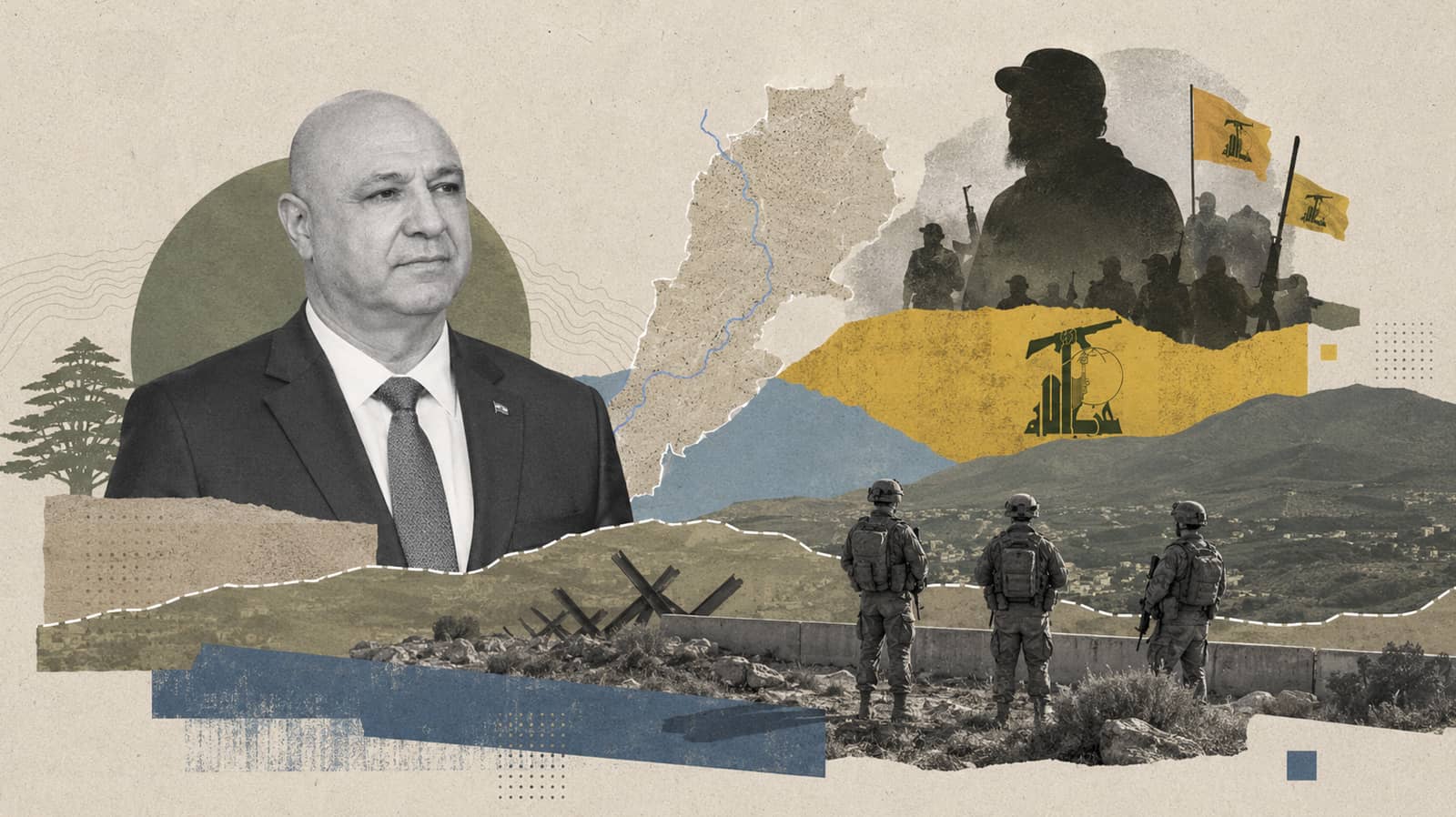
Israel’s current Lebanon policy rests on two parallel tracks that are being pursued under the absurd reality of what is effectively a “ceasefire” in name only—a caveat that applies both to the ceasefire declared by United States President Donal Trump and to the later one agreed upon between Israel and Lebanon in Washington.
The first track is escalating military pressure aimed at the destruction of terrorist infrastructure in southern Lebanon, together with strikes on Hezbollah targets across the country. These operations, however, remain subject to limits arising from the Trump administration’s considerations, and more recently, from the restrictions put in place by the ceasefire agreement, and by Iran’s effort to link the two arenas.
The other is direct diplomatic engagement, unprecedented in its character and extending to military-to-military contacts, which, through active American involvement, led to the ceasefire agreed upon in Washington, which envisions a modular process to push Hezbollah back beyond the Litani River.
The combination of military pressure and diplomacy is however inherently complex and difficult to manage, even though its legitimate goal is to nudge the Lebanese side to eventually fulfil its commitment to disarm Hezbollah. Israel therefore needs a third track if it is to achieve its objectives: a patient intelligence and political effort, supported by regional and perhaps international actors that share the same goal, to loosen Hezbollah’s stranglehold over the Shiite community and identify alternative forces within it.
Long-standing loyalties are difficult to break. Yet Hezbollah’s actions on Iran’s behalf have brought disaster upon Lebanon’s Shiite population, and voices within the community now acknowledge this, even if they rarely do so in public. The main obstacle is the Shiites’ fear (rooted in Lebanon’s and the region’s blood-soaked history) that other Lebanese communities, and the new Syrian regime, would take revenge if Hezbollah could no longer protect them.
For that reason, despite the temptation (that President Trump alluded to recently) to make use of Ahmad al-Sharaa’s regime against Hezbollah, it should for now be kept out of the Lebanese equation while Israel assesses whether Shiite criticism of the organization gathers momentum. Any effort to strengthen alternative forces within the community should combine incentives and assistance with long-term security guarantees, and even with reconstruction of the south, provided (and only on that condition) that the threat of renewed Hezbollah entrenchment is fully removed.
The Challenge of Balancing Military Force and the Diplomatic Track
President Donald Trump’s April 17 declaration of a ceasefire in Lebanon, which he described as the tenth war he has ended, has in effect produced a worsening of the security situation. IDF forces have come under growing attack, mainly by explosive-laden drones, and strikes against military and civilian targets inside Israel have gradually resumed. Public pressure from residents of the conflict zone now weighs heavily on decision makers, alongside Israel’s security and diplomatic calculations. At the same time, Israel still faces limits deriving from the U.S. administration’s desire to promote an arrangement in Lebanon, shield the country from any further deterioration of the security situation, and use the fictitious Lebanese ceasefire to advance a deal with Iran. This explains the continued caution over renewed strikes in Beirut, which Iran has threatened to retaliate for and then came through on its threat: a constraint which remains even as Israel’s patience wears thin.
Israel has chosen two parallel courses of action that are supposed to reinforce each other, but in practice have inherent tensions:
- The military effort has recently expanded beyond the line set at the time of the “ceasefire.” Hezbollah elements have been pushed northward; commanding terrain has been seized; and the organization’s operatives and infrastructure have been hit extensively in southern Lebanon and beyond, though at this stage they rarely include the Dahiya quarter of Beirut. This effort has also sought to deny Hezbollah infrastructure to which it could return in the future, including the Shiite villages along the border. The scale of destruction in the south has created a wave of displaced persons, who are, in effect, internal refugees within Lebanon.
- The diplomatic track meanwhile continues through engagement with the Lebanese government and includes military-to-military contacts under U.S. auspices, with active U.S. involvement. The direct nature of these contacts is itself exceptional, and Hezbollah has repeatedly denounced Lebanon’s willingness to take part in them. Until recently, Lebanon carefully avoided such engagement; even the arrangement over the maritime economic boundary was handled through two parallel but separate tracks, with Lebanon and Israel each negotiating with the United States. A significant change is also visible in official statements and no less important, in Lebanon’s public and media discourse regarding Hezbollah, its conduct, and even the possibility of peace with Israel.
Military pressure is meant to make the Lebanese government even more willing to reach an arrangement with Israel and, beyond that, to act on its declared commitment to disarm Hezbollah. In practice, however, it is difficult to reconcile this aspect of the diplomatic track with the Lebanese response to the scale of destruction in the south, and with the questions being raised in Lebanon about the IDF’s objectives and Israel’s long-term intentions. Against this backdrop, the Lebanese Embassy in Washington, which is handling the contacts with Israel, appears to have been instructed to proceed with extreme caution and is not rushing to offer additional gestures while the IDF continues to operate on Lebanese soil. The talks, on their own, are therefore highly unlikely to achieve Israel’s principal diplomatic-strategic objective.
The Missing Element: Change Within the Shiite Community
Israel’s approach to Lebanon should not rely only on the military effort as the main instrument and on diplomacy as its supposed “continuation by other means.” A third track is required. It should be built on intelligence tools, including the identification and activation of covert channels of influence, and supported by discreet cooperation with regional actors such as the United Arab Emirates that share the goal of undermining Hezbollah’s standing and weakening Iran’s proxy system.
The core task is to map the voices already emerging within the Shiite community, especially among young people who are not subordinate to Hezbollah’s power structures. Some are now prepared to look soberly at the disastrous price Hezbollah has imposed on their community: vast destruction in the south and in the Dahiya; thousands of dead, including leading figures in Hezbollah; and deepening alienation from Lebanon’s other communities as well as from Arab and Western states. This cost was incurred in the service of Iran, a foreign power, and with a clear understanding of where escalation with Israel could lead. Such an effort is likely to receive support from the U.S. administration as well, given its recent condemnation of Hezbollah over its call to overthrow Lebanon’s legitimate government.
Such elements within the community do exist, and some are already attracting attention and finding a receptive audience. They should not be named, but they should be cultivated as part of a long-term effort; the necessary shift cannot be brought about overnight. Resources and instruments of influence should be made available to them, and they should receive coordinated support from others in the region and from the United States so that they can acquire political standing in Lebanon. The purpose should be to challenge Hezbollah’s claim to be the sole representative of the Shiite community. (Amal elements have shown signs of a rift with Hezbollah, but the movement has become, overall, a one-man vehicle for Nabih Berri, who tries to present himself as an independent actor but is tied deeply to Hezbollah.)
Security Guarantees for the Shiite Community
Hezbollah’s disarmament is difficult not only because the organization insists on preserving its status as the muqawama, or “resistance,” and openly defies the authority of the government. The issue also touches on a genuine fear within the Shiite community, not only of Israel and the malicious intentions attributed to it, but also of the new regime in Syria. Hezbollah, acting on Iran’s behalf, played a major role in helping the Assad regime carry out its brutal repression of the Syrian people. Assad’s enemies took power in December 2024, leaving a bloody open account between them and those who were among the most loyal auxiliaries of the man who massacred them.
This is why the idea of Syrian intervention in Lebanon against Hezbollah, which arises periodically and has even tempted some in Israel, is potentially dangerous. Such a threat would not be understood only as aimed at Hezbollah as an organization, but at to the very survival of the Shiite community; what happened to the Druze in Suwayda could pale in comparison. It would only reinforce the stranglehold that Naim Qassem and Hezbollah maintain over the Shiites, who remain the largest of Lebanon’s minority communities. If such a course were attempted, it could also enable jihadist elements close to Turkey to establish themselves in Lebanon.
If additional signs emerge that Hezbollah’s hold on power is loosening, Israel should work with the United States, France, and its partners in the Arab camp to offer the Shiite community security guarantees (this could be done openly or , even better, under appropriate regional cover). Such guarantees, by definition, would apply only on the “day after” Hezbollah’s disarmament.
Israel can also signal that it would be prepared to allow the reconstruction of the south and the return of residents to most of their villages, though not all of them, with backing from the UAE and others. The condition should be clear: Israel, not any external actor, must be the party that determines that Hezbollah can no longer renew its armed presence anywhere in Lebanon, and certainly not south of the Litani.
JISS Policy Papers are published through the generosity of the Greg Rosshandler Family.
Source: https://jiss.org.il/en/lerman-the-missing-element-in-israels-lebanese-equation/