


Introduction
On July 17, 2026, the governments of Iraq and Syria signed a memorandum of understanding to restore the historic Kirkuk–Baniyas oil pipeline, which has been out of service since the 2003 Iraq War. The pipeline connects the oil fields around Kirkuk in northern Iraq with the Mediterranean port of Baniyas in Syria. Built in the 1950s, the 500-mile, 32-inch pipeline was designed to enable Iraq to export oil through Mediterranean ports rather than rely on routes through the Persian Gulf. The pipeline was shut down in 2003 following the U.S.-led invasion of Iraq and the collapse of Saddam Hussein’s regime. The ensuing damage to energy infrastructure and prolonged security instability brought oil exports through Syria to a halt.
Washington has given the project strong diplomatic, political, and commercial backing. Politically, the U.S. State Department formally welcomed the memorandum of understanding, describing the restoration of the Kirkuk–Baniyas pipeline as an important regional initiative to strengthen energy security and diversify export routes. Diplomatically, U.S. Special Envoy for Syria Tom Barrack—who also serves as U.S. ambassador to Turkey and is widely viewed as having close ties to Ankara—helped facilitate negotiations between the parties and shape the framework for their cooperation. Commercially, Washington has encouraged the participation of U.S. companies, with Chevron expected to play a leading role in rehabilitating and expanding the pipeline infrastructure. The United States has also promoted the creation of an international consortium comprising Chevron, the U.S.-based TI Capital, and Qatar’s UCC Holding to conduct technical and financial feasibility studies and develop the implementation framework for the pipeline’s restoration.
Also on July 17 the Iraqi government signed a series of agreements and memoranda of understanding with Western energy companies worth more than $60 billion to expand the country’s export capacity. These included agreements with Chevron and ConocoPhillips to develop new oil fields and pipeline infrastructure in Iraq.
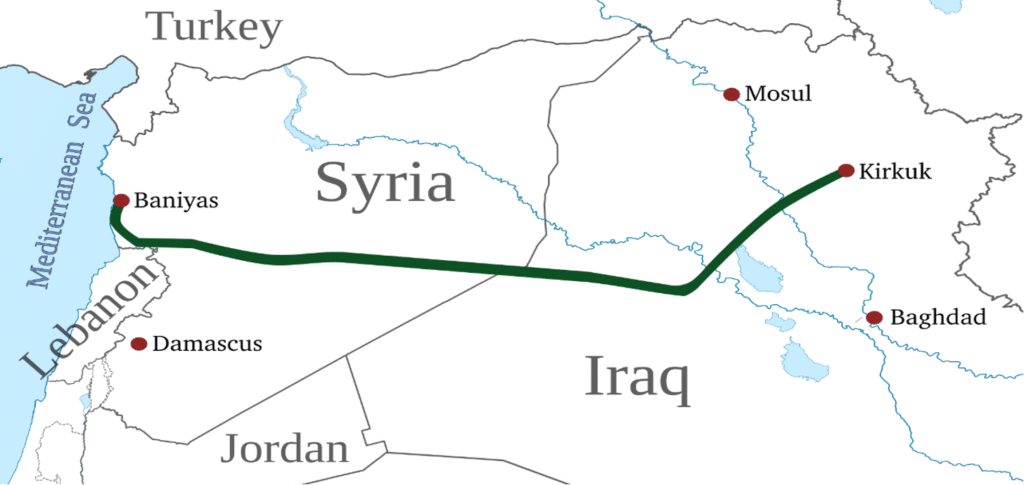
Strategic Implications
Restoring the pipeline will give Iraq an alternative route for exporting oil through the Mediterranean port of Baniyas, reducing its reliance on the Strait of Hormuz. A western export corridor would strengthen Iraq’s economic autonomy and expand its access to European and global markets. Syria stands to gain transit revenues while reinforcing its regional position.
The initiative to restore the Kirkuk–Baniyas pipeline emerged in response to the severe disruption of Iraq’s oil exports through the Persian Gulf following the closure of the Strait of Hormuz during the military confrontation with Iran. The crisis underscored the vulnerability of the region’s energy system to disruptions in the strait. Since February 2026, Iraq—the second-largest oil producer in OPEC—has seen its oil exports fall by roughly 85 percent, to just 500,000 barrels per day, after its primary export route was shut down.
Nevertheless, it is important to recognize that the pipeline cannot fully replace Iraq’s oil exports through the Strait of Hormuz. The original Kirkuk–Baniyas pipeline had a capacity of roughly 300,000 barrels per day, while the restored line is expected to carry up to two million barrels per day. This increase will be achieved primarily by rehabilitating the existing infrastructure and connecting it to oil fields in southern Iraq.[1] Before the Hormuz crisis, however, Iraq exported approximately 3.3 million barrels per day through the Gulf.[2] As a result, even at full capacity, the restored pipeline would replace only about 60 percent of the oil previously exported through the strait, leaving Iraq still significantly dependent on that route.
The Kirkuk–Baniyas pipeline will not provide an immediate solution to the disruption of Iraqi oil exports through the Strait of Hormuz. Current estimates indicate that restoring it will take approximately 36 months from the start of construction, as crews must rehabilitate damaged pipeline segments, pumping stations, and control systems that have deteriorated over many years. Political, security, and financing challenges could delay completion even further.
Despite these limitations, the agreement represents another important step by Gulf oil exporters to diversify their export routes and develop alternatives to the Strait of Hormuz. Saudi Arabia, for example, has expanded shipments through its East–West Pipeline to the Red Sea port of Yanbu, while the United Arab Emirates has increased its reliance on the Habshan–Fujairah pipeline, which enables exports through the Gulf of Oman. Together, these investments have made both countries’ export networks more resilient to disruptions in the strait.
Strategically, expanding the Gulf’s oil-export options would strengthen supply-chain resilience and reduce Iran’s ability to influence global energy markets by controlling or threatening the Strait of Hormuz. These efforts are unfolding amid growing international concern that the Iran-backed Houthis in Yemen could also disrupt maritime trade through the Bab el-Mandeb Strait.
Implications for Israel
From Israel’s perspective, the project carries geopolitical as well as economic significance. Its success could indirectly serve Israeli interests by advancing the shared strategic goal of weakening Iran’s regional influence. The pipeline also fits into a broader U.S. effort to diversify Middle Eastern energy-export routes, reduce dependence on the Strait of Hormuz, and limit Iran’s leverage across the region.
The project also carries a potential downside for Jerusalem: restoring the Iraq–Syria oil pipeline could reduce Israel’s prospects of becoming a major hub for exporting Middle Eastern energy to Europe. For years, various proposals have sought to position Israel as an energy corridor linking the Gulf states and Jordan with Israeli Mediterranean ports, including by using the Eilat–Ashkelon Pipeline Company’s infrastructure and eventually connecting it to Gulf energy networks. Some of these proposals depend on major geopolitical developments, above all normalization with Saudi Arabia and other regional states. A direct route from Iraq to the Syrian port of Baniyas would provide an overland alternative that bypasses Israel, thereby reducing the economic and geopolitical incentive to advance some of these plans.
Syria’s emergence as a major regional energy-transit state would also compete directly with Israel’s ambitions in this field. Large-scale international investment in Syria could strengthen its economic and political position, reduce the relative importance of alternative routes through Israel, and make Syria a more attractive transit option. The project would therefore reshape competition among regional energy corridors by giving Middle Eastern producers and European consumers more transport choices, thus potentially eroding Israel’s comparative advantage as a future energy-transit route.
[1] Iraq has a legacy oil pipeline network known as the Strategic Pipeline, designed to connect the country’s southern oil fields with the Kirkuk region in the north and allow oil to flow in either direction. Its planned capacity is approximately 800,000 barrels per day (bpd). However, following successive wars, damage to infrastructure, and changes in energy policy, only a limited section remains operational, with a capacity of about 40,000 bpd—roughly 5 percent of its planned capacity. It is used primarily to supply refineries in the Baghdad area, and there is currently no regular flow of crude oil from southern to northern Iraq for export purposes.
[2] In addition to seaborne exports through the port of Basra, Iraq exported approximately 450,000 bpdthrough theKirkuk–Ceyhan pipeline to Turkey. That route has been suspended since February 2023 because of a financial dispute with Ankara. The pipeline could carry up to 1.6 million bpd but reaching that volume would require agreements with both the Kurdistan Region and Turkey.
JISS Policy Papers are published through the generosity of the Greg Rosshandler Family.