

Introduction
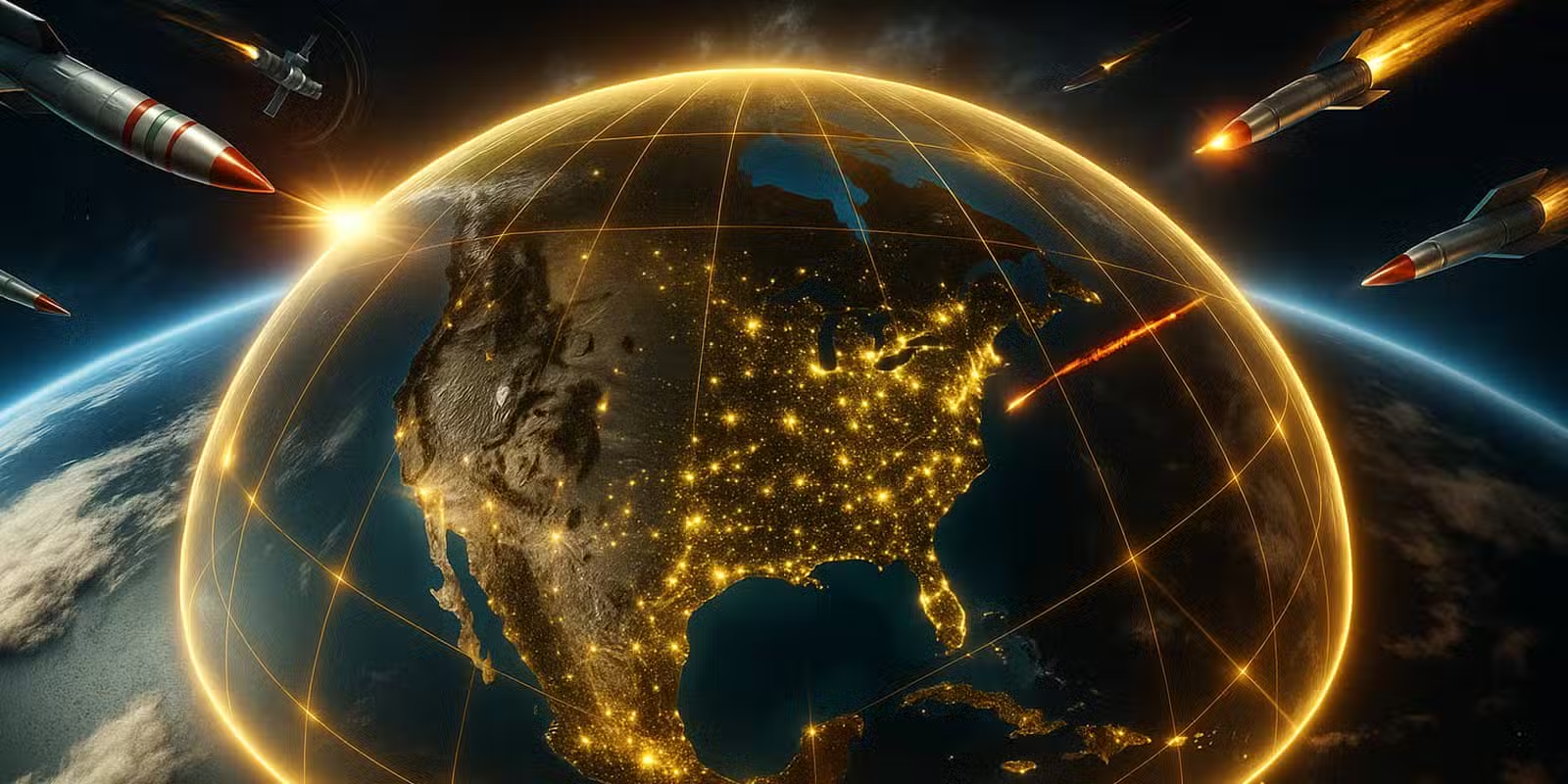
Since 1979, Tehran has pursued two parallel objectives: exporting the revolution and ensuring the survival of the Islamic regime. To do so, it built a proxy-based “ring of fire” across the region at great expense—Hezbollah in Lebanon; Hamas and Palestinian Islamic Jihad in Gaza and the West Bank; Shiite militias in Iraq and Syria; and the Houthis in Yemen. From Tehran’s perspective, this doctrine allowed it to deter Israel and the United States while avoiding direct confrontation on its own territory. In parallel, Iran enormous resources in its nuclear program, calculating that a nuclear capability would provide it immunity along the lines of North Korea and enable it to export its radical model.
That doctrine held for decades, but the current campaign has broken it. For the first time since the Iran–Iraq War, war has hit directly at the core of the Iranian system. What Tehran framed as “strategic patience”—absorbing pressure through proxies while avoiding escalation—has been exposed as a structural weakness. Following the October 7 attack, Israel shifted its approach: from containment to a campaign aimed at dismantling the proxy network and, increasingly, Iran itself. The War of Redemption (Operation Swords of Iron) marks a historical turning point, transforming a regional confrontation into a broader contest between two emerging global blocs: an Iran–China–Russia axis seeking regional and global hegemony, and an axis shaping a new order aligned around the U.S. and Israel and supported by Gulf states and India.
Khomeini’s 1988 remark likening the ceasefire with Iraq to “drinking from the poison chalice” captures the scale of the current moment. The parallel is clear, but the circumstances are far more severe. In both 1988 and 2015 (the JCPOA nuclear accords), the regime stepped back to preserve itself. Now, it is doing so after absorbing devastating blows. This is not a tactical withdrawal. It reflects a deeper recognition that the regime’s core assets—its nuclear program, missile arsenal, and regional network—have become strategic liabilities that it can no longer effectively defend.
The demands put forward by Israel and the United States—ending enrichment, surrendering enriched uranium, halting ballistic missile production, and abandoning regional terrorism—do not constitute an invitation to negotiate. They reflect terms imposed by a victor on a defeated adversary. The apparent collapse of the Islamabad talks underscores Washington’s determination to achieve its war objectives. This article examines how the combined effect of leadership decapitation, the physical destruction of infrastructure, and near-total international isolation is pushing the Islamic Republic to the brink—and why, unlike in previous crises, the regime has no viable path back to the status quo, despite attempts to leverage its perceived control over the Strait of Hormuz.
Dismantling Iran’s Military and Logistical System
The collapse of Iran’s military system in the current campaign was not the result of gradual attrition. It reflects the application of a modern “shock and awe” doctrine that fused real-time intelligence with unprecedented firepower. Iran has long relied on strategic depth and the dispersal of assets to ensure survivability. The current, however, has exposed the limits of that approach in an era defined by precision strike capabilities and intelligence and cyber dominance, where no location remains beyond the operational reach of the United States and Israel.
The decisive factor has been the elimination of Iran’s senior command echelon. At the strategic level, the Iranian system operates as a centralized pyramid in which key decisions require approval from the highest ranks, while at the tactical level it functions in a decentralized manner. The removal of senior leadership created a vacuum that effectively paralyzed the system and severely degraded its ability to respond to attacks, beyond the continued launch of missiles and drones. The targeting of the operational tier, including the leadership of the SPND[1] organization responsible for the nuclear domain, as well as the defense minister, further deepened disruption.
For years, Iran boasted of its air defense capabilities, combining domestically developed platforms with systems acquired from China and Russia. The current campaign demonstrated their limited effectiveness against the air forces of Israel and the United States. Within hours of the opening strikes, national control and detection centers were destroyed. Iran’s air force, built on aging aircraft, failed to generate a response; aircraft that attempted to take off were quickly downed. With air defenses neutralized, Israeli and U.S. aircraft were able to conduct fighter sweeps over Tehran, Isfahan, and Qom, creating a sustained psychological effect of vulnerability and loss of control among both the population and the leadership.
Iran structured its naval doctrine around asymmetric warfare with swarms of fast boats, naval mines, and anti-ship missiles designed to disrupt traffic through the Strait of Hormuz. The maritime campaign was brief and decisive. A combination of capabilities destroyed IRGC naval bases in Bandar Abbas and on Iran’s operational islands. The Iranian naval force has suffered damage that cannot be repaired in the near term. Even so, Iran is still assessed to retain a limited ability to threaten shipping in the Strait of Hormuz.
A distinguishing feature of the campaign has been the direct targeting of the regime’s mechanisms of repression. Numerous Basij bases and regional headquarters were destroyed, along with its central command centers. The organization’s leadership, including its head and deputy, was eliminated, along with many senior commanders. The police force was also degraded, losing the heads of its intelligence apparatus and likely much of its capacity to monitor opposition activity effectively. Despite these setbacks, the security apparatus remains sufficiently cohesive and determined to deter open challenges to the regime.
Iran retains the ability, through IRGC missile units, to continue launching missiles, albeit at a low rate, toward Israel and the Gulf states. However, Israel and the U.S. have destroyed dozens of facilities producing missiles, UAVs, and munitions across Iran, which has effectively lost the domestic production capacity that it once boasted of, and now depends on external supply channels that have been largely severed by a maritime and aerial siege.
At the conclusion of this phase of the campaign, Iran finds itself in acute distress. Its armed forces persist in formal terms but lack meaningful offensive capability beyond missile launches, themselves diminished relative to past capacity. The army’s defensive capabilities have also been degraded, and most critically, it lacks coherent leadership. In our view, this situation played a decisive role in Tehran’s acceptance of the U.S. ultimatum, reflecting an assessment that continued fighting would result in the physical elimination of critical infrastructure and, ultimately, threaten the regime’s survival.
The Failure of Iranian Counterintelligence
If the military campaign functioned as the “axe,” intelligence served as the “scalpel.” The collapse of the Islamic Republic’s position cannot be explained by firepower alone. U.S. and Israeli intelligence services succeeded in rendering even Tehran’s most sensitive systems effectively transparent. Iran’s intelligence failure in this campaign is multi-layered, likely encompassing human penetration, technological superiority, and structural weaknesses in counterintelligence.
The first and most consequential blow targeted those responsible for anticipating it. The elimination of the minister of intelligence, the head of the IRGC Intelligence Organization (IRGC-IO), and senior police intelligence officials severed the leadership chain. As top commanders were removed in succession, the operational level was left without direction and, more critically, without the capacity to assess the operational intentions of Israel and the United States.
A structural failure compounded the damage. Iran’s intelligence system is built on institutional rivalry, most notably between the IRGC intelligence arm and the Ministry of Intelligence. In the current campaign, this “competitive” model became a liability. Agencies withheld information, suspected one another of being compromised, and ultimately buckled under the weight of internal mistrust, while Israel and the United States operated with a high degree of coordination.[2]
The precision with which figures such as Supreme Leader Ali Khamenei; his senior political advisor, Ali Shamkhani; the chief of staff; and the heads of the military nuclear program (SPND) were targeted points to deep penetration of the regime’s inner core. Economic strain and systemic corruption appear to have affected mid-level intelligence officers as well. The campaign suggests that U.S. and Israeli services were able to recruit sources within command structures, likely providing real-time targeting data. The elimination of the police intelligence chief and his deputy further indicates that even those tasked with rooting out spies were themselves under close surveillance.
Despite heavy investment in offensive cyber capabilities, Iran’s cyber defense systems proved vulnerable.[3] The campaign exposed breaches in the IRGC’s supposedly secure communications networks. Orders issued from the general staff in Tehran were intercepted and analyzed by U.S. and Israeli intelligence before reaching their intended recipients. This is comparable to the breaking of the Nazi Enigma code in World War II, but at 21st century speeds. The early neutralization of Iran’s radar and satellite surveillance systems further deprived the regime of situational awareness. Entire regions were effectively cut off from Tehran, and reports on the damage from strikes likely arrived hours in delay.
The intelligence collapse left Iran operating like a blind fighter. Its responses, primarily preplanned missile and UAV launches, lacked precision, while U.S. and Israeli forces delivered targeted strikes. The elimination of the IRGC intelligence chief and the minister of intelligence effectively blinded the regime. Among the surviving leadership, this produced a pervasive sense of paranoia. Communications, meetings, and safe locations all appeared compromised. Attempts to relocate to alternate command centers were quickly targeted, and even mobile command posts established in undisclosed locations were struck shortly thereafter. This reinforced the perception of total exposure and deepened the sense of helplessness.
The Economic Campaign – Strangling the Regime’s Lifeline
The strikes did not stop at military capabilities; they were also designed to choke Iran’s economy as well. The objective was to undermine the state’s ability to function as a coherent system. Iran’s so-called “resistance economy,” built on oil exports, refined oil products, and sanctions evasion, has come under sustained pressure from a strategy that systematically neutralizes its core assets.
Oil and gas form the backbone of Iran’s economy, and the latest campaign has targeted not only export terminals but also refineries in Abadan and gas facilities in the South Pars, the heart of Iran’s oil and gas industry, disrupting fuel production for domestic use and export alike. The impact extends beyond lost revenue, estimated in the billions of dollars, to visible internal strain, such as fuel shortages leading to long queues at gas stations and disrupting transportation and logistics. The shutdown of olefin production has compounded the damage. These materials underpin plastics, fertilizers, and chemical industries and have served as a primary non-oil source of foreign currency.
The financial system has also come under sustained pressure. For years, Dubai and other Gulf financial hubs served Tehran as conduits for money laundering and the import of restricted technologies. Under U.S. pressure, these channels have been curtailed, cutting off key dollar flows into Iran. Straw companies linked to the IRGC have been exposed and frozen, leaving the regime struggling to meet payroll for security forces and government employees. Inflation is accelerating to the remnants of Iran’s banking system being cut off, with the rial losing value on a basis.
The tectonic shifts in the diplomatic landscape in the Gulf further compound Iran’s economic collapse. Neighboring states that once acted with caution out of fear of Iranian retaliation now read the regime’s weakness differently and have aligned openly with the sanctions regime. Qatar, which previously served as a channel for communication and financial support, has recalibrated its policy in response to Iran’s growing isolation and its diminished ability to defend its interests. This loss of access further tightens economic pressure. The closure of Venezuela as a logistical and financial rear base has added to the strain. As a result, Iran’s dependence on China and Turkey has deepened, but these ties cannot offset the damage inflicted by the war.
The combined effect of economic isolation and infrastructure destruction has created a volatile social environment. Accumulated damage, coupled with the degradation of police and Basij command structures, has produced a governance vacuum that constrains the state’s ability to function. Economic collapse has become a pressure mechanism in its own right, confronting the regime with public demands it cannot meet without accepting U.S. terms.
The Domestic Arena – A Fractured Society
The war did not unfold in a vacuum. It collided with an Iranian society already strained, repressed, and hungry for change. For years, the regime projected an image of national unity against the “little Satan” and the “great Satan.” The outcome of the fighting has instead exposed the depth of the divide between the religious-military establishment and the broader public. This is no longer just a political gap; it is an existential rupture that calls into question the continuity of the Islamic Revolution itself.
A central driver of unrest is the growing perception that the regime has sacrificed its citizens in pursuit of regional ambitions. While senior leadership and commanders focused on self-preservation and wartime management from underground bunkers, the civilian population remained exposed. The war and the resulting damage to infrastructure hit lower-income groups first, reinforcing the conclusion that the regime is willing to sacrifice public welfare for its own survival, a pattern evident in previous crises. The collapse of the “victory” narrative is likely to follow. Efforts by remaining institutions to frame survival as success are expected to meet public skepticism, if not outright contempt. A population witnessing the damage inflicted on Iran’s major cities and its industry is unlikely to believe the regime’s revolutionary rhetoric.[4]
Regime stability in Iran has long depended on a cruel coercive apparatus. The war has struck at its core. Previous waves of protest, such as those in 2009 and 2022, largely sought reform within the system. The present moment marks a shift in tone. The mass casualties reported in January 2026, combined with widespread destruction, have deepened the rupture between state and society. The regime’s lies as to the course of the war, its efforts to conceal losses among the leadership, and its attempts to veil the scale of losses through restrictions on internet access have produced an acute crisis of legitimacy.
Social fracture is now translating into political pressure on the surviving members of the leadership. Economic collapse is fueling that pressure, while a weakened government lacks the capacity to respond to mounting public demands. Under these conditions, localized protests could escalate into nationwide unrest. For many Iranians, the ceasefire with the United States and Israel is not an endpoint but a starting signal for the next phase of internal struggle. The regime may have bought time by accepting some of the U.S. terms, but it has lost the minimal legitimacy required to govern effectively. The rupture between state and society is deep and unlikely to be repaired; even in the absence of renewed external conflict, Iran appears headed toward a period of acute internal instability that could collapse the regime from within.
Toward a New Global Order
The campaign against the Islamic Republic is not a localized military episode. It marks a strategic watershed, closing a five-decade chapter. The current ceasefire, secured under a U.S. ultimatum, reflects a shift from a paradigm of containment and conflict management to one of decisive outcome.
For years, Iran built a network of proxies designed to serve as a forward defensive shield and as instruments for advancing its campaign against Israel and exporting the revolution. Israel’s strategy in the War of Redemption has been to dismantle these proxies first and only then turn to the “head of the octopus” in Iran itself. Without its proxy network, Iran has been reduced to a “paper tiger.” It retains the ability to launch ballistic missiles and UAVs, but these have amounted primarily to harassment rather than any significant capability. With the “head of the octopus” severely damaged, its tentacles will struggle to function over time. Without sustained funding, weapons supply, and ideological direction from Tehran, organizations such as Hezbollah, Hamas, Palestinian Islamic Jihad, the Houthis, and Shiite militias in Iraq will face growing political and military isolation. At the same time, the erosion of Iranian deterrence creates space for moderate Sunni states and Israel to develop a regional defense framework without fear of effective Iranian retaliation. Iran’s attacks on neighboring states during Operation Roaring Lion have been closely studied by these states and are likely to reshape their posture toward both Iran and Israel.
The U.S. demand to halt enrichment and surrender enriched uranium delivers a decisive blow to the regime’s nuclear vision. Unlike previous agreements that imposed limits, the current terms require the physical dismantlement of key capabilities. The destruction of SPND and the elimination of its leadership ensure that even a covert attempt to rebuild the program would take years to recover lost expertise and infrastructure. The outcome in Iran serves as a warning to other states pursuing nuclear weapons while threatening regional and global stability.
The combination of leadership decapitation, weakening of the regime’s mechanisms of repression, economic damage, and public anger raises a central question: what and who will replace the rule of the ayatollahs? Without a supreme leader and with its military command structure shattered, Iran is likely to enter a period of severe internal instability. Power struggles between remnants of the IRGC and civilian actors could lead to civil conflict or, alternatively, to a rapid regime transition with external backing.
The trajectory inside Iran remains uncertain, but the cumulative effect is clear: a significant erosion of the regime’s control over society. The dynamic resembles the gradual weakening of the Soviet system or the collapse of the Assad regime in Syria—a slow loss of confidence that can accelerate into rapid breakdown. The “day after” in Iran is not only a domestic question; it has regional and global implications. In this sense, Operation Roaring Lion shifts from a campaign of destruction to one that also shapes the conditions for reconstruction. It creates the conditions for internal erosion while laying the groundwork for a new regional order in which Israel moves from a focal point of threats to a central node linking India, the Gulf, and Europe. Historical experience suggests that systemic collapses unfold incrementally before reaching a tipping point. Operation Roaring Lion is creating those conditions in a methodical and coordinated manner. When conditions mature, the collapse will commence, and the “day after” will produce not chaos but hope for Iran and the wider region in the framework of a world order built on peace through strength.
The breakdown of U.S.–Iran talks in Islamabad, after a day of negotiations, reflects wide gaps over Iranian demands for sanctions relief, the release of frozen assets, compensation, and a comprehensive ceasefire in Lebanon. It also underscores Washington’s determination to secure its war objectives, including an end to any Iranian attempt to disrupt shipping through the Strait of Hormuz. Whether hostilities resume or further diplomatic efforts are pursued remains unclear. In either case, Iran will be forced to direct its limited resources toward rebuilding damaged petrochemical and civilian infrastructure, a process that will constrain its power for years. The regimes claims of victory should be taken with a pinch of salt; they echo Hassan Nasrallah’s “divine victory” narrative after the Second Lebanon War. Iran is no longer what it was before the War of Redemption.
Conclusion
The campaign against the Islamic Republic will go down in history as the turning point at which Iran’s doctrine of “exporting the revolution” collapsed. What began as a confrontation over nuclear capability and regional influence has culminated in the systematic dismantling of the regime’s key power centers in Tehran. The current ceasefire does not reflect a negotiated compromise between equals, but a de facto surrender by a regime that has lost its strategic assets, its leadership, and the trust of its population.
The United States and Israel achieved dominance through the systematic decapitation of Iran’s chain of command, demonstrating that even deeply entrenched ideological regimes are not immune to technological prowess and precise intelligence capabilities. Iran emerges from this campaign stripped of its core assets: without effective air defenses, without functioning defense industries, with a severely degraded economy, and with a leadership vacuum that cannot be filled in the near term.
The regime’s decision to accept the terms of Washington’s ultimatum reflects a clear prioritization of physical survival over revolutionary ideology. As was the case with the ceasefire with Iraq in 1988, Tehran opted to avert total collapse. Unlike in the past, however, the regime now lacks the capacity to rebuild in secrecy. The level of intelligence transparency demonstrated in this campaign suggests that any attempt to violate these conditions would trigger an immediate and lethal response.
The collapse of Iranian deterrence marks the beginning of a new phase in the Middle East. The regional alignments forged under fire between Israel and the Gulf states are likely to consolidate into a more durable security framework. Without sustained Iranian backing, militant organizations in Lebanon, Gaza, and Yemen will struggle to maintain their position, creating openings for new diplomatic arrangements.
Within Iran, the cessation of hostilities is likely to mark the opening of an internal struggle over the country’s future direction. A population that has experienced both neglect and violent repression is unlikely to accept a return to the status quo. Economic collapse, combined with a sense of national defeat, particularly if Tehran ultimately accepts U.S. terms on the nuclear issue,[5] will act as catalysts for regime change emerging from within, whether in the near term or over a longer horizon.
The campaign in Iran underscores a broader shift in how power is exercised in modern conflict. It is no longer defined primarily by the volume of firepower, but by the integration of precise intelligence, technological superiority, and economic pressure into a coherent, unified strategy. The limitations of the Islamic Republic, as it has operated over the past five decades, have now been exposed. Its remaining leverage lies in a constrained ability to disrupt maritime traffic in the Strait of Hormuz, sustain limited missile launches against Israel and Gulf states, and suppress internal dissent, either from among the public or within the security forces. The international community now faces the challenge of sustaining pressure in a way that accelerates the collapse of the regime following the war while shaping the conditions for a new Iran—an Iran that is reintegrated into the international system rather than being a source of terror and instability. In this sense, the ball is already rolling.
The ceasefire and the collapse of the talks in Islamabad mark only the end of the first phase. The second phase, which will determine the future of the Iranian people and the shape of the emerging global order, has just begun.
[1] Organization of Defensive Innovation and Research (SPND), Iran Watch.
[2] Doug Livermore, By fusing intelligence and special operations, Israel’s strikes on Iran are a lesson in strategic surprise, Atlantic Council, June 14, 2025.
[3] Nikita Shah, What the Israel-Iran conflict revealed about wartime cyber operations, Atlantic Council, July 30, 2025.
[4] Karim Sadjadpour, Iran’s predatory contract with its people has expired, Financial Review, February 25, 2026.
[5] Yossi Kuperwasser, An Early Review of the Iran War: Gains on the Battlefield, Questions Beyond It, JISS, March 4, 2026.
JISS Policy Papers are published through the generosity of the Greg Rosshandler Family.
Source: https://jiss.org.il/en/siboni-winner-the-waning-of-the-iranian-crescent/