


The Trump administration has clearly demonstrated that it is prepared to use military force against Iran and elsewhere. It also shares Israeli demands in three key arenas: the dismantling of Iran’s nuclear program, and the disarmament of Hezbollah in Lebanon and Hamas in Gaza—objectives that require patience, resilience, and the application of sustained pressure. At the same time, President Trump’s preference is unmistakable; he seeks to be the one to announce “peace” (or rather the cessation of hostilities), to prevent a renewed outbreak of fighting, and to cast himself as an indispensable broker of diplomatic solutions. He has already described the Israel-Lebanon talks as the tenth such achievement of his current term. His blunt instruction, which in effect appeared to forbid Israeli strikes in Lebanon (somewhat mitigated since it was posted), seemed to create a troubling connection with the suspension of attacks on Iran. In renewed anticipation of a breakthrough in the negotiations, despite the collapse of the previous Pakistan-mediated efforts, Washington has now dropped the bid to open the Hormuz Straits by force – although the economic vise remained in place – and does not seem keen to carry out Trump’s earlier threat to bring about the “destruction of Iranian civilization.” In Gaza, too, Secretary of State and National Security Advisor Marco Rubio has, for now, brushed aside the military option as “theoretical,” while the president himself has said little on the matter, despite the evident failure of Nikolay Mladnov’s efforts to negotiate with Hamas.
For Israel, this creates a reality in which its room for maneuver in all these arenas is now shaped by Trump’s disposition — even if close U.S.–Israeli cooperation continues in its present form, and even if American aid remains in place (until replaced by another agreed framework, as Israel now suggests). In more specific terms:
- Iran. In the case of an agreement, or even if the two parties do not shift their positions on the core issues, Israel has no viable path to independent kinetic action while the United States is relying primarily on diplomacy, combined with economic pressure generated by the naval blockade. Two exceptions, however, should be agreed with Washington in advance: first, a broad and forceful Israeli response to any renewed launches against it from Iran; and second, intelligence-driven preventive action against any effort by Tehran to revive its military nuclear program.
- Lebanon. Hezbollah’s persistent refusal to obey the Lebanese government and disarm gives the IDF a degree of freedom of action, provided it avoids strikes on Lebanese national infrastructure and the Beirut area (with the U.S.-approved exception of the commanders of the Radwan Force). Even within these limits, Israel can intensify its campaign to erode Hezbollah’s capabilities—and standing in Lebanon—by holding a security zone in southern Lebanon and using the pressure generated by the displaced residents from the south together with the diplomatic track in Washington to advance its objectives.
- Gaza. Despite Secretary of State Marco Rubio’s remarks about progress, Hamas does not appear ready in practice to accept the disarmament plan presented to it by Nikolay Mladenov on behalf of the “Board of Peace” in March 2026 —in fact, the talks have reached a dead end. On the face of it, this could justify a resumption of large-scale Israeli military operations. Yet the constraint of American reservations applies in this arena as well. Israel therefore needs to map out alternative levers of pressure that could change the problematic equation, including a “creeping” pattern of advance against the Hamas held areas, alongside measures that would draw the population from under Hamas control. At this stage, however, Gaza is the less urgent theater.
President Trump as Peacemaker
The current U.S. administration has demonstrated beyond doubt its willingness to use military force. It has done so in limited fashion against smuggling routes in the Caribbean and against Maduro in Venezuela, as well as against terrorist elements in Africa; and on a far larger scale, shoulder to shoulder with Israel, against Iran in the current campaign (following the use of force against the Houthis in Yemen, and delivering the decisive final blow in June 2025). It has acted despite the noisy isolationist currents on the right and “anti-imperialist” criticism from the left.
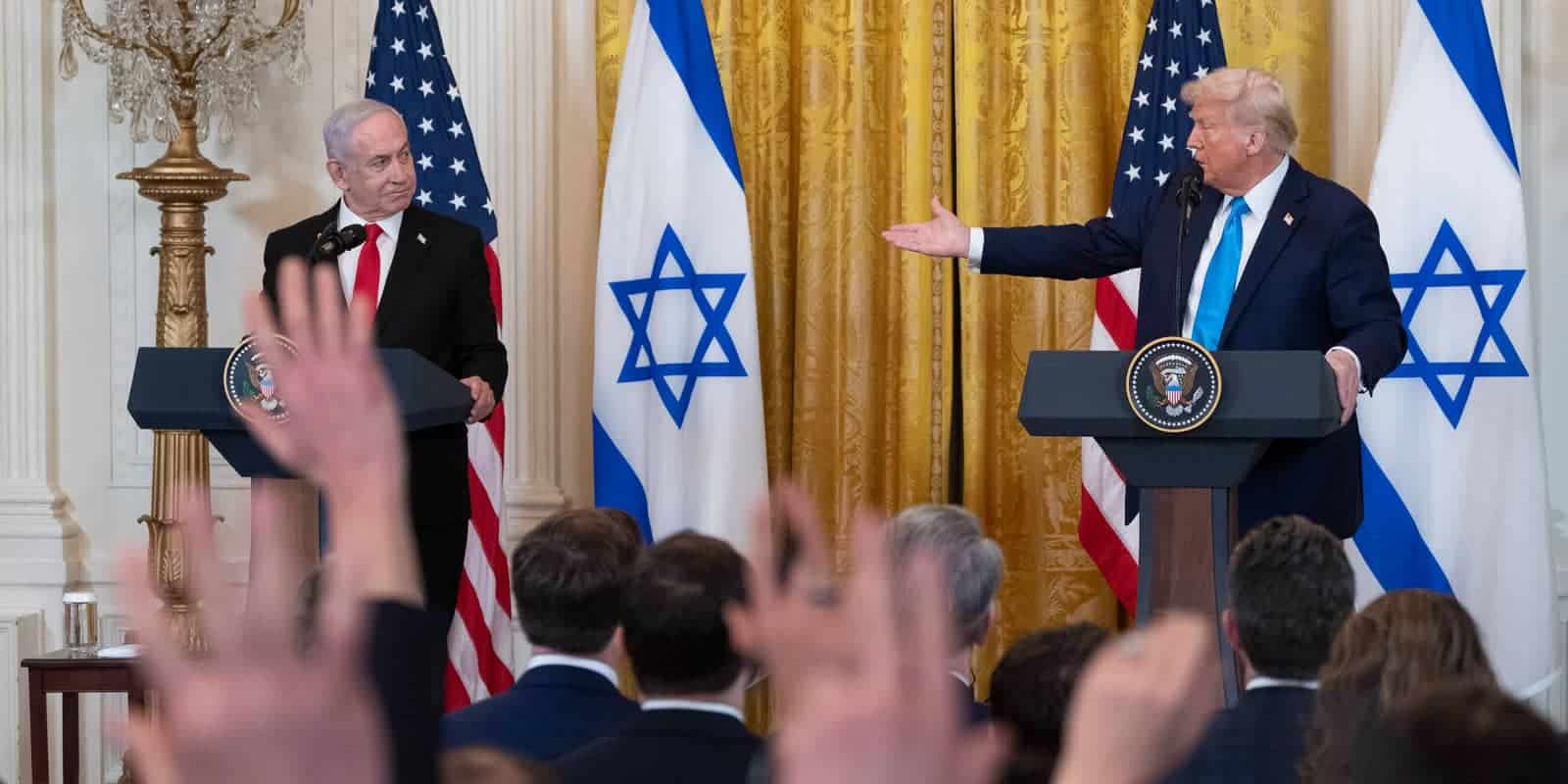
Yet Trump’s self-image as a peacemaker remains central to his conduct, even if he no longer dwells openly on the prospect of a Nobel Peace Prize. He repeatedly presents his diplomacy as having produced—or as capable of producing—peace, claiming to have brought to an end what he describes as the “thousands of years” of conflict between Israel and its neighbors. Trump cast his personal involvement in the ambassadorial-level talks between Israel and Lebanon in Washington (even if largely symbolic) as being behind what he described as the tenth breakthrough of this kind in his current term. The count is not entirely clear, but it appears to include the cessation of hostilities in the Gaza Strip and the return of the hostages, along with a series of initiatives in other theaters, such as:
- Efforts to reach an arrangement between Russia and Ukraine, so far without any practical success.
- The prevention of a full-scale conflagration between India and Pakistan, alongside the cultivation of warm ties with Pakistan’s military leadership, which were reflected in Islamabad’s attempted mediation with Iran.
- A partial de-escalation of the crisis between Thailand and Cambodia.
- The attempt to reach an agreement between Egypt and Ethiopia over the Grand Ethiopian Renaissance Dam, which has so far produced no agreement, but also no resort to force.
- The promotion of the Armenia–Azerbaijan agreement, including a U.S.-backed corridor linking Azerbaijan with its Nakhchivan exclave.
Trump has also listed the end of Operation Rising Lion in June 2025 among his “peace” achievements, using the term in its broadest possible sense: not reconciliation, but the cessation of combat. In that case, however, Washington itself later concluded that action against Iran had to be resumed. Still, Trump makes no secret of his preference for a political arrangement with Iran’s leadership—provided it meets basic American demands. He argues that Iran has, in effect, already undergone “regime change,” meaning that its overthrow is no longer a war aim. He is therefore in no hurry to resume fire, or even to revive his threats of large-scale destruction. From his perspective, the U.S. naval blockade—an instrument also used against Venezuela—appears preferable to a renewed kinetic campaign: whereas the formally announced effort to break the blockade in the Strait of Hormuz was suspended almost immediately, apparently due to Saudi reluctance to assist as well as some renewed momentum in the talks with Iran.
Implications for Israel
Iran
Israel cannot independently resume strikes against Iran so long as Washington insists on preserving the ceasefire, which it has, in effect, extended unilaterally, and recently announced formally that Operation Epic Fury has ended. For now, the test is what effect can be achieved by the American naval blockade —in which Israel has no role other than contributing intelligence —and what happens at the negotiating table. At the same time, Washington must keep its military in a state of full preparedness in view of the possibility that the fighting may resume, be it because the president reverses course, or because Tehran demurs and escalates. Hence the continued depth of IDF–CENTCOM coordination, including the presence of U.S. Air Force elements in Israel and joint operational planning.
The current standoff has its advantages for Israel. If the economic vise continues to tighten, and if Trump remains committed to the full neutralization of Iran’s nuclear capabilities, Israel gains time without absorbing additional Iranian attacks or carrying the burden of an intensive campaign deep inside Iran. A “deal” in which Iran hands over its enriched uranium, together with a long moratorium on enrichment (and which is better than the JCPoA) may also be viewed as an achievement of the war. The risk lies further down the road. A U.S. administration facing domestic political pressures may decide to ease off before the main objectives have been secured, and to treat partial Iranian concessions as sufficient. In that case, unilateral Israeli action would not be a realistic substitute for U.S. pressure. Israel would need a different fallback posture, centered on:
- A more aggressive intelligence posture.
- Covert disruption of Iran’s remaining strategic capabilities, above all in the nuclear and ballistic missile fields.
- Continued investment in Israel’s multilayered defenses against ballistic missiles, cruise missiles, and UAVs—a force package that Washington is unlikely to compel Iran to relinquish, even if understandings are reached on other issues.
- Deeper coordination on all these matters with the United States and with relevant regional actors.
In any event, Israel should reach understandings with Washington on the circumstances in which it would respond kinetically, and at full force, even without direct U.S. participation:
- Renewed launches against Israel, or an intelligence picture indicating that Iran is preparing to do so in the near term.
- Any Iranian attempt identified by intelligence to recover uranium enriched to 60 percent, or even 20 percent; to resume enrichment to weapons-grade levels; or to restart work on weaponization.
Lebanon
The linkage between the Iran ceasefire and the American enforcement of restraint on Israel in Lebanon is not merely cosmetic. It creates a problem for both Jerusalem and Washington as it is read by Tehran and Hezbollah as proof that the ability to threaten freedom of navigation in the Strait of Hormuz gives them leverage over the terms of the Lebanon ceasefire as well. Hezbollah’s posture toward the Lebanese government’s demands reflects this growing and regained confidence. So do the continuing attacks on IDF forces and the launches into northern Israel, which together point to a troubling pattern of attrition.
Israel’s political leadership has made clear that Washington is not denying Israel the right to respond to ceasefire violations, even beyond the immediate combat zone in southern Lebanon. The Israeli Air Force has indeed struck targets in the Beqaa, and on May 6 (with the reported approval of the U.S.) even in downtown Beirut, eliminating the commanders of Hezbollah’s elite Radwan Force. Still, Trump(who has a special interest in Lebanon, as well as a family connection to it)and his advisers want Beirut kept out of the equation. They also want to avoid the extensive destruction of buildings, beyond the demolition in the security zone, and strikes on Lebanese national infrastructure. He views restraint as necessary to preserve the possibility of a U.S.-sponsored summit between Israel’s prime minister and Lebanon’s president (which the latter continues to hold off on agreeing to).
Within these constraints, Israel can and should act along the following lines:
- Consolidate its hold on a broad security zone in southern Lebanon, while maintaining the necessary distinction between hostile and nonhostile populations. This would also give Israel a stronger starting point for the diplomatic track.
- Sustain intensive strikes against Hezbollah targets and infrastructure within the framework of understandings reached with Washington. The purpose should be to weaken Hezbollah enough to improve the Lebanese government’s ability to complete the task of disarmament, should it choose to take the risks involved in doing so.
- Accelerate the search for technological and operational answers to the tactical threats now taking a toll on Israeli forces: explosive drones and high-trajectory fire. This is particularly urgent given the possibility that IDF units may once again need to remain in Lebanon for an extended period, evoking bitter memories of 1982-2000.
The Gaza Strip
It is not yet clear what led Secretary of State and National Security Advisor Marco Rubio to speak of progress toward Hamas’s disarmament. Hamas spokesmen are saying the opposite. According to press reports, U.S. envoy Aryeh Lightstone has been directly involved in contacts with Hamas: but the organization shows no sign of accepting the phased plan presented to it in March 2026 by Nikolay Mladenov on behalf of the “Board of Peace.” The talks appear to have reached an impasse, as Mladenov acknowledged during his visit in Israel
The plan is built around Hamas’s disarmament, beginning with heavy weapons and infrastructure—namely its tunnels. In return, the IDF would withdraw, Palestinian policing units would enter, and units of the ISF, the multinational stabilization force, would deploy. In practice, however, that force has been slow to take shape. Hamas representatives argue that Israel, by its very presence and actions, is the party violating the ceasefire and blocking implementation of the plan. The deeper reality is that for Hamas to give up its weapons voluntarily would be to undermine its own ideological and political identity. Without significantly greater pressure, the chances of this happening remain low.
If, as appears to be the case, the Trump administration does not see Gaza as urgent and is reluctant to see the fighting resume, Israel is left with several strategic options—none of them attractive:
- Accept the de facto partition of the Gaza Strip, with Hamas entrenched west of the “yellow line” and large-scale humanitarian assistance continuing to enter Gaza. (The humanitarian effort itself should be given far greater weight in Israel’s public diplomacy particularly against the backdrop of the recently thwarted flotilla.) Israel should tighten its monitoring of weapons smuggling and local weapons production, but leave Hamas be
- Increased pressure on the humanitarian track as well—an option whose diplomatic and reputational cost would far outweigh its benefit.
- Carry out localized moves designed to push Hamas back and improve the IDF’s line of control on the ground, as a deterrent signal—a “creeping offensive,” along the lines of what is currently being done in southern Lebanon.
- Alongside these options, and not as a substitute for them, Israel should test whether it can establish on its side of the yellow line a credible civilian infrastructure with orderly governance under ISF auspices, thus creating conditions that would allow Gazans to leave areas still under Hamas control. There is no guarantee that such an effort would succeed, but it is worth attempting.
JISS Policy Papers are published through the generosity of the Greg Rosshandler Family.